
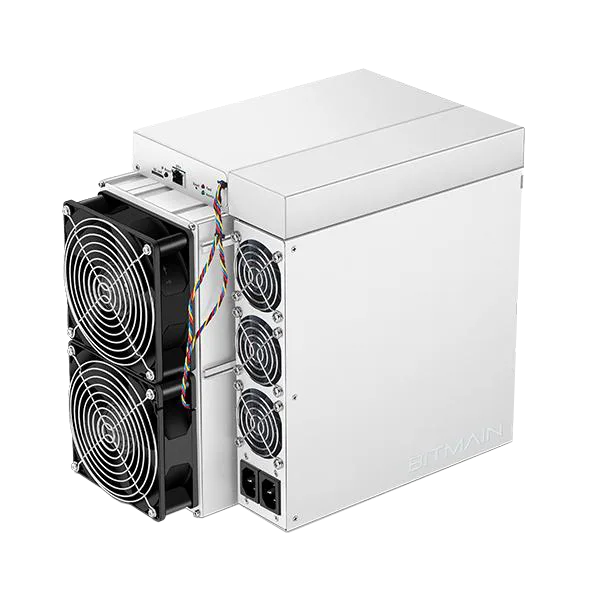
Antminer S19k Pro
Great efficiency for its generation, lower power draw than other S19 models
Réponse rapide
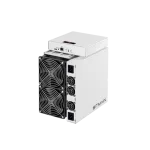
The Antminer S19k Pro is a Bitcoin miner rated about 120 TH/s at roughly 2,760 W (about 23 J/TH), built on 88× BM1366. An industrial-class unit — loud and power-hungry, best suited to a dedicated mining space, not living areas.
DCENT_OS Compatible
DCENT_OS is custom firmware developed by D-Central Technologies specifically for home miners. It transforms this miner with whisper-quiet fan profiles, 120V North American outlet support, auto-tuning for maximum efficiency, heater mode integration, and a clean web dashboard for monitoring.
Miners running DCENT_OS score higher on our Home Mining Assessment because the firmware is purpose-built to make industrial hardware livable in residential spaces.
Learn More About DCENT_OS →Professional-Grade Miner
This miner draws 2,760W and produces 75 dB of noise — it is designed for dedicated mining environments, not living spaces. Professional-grade miners deliver the highest hashrate and revenue per unit but require proper infrastructure: a 240V circuit, adequate ventilation or exhaust ducting, and a space where noise is not a concern (garage, basement, warehouse, or outdoor enclosure).
However, this miner is compatible with DCENT_OS — D-Central's custom firmware that adds whisper-quiet fan profiles and 120V North American outlet support. With DCENT_OS installed, this industrial miner can be transformed for home use.
Heater-Class Miner
At 2,760W, this miner outputs approximately 9417.1 BTU/hr of heat — equivalent to a standard electric space heater. Every watt consumed by an ASIC miner is converted to heat with 100% efficiency, making it a space heater that also mines Bitcoin.
During heating season, miner heat can offset part of the heat a room would otherwise need from another electric heater. The economics depend on your electricity rate, room heat demand, BTC price, network difficulty, and noise constraints.
Calculateur de rentabilité
| Period | Revenue | Electricity Cost | Profit |
|---|---|---|---|
| Daily | $3.71 | $4.64 | $-0.93 |
| Weekly | $25.96 | $32.46 | $-6.50 |
| Monthly | $111.27 | $139.10 | $-27.84 |
| Yearly | $1,353.75 | $1,692.43 | $-338.68 |
Heating offset estimates the value of heat replacing an electric space heater during heating season (~6 months/year in Canada). Actual savings depend on your heating setup and climate.
Buy from D-Central
In stock and ready to ship from Laval, Quebec.
Where to Buy the Antminer S19k Pro
D-Central Technologies
CanadaBitcoin Mining Hackers since 2016. Ships from Laval, Quebec.
Full Specifications
| Model | Antminer S19k Pro |
|---|---|
| Model Number | S19k Pro |
| Manufacturer | Bitmain |
| Algorithme | SHA-256 |
| Coins Mined | Bitcoin (BTC) |
| Taux de hachage | 120 TH/s |
| Consommation électrique | 2,760 W |
| Efficiency | 23 J/TH |
| Niveau de bruit | 75 dB |
| Chip Model | BM1366 |
| Chip Count | 88 |
| Cooling | Air |
| Voltage Range | 200-240V AC |
| Operating Temperature | 5-40°C |
| Dimensions | 370x195x290 |
| Weight | 12.5 |
| Interface | Ethernet |
| BTU Output | 9417.1 BTU/hr |
| Equivalent Heater | Equal to a 2,760W space heater |
| Daily Power Cost | $4.64/day |
| Monthly Power Cost | $139.10/mo |
| Circuit Requirement | 240V circuit required |
| Release Date | 2023-04-01 |
| MSRP | $2,800.00 |
| État | Active |
Custom Power Profiles
With custom firmware like DCENT_OS, this miner can be tuned across a wide range of power levels. Lower wattage improves efficiency and reduces electricity costs; higher wattage increases hashrate at the expense of efficiency.
Normal Mode
| Wattage | Taux de hachage | Efficiency |
|---|---|---|
| 2,050 W | 80 TH/s | 25.6 J/TH |
| 2,180 W | 85 TH/s | 25.6 J/TH |
| 2,310 W | 90 TH/s | 25.7 J/TH |
| 2,470 W | 95 TH/s | 26 J/TH |
| 2,600 W | 100 TH/s | 26 J/TH |
| 2,730 W | 105 TH/s | 26 J/TH |
| 2,860 W | 111 TH/s | 25.8 J/TH |
| 2,990 W | 116 TH/s | 25.8 J/TH |
| 3,120 W | 121 TH/s | 25.8 J/TH |
| 3,270 W | 126 TH/s | 26 J/TH |
| 3,400 W | 131 TH/s | 26 J/TH |
| 3,530 W | 136 TH/s | 26 J/TH |
| 3,660 W | 142 TH/s | 25.8 J/TH |
| 3,790 W | 147 TH/s | 25.8 J/TH |
| 3,920 W | 152 TH/s | 25.8 J/TH |
| 4,080 W | 157 TH/s | 26 J/TH |
| 4,210 W | 162 TH/s | 26 J/TH |
| 4,340 W | 167 TH/s | 26 J/TH |
| 4,470 W | 173 TH/s | 25.8 J/TH |
| 4,600 W | 178 TH/s | 25.9 J/TH |
| 4,730 W | 183 TH/s | 25.8 J/TH |
| 4,860 W | 188 TH/s | 25.9 J/TH |
Performance Mode
| Wattage | Taux de hachage | Efficiency |
|---|---|---|
| 2,850 W | 78 TH/s | 36.5 J/TH |
| 3,050 W | 85 TH/s | 35.9 J/TH |
| 3,250 W | 91 TH/s | 35.7 J/TH |
| 3,325 W | 95 TH/s | 35 J/TH |
| 3,465 W | 99 TH/s | 35 J/TH |
| 3,655 W | 105 TH/s | 34.8 J/TH |
| 3,880 W | 110 TH/s | 35.3 J/TH |
| 4,050 W | 115 TH/s | 35.2 J/TH |
| 4,250 W | 120 TH/s | 35.4 J/TH |
| 4,500 W | 125 TH/s | 36 J/TH |
| 4,750 W | 130 TH/s | 36.5 J/TH |
| 5,000 W | 135 TH/s | 37 J/TH |
Actual performance varies by individual unit silicon quality, ambient temperature, and cooling configuration. These operating points are achievable with custom tuning firmware such as DCENT_OS; values are calculated at runtime by the autotuner, not fixed presets.
Home Mining Assessment
Great efficiency for its generation, lower power draw than other S19 models
The Antminer S19k Pro is Bitmain’s value-efficiency SHA-256 miner: 120 TH/s at a nameplate 2,760 W (23 J/TH) from a single air-cooled box. Built on TSMC 5 nm BM1366 silicon, it draws less power than the flagship S19 XP while staying efficient enough for home, hosted, or small-farm Bitcoin mining.
Chip and hashboard architecture
The S19k Pro runs on the BM1366, Bitmain’s fourth-generation S19-family ASIC, fabricated on a TSMC 5 nm process. It is the same chip found in the Antminer S19 XP and S19 XP Hydro, and a single BM1366 is the heart of the open-source Bitaxe Ultra desktop miner — so this is one of the most widely deployed and best-understood ASICs of its generation. Each chip packs hundreds of small SHA-256 hashing cores and delivers on the order of 100 GH/s in this configuration.
Inside the chassis sit three hashboards (Chain 0, Chain 1, Chain 2), each carrying 77 BM1366 chips for a total of 231 across the miner. Those chips are daisy-chained for the command, clock and reset signals that run the length of every board. The hashboard SKUs are Bitmain’s BHB56902 / BHB56903 / BHB56907, which are « NoPic » boards — there is no PIC microcontroller acting as a sensor and voltage proxy. Board identity lives in an AES-encrypted EEPROM, and the two on-board temperature sensors are read directly over I²C rather than through a PIC.
Voltage domains, not per-chip control
A common misconception is that an ASIC regulates each chip individually. It does not. On the S19k Pro the 77 chips of each board are grouped into 11 voltage domains of 7 chips, and voltage is controlled per domain. Each domain has its own regulator (an LDO/op-amp stage) hanging off a boosted rail, and the chips within a domain are wired in series so the domain voltage equals the per-chip voltage multiplied by seven. This architecture matters for diagnostics: a fault rarely affects one isolated chip in isolation — it takes down, or distorts, the whole domain it belongs to.
Control board (carrier)
The S19k Pro is a multi-carrier machine. The control board you actually have in hand determines its boot chain and which firmware images apply. Most retail units ship on an Amlogic A113D (am3-class, Cortex-A53) NoPic board, but the same model also exists on Cvitek CV1835 and Xilinx Zynq carriers in the field. The Zynq variant uses the familiar S19-class XC7Z010 SoC with dual ARM Cortex-A9 cores running at 667 MHz. All three carriers talk to the same BM1366 chips over UART and I²C and share the same gigabit-class Ethernet interface — the difference is the system-on-chip, the boot process, and the fan/GPIO plumbing, not the mining protocol. Always confirm the carrier before flashing firmware or ordering a replacement control board.
Real-world power and efficiency
Bitmain’s nameplate is 120 TH/s at 2,760 W, or 23 J/TH. That figure is the optimistic factory rating; in practice the wall draw runs a little higher once PSU losses and ambient temperature are accounted for. D-Central has the S19k Pro as a live bench unit, and the characterized tuning ladder tells the honest story: across its useful range the chip holds a remarkably flat ~25.6 to 26.0 J/TH in normal mode, which is the number to plan a power bill around.
The machine has genuine tuning headroom in both directions. Under-clock it to roughly 80 TH/s and it sips about 2,050 W — quieter, cooler and ideal for a home circuit. Push it the other way and it will climb past stock; the normal-mode profiles reach as high as ~188 TH/s, though that demands far more power and a serious cooling and breaker budget. A separate, higher-voltage « performance » profile set can force ~135 TH/s but efficiency collapses to 35–37 J/TH, so it is only worth it when you need maximum hashrate per rack slot rather than maximum coins per watt. The sweet spot for most operators is at or just below stock.
| Normal-mode setting | Wall power | Efficiency |
|---|---|---|
| 80 TH/s (quiet / low-power) | ~2,050 W | 25.6 J/TH |
| 100 TH/s | ~2,600 W | 26.0 J/TH |
| 121 TH/s (near stock) | ~3,120 W | 25.8 J/TH |
| 152 TH/s (over-clock) | ~3,920 W | 25.8 J/TH |
| 188 TH/s (max normal) | ~4,860 W | 25.9 J/TH |
Power is delivered by an APW12-series PSU (the APW121215f revision, firmware 0x76) — a newer APW12 build that was first observed on this very model. The PSU and control board exchange a PMBus heartbeat roughly once a second; if that heartbeat drops for about 30 seconds, the supply’s watchdog cuts output, which is a deliberate safety behaviour worth knowing when you are bench-testing. For the full set of frequency/voltage steps and the heat-versus-hashrate trade-offs, see our ASIC power profiles database.
At 2,760 W the S19k Pro converts essentially all of that electricity into about 9,417 BTU/h of heat. Ducted into a room or a heat-recovery loop, that waste heat turns money you would otherwise spend on heating into hashrate — which is why this model scores well as a residential space heater.
How it compares
| Model | ASIC | Node | Hashrate | Power | Efficiency |
|---|---|---|---|---|---|
| Antminer S19 Pro | BM1398 | 7 nm | 110 TH/s | 3,250 W | ~29.5 J/TH |
| Antminer S19k Pro | BM1366 | 5 nm | 120 TH/s | 2,760 W | 23 J/TH |
| Antminer S19 XP | BM1366 | 5 nm | 141 TH/s | 3,010 W | ~21.5 J/TH |
| Antminer S21 | BM1368 | 5 nm | 200 TH/s | 3,500 W | ~17.5 J/TH |
Firmware compatibility
Out of the box the S19k Pro runs Bitmain’s stock AntMiner OS, which handles pool configuration, monitoring and the factory tuning curve. Beyond stock, the model is well covered by the broader third-party firmware ecosystem, which typically adds runtime autotuning, finer per-domain power control and more flexible pool handling. It is worth being clear about what autotuning actually is: the firmware calculates each board’s voltage and frequency targets at runtime from the chips’ measured behaviour — these are not pre-baked preset values, which is why two physically identical S19k Pros can settle on slightly different operating points.
Two honest caveats. First, third-party firmware images are carrier-specific — an Amlogic-carrier S19k Pro takes a different build than a Cvitek or Zynq unit, so the control board has to be identified before flashing. Second, if you specifically want Stratum V2 negotiated natively at the miner, only one firmware family currently speaks it natively; most others bridge Stratum V1 to V2 through a proxy.
The S19k Pro is also D-Central’s primary live test platform for DCENT_OS, our own open-source (GPL-3.0) Antminer firmware, now in public beta. Where stock firmware blasts the fans to 100% the moment a board gets hot, DCENT_OS is tuned for a deliberately tighter, home-quiet thermal envelope — lower target temperatures and a capped fan duty so a miner living in a house behaves like a heater, not a jet engine. That space-heater philosophy is the design difference, and this model is where we prove it first.
Common faults and troubleshooting
Most S19k Pro failures fall into a handful of recognisable patterns:
- A board drops to zero / « 0 ASIC found ». The miner detects the hashboard but counts no working chips — usually a power-delivery or signal-chain break on that board.
- Chip enumeration stalls partway down a chain. Because the chips are daisy-chained, an open fault makes every chip downstream of it invisible, so the board reports fewer ASICs than it should. The reported chip count points you to roughly where on the chain the break is.
- A single shorted chip or a failed domain regulator (LDO). Since voltage is regulated per domain, one shorted chip drags down its entire 7-chip domain’s voltage, and a failed LDO starves that domain completely.
- Temperature-sensor read errors and fan faults. Stock firmware throttles around 85 °C chip temperature, and emergency-stops near 90 °C chip or 80 °C board temperature — so a flaky sensor or a stalled fan will shut a board down even when the silicon is healthy.
- PSU heartbeat loss and 12 V rail sag. A drooping input rail or a missed PMBus heartbeat can cause repeated hashboard dropouts that look like a chip fault but are really a power problem.
For BM1366-specific behaviour such as a sudden hashrate cliff, see our error reference on the BM1366 hashrate cliff (same chip, single-chip platform), and for brownout-style dropouts see 12 V rail sag and hashboard brownout. To localise a fault on your own unit step by step, run it through our ASIC fault finder.
Repair and longevity
D-Central has repaired Antminers in-house since 2016, and the S19k Pro is firmly within that scope. Our technicians work the BHB56902/56903/56907 NoPic hashboards down to the domain and chip level — diagnosing failed voltage domains, reflowing or replacing individual BM1366 chips, servicing the APW12 PSU, and recovering control boards across all three carriers (Amlogic, Cvitek and Zynq). Because the EEPROM identity is AES-encrypted, board-level work has to respect the original SKU, which is exactly the kind of detail an experienced shop handles rather than a parts-swapper.
On longevity, 5 nm BM1366 silicon ages gracefully. Under-clocking lowers voltage, heat and fan wear, and routine maintenance — dust removal, fresh thermal interface material, and fan replacement before they seize — keeps an S19k Pro productive for years. If you want it inspected, repaired or refreshed, see our ASIC repair service.
Who it is for, and buying
The S19k Pro is the value-efficiency pick of the S19 generation. It is meaningfully more efficient than the 7 nm BM1398 S19 and S19 Pro, and at 2,760 W it draws less power — and usually costs less — than the flagship S19 XP, which makes it far friendlier to a home circuit or a modest hosted slot. With its strong home-mining profile and ~9,417 BTU/h of usable heat, it is a sensible single-unit miner anywhere electricity is moderately priced or the heat is wanted.
If you are drawn to the BM1366 but want something smaller to learn on or to solo-mine for the lottery thrill, the same silicon — as a single chip — powers the open-source Bitaxe Ultra. It is the desktop counterpart to this farm-class machine, and a great way to get hands-on with the architecture before scaling up.
Generational context
Credit where it is due: the S19 line is Bitmain’s, and the S19k Pro is one of its smartest entries — the company took its proven S19 platform and dropped in the more efficient 5 nm BM1366 to deliver near-S19-XP efficiency at a lower power draw and price. It slots cleanly into the hierarchy: more efficient than the 7 nm BM1398 S19/S19 Pro, a half-step behind its BM1366 sibling the S19 XP on raw throughput, and superseded on efficiency by the later BM1368 (S21) and BM1370 (S21 Pro) generations. What makes it unusual is reach — the same BM1366 spans a three-board, 231-chip data-centre machine and a single-chip desktop solo miner, which is why it remains one of the best-documented ASICs D-Central works with.
Broken miner? Get a real quote.
Tell us the symptom and get an instant repair-tier estimate ($95 / $145 / $195 CAD). Mail-in from across Canada, bench in Laval, Quebec.
Send it to D-Central — start a repair →Related Miners
Bitmain Antminer S9i (14Th)
MicroBT Whatsminer M3X
Bitmain Antminer S21e Hyd (310Th)
Bitmain Antminer S17 (56Th)
Codes d'erreur courants du Antminer S19k Pro
Codes d'erreur connus et guides de dépannage pour le Antminer S19k Pro. Cliquez sur une erreur pour des instructions de réparation étape par étape.
Foire aux questions
What are the current mining economics for the Antminer S19k Pro?
At $0.07/kWh, the Antminer S19k Pro currently shows an estimated daily net cost of $0.93 before pool fees and hardware cost. Lower electricity rates, network changes, BTC price changes, or useful heat recovery can change the result.
Can I mine Bitcoin at home with the Antminer S19k Pro?
The Antminer S19k Pro has a home mining score of 8/100. With 75 dB noise and 2,760W power draw, it may require a dedicated space like a garage, basement, or outdoor enclosure. Consider noise insulation and proper ventilation.
Can the Antminer S19k Pro heat my home?
The Antminer S19k Pro outputs approximately 9417.1 BTU/hr of heat. For reference, a typical space heater produces 5,000-5,500 BTU/hr. All electrical energy consumed by the miner is converted to heat, making it 100% efficient as a heater. D-Central offers Bitcoin Space Heater builds designed specifically for home heating integration.
Does D-Central repair the Antminer S19k Pro?
Yes, D-Central provides professional repair services for the Antminer S19k Pro. Services include hashboard repair, control board diagnostics, fan replacement, and full refurbishment. Ship your miner to our Laval, Quebec facility for diagnosis and repair.
What power supply does the Antminer S19k Pro need?
The Antminer S19k Pro draws 2,760W of power. You need a power supply rated for at least 3,036W with appropriate voltage (200-240V AC). D-Central stocks compatible power supplies in our shop. Always use a quality PSU from a reputable manufacturer to protect the miner and wiring.