
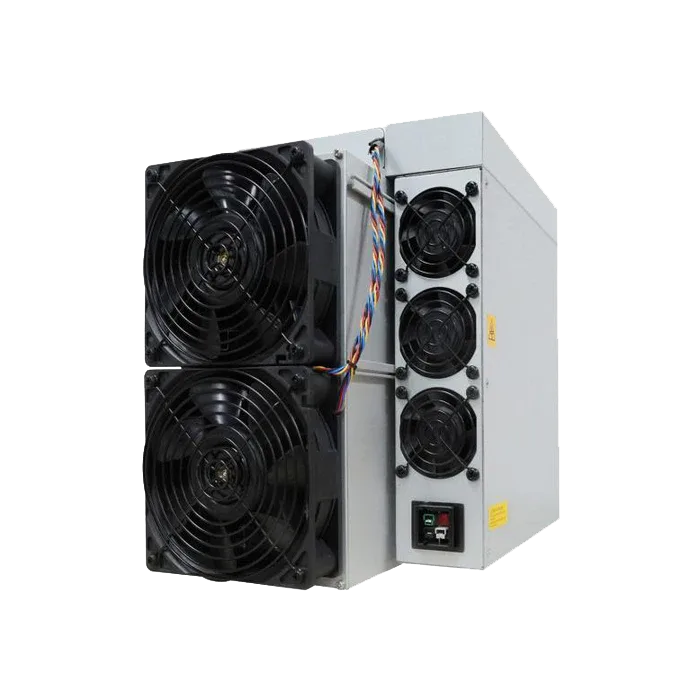
Antminer S21+
Enhanced S21 with improved BM1370 chips. 216 TH/s at 16.5 J/TH efficiency. Standard Antminer form factor.
Réponse rapide
The Antminer S21+ is a Bitcoin miner rated about 216 TH/s at roughly 3,564 W (about 16.5 J/TH), built on the BM1370 ASIC. An industrial-class unit — loud and power-hungry, best suited to a dedicated mining space, not living areas.
Professional-Grade Miner
This miner draws 3,564W and produces 75 dB of noise — it is designed for dedicated mining environments, not living spaces. Professional-grade miners deliver the highest hashrate and revenue per unit but require proper infrastructure: a 240V circuit, adequate ventilation or exhaust ducting, and a space where noise is not a concern (garage, basement, warehouse, or outdoor enclosure).
For home miners looking for a quieter alternative, consider our Bitcoin Space Heater builds or explore open-source miners like the Bitaxe that are purpose-built for residential environments.
Calculateur de rentabilité
| Period | Revenue | Electricity Cost | Profit |
|---|---|---|---|
| Daily | $6.84 | $5.99 | $0.85 |
| Weekly | $47.87 | $41.91 | $5.96 |
| Monthly | $205.16 | $179.63 | $25.53 |
| Yearly | $2,496.07 | $2,185.44 | $310.62 |
Heating offset estimates the value of heat replacing an electric space heater during heating season (~6 months/year in Canada). Actual savings depend on your heating setup and climate.
Where to Buy the Antminer S21+
D-Central Technologies
CanadaBitcoin Mining Hackers since 2016. Ships from Laval, Quebec.
magasiner le materiel de minage BitcoinASIC Miner Market
United StatesWide selection of new and used ASIC miners. US-based shipping.
MagasinerMinersDeals
United StatesCompetitive prices on new ASIC miners with coupon codes.
MagasinerFull Specifications
| Model | Antminer S21+ |
|---|---|
| Model Number | S21+ |
| Manufacturer | Bitmain |
| Algorithme | SHA-256 |
| Coins Mined | Bitcoin (BTC) |
| Taux de hachage | 216 TH/s |
| Consommation électrique | 3,564 W |
| Efficiency | 16.5 J/TH |
| Niveau de bruit | 75 dB |
| Chip Model | BM1370 |
| Cooling | Air |
| Voltage Range | 200-240V AC |
| Operating Temperature | 5-40°C |
| Dimensions | 400x195x290 |
| Weight | 15 |
| Interface | Ethernet |
| BTU Output | 12160.4 BTU/hr |
| Equivalent Heater | Equal to a 3,564W space heater |
| Daily Power Cost | $5.99/day |
| Monthly Power Cost | $179.63/mo |
| Circuit Requirement | 240V circuit required |
| Release Date | 2025-01-01 |
| MSRP | $6,500.00 |
| État | Active |
Custom Power Profiles
With custom firmware like DCENT_OS, this miner can be tuned across a wide range of power levels. Lower wattage improves efficiency and reduces electricity costs; higher wattage increases hashrate at the expense of efficiency.
Normal Mode
| Wattage | Taux de hachage | Efficiency |
|---|---|---|
| 2,640 W | 176 TH/s | 15 J/TH |
| 2,890 W | 194 TH/s | 14.9 J/TH |
| 3,160 W | 212 TH/s | 14.9 J/TH |
| 3,430 W | 230 TH/s | 14.9 J/TH |
| 3,700 W | 248 TH/s | 14.9 J/TH |
| 3,970 W | 266 TH/s | 14.9 J/TH |
| 4,240 W | 283 TH/s | 15 J/TH |
| 4,510 W | 301 TH/s | 15 J/TH |
| 4,690 W | 313 TH/s | 15 J/TH |
Performance Mode
| Wattage | Taux de hachage | Efficiency |
|---|---|---|
| 3,975 W | 265 TH/s | 15 J/TH |
| 4,365 W | 291 TH/s | 15 J/TH |
| 4,755 W | 317 TH/s | 15 J/TH |
| 5,145 W | 343 TH/s | 15 J/TH |
| 5,535 W | 369 TH/s | 15 J/TH |
| 5,940 W | 396 TH/s | 15 J/TH |
| 6,382 W | 413 TH/s | 15.5 J/TH |
| 6,845 W | 430 TH/s | 15.9 J/TH |
| 7,347 W | 448 TH/s | 16.4 J/TH |
Low Power Mode
| Wattage | Taux de hachage | Efficiency |
|---|---|---|
| 2,440 W | 170 TH/s | 14.4 J/TH |
| 2,500 W | 176 TH/s | 14.2 J/TH |
| 2,680 W | 188 TH/s | 14.3 J/TH |
| 2,830 W | 200 TH/s | 14.2 J/TH |
| 2,910 W | 206 TH/s | 14.1 J/TH |
| 3,130 W | 218 TH/s | 14.4 J/TH |
| 3,320 W | 230 TH/s | 14.4 J/TH |
| 3,550 W | 242 TH/s | 14.7 J/TH |
| 3,650 W | 248 TH/s | 14.7 J/TH |
Actual performance varies by individual unit silicon quality, ambient temperature, and cooling configuration. These operating points are achievable with custom tuning firmware such as DCENT_OS; values are calculated at runtime by the autotuner, not fixed presets.
Home Mining Assessment
Enhanced S21 with improved BM1370 chips. 216 TH/s at 16.5 J/TH efficiency. Standard Antminer form factor.
The Antminer S21+ is Bitmain’s air-cooled, BM1370-based SHA-256 miner rated at 216 TH/s for 3,564 W — about 16.5 J/TH measured at the wall. It carries 165 fifth-generation 5 nm ASICs across three hashboards on an Amlogic control board, slotting between the base S21 and the S21 Pro on efficiency.
Chip and hashboard architecture
The S21+ is built on the BM1370, the same Gen-5 SHA-256 die Bitmain uses in the S21 Pro and S21 XP. It is fabricated on TSMC’s 5 nm process — not 3 nm, a number that circulates online but does not match the silicon. The BM1370 is the highest-binned chip in Bitmain’s air-cooled line, which is why the S21+ reaches 216 TH/s with fewer chips than the older, BM1368-based base S21.
Inside the chassis are three identical hashboards. Each board carries 55 BM1370 chips, for 165 chips total. The chips are wired in a single series daisy-chain per board and grouped into voltage domains: clusters of chips that share one regulated power rail fed by its own LDO or buck regulator. This is the architectural detail most third-party guides get wrong — voltage on the S21+ is controlled per domain, never per individual chip. A domain’s voltage is the sum of the series core voltages of every chip in it, so the failure of a single chip pulls down or opens an entire rail rather than just one die.
The control board is an Amlogic A113D (a 64-bit ARM SoC), not a Xilinx Zynq FPGA like the S9 through S19 generation. There is no FPGA arbitrating per-chain FIFOs; instead a single UART bus daisy-chains through all three hashboards. Just as importantly, the S21 family is a “no-PIC” design — Bitmain removed the PIC microcontroller that gatekept voltage on earlier boards. Hashboard supply is set digitally over I²C to the on-board regulators. That changes how the board is diagnosed and repaired compared with an S19, and it is worth understanding before you open one up. For the chip-level reference, see our ASIC chip reference.
Real-world power and efficiency
The nameplate spec is 216 TH/s at 3,564 W, which works out to 16.5 J/TH. That figure is the chip-side draw; the number that matters on your power bill is wall draw, which runs a few percent higher once you account for PSU conversion losses. Plan around roughly 3.6–3.8 kW at the outlet on a 200–240 V circuit — the S21+ is a 240 V machine and is not designed to run on standard North American 120 V household power.
16.5 J/TH places the S21+ squarely in the current-generation efficiency tier: more efficient than the base S21 (~17.5 J/TH) but a step behind the S21 Pro (~15 J/TH) and the flagship S21 XP (~13.5 J/TH). For most operators the S21+ is the value-per-terahash pick of the air-cooled lineup.
The BM1370 has meaningful tuning headroom. Because efficiency is a function of voltage and frequency, dropping clocks and core voltage trades raw hashrate for better J/TH, while overclocking does the reverse. The water-cooled S21+ Hydro — same BM1370 silicon, better thermals — demonstrates the envelope: its catalogued profiles span from an ultra-low-power mode near 11.6–12 J/TH up through a performance mode past 16 J/TH at much higher absolute hashrate. The air-cooled S21+ cannot reach the Hydro’s coldest numbers (air can only shed so much heat), but a sensible undervolt can still pull it toward ~15 J/TH at a modest hashrate cost. These tuning points are calculated by the autotuner at runtime for the specific chips in your unit, not fixed presets baked into firmware. See our ASIC power profiles database for the per-model tuning data and our most efficient miners ranking for where the S21+ lands against the field.
Firmware compatibility
The S21+ ships with Bitmain’s stock firmware, which is stable, well-supported, and handles autotuning, pool configuration, and basic monitoring out of the box. For most owners that is all they need.
Because the S21+ runs the widely-used Amlogic A113D control board, aftermarket firmware exists for the platform. The best-known open option is BraiinsOS+, which on supported S21-class hardware adds finer autotuning and lower-level telemetry — and is the only firmware that natively speaks Stratum V2, the upgraded pool protocol that lets miners (rather than pools) construct block templates. Always confirm your exact board revision against the firmware vendor’s supported-models list before flashing; the “S21+” label covers several hardware sub-revisions. A word of honesty: third-party firmware can void your manufacturer warranty and, flashed carelessly, can brick a control board.
D-Central is also building DCENT_OS, our own GPL-3.0 mining firmware aimed at operators who want a sovereign, auditable stack rather than a closed binary — it targets exactly this Amlogic platform. DCENT_OS is in public beta as of July 2026; we mention it as a roadmap item, not an over-promise. For the broader landscape, our guide to ASIC firmware types lays out the trade-offs without the hype.
Common faults and troubleshooting
The S21+ fails the way every chained-ASIC miner fails — at the weakest link in a board. The most common symptoms we see on the bench:
- Fewer chips detected than expected. If a board reports, say, 30 of its 55 chips, the break is at the chip immediately after the last one detected. A dead (open) chip stops forwarding clock and data, making every downstream chip invisible to the control board.
- Whole board reads zero / “0 ASIC found.” A shorted chip can pull down the shared signal lines and take the entire chain offline, or the fault can be upstream at the boost/regulator stage.
- Abnormal voltage-domain readings. A domain sitting 100 mV+ below its neighbours points to a partial short (failed chip or blown decoupling capacitor); a domain reading high points to an open circuit or cracked solder joint. Domains should track within about ±50 mV of one another.
- Thermal throttling and shutdowns. S21-class firmware throttles frequency as chip temperature climbs and triggers an emergency stop in the high-80s°C while holding fans at full duty to cool down. Persistent throttling usually means clogged fins, a failing fan, or dried thermal interface material — not a dead chip.
Work a no-hash or low-hash S21+ methodically rather than swapping parts blindly. Our interactive ASIC fault finder walks you from symptom to likely root cause, and the model-specific Antminer S21 error code reference decodes the messages the dashboard throws.
Repair and longevity
An ASIC is not disposable. At 16.5 J/TH the S21+ stays economically relevant for years, and a single failed chip or regulator should never condemn an otherwise healthy board. D-Central has repaired Bitmain hardware in-house in Quebec since 2016, and our technicians service the S21+ at the component level — chip-level reballing and replacement, voltage-domain and regulator repair, fan and PSU diagnosis, and full board testing. Because the S21+ uses the no-PIC Amlogic platform, repairs lean on UART chain analysis and per-domain voltage probing rather than the PIC-era tricks that work on an S19.
If your unit is down, start with our ASIC repair service for the full intake process, or go straight to the Antminer S21 hashboard repair page for board-specific work. Keeping a miner alive for an extra few years is the most decentralizing thing you can do with it — every repaired board is one less unit retired to e-waste and one more hashing independently.
Who it’s for and buying
The S21+ is a serious production miner, not a quiet desktop novelty. At 75 dB it belongs in a dedicated mining space, garage, or purpose-built enclosure — never a bedroom in stock form. It suits small-to-mid operators who want strong efficiency without paying the premium for the S21 Pro or XP, and home miners who can house it properly. Plebs who want something living-room-quiet should look instead at a custom quiet Antminer build or a small open-source miner.
One genuinely useful trait: the S21+ dumps roughly 12,160 BTU/h of heat. Ducted into a workshop or garage, that waste heat offsets electric heating you would have paid for anyway — see our best miners for heating guide. To compare the S21+ against the rest of the catalog, use the ASIC miner database or our miner comparison tool; Canadian buyers can check stock and refurbished options through buy ASIC miners in Canada and weigh the trade-offs in refurbished vs new.
Generational context
The S21+ is part of Bitmain’s 2024–2025 S21 generation — the company’s first SHA-256 line to break below 18 J/TH across the board and the generation that retired the PIC voltage controller. Credit where it’s due: Bitmain’s BM1368/BM1370 silicon set the efficiency bar the rest of the industry now chases. Within the family, the S21+ is the efficiency-per-dollar middle child.
| Model | Chip | Chips / board (total) | Hashrate | Efficiency | Cooling |
|---|---|---|---|---|---|
| Antminer S21 | BM1368 (5 nm) | 108 (324) | ~200 TH/s | ~17.5 J/TH | Air |
| Antminer S21+ | BM1370 (5 nm) | 55 (165) | 216 TH/s | 16.5 J/TH | Air |
| Antminer S21 Pro | BM1370 (5 nm) | 65 (195) | ~234 TH/s | ~15 J/TH | Air |
| Antminer S21 XP | BM1370 (5 nm) | 91 (273) | ~270 TH/s | ~13.5 J/TH | Air |
Step up to the S21 Pro or XP for better J/TH, or move to the water-cooled S21+ Hydro / S21 XP Hydro variants if you have the infrastructure to handle liquid cooling. For most operators building or expanding an air-cooled fleet in 2025, the S21+ is the sensible, repairable, well-understood choice — and when something does go wrong, it’s a machine we know how to fix.
Broken miner? Get a real quote.
Tell us the symptom and get an instant repair-tier estimate ($95 / $145 / $195 CAD). Mail-in from across Canada, bench in Laval, Quebec.
Send it to D-Central — start a repair →Related Miners
MicroBT Whatsminer M3X
Bitmain Antminer S17 (53Th)
Antminer S19
Canaan Avalon Mini 3
Foire aux questions
What are the current mining economics for the Antminer S21+?
At $0.07/kWh electricity, the Antminer S21+ currently shows an estimated $0.85 daily net result before pool fees and hardware cost. Results depend on your electricity rate and Bitcoin network conditions. Use the calculator above with your actual electricity rate.
Can I mine Bitcoin at home with the Antminer S21+?
The Antminer S21+ has a home mining score of 8/100. With 75 dB noise and 3,564W power draw, it may require a dedicated space like a garage, basement, or outdoor enclosure. Consider noise insulation and proper ventilation.
Can the Antminer S21+ heat my home?
The Antminer S21+ outputs approximately 12160.4 BTU/hr of heat. For reference, a typical space heater produces 5,000-5,500 BTU/hr. All electrical energy consumed by the miner is converted to heat, making it 100% efficient as a heater. D-Central offers Bitcoin Space Heater builds designed specifically for home heating integration.
Does D-Central repair the Antminer S21+?
Yes, D-Central provides professional repair services for the Antminer S21+. Services include hashboard repair, control board diagnostics, fan replacement, and full refurbishment. Ship your miner to our Laval, Quebec facility for diagnosis and repair.
What power supply does the Antminer S21+ need?
The Antminer S21+ draws 3,564W of power. You need a power supply rated for at least 3,920W with appropriate voltage (200-240V AC). D-Central stocks compatible power supplies in our shop. Always use a quality PSU from a reputable manufacturer to protect the miner and wiring.