
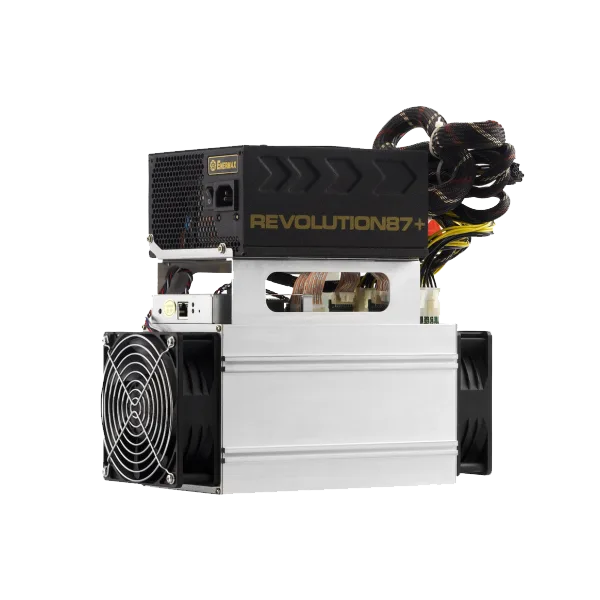
Bitmain Antminer S7-LN
Réponse rapide
The Bitmain Antminer S7-LN is a Bitcoin miner rated about 2.7 TH/s at roughly 697 W (about 258.1 J/TH). Runnable at home with proper airflow and noise control; best in a dedicated space.
Heater-Class Miner
At 697W, this miner outputs approximately 2378 BTU/hr of heat — equivalent to a standard electric space heater. Every watt consumed by an ASIC miner is converted to heat with 100% efficiency, making it a space heater that also mines Bitcoin.
During heating season, miner heat can offset part of the heat a room would otherwise need from another electric heater. The economics depend on your electricity rate, room heat demand, BTC price, network difficulty, and noise constraints.
Calculateur de rentabilité
| Period | Revenue | Electricity Cost | Profit |
|---|---|---|---|
| Daily | $0.08 | $1.17 | $-1.09 |
| Weekly | $0.59 | $8.20 | $-7.61 |
| Monthly | $2.51 | $35.13 | $-32.62 |
| Yearly | $30.58 | $427.40 | $-396.82 |
Heating offset estimates the value of heat replacing an electric space heater during heating season (~6 months/year in Canada). Actual savings depend on your heating setup and climate.
Where to Buy the Bitmain Antminer S7-LN
D-Central Technologies
CanadaBitcoin Mining Hackers since 2016. Ships from Laval, Quebec.
magasiner le materiel de minage BitcoinASIC Miner Market
United StatesWide selection of new and used ASIC miners. US-based shipping.
MagasinerMinersDeals
United StatesCompetitive prices on new ASIC miners with coupon codes.
MagasinerFull Specifications
| Model | Bitmain Antminer S7-LN |
|---|---|
| Model Number | Antminer S7-LN |
| Manufacturer | Bitmain |
| Algorithme | SHA-256 |
| Coins Mined | Bitcoin (BTC) |
| Taux de hachage | 2.7 TH/s |
| Consommation électrique | 697 W |
| Efficiency | 258.1 J/TH |
| Dimensions | 150 x 275 x 306mm |
| Weight | 7.5 |
| BTU Output | 2378 BTU/hr |
| Equivalent Heater | Small personal heater (2,378 BTU/hr) |
| Daily Power Cost | $1.17/day |
| Monthly Power Cost | $35.13/mo |
| Circuit Requirement | Standard 120V 15A |
| Release Date | 2016-06-01 |
| État | Active |
Home Mining Assessment
The Antminer S7-LN is Bitmain’s « Low Noise » version of the 2015-era S7, a legacy SHA-256 miner built on the 28 nm BM1385 ASIC. Rated at 2.7 TH/s for roughly 697 W (258.1 J/TH), it is long obsolete for profit, but it remains a quiet, exceptionally well-documented machine for learning, lab work, and heat recovery.
Antminer S7-LN at a glance
| Specification | Antminer S7-LN |
|---|---|
| Hashrate (nameplate) | 2.7 TH/s |
| Power draw (nameplate) | ~697 W |
| Efficiency | 258.1 J/TH |
| ASIC chip | BM1385 (TSMC 28 nm, 50 cores per chip) |
| Algorithm / coin | SHA-256 (Bitcoin and other SHA-256 coins) |
| Heat output | ~2,378 BTU/h |
| Weight | ~7.5 kg (about 16.5 lb) |
| Dimensions | 150 x 275 x 306 mm |
| Temperature sensor | LM75A (external, board-mounted) |
| Cooling | Single low-noise fan (the « LN » trait) |
| Released | Circa 2016 |
One correction worth flagging up front: the unit weighs roughly 7.5 kilograms, not the inflated figure that legacy spec sheets sometimes carry. Everything below is cross-referenced against our in-house repair data and the publicly available BM1385 documentation.
Chip and hashboard architecture
The S7 family is powered by the BM1385, a SHA-256 ASIC fabricated on TSMC’s 28 nm process and carrying chip ID 0x1385. Each BM1385 packs 50 hashing cores. That is a fraction of what later silicon would deliver, but the BM1385 holds a special place in mining history: its datasheet is the only Bitmain ASIC datasheet ever released publicly, which makes it the « Rosetta Stone » the entire reverse-engineering community still uses to interpret every closed chip that followed.
On a full-power S7, three hashboards each host a string of BM1385 chips. Bitmain shipped two factory board layouts: a 45-chip board clocked around 600 MHz, and a denser 54-chip board run at a lower 500-550 MHz. The S7-LN (« Low Noise ») is a reduced, quieter factory configuration of that same platform, trading raw throughput and a second fan for lower noise and a smaller power envelope, which is why it lands at 2.7 TH/s rather than the standard S7’s higher rating.
Voltage domains, not per-chip control
The chips on each board are wired as a series string forming a single voltage domain. Voltage is set for the whole board, never for an individual chip — a per-domain model that has carried through every Antminer generation since. The BM1385 is also notable for what it lacks: there is no I2C PIC microcontroller on these boards. Frequency and voltage are driven directly in firmware using Bitmain’s older fixed-length (FIL) command mode, rather than the variable-length (VIL) protocol and PIC/DAC voltage chain introduced on the 16 nm S9. For service work, see our Antminer voltage domain reference for how board-level domains are probed.
Real-world power and efficiency
At a nameplate 697 W for 2.7 TH/s, the S7-LN works out to 258.1 J/TH. Expect actual wall draw to run modestly higher once you account for PSU conversion losses and the realities of a decade-old unit — older capacitors and connectors are rarely as efficient as the day they shipped. There is essentially no tuning headroom here: the S7 predates the runtime autotuning era entirely. Modern firmware calculates a clock-and-voltage operating point for each chip at runtime and lets you push or pull a power profile; the S7 simply runs a single fixed operating point baked into its config.ini.
That said, the BM1385 era already demonstrated the universal efficiency lever. Bitmain’s own factory test profiles show the 54-chip boards running at lower clocks and lower voltage than the 45-chip 600 MHz boards — the same undervolt-for-efficiency tradeoff that the LN configuration leans on to land slightly better J/TH than a flat-out S7. If you run a mixed fleet, our ASIC power profiles database is the place to dial in modern hardware; just know the S7-LN itself has one profile, set at the factory.
For context, 258 J/TH is roughly an order of magnitude behind anything sold today:
| Miner (generation) | Process node | Approx. efficiency | vs S7-LN |
|---|---|---|---|
| Antminer S7-LN (2015-16) | 28 nm | 258 J/TH | baseline |
| Antminer S9 (2016) | 16 nm | ~98 J/TH | ~2.6x better |
| Antminer S19 XP (2022) | 5 nm | ~21.5 J/TH | ~12x better |
| Antminer S21 (2024) | 5 nm | ~17.5 J/TH | ~15x better |
Figures for the comparison units are approximate, rounded generational benchmarks; the S7-LN’s own numbers are its rated values.
Firmware compatibility
Be honest with yourself about firmware before buying: the S7-LN runs Bitmain’s original stock cgminer-based firmware and little else. The modern third-party ecosystem — performance-tuning firmware with autotuning, advanced telemetry, and native Stratum V2 — was built for the 16 nm S9 generation and newer. The BM1385 predates all of it. There is no mainstream BraiinsOS+, VNish, or LuxOS build for the S7, and our own DCENT_OS work likewise targets modern control boards. None of these will turn an S7 into anything other than a quiet, slow S7.
Practically, that means you manage the unit through the classic Antminer web UI, point it at a pool, and leave it. If firmware history is your interest, our ASIC firmware overview traces how stock and aftermarket firmware diverged across generations — the S7 sits right at the start of that timeline.
Common faults and troubleshooting
After a decade in service, S7-LN failures cluster in a few predictable places. Because each board is a single series string, one bad chip can drop an entire hashboard offline, so the most common symptom is a unit reporting far fewer than the expected ASIC count, or a board showing zero. Watch for:
- Dead or « missing » chips in a chain — the controller detects fewer ASICs than the board should carry, usually from a cracked chip or a broken solder joint after years of thermal cycling on 28 nm packages.
- Fan failure — the LN’s defining single fan is also a single point of failure. A stalled fan triggers a protective shutdown, and the board cooks if it is bypassed.
- Power-stage faults — aged buck converters and capacitors on the boards, or a tired PSU, cause boards to drop out under load or refuse to start.
- Temperature-sensor errors — the external LM75A sensor or its I2C trace can fail, producing temperature read errors and false thermal shutdowns.
Work symptom-first. Our ASIC fault finder and error-code database maps these messages — missing ASICs, board-not-detected, temperature read errors — to likely root causes and next diagnostic steps.
Repair and longevity
D-Central has been repairing Antminers at the chip level in Laval, Quebec since 2016 — the S7 generation is part of our living memory, not a museum piece. The good news for the S7-LN is mechanical simplicity: with no PIC to « marry » to a board and a straightforward series-string layout, board-level diagnosis is comparatively clean. We can trace dead domains, reflow or replace failed components, and bring boards back from a partial-chain fault.
The honest caveat is parts. The BM1385 is end-of-life 28 nm silicon, so donor chips are increasingly scarce; some chip-level repairs are limited by what can still be sourced rather than by skill. For a unit this old, we will always tell you plainly when a board is worth saving and when it is not. If you have an S7 worth keeping running, our ASIC repair service is the place to start, and the newer S9 repair workflow shows how the same diagnostic discipline carried into the next generation.
Who the S7-LN is for
Let’s be candid: at 258 J/TH, the S7-LN cannot mine Bitcoin profitably against grid power. Where it still earns its keep is everywhere efficiency is not the point:
- Learning and lab work — a real, cheap, complete ASIC to study pool connections, firmware, and hashboard behavior without risking expensive hardware.
- Quiet supplemental heat — its ~2,378 BTU/h of waste heat can warm a small space; see our guide to Bitcoin miners for heating for how to think about heat recovery.
- Lottery and hobby solo mining — a long-shot ticket on a block, run for the fun of it rather than the math.
- Collectors — the S7 carries genuine historical weight as the home of the only public Bitmain datasheet.
If your real goal is learning to mine on something modern and low-power, a single-chip open-source board is the better path today — start at our Bitaxe hub. And if you are shopping for a machine that can actually turn a profit, browse current, efficient hardware in our ASIC miner catalog or compare options in the universal ASIC spec database.
Generational context
The S7-LN sits at a hinge point in mining history. It was Bitmain’s last major 28 nm SHA-256 platform before the 16 nm BM1387 S9 arrived in 2016 and roughly tripled efficiency — the leap that defined the home-mining boom. The 50-core BM1385, its FIL command mode, and its PIC-free boards mark the end of the era when Bitmain hardware was relatively open and documented; everything after leaned harder on closed firmware and locked PICs. We credit Bitmain for shipping the silicon that bootstrapped an entire industry, and for the BM1385 datasheet that, intentionally or not, taught a generation of mining hackers how these chips actually work. The S7-LN is no longer a money-maker, but as a teaching tool, a quiet heater, and a historical artifact, it is still very much worth understanding.
Broken miner? Get a real quote.
Tell us the symptom and get an instant repair-tier estimate ($95 / $145 / $195 CAD). Mail-in from across Canada, bench in Laval, Quebec.
Send it to D-Central — start a repair →Related Miners
Whatsminer M60S++
NerdAxe
Bitmain Antminer T17 (40Th)
Innosilicon T2 Turbo 25T
Comparer le Bitmain Antminer S7-LN
Foire aux questions
What are the current mining economics for the Bitmain Antminer S7-LN?
At $0.07/kWh, the Bitmain Antminer S7-LN currently shows an estimated daily net cost of $1.09 before pool fees and hardware cost. Lower electricity rates, network changes, BTC price changes, or useful heat recovery can change the result.
Can I mine Bitcoin at home with the Bitmain Antminer S7-LN?
The Bitmain Antminer S7-LN has a home mining score of 59/100. With 0 dB noise and 697W power draw, it may require a dedicated space like a garage, basement, or outdoor enclosure. Consider noise insulation and proper ventilation.
Can the Bitmain Antminer S7-LN heat my home?
The Bitmain Antminer S7-LN outputs approximately 2378 BTU/hr of heat. For reference, a typical space heater produces 5,000-5,500 BTU/hr. All electrical energy consumed by the miner is converted to heat, making it 100% efficient as a heater. D-Central offers Bitcoin Space Heater builds designed specifically for home heating integration.
What power supply does the Bitmain Antminer S7-LN need?
The Bitmain Antminer S7-LN draws 697W of power. You need a power supply rated for at least 767W with appropriate voltage (200-240V AC). D-Central stocks compatible power supplies in our shop. Always use a quality PSU from a reputable manufacturer to protect the miner and wiring.