
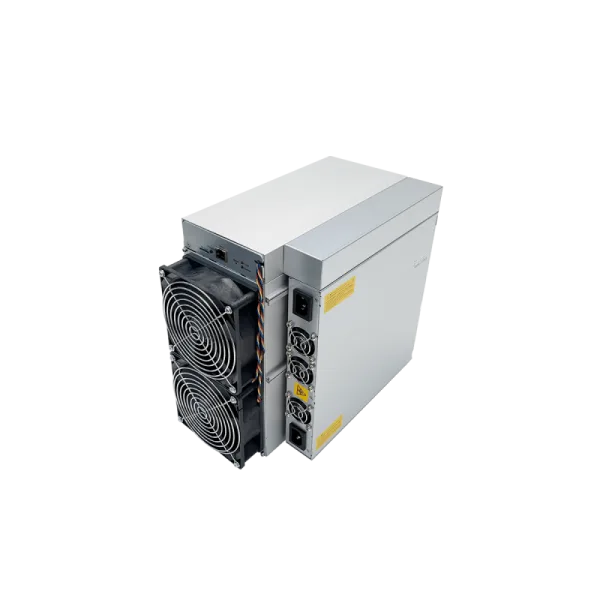
Antminer S19j Pro+
Improved S19j Pro with better efficiency, same infrastructure requirements
Réponse rapide
The Antminer S19j Pro+ is a Bitcoin miner rated about 117 TH/s at roughly 3,355 W (about 28.68 J/TH), built on 378× BM1362. An industrial-class unit — loud and power-hungry, best suited to a dedicated mining space, not living areas.
DCENT_OS Compatible
DCENT_OS is custom firmware developed by D-Central Technologies specifically for home miners. It transforms this miner with whisper-quiet fan profiles, 120V North American outlet support, auto-tuning for maximum efficiency, heater mode integration, and a clean web dashboard for monitoring.
Miners running DCENT_OS score higher on our Home Mining Assessment because the firmware is purpose-built to make industrial hardware livable in residential spaces.
Learn More About DCENT_OS →Professional-Grade Miner
This miner draws 3,355W and produces 75 dB of noise — it is designed for dedicated mining environments, not living spaces. Professional-grade miners deliver the highest hashrate and revenue per unit but require proper infrastructure: a 240V circuit, adequate ventilation or exhaust ducting, and a space where noise is not a concern (garage, basement, warehouse, or outdoor enclosure).
However, this miner is compatible with DCENT_OS — D-Central's custom firmware that adds whisper-quiet fan profiles and 120V North American outlet support. With DCENT_OS installed, this industrial miner can be transformed for home use.
Heater-Class Miner
At 3,355W, this miner outputs approximately 11447.3 BTU/hr of heat — equivalent to a standard electric space heater. Every watt consumed by an ASIC miner is converted to heat with 100% efficiency, making it a space heater that also mines Bitcoin.
During heating season, miner heat can offset part of the heat a room would otherwise need from another electric heater. The economics depend on your electricity rate, room heat demand, BTC price, network difficulty, and noise constraints.
Calculateur de rentabilité
| Period | Revenue | Electricity Cost | Profit |
|---|---|---|---|
| Daily | $3.65 | $5.64 | $-1.98 |
| Weekly | $25.58 | $39.45 | $-13.88 |
| Monthly | $109.61 | $169.09 | $-59.48 |
| Yearly | $1,333.65 | $2,057.29 | $-723.64 |
Heating offset estimates the value of heat replacing an electric space heater during heating season (~6 months/year in Canada). Actual savings depend on your heating setup and climate.
Buy from D-Central
In stock and ready to ship from Laval, Quebec.
Where to Buy the Antminer S19j Pro+
D-Central Technologies
CanadaBitcoin Mining Hackers since 2016. Ships from Laval, Quebec.
Full Specifications
| Model | Antminer S19j Pro+ |
|---|---|
| Model Number | S19j Pro+ |
| Manufacturer | Bitmain |
| Algorithme | SHA-256 |
| Coins Mined | Bitcoin (BTC) |
| Taux de hachage | 117 TH/s |
| Consommation électrique | 3,355 W |
| Efficiency | 28.7 J/TH |
| Niveau de bruit | 75 dB |
| Chip Model | BM1362 |
| Chip Count | 378 |
| Cooling | Air |
| Voltage Range | 200-240V AC |
| Operating Temperature | 5-40°C |
| Dimensions | 400x195x290 |
| Weight | 13.6 |
| Interface | Ethernet |
| BTU Output | 11447.3 BTU/hr |
| Equivalent Heater | Equal to a 3,355W space heater |
| Daily Power Cost | $5.64/day |
| Monthly Power Cost | $169.09/mo |
| Circuit Requirement | 240V circuit required |
| Release Date | 2022-05-01 |
| MSRP | $3,200.00 |
| État | Active |
Custom Power Profiles
With custom firmware like DCENT_OS, this miner can be tuned across a wide range of power levels. Lower wattage improves efficiency and reduces electricity costs; higher wattage increases hashrate at the expense of efficiency.
| Wattage | Taux de hachage | Efficiency |
|---|---|---|
| 1,450 W | 65 TH/s | 22.3 J/TH |
| 1,600 W | 70 TH/s | 22.9 J/TH |
| 1,750 W | 75 TH/s | 23.3 J/TH |
| 1,900 W | 80 TH/s | 23.8 J/TH |
| 2,050 W | 85 TH/s | 24.1 J/TH |
| 2,200 W | 87 TH/s | 25.3 J/TH |
| 2,500 W | 94 TH/s | 26.6 J/TH |
| 2,650 W | 103 TH/s | 25.7 J/TH |
| 2,800 W | 108 TH/s | 25.9 J/TH |
| 2,950 W | 112 TH/s | 26.3 J/TH |
| 3,200 W | 116 TH/s | 27.6 J/TH |
| 3,500 W | 122 TH/s | 28.7 J/TH |
| 3,800 W | 126 TH/s | 30.2 J/TH |
| 4,100 W | 131 TH/s | 31.3 J/TH |
| 4,400 W | 135 TH/s | 32.6 J/TH |
| 4,700 W | 140 TH/s | 33.6 J/TH |
| 5,000 W | 145 TH/s | 34.5 J/TH |
| 5,300 W | 149 TH/s | 35.6 J/TH |
| 5,600 W | 154 TH/s | 36.4 J/TH |
| 5,900 W | 159 TH/s | 37.1 J/TH |
Actual performance varies by individual unit silicon quality, ambient temperature, and cooling configuration. These operating points are achievable with custom tuning firmware such as DCENT_OS; values are calculated at runtime by the autotuner, not fixed presets.
Home Mining Assessment
Improved S19j Pro with better efficiency, same infrastructure requirements
The Antminer S19j Pro+ is Bitmain’s efficiency-tuned SHA-256 miner, rated at 117 TH/s for about 3,355 W (roughly 28.68 J/TH at stock). Built on the 5nm BM1362 ASIC across three 126-chip hashboards, it is a previous-generation workhorse: cheap to acquire, easy to service, and a capable space heater.
Chip and hashboard architecture
The S19j Pro+ runs the BM1362, a TSMC 5nm « small-die » SHA-256 ASIC that carries four large hashing cores per chip. Each of the three hashboards is populated with 126 chips, for 378 chips in a fully populated unit. That high chip count on a mature 5nm process is what lets the S19j Pro+ undercut the older 7nm S19/S19 Pro on energy per terahash while staying on the same physical platform.
Compute is orchestrated by Bitmain’s X19-class control board. On the FPGA-based revision this is a Xilinx Zynq-7000 (XC7Z007S) system-on-chip — dual ARM Cortex-A9 cores at 667 MHz paired with programmable logic that runs the per-chain UART and work-distribution FPGA design. The control board streams work to each chain, collects nonces, and relays I2C telemetry from the power and temperature controllers. Later S19j-series units shipped instead on a BeagleBone-class (TI AM335x) control board that handles ASIC communication in software with no FPGA — a distinction worth confirming before you plan a firmware change, because aftermarket firmware coverage differs between the two boards.
Voltage domains, not per-chip control
A common misconception is that each ASIC is tuned individually. It is not. The chips on every hashboard are grouped into voltage domains — clusters wired in series that share one regulated rail. The domain voltage equals the per-chip core voltage multiplied by the number of chips in that domain, so voltage is set per domain, never per individual chip. A shared-rail PSU (Bitmain’s APW12-class, ~13.5 V on the main rail) feeds the boost and domain regulators, and a dsPIC33 power-controller relays voltage and current readings back to the control board over a single I2C bus it shares with the temperature sensors. Stock firmware drives the whole board from that shared rail; there is no per-chain voltage trim on a factory S19j Pro+.
Thermals are watched by a TMP451 sensor on each board plus the on-die temperature reading inside every BM1362. Bitmain’s firmware targets roughly 60 °C on the PCB, treats ~80 °C as hot, and trips protection near 90 °C board / 110 °C chip junction. Four fans in a dual-tunnel airflow path move the heat, which is also why this is a loud machine at full tilt.
Real-world power and efficiency
Nameplate numbers and wall numbers are not the same thing. At its stock 117 TH/s the S19j Pro+ pulls about 3,355 W at the wall for ~28.68 J/TH, but the BM1362 platform has a wide, well-characterized tuning curve. D-Central catalogs 21 power profiles for this model — see the full curve on our ASIC power profiles database. A representative slice:
| Mode | Power (W) | Hashrate (TH/s) | Efficiency (J/TH) |
|---|---|---|---|
| Deep undervolt (heater / low-cost power) | 1,450 | 65 | 22.3 |
| Efficiency sweet spot | 1,750 | 75 | 23.3 |
| Balanced | 2,650 | 103 | 25.7 |
| Near stock | 3,200 | 116 | 27.6 |
| Stock (factory) | ~3,355 | 117 | 28.68 |
| Light overclock | 3,500 | 122 | 28.7 |
| Aggressive overclock | 5,900 | 159 | 37.1 |
The striking detail is the bottom of the curve: undervolted to ~65–75 TH/s the S19j Pro+ reaches 22–23 J/TH, comfortably better than its stock efficiency and competitive with newer hardware in absolute energy terms. If your priority is profit per kilowatt-hour rather than raw hashrate, the efficient operating point sits well below the nameplate. Push the other way and the curve is unforgiving — past ~140 TH/s efficiency climbs above 33 J/TH, so overclocking only makes sense where power is genuinely cheap or where you specifically want the extra heat. At stock the unit dumps roughly 11,447 BTU/h, enough to meaningfully warm a workshop or basement.
Firmware compatibility
Out of the box the S19j Pro+ runs Bitmain’s stock firmware, which is stable but offers limited tuning beyond a few preset modes. Because the BM1362/X19 platform is so widespread, it is also one of the most thoroughly supported targets for third-party firmware, which is where the granular auto-tuning behind the curve above comes from. Note that an auto-tuner calculates each operating point at runtime against the silicon’s measured behavior — those values are computed live, not pulled from a fixed preset list.
Two honest caveats. First, native Stratum V2 support is rare: among the available open-source firmwares, only Braiins OS+ ships it natively, so if end-to-end V2 matters to you, confirm the firmware actually implements it rather than assuming. Second, firmware options depend on the control board — FPGA-based Zynq units enjoy the broadest coverage, while BeagleBone-class units are more limited. D-Central’s own DCENT_OS — our GPL-3.0, open-source Antminer firmware — targets this BM1362 platform; it is in public beta as of July 2026, and is part of our broader effort to keep these machines self-hostable rather than dependent on any single vendor. We credit the open-source firmware projects that proved this ground before us; DCENT_OS is one more layer of decentralization, not a replacement for them.
Common faults and troubleshooting
Most S19j Pro+ failures show up as a hashboard that comes up with fewer than its 126 expected chips, a chain that drops to zero, or a unit that throttles and restarts under load. Because the chips are series-wired into domains, a single point of failure usually takes a region offline rather than one chip:
- Reduced ASIC count on a chain (e.g. 86/126) — a broken chip or open domain interrupts the daisy-chain, so every chip downstream of the fault stops reporting.
- Zero hashrate on one board — a shorted domain collapses its rail; the boost regulator may fold back to protect the PSU, or the control board fails to detect the chain entirely.
- Temperature / sensor errors — a failed TMP451 or a clogged heatsink trips the thermal cutoff well before the silicon is actually in danger.
- Won’t start / no chain detected — control-board, PSU-handshake, or cabling issues rather than the hashboards themselves.
Work through symptoms systematically with our ASIC fault finder, which maps error codes and behaviors to likely causes for the S19 family. Before condemning a board, measure the domain test points: an abnormal voltage between domains points to a specific failed chip or its domain regulator. One platform-specific warning — do not reset the dsPIC power controller on these units as a troubleshooting step; on the S19j series that is a one-way downgrade, not a fix.
Repair and longevity
The S19j Pro+ is a genuinely repairable machine, and that is central to why it remains worth owning. D-Central has run an in-house ASIC repair lab in Laval, Québec since 2016, and we service this model down to the component level: domain diagnosis, BM1362 chip reballing and replacement, regulator and PSU work, and control-board recovery. A 5nm board with a couple of dead domains is usually an economic repair, not scrap — see our ASIC repair service for turnaround and what we can fix. Treated well (clean air, sane temperatures, and tuning kept off the aggressive end of the curve), these units run for years, which is exactly why a healthy secondary market exists for them.
Who it’s for and buying
The S19j Pro+ suits two buyers especially well. The first is the cost-sensitive miner who wants real terahash without flagship pricing and is happy to undervolt for 22–24 J/TH where power costs matter. The second is the heat-reuse miner: with a home-mining score of 84/100 and ~11,447 BTU/h of recoverable heat, it makes a credible — if loud, at ~75 dB — supplemental heater for a garage, workshop, or grow space, ducted away from living areas. Browse current ASIC stock in our ASIC miners catalog or the full D-Central shop. If 3.3 kW and 75 dB are simply too much for your space, a low-power open-source option like the DCENT_axe is a better entry point into self-hosted mining — it won’t pay an electricity bill, but it teaches the whole stack at a few watts.
Generational context
The S19j Pro+ is a 2022, fourth-generation Antminer — the efficiency-optimized sibling of the standard S19j Pro, tightening energy-per-terahash at a similar hashrate by leaning harder on the 5nm BM1362. It sits between the 7nm S19/S19 Pro it improved on and the 5nm BM1366 generation (S19k Pro, S19 XP) and the later BM1368-based S21 that followed it.
| Model | ASIC | Process | Stock hashrate | Efficiency tier |
|---|---|---|---|---|
| S19 Pro | BM1398 | 7nm | ~110 TH/s | ~29–30 J/TH |
| S19j Pro | BM1362 | 5nm | ~104 TH/s | ~29–30 J/TH |
| S19j Pro+ | BM1362 | 5nm | 117 TH/s | ~28.7 J/TH |
| S19k Pro | BM1366 | 5nm | ~120 TH/s | ~23 J/TH |
| S19 XP | BM1366 | 5nm | ~134 TH/s | ~21.5 J/TH |
Figures above are representative stock/nameplate values; every one of these models has a full tuning range documented in our power profiles database. In 2026 the S19j Pro+ is no longer a frontier machine, but its combination of low acquisition cost, strong undervolt efficiency, recoverable heat, and component-level repairability keeps it one of the more sensible ways to put hashrate on the network — or to keep an existing fleet alive long past its warranty.
Broken miner? Get a real quote.
Tell us the symptom and get an instant repair-tier estimate ($95 / $145 / $195 CAD). Mail-in from across Canada, bench in Laval, Quebec.
Send it to D-Central — start a repair →Related Miners
Avalon A1466
Whatsminer M53S
Auradine Teraflux AI3680
Bitmain Antminer S21+ Hyd (358Th)
Foire aux questions
What are the current mining economics for the Antminer S19j Pro+?
At $0.07/kWh, the Antminer S19j Pro+ currently shows an estimated daily net cost of $1.98 before pool fees and hardware cost. Lower electricity rates, network changes, BTC price changes, or useful heat recovery can change the result.
Can I mine Bitcoin at home with the Antminer S19j Pro+?
The Antminer S19j Pro+ has a home mining score of 8/100. With 75 dB noise and 3,355W power draw, it may require a dedicated space like a garage, basement, or outdoor enclosure. Consider noise insulation and proper ventilation.
Can the Antminer S19j Pro+ heat my home?
The Antminer S19j Pro+ outputs approximately 11447.3 BTU/hr of heat. For reference, a typical space heater produces 5,000-5,500 BTU/hr. All electrical energy consumed by the miner is converted to heat, making it 100% efficient as a heater. D-Central offers Bitcoin Space Heater builds designed specifically for home heating integration.
Does D-Central repair the Antminer S19j Pro+?
Yes, D-Central provides professional repair services for the Antminer S19j Pro+. Services include hashboard repair, control board diagnostics, fan replacement, and full refurbishment. Ship your miner to our Laval, Quebec facility for diagnosis and repair.
What power supply does the Antminer S19j Pro+ need?
The Antminer S19j Pro+ draws 3,355W of power. You need a power supply rated for at least 3,691W with appropriate voltage (200-240V AC). D-Central stocks compatible power supplies in our shop. Always use a quality PSU from a reputable manufacturer to protect the miner and wiring.