Quick answer
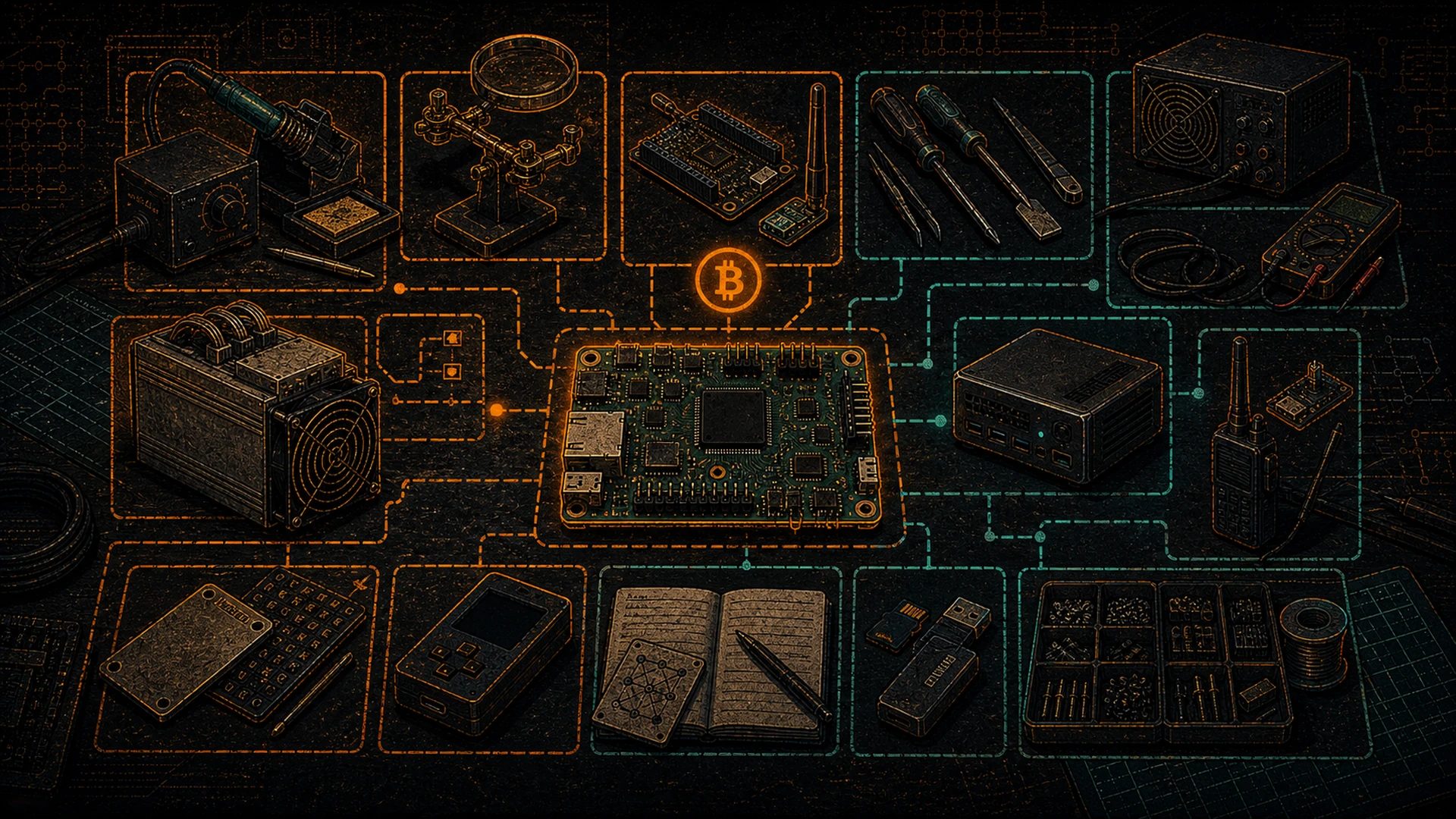
A sovereign stack is only as sovereign as the hardware under it. This practical directory catalogs the open-source and open-firmware hardware that belongs in a Bitcoiner's lab — from pocket multitools like the Flipper Zero to ASIC firmware stacks. Each entry gives what it is, who made it, its license, use cases, a price range, and where to buy.
Why This Directory Exists
A sovereign stack is only as sovereign as the hardware under it. You can run your own node, your own wallet, your own Hashcenter — but if the device between you and the world is a locked-down black box you rent from a vendor, you haven’t actually escaped the custodial model; you’ve just moved it.
The good news is that the last fifteen years have produced a remarkable catalog of open-source and open-firmware hardware. Volunteers and small companies have shipped everything from pocket multitools to full ASIC firmware stacks, and a lot of it is affordable, documented, and genuinely maintained. This is a practical directory of what we think belongs in a Bitcoiner’s lab, with honest notes on what each thing is good for.
We owe credit to hundreds of maintainers, companies, and community projects. Where a specific person or team is the obvious driver, we name them. Where it’s a community effort, we call it that. None of this exists because D-Central built it; it exists because a lot of people built it first.
How to Read This Directory
Each entry includes:
- What it is — one paragraph, no marketing.
- Who made it — individuals, companies, and communities to credit.
- License — hardware and/or firmware licensing, as best we can summarize.
- Use cases — what a miner or Bitcoiner actually does with it.
- Price range — USD, late 2026, excluding import duties.
- Where to buy — direct links where available, plus reputable resellers.
Prices move. Licenses change. Always verify current terms at the source.
1. Flipper Zero
| Category | Hardware multitool |
| Maker | Flipper Devices |
| License | Firmware: MIT + custom on certain modules; hardware: proprietary but extensively documented |
| Price | USD $169 retail, often $200+ through resellers |
| Where | flipperzero.one, reputable EU/US distributors |
A pocket-sized STM32-based multitool with sub-GHz, NFC, 125 kHz RFID, IR, iButton, GPIO, USB-C, and BLE. Firmware lives at github.com/flipperdevices/flipperzero-firmware and community forks (notably Momentum) extend it. For a Bitcoiner, the main uses are: duplicating your own access-control badges, diagnosing your own IR and sub-GHz remotes, probing GPIO/UART on your own ASIC control boards, and running community apps like FlipBIP for experimental offline Bitcoin work. We have a full write-up in Flipper Zero for Bitcoin Miners. Scope it as a diagnostic and dev tool, not a master key.
2. HackRF One
| Category | Software-defined radio (SDR) |
| Maker | Great Scott Gadgets (Michael Ossmann) |
| License | Hardware: CC-BY 3.0; firmware: GPLv2+ |
| Price | USD $350–420 new; clones from $120 |
| Where | greatscottgadgets.com, Sparkfun, Adafruit |
A half-duplex transceiver covering 1 MHz to 6 GHz, 20 MS/s, with full schematics and firmware published. HackRF is the definitive open SDR, and almost every serious RF project in the last decade has either used it directly or learned from it. For miners: analyze RF noise floors in your Hashcenter, develop LoRa/Meshtastic payloads, characterize sub-GHz telemetry, debug your own WISP backhaul. Pair with SDR++ or CubicSDR. Credit: Michael Ossmann has made this entire category legible to hobbyists, and the related Throwing Star LAN Tap and Ubertooth projects extend the same ethos.
3. ProxMark3 RDV4
| Category | RFID research |
| Maker | Proxmark project; flagship hardware by RRG / Proxgrind; firmware by the Iceman community |
| License | Hardware: open; firmware: GPLv2 (Iceman fork) |
| Price | RDV4 kits USD $350–500; “Easy” variants under $100 |
| Where | proxmark.com (RRG), lab401.com, Hacker Warehouse |
The serious RFID tool. Reads and emulates HF (13.56 MHz) and LF (125 kHz) cards at a level the Flipper can’t match — full MIFARE research, DESFire probing, protocol work on HID iCLASS (defensive only), legacy EM/HID, and almost everything in between. The Iceman firmware fork (github.com/RfidResearchGroup/proxmark3) is the de-facto standard; the community around it is a decade deep. Legitimate lab use: deep diagnostics on your own access-control deployments, inventory tag development, credential migration planning. Not a toy — used irresponsibly it will get you in real trouble. Use it on your own credentials.
4. Pwnagotchi
| Category | Educational Wi-Fi research |
| Maker | evilsocket (Simone Margaritelli) + community |
| License | GPLv3 |
| Price | ~USD $80 for a Pi Zero 2 W kit with Waveshare e-ink HAT |
| Where | pwnagotchi.ai, github.com/evilsocket/pwnagotchi |
A Pi Zero running a reinforcement-learning agent that opportunistically captures WPA/WPA2 handshakes over monitor-mode Wi-Fi. Frame it correctly: this is educational research hardware for your own networks and authorized test environments. It is an excellent way to internalize how weak Wi-Fi hygiene is at most home mining sites, which is exactly why you should audit your own rack-management VLAN with it and then fix what you find. Credit to evilsocket for building one of the most memorable learning tools in the space.
5. O.MG Cable (educational)
| Category | USB implant / red-team research |
| Maker | Hak5 (design by Mischief Gadgets, MG) |
| License | Commercial; firmware not open |
| Price | USD $129–180 |
| Where | shop.hak5.org |
A USB-C or Lightning cable with a microcontroller, Wi-Fi, and HID injection capability hidden in the connector. Included here in the educational framing only: if you run a Hashcenter and the cable your tech plugs into your control laptop could be an O.MG, you should know that and defend accordingly. Use it on your own lab networks to train your own team and write your own detection rules. This is not an offensive tutorial. The lesson is: supply-chain matters down to the cable, and a disciplined shop treats USB as hostile by default.
6. Raspberry Pi 5 / Pi Zero 2 W
| Category | Sovereign home server foundation |
| Maker | Raspberry Pi Ltd. |
| License | Hardware: proprietary (docs open); software: overwhelmingly open |
| Price | Pi 5 8GB: USD $80; Pi Zero 2 W: USD $15 |
| Where | raspberrypi.com, Adafruit, CanaKit |
The Pi earns its spot because it is the cheapest credible foundation for a home node, a Meshtastic gateway, a Flipper companion, or a Pwnagotchi. Running Umbrel, Start9, or a vanilla Debian+Bitcoin Core install on a Pi 5 with an NVMe hat is a fine Bitcoin node today. The Pi Zero 2 W is the go-to carrier for compact sensor projects and ASIC-adjacent monitoring. Community scale matters here — documentation, forks, and cases exist for every niche you can imagine.
7. ESP32 / Heltec / LILYGO
| Category | Microcontroller platform; LoRa/Meshtastic carrier |
| Maker | Espressif Systems (silicon); Heltec, LILYGO, SparkFun (boards) |
| License | SDK: Apache 2.0 (ESP-IDF); most community firmwares GPL/MIT |
| Price | Bare ESP32 board: USD $5–10; Heltec LoRa V3: $25–35; LILYGO T-Beam: $40–60 |
| Where | Espressif partners, Mouser, Digi-Key, Aliexpress for hobby-grade |
The ESP32 is the de-facto open microcontroller for anything networked. Relevant to Bitcoiners three ways: (1) it’s the brain of most Meshtastic nodes when paired with an SX1262/SX1276 LoRa radio; see our companion Meshtastic getting-started guide; (2) it’s the control processor in the Bitaxe family of open-source miners; (3) it’s the cheapest way to build an ASIC-adjacent probe — temperature loggers, current shunts, tamper sensors, watchdog controllers. Heltec and LILYGO ship good all-in-one boards with OLED screens and LoRa radios pre-wired.
8. Bus Pirate / USB Logic Analyzers
| Category | Digital protocol tools |
| Makers | Bus Pirate: Dangerous Prototypes + community (v5 by Ian Lesnet); Saleae; Kingst; OpenBench |
| License | Bus Pirate: hardware open, firmware open; Saleae Logic: proprietary host SW, MIT protocol decoders; sigrok: GPLv3 |
| Price | Bus Pirate v5: USD $60–90; cheap “24 MHz” logic analyzers: $12–20; Saleae Logic 8: $400+ |
| Where | dangerousprototypes.com, Sparkfun, Amazon for generics |
Every hardware lab needs digital protocol visibility. The Bus Pirate is a universal bus interface — SPI, I²C, UART, 1-Wire — driven from a serial console, and it’s excellent for poking at unknown peripherals on an ASIC control board. A cheap FX2-based USB logic analyzer running sigrok gives you multi-channel protocol capture for the price of a steak dinner. Upgrade to a Saleae Logic 8 or 16 when you need more channels, higher sample rates, and their (very good) UI. This tier is where you catch the bugs that oscilloscopes can’t see and UART terminals can’t reach.
9. SeedSigner
| Category | DIY air-gapped Bitcoin signer |
| Maker | SeedSigner community (founded by SeedSigner) |
| License | MIT |
| Price | USD $50–80 in parts; pre-built kits $80–120 |
| Where | seedsigner.com, Etsy makers, MicroSeedSigner variants |
A DIY stateless Bitcoin signer built from a Pi Zero, a small screen, and a camera module. It boots from SD card, derives keys in RAM, signs PSBTs over QR code, and has no persistent storage — the seed lives only in your head (or on steel) and is entered each time. The threat model is deliberately paranoid. Credit to the SeedSigner team for making “roll your own signer” accessible to anyone who can solder a Pi header. Pair with a Foundation Passport and a Trezor in a 2-of-3 multisig and you have a genuinely sovereign setup using three different supply chains and three different firmwares.
If you already have SeedSigner hardware and need a separate or replacement case, compare our printed SeedSigner case. This is a printed case only, not an assembled signer. Confirm dimensions and fit with your components before ordering.
10. Coldcard Q / Mk4
| Category | Commercial hardware wallet with open firmware |
| Maker | Coinkite |
| License | Firmware: source-available, compilable, verifiable; hardware: proprietary |
| Price | Coldcard Mk4: USD $150; Coldcard Q: USD $240 |
| Where | coldcard.com, authorized resellers |
Included in a directory of “open-source hardware” with the right asterisk: Coldcard’s hardware is not open, but the firmware is readable and reproducible, and the device is designed around sovereign-Bitcoiner principles (dice-roll entropy, air-gapped PSBT workflows, duress PINs, anti-phishing words). Coinkite has shipped this category honestly for a decade, and when a seed-generation flaw was found in their firmware on 2026-07-30 they disclosed it themselves, published a technical backgrounder explaining exactly how the mistake was made, and shipped fixed firmware the next day. That is the behaviour you want from a vendor. It does not make the affected seeds safe: the patch does not repair a seed that already exists, and coins are being actively swept. We are not recommending this device at present — see our advisory and Coinkite’s. For significant sats, SeedSigner alongside a conventional signer like Trezor Safe 5, whose firmware is similarly auditable, is where we would start instead.
11. Bitaxe Family (and NerdAxe, NerdQAxe, NerdOctaxe)
| Category | Open-source Bitcoin ASIC miners |
| Maker | Open Source Miners United (OSMU) community; original design by Skot; NerdAxe variants by Bitronics |
| License | Hardware: CERN-OHL-S 2.0 / CC-BY-SA (varies); firmware: GPL |
| Price | Bitaxe Gamma (1x BM1370): USD $200–250; NerdQAxe++ (4x BM1370): $550–700; NerdOctaxe Gamma (8x BM1370): $900+ |
| Where | an independent hardware vendor.com, an independent hardware vendor.io, directly from community builders |
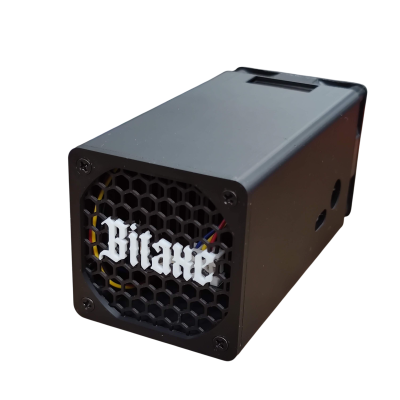
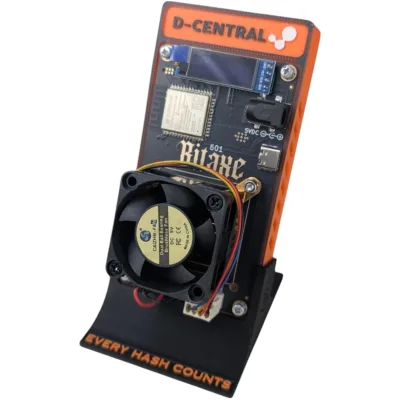
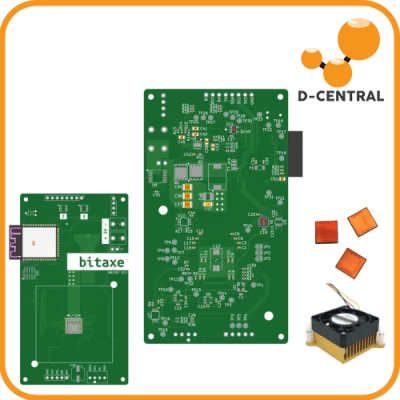
This is the category D-Central cares about most: independent hashing on open hardware. The Bitaxe is the reference design — one Bitmain BM1370 ASIC on a small PCB, controlled by an ESP32. From there the ecosystem has forked into multi-chip variants (Bitaxe GT, Bitaxe Hex) and fully independent designs (NerdAxe, NerdQAxe++, NerdOctaxe Gamma). Hashrate is low by datacenter standards but the point is sovereign hashing — solo-pool participation, home heat capture, and keeping the open-miner skill-tree alive. D-Central contributes to this tree with DCENT_axe, our AI-native Bitaxe firmware now in public beta and in public beta since July 2026 under GPL-3.0. This is one more layer decentralized on top of an already-open stack.
12. Antenna and RF Analysis Tools
| Category | RF test equipment |
| Key tools | NanoVNA, tinySA, SDR++, CubicSDR, GQRX |
| License | NanoVNA & tinySA: hardware open-source; software tools: MIT/GPL |
| Price | NanoVNA-H4: USD $70–100; tinySA Ultra: $120–160; software: free |
| Where | nanovna.com, authorized makers, Amazon with caveats |
If you run LoRa, Meshtastic, sub-GHz, or any kind of RF backhaul to your Hashcenter, you need at least one NanoVNA on the bench. It characterizes antennas (SWR, return loss, Smith charts) for a fraction of the price of a Rigol or Siglent lab VNA. Pair it with tinySA for spectrum work and the SDR++ / CubicSDR / GQRX software stack for receive-side analysis. The open RF community has made serious measurement gear accessible to anyone with $200 and patience.
13. The ASIC Firmware Ecosystem
The firmware running on a modern Bitmain or Whatsminer control board is its own ecosystem, and we include it here because firmware is hardware’s software twin — they live and die together.
- Braiins OS+ by Braiins. The oldest and most mature alternative firmware for Antminer hardware. The BCB100 (Braiins Control Board) hardware reference design is fully open; the firmware itself is a mix of open components and closed binaries. Braiins pioneered Stratum V2 and deserves credit for keeping open-miner ideas alive at scale.
- VNish. Widely deployed among large operators. Not our position to trash-talk; we simply note the feature overlap and move on.
- LuxOS by Luxor. Firmware with strong enterprise fleet features and a good relationship with the mining pool business of the same company.
- Stock firmware from Bitmain / Whatsminer. Closed, serviceable, fine for a fleet you trust the OEM on.
- DCENT_OS is D-Central Technologies’ GPL-3.0 open-source Bitcoin mining firmware for selected Bitmain Antminer ASIC miners. Guarded artifacts exist only for exact S9 XIL and S19j Pro XIL lanes; install evidence is incomplete and neither is production-ready. Check the exact evidence ledger.
Choose what fits your stack. The fact that there are five credible firmware options instead of one is a win for the whole industry.
Quick-Reference Buying Table
| Tier | Tools | Approx. Cost |
|---|---|---|
| Entry | Flipper Zero, cheap USB logic analyzer, Pi 5, NanoVNA | $400 |
| Bench | + HackRF One, ProxMark3 RDV4, Bus Pirate v5, ESP32/Heltec kit, SeedSigner parts | +$1,200 |
| Lab | + Saleae Logic 8, Bitaxe/NerdQAxe, OEM oscilloscope | +$1,500+ |
See our hardware hacker starter kit for Hashcenter operators for a more prescriptive buying path organized around ASIC repair and operations.
What’s Not on This List (and Why)
Any closed-source “hacking box” that doesn’t publish its firmware. If it won’t tell you how it works, it’s not in the sovereign stack.
Consumer-grade “security tokens” that exist to sell subscriptions. The sovereign path is owned hardware, not rented software.
Anything whose primary use case is committing crimes. This directory is explicit about legitimate, diagnostic, own-hardware use cases. We’re not squeamish about dual-use tools — every serious piece of hardware in this list is dual-use — but the framing is research and ownership, not offense.
The Pattern Across the Whole Directory
Look at the list as a whole. Every entry has the same shape: a community or a small company that shipped something open, and kept shipping it. Flipper Devices. Great Scott Gadgets. The Iceman Proxmark community. evilsocket. Hak5. Espressif and the ESP32 ecosystem. SeedSigner. Coinkite. Braiins. The Bitaxe / OSMU contributors. Every one of them is a small node, and together they form the mesh that makes a sovereign Bitcoin stack possible in 2026.
D-Central’s job — and our DCENT_axe and DCENT_OS projects — is to add one more node to that mesh. One more firmware. One more open reference. One more layer decentralized. The directory above is what we’re standing on.
Further Reading
- Flipper Zero for Bitcoin Miners
- FlipBIP: Turn a Flipper Zero Into an Offline Bitcoin Hardware Wallet
- The Hardware Hacker Starter Kit
- Meshtastic Getting Started for Bitcoiners
- DCENT_axe — AI-Native Bitaxe Firmware
- DCENT_OS — Our Open-Source Miner Firmware
- Sovereignty hub