Quick answer
A zap is a Lightning payment attached to a Nostr event: sats fly from one wallet to another with a signed, public, unforgeable receipt. No partner program, no ad rail, no KYC, no platform taking 30 percent. The spec is NIP-57 — a four-step handshake from zap request (kind 9734) to zap receipt (kind 9735).
What a zap is
A zap is a Lightning payment attached to a Nostr event. That is the whole idea. Someone reads your note, decides it was worth 500 sats, presses the lightning-bolt button in their client, and a Lightning payment flies from their wallet to yours — with a signed Nostr event as the public receipt.
There is no “monetization partner program” to apply for. There is no ad rail. There is no KYC. There is no platform taking 30 percent. The sats land in the recipient’s Lightning wallet, and a Nostr event says this key zapped that note for that amount at that time. That event is public, permanent on the relays that keep it, and impossible to forge.
It is the first native monetization primitive the open web has ever had, and it is a couple of years old.
NIP-57 mechanics
The spec behind zaps is NIP-57. It defines two event kinds and a four-step handshake. You do not need to memorize it, but understanding it demystifies what your client is doing.
1. Zap request (kind 9734). The sender’s client builds a Nostr event containing the recipient’s pubkey, the note being zapped, the amount in millisats, and a relay list where the receipt should be published. This event is signed by the sender’s key but not broadcast to relays yet.
2. LNURL-pay invoice. The client takes the recipient’s Lightning address (from the recipient’s Nostr profile), resolves its LNURL-pay endpoint, and asks for an invoice — passing the signed zap request along inside the LNURL-pay nostr parameter.
3. Payment. The recipient’s Lightning service (or self-hosted node) returns a BOLT-11 invoice. The sender’s Lightning wallet pays it. Standard Lightning routing from here on out.
4. Zap receipt (kind 9735). Upon receiving payment, the recipient’s service publishes a signed zap receipt event referencing the original zap request and the paid invoice. Clients see the receipt on the relays and render a lightning bolt with the amount on the original note.
Four steps. Two event kinds. No new infrastructure — it is just Lightning and Nostr composed, and the composition happens to be exactly what “tipping on the internet” should have been since 2010.
Why this is a big deal
Value-for-value, directly. The people who read your stuff pay for your stuff, proportionally to how much they liked it. No subscription tier to guess at, no per-article paywall to resent, no algorithm deciding who sees what based on engagement laundered into ad impressions.
No ads. Ad-based monetization is the reason every social platform eventually turns hostile: the advertiser is the customer and the user is the product. Zaps remove the advertiser from the loop entirely. The user is the customer again.
No platform tax. A zap routes from sender wallet to recipient wallet over Lightning. The relay that hosts the receipt does not touch the money. Nobody is skimming 30 percent. Nobody is skimming 2 percent. Lightning routing fees are typically measured in single-digit sats.
No KYC. Both parties can zap and be zapped without ever handing a driver’s license to a monetization provider. This is not an edge case — it is the default.
Global and instant. A pleb in Buenos Aires can zap a pleb in Lagos for 100 sats in two seconds. Try that with Patreon.
Wallets that zap well
A zap-capable wallet needs two things: a Lightning address (or LNURL-pay endpoint) you can publish, and a way to sign zap requests. The ecosystem has converged on a good handful.
Wallet of Satoshi — custodial, UK-based, easiest on-ramp. Every pleb you onboard this year probably starts here. Be transparent: funds are held by the provider. Small amounts only, and migrate off once the user is ready.
Alby — browser extension + hub. Alby Hub pairs with a self-hosted LDK/LND node or a connected service; the browser extension signs zaps seamlessly on every Nostr web client. Alby also issues @getalby.com Lightning addresses for custodial convenience during migration.
Mutiny Wallet — self-custodial, in-browser, LDK-based. Mutiny runs a Lightning node inside your browser (yes, really) and can receive zaps via its Lightning address service. Best of the “self-custody with zero server” category.
Phoenix / phoenixd — by ACINQ. Mobile self-custodial wallet with on-demand channels and a rock-solid UX. phoenixd is the headless server variant — you run it on a home server, and now your Nostr zaps settle into a wallet you fully control.
Primal wallet — the Primal client ships a built-in wallet that is the one-tap on-ramp for new Nostr users. Custodial today, good for volume tipping, ideal for onboarding.
The honest tradeoff: custodial wallets are easier but a third party can freeze you. Self-custodial wallets require you to understand channels, but nobody can get between you and your sats. Ladder up.
Setup walkthrough
Add a Lightning address to your Nostr profile
Every Nostr client has a profile-edit screen with a “Lightning address” or “LUD-16” field. Paste yours (looks like pleb@getalby.com or pleb@strike.me or pleb@phoenix.yourdomain.com if you self-host). Save. Your profile now broadcasts a zap target to every relay you publish to.
Behind the scenes, this populates the lud16 field on your kind 0 profile metadata event. Any client that sees your profile will show a lightning bolt next to your notes.
Zap a note
Find a note you liked. Tap the lightning bolt. Pick an amount (most clients have 21 / 100 / 500 / 1k / 5k / 10k sats preset). Add a comment if you want — it goes in the zap request. Confirm. Your Lightning wallet pops up, pays the invoice, and a few seconds later the note shows your zap.
That is it. You have sent money to a stranger on the internet because they wrote a good sentence. No account, no checkout flow, no shipping address.
Receive zaps
Post a good note. Wait. Refresh. If the note resonated, the number next to the lightning bolt grows. Funds land in whichever Lightning wallet is associated with your Lightning address.
Pro tip: make sure the wallet tied to your address has enough inbound liquidity. A self-custodial wallet with no inbound capacity cannot receive zaps. Phoenix solves this with on-demand channels; Mutiny uses LSPs; Alby Hub coordinates with its own LSP service.
Self-custodial zap flow
The cleanest fully-sovereign setup looks roughly like this.
- Run a Lightning node at home or on a VPS — LND, CLN, or phoenixd.
- Run an LNURL-pay endpoint in front of it. LNbits is the common pick and has a NIP-57 extension that generates zap receipts natively. Alternatives include Alby’s self-hosted “Hub” and the open-source
nostr-wallet-connectimplementations. - Point a subdomain at it with TLS —
pay.yourdomain.com. - Configure your Lightning address (
you@yourdomain.com) via the.well-known/lnurlp/endpoint on your web host. - Publish that Lightning address to your Nostr
kind 0.
Now a zap flows: sender client → your LNURL-pay → your Lightning node → your wallet → your LNbits → a signed zap receipt → published to relays. No custodian, no intermediary, no third-party account. This is the same pattern the sovereign mining stack uses for pool payouts: you control the endpoint, you control the node, you control the key.
Breez SDK is the newer kid on the block and worth watching — it bundles a Lightning node, LSP relationship, and Nostr zap signing into a single library that any app can embed, pushing the “no operations required” bar even lower.
Creator economics and emergent behaviors
Once a network has zaps, weird and wonderful things start happening.
Zap-for-engagement bots. Accounts that automatically zap every post from a list of curated npubs — the world’s most polite attention market.
Zap goals (NIP-75). A note can declare a zap goal — “I’m raising 100k sats for X.” Clients aggregate the zaps toward that goal and render progress. Kickstarter, but without Kickstarter.
Zap splits. Split the incoming sats across multiple npubs by percentage — paying collaborators automatically on every tip. Already in production in several clients.
Paid subscriptions. Not standardized yet, but several NIPs are exploring recurring-zap-as-subscription. When it ships, Patreon becomes a protocol instead of a company.
Reputation. Total zaps received is already a better signal than follower count. Followers are free. Zaps cost sats. The market clears.
None of this was built by committee. All of it emerged because the primitive exists and the network is permissionless.
Ties to the Bitcoin mining audience
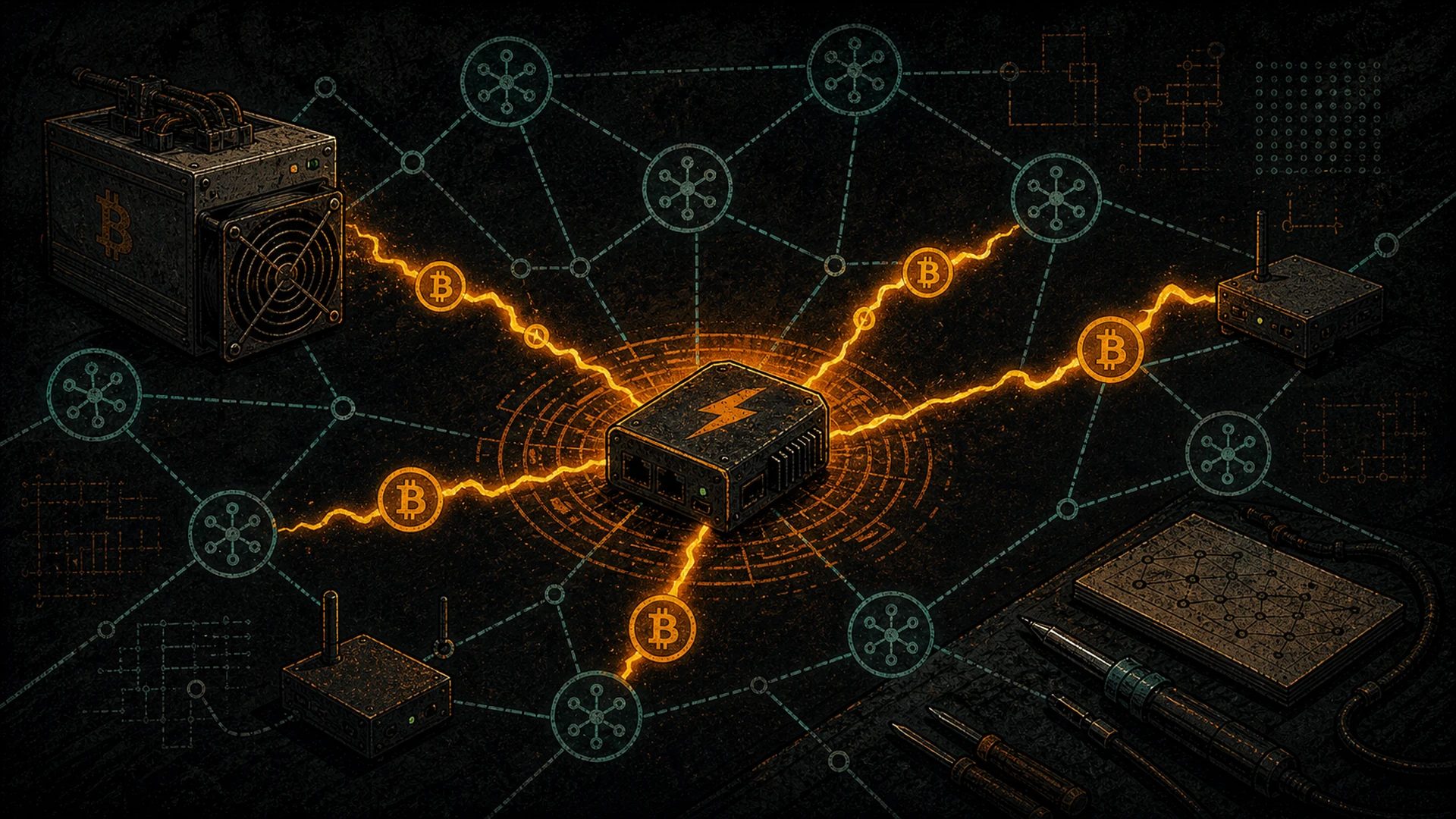
If you mine Bitcoin, you already generate sats from thin air and an electricity bill. Zaps are the most direct, KYC-free, platform-free way to route those sats back into culture — to pay the writers, the podcasters, the client developers, the relay operators, and the plebs whose posts move the conversation.
It works in the other direction too. If you write about mining, teach mining, open-source mining tooling, or host mining infrastructure, zaps are revenue. No ad network. No Patreon. A Lightning address in your profile and decent notes are the whole funnel.
This is why the Nostr primitives fit so cleanly next to the mining stack. Same key type. Same sovereignty thesis. Same incentive — make the rails honest and the rest follows.
Where to go from here
- If you have not yet generated a Nostr identity, start with Nostr for Bitcoiners.
- If you want your zaps to land in a relay you control, run your own Nostr relay.
- For the wider thesis, the Pleb’s Sovereign Stack Manifesto frames why identity + money + energy belong on the same side of the line, and the Sovereignty hub is the live map.
Post a good note. Turn on your Lightning address. See what happens.
The sovereign stack: own every layer
Sovereignty is layered: Bitcoin for money, a local LLM for intelligence, mesh for connectivity, Nostr for identity, and your own power. Each piece is one more layer no single actor can switch off.