Quick answer
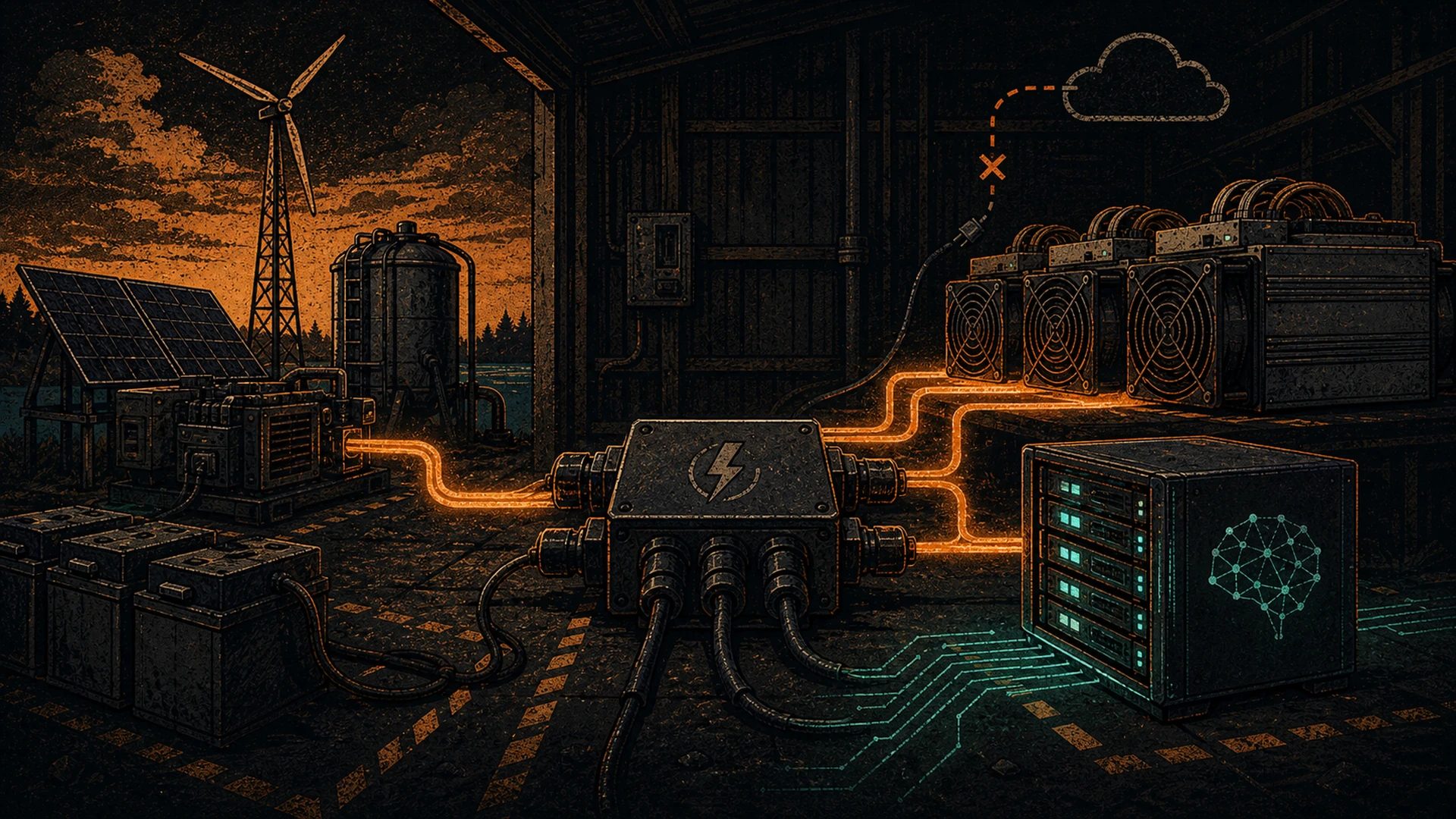
For a decade Bitcoin miners turned stranded power — flared gas, spilled hydro, overproduced solar — into value, because a miner is a perfectly interruptible, location-agnostic load that ramps in seconds and needs only a network connection. Local AI compute wants those same scraps, so the off-grid energy playbook miners already wrote becomes the foundation for a sovereign-compute rig.
For more than a decade, Bitcoiners have been doing something the rest of the energy world is only now waking up to: turning power that nobody else could use into something valuable. Gas flared off at a remote wellhead. Hydro spilling over a dam at 3 a.m. when demand is zero. A solar array that overproduces every sunny afternoon. That energy used to be wasted, vented, or curtailed. Miners showed up with a machine that says yes to electrons anytime, anywhere, and built a quiet industry on the scraps.
Now there’s a second machine that wants those same scraps: local AI compute. The interesting part isn’t that AI is hungry for power — everyone knows that. It’s that the off-grid energy playbook Bitcoiners already wrote turns out to be the foundation for running your own AI rig too. Same stranded power. Same intermittency problem. Same hard-nosed honesty about economics. If you’ve built energy sovereignty for mining, you’ve already done most of the work for sovereign compute.
This is the energy layer of the sovereignty stack — and it’s worth being honest about what works, what doesn’t, and where the marketing gets ahead of the physics.
Why Stranded Energy and Bitcoin Already Works
The reason stranded-energy mining took off isn’t ideology — it’s a property of the load. A Bitcoin miner is a perfectly interruptible, location-agnostic buyer of electricity. It doesn’t care where the power comes from, it can ramp up or shut off in seconds, and it needs nothing but a network connection (and not even a fast one). That makes it the ideal customer for energy that has no other home.
- Flared gas: Oil wells often produce gas with no pipeline to carry it. Flaring burns it off as waste. Routing that gas to a generator that powers miners turns a vented liability into hashrate — and burns methane more completely than an open flare would.
- Curtailed renewables: Wind and solar farms regularly produce more than the grid can absorb, so operators are paid to not generate. A miner soaks up that surplus instead of letting it evaporate.
- Stranded hydro and remote sites: Small hydro, geothermal, and remote installations frequently sit far from population centers. Mining monetizes them without needing transmission lines that would cost more than the project.
This is where Bitcoin earns its reputation as the “buyer of last resort” for power — the interruptible base load that makes otherwise marginal energy projects pencil out. None of this is theoretical, and none of it was invented by us. The flared-gas pioneers, the off-grid homesteaders, and the renewable operators who first plugged a miner into spilled electrons did the hard, unglamorous work of proving it. We’re standing on their shoulders. If you want the full home-scale build, our off-grid Bitcoin mining guide walks through power, connectivity, and independence end to end — this post is about what comes next on that same foundation.
The Energy Layer of the Sovereignty Stack
Think of self-sovereignty as a stack, each layer resting on the one below it:
- Own your money — Bitcoin, self-custodied, no permission required.
- Own your compute — local AI models you run yourself instead of renting from a cloud that reads your prompts.
- Own your firmware — the code on your hardware, transparent and yours to control.
- Own your energy — the electrons that power all of the above.
Energy is the bottom of the stack because nothing above it runs without power. You can hold your own keys and run your own models, but if your power comes from a single grid connection that can be cut, throttled, or priced out of reach, your sovereignty has a fragile foundation. Off-grid energy is what makes the rest durable. It’s the layer the whole sovereignty stack stands on.
And here’s the leverage point: the same off-grid energy build serves multiple loads. The generator, the solar array, the battery bank, the inverter, the breaker panel — that infrastructure doesn’t know or care whether it’s feeding a Bitcoin miner or a GPU running a language model. Build the energy layer once, and you can stack compute on top of it.
Adding AI Compute to an Off-Grid Site (Honestly)
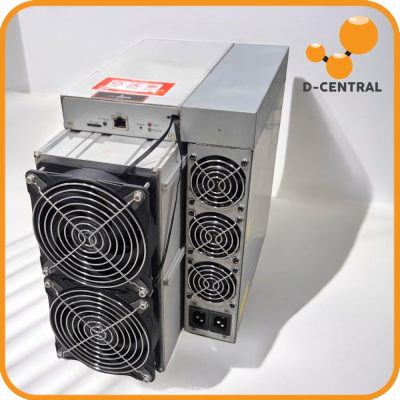
Now the part where honesty matters most, because this is where bad content goes off the rails. Your Bitcoin ASIC cannot run AI. Full stop. A SHA-256 ASIC — the BM1368 in an S21, the BM1370 in an S21 Pro — is fixed-function silicon. It does exactly one thing: compute SHA-256 double hashes as fast and efficiently as physically possible. It has no general-purpose math units, no floating-point pipeline, no way to run a neural network. It is the opposite of a GPU. We dig into this in detail in Can You Actually Run AI on a Bitcoin Miner?, and the answer there is the same answer here: no, and anyone telling you otherwise is selling something.
So when we say “add AI compute to an off-grid site,” we mean adding a separate GPU box — a machine with one or more graphics cards (or a purpose-built inference accelerator) that runs your models. What’s shared is the energy infrastructure, not the silicon:
- The miner keeps doing SHA-256 on its ASICs — interruptible, always-hungry, your base load.
- The GPU box runs inference (and maybe light fine-tuning) when you actually need a model — bursty, on-demand, your variable load.
- The power system — generation, storage, distribution — feeds both. Build it once, run two workloads.
This is the “own your compute” layer made physical. A self-hosted model on your own GPU, powered by your own energy, answering only to you — no cloud bill, no terms of service, no logging of your prompts to someone else’s server. That’s sovereign compute, and the off-grid energy build is what makes it possible somewhere a utility connection never reaches.
Intermittency Is the Real Problem
Here’s the catch that the off-grid dream glosses over: stranded and renewable energy is intermittent. The sun sets. The wind drops. The flared-gas well’s output fluctuates. A naive setup that runs your loads only when power is abundant means your AI rig — and your miner — sit idle whenever the source dips. That’s wasted capital and a terrible experience.
There are two honest tools for dealing with intermittency, and they work together:
1. Storage smooths the curve
Batteries (and at larger scale, other storage) bank surplus energy when generation is high and release it when generation drops. Storage is what lets a GPU box — which generally wants steady, reliable power for a clean inference session — run on a source that wobbles. But storage is expensive, finite, and degrades over time. It’s a real cost, not a free fix, and oversizing it is one of the fastest ways to torch an off-grid budget.
2. Bitcoin mining is the shock absorber
This is the elegant part. Because a miner is perfectly interruptible, it can act as a flexible base load that soaks up whatever’s left over. When the sun is blazing and the batteries are full, point everything you’ve got at the miner — it’ll happily convert surplus electrons to sats. When clouds roll in and power gets tight, throttle or pause the miner first and prioritize the battery, the household, and the GPU job you actually care about right now. The miner becomes a dump load with a paycheck — it monetizes surplus and protects your priority loads by yielding power on demand.
That dynamic — Bitcoin as the interruptible base load that absorbs volatility — is exactly why mining and off-grid energy fit together so well. Bolt AI compute onto the same system and the miner keeps doing the same job: it’s the buffer that makes intermittent power usable for everything else.
What This Looks Like at Pleb Scale
You don’t need an oil field. The same logic scales down to a cabin, a homestead, or a determined backyard. A pleb-scale version might look like:
- Generation: a solar array sized to your roof or land, optionally paired with a small wind turbine or a generator for the dark stretches.
- Storage: a battery bank big enough to carry your priority loads through the night and the cloudy days — sized honestly, not aspirationally.
- Base load: a Bitcoin miner that eats surplus whenever there’s surplus, and steps aside when there isn’t. Older or efficiency-tuned units double as heat in winter, which is its own off-grid superpower.
- Compute: a modest GPU box that runs a self-hosted model on demand, powered by stored energy so it doesn’t care that a cloud passed overhead.
The point isn’t to run a Hashcenter in your garage. It’s that one well-built energy layer can carry your household, monetize its own surplus through mining, and host the compute that keeps your data and your models under your own roof. That’s a lot of sovereignty from a single power system.
Honest Economics (No ROI Promises)
We’re not going to hand you a payback table, because anyone who does is guessing. Off-grid energy economics depend on too many things that are specific to you: your sun and wind, your hardware costs, your local fuel prices, the difficulty and price of Bitcoin, how much you value not depending on a utility, and how much your AI compute is actually worth to you in dollars you’d otherwise pay a cloud.
What we’ll say honestly:
- Off-grid builds carry real upfront capital — panels, batteries, inverters, the works. There’s no scenario where this is free.
- Mining surplus energy improves the economics of an off-grid build, but it does not guarantee a profit or a payback date. Bitcoin’s price and difficulty move, and so does your output.
- The value of sovereign compute is partly non-financial: privacy, resilience, and not handing your prompts to a third party. Price that how you will.
- The cheapest energy is energy that would otherwise be wasted. The closer your build leans on genuine surplus, the better the math — but “better math” is not the same as “guaranteed return.”
Build for resilience and sovereignty first, and treat the sats and the compute as the dividend on infrastructure you wanted anyway. That’s the honest frame.
Frequently Asked Questions
Can my Bitcoin miner also run AI?
No. A Bitcoin miner uses fixed-function SHA-256 ASICs that can only compute Bitcoin hashes — they have no general-purpose or floating-point math, so they cannot run neural networks. AI inference and training run on GPUs (or dedicated accelerators), which is entirely different silicon. What an off-grid site shares between mining and AI is the energy infrastructure, not the chips. You add a separate GPU box for compute.
Why pair Bitcoin mining with off-grid AI at all?
Because the miner solves the intermittency problem. A GPU job wants steady power on demand; renewable and stranded energy is bursty and unpredictable. A Bitcoin miner is perfectly interruptible, so it can soak up surplus when there’s plenty and step aside when power is tight — acting as a flexible base load that monetizes excess energy and protects your priority loads. It’s the shock absorber that makes intermittent power practical for everything else on site.
Is off-grid mining and AI profitable?
We don’t make ROI or payback promises, and you should distrust anyone who does. Off-grid builds have real upfront costs, and returns depend on your specific energy resource, hardware prices, Bitcoin’s price and difficulty, and how much you value self-hosted compute. Mining surplus energy can improve the economics, but it doesn’t guarantee a profit. Build for resilience and sovereignty first; treat sats and compute as the dividend.
What is stranded or curtailed energy?
Stranded energy is power that can’t reach a market — gas flared at a remote well, hydro or geothermal far from transmission lines, or a remote site with no grid connection. Curtailed energy is renewable generation the grid can’t absorb, so operators are paid to switch it off. Both are wasted by default. Bitcoin miners — and, on the same infrastructure, an AI compute box — can monetize that otherwise-lost energy on site.
Do I need a huge setup to do this?
No. The same principles scale down to a cabin or homestead: a solar array, an honestly-sized battery bank, a Bitcoin miner as the surplus-eating base load (which doubles as winter heat), and a modest GPU box for self-hosted AI. The goal isn’t to run a Hashcenter in your garage — it’s one well-built energy layer that powers your household, mints sats from its own surplus, and keeps your compute under your own roof.
The Bottom Line
Bitcoiners proved you can build an economy on energy nobody else wanted. That same off-grid playbook — generation, storage, and an interruptible base load that turns surplus into sats — is the foundation for sovereign compute too. Own your energy, and the layers above it (your money, your models, your firmware) finally have something solid to stand on. Be honest about the intermittency, never promise a payback date, and let Bitcoin do what it does best: absorb the volatility so everything else can run.
If you’re ready to build the hardware layer of all this, our shop stocks the miners that make excellent off-grid base loads — and our sovereignty hub ties the whole stack together, from money to compute to energy.
Explore the decentralized stack
Mining is one layer of owning your own infrastructure. The same energy, hardware, and sovereignty thinking extends to AI, compute, communications, and identity.