No — a Bitcoin ASIC miner cannot run AI. ASICs are fixed-function SHA-256 chips with no general-purpose compute, so they physically cannot execute AI models. What transfers from Bitcoin mining to AI is the operator’s edge — the power, cooling, and Hashcenter infrastructure — which a GPU-based system then uses to run local AI inference.
It is the question every miner asks the moment the AI gold rush hits the headlines: GPUs that used to mine Ethereum now print money renting out tokens, hyperscalers are paying any price for compute, and you are sitting on a rack of Antminers that suddenly feel like yesterday’s hardware. So the natural thought follows: can you repurpose an ASIC miner for AI? Can you flash something onto an S19 and have it run a language model overnight?
The short answer (TL;DR)
No. A Bitcoin SHA-256 ASIC cannot run AI inference, and no firmware can change that. The chips are fixed-function silicon: they are wired to do exactly one math operation (double SHA-256) and nothing else. AI inference needs general-purpose floating-point math (FP16/BF16, tensor cores, and gigabytes of VRAM) that the ASIC physically does not have. What the famous “mining-to-AI pivot” actually reuses is the power, the cooling, and the real estate around the miners, never the mining chips themselves. The inference always runs on a GPU or CPU you own next to the miner, not on the ASIC. So a retired ASIC is not worthless either: it is still a paid-for Bitcoin printer, a space heater, and one more decentralization unit on the network.
That is the honest answer, and the rest of this piece walks through exactly why, because the internet is full of breathless takes that blur the line between an ASIC and a GPU until the difference disappears. We are Bitcoin mining hackers; we repair what the industry throws away and we read the silicon datasheets. So let us be precise.
What a SHA-256 ASIC physically is
ASIC stands for Application-Specific Integrated Circuit. The “application-specific” part is the whole story. A CPU is a generalist that can run any program. A GPU is a massively parallel generalist tuned for math. A Bitcoin ASIC is the opposite of a generalist: it is a chip etched in silicon to compute one function, the SHA-256 hash, over and over, billions of times per second, and it can do literally nothing else.
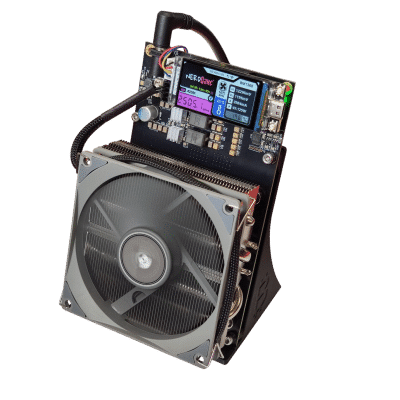
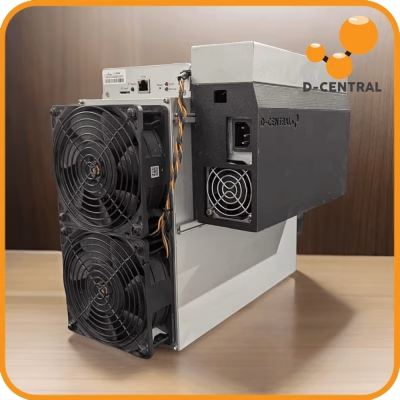
Take a concrete example. The Antminer S9, the workhorse that defined home-scale mining, carries 189 BM1387 chips across three hashboards (63 chips per board). Each BM1387 is a sea of identical hashing cores. There is no instruction decoder waiting to run your code, no floating-point unit, no register file you can repurpose. The chip wakes up, receives a block header and a range of nonces to try, grinds SHA-256 across that range, and reports back if it found a hash below the target. The control board, an embedded Linux system on a Xilinx Zynq with a dual ARM Cortex-A9 running at 667 MHz, just feeds work to the hashing chips and talks to the pool. That little ARM core is general-purpose, but it is a weak microcontroller-class processor; it could not run a modern AI model if you begged it.
This is why ASICs are so brutally efficient at mining and so useless at everything else. The hardware designers stripped out everything that was not SHA-256 to win on joules-per-terahash. That trade-off is permanent. You cannot “unlock” general compute that was never fabricated into the die. Newer chips like the BM1368 in the S21 follow the same logic, just smaller and more efficient; fixed-function is fixed-function regardless of generation.
What AI inference actually needs
Running a language model, an image generator, or any neural network is a fundamentally different kind of math from hashing. Hashing is integer bit-shuffling. Inference is linear algebra at scale: enormous matrix multiplications over floating-point numbers. To do that, the hardware needs a specific toolkit that an ASIC simply does not contain:
- Floating-point math units (FP16/BF16/FP8). Neural networks are trained and run in floating-point or quantized floating-point formats. A SHA-256 ASIC has no floating-point hardware at all.
- Tensor cores or equivalent matrix engines. Modern GPUs ship dedicated units that multiply small matrices in a single operation. That is the beating heart of inference. ASICs have hashing cores instead, and hashing cores cannot multiply matrices.
- Large, fast VRAM. Even a modest 7-billion-parameter model needs several gigabytes of memory just to hold its weights, and bigger models need far more. GPUs pair their compute with high-bandwidth VRAM measured in gigabytes. A mining ASIC has a few hundred bytes of working state per core and no addressable model memory whatsoever.
- A flexible programming model (CUDA, ROCm, Metal, Vulkan). You point a framework like PyTorch or llama.cpp at the device and it schedules arbitrary operations. There is no programming interface to a hashing core; it only does SHA-256.
So when you read “repurpose your miner for AI,” translate it in your head to “buy a GPU.” Inference runs on GPUs (and to a lesser extent CPUs and Apple silicon) because those chips have the floating-point matrix hardware and the memory. The ASIC and the GPU are not interchangeable any more than a diesel locomotive engine is interchangeable with an aircraft turbine just because both burn fuel.
What the “mining-to-AI pivot” actually reuses
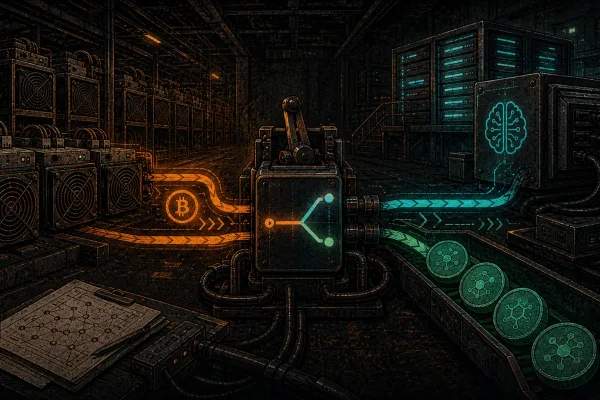
Here is where the confusion comes from. The headlines are real: big mining companies are pivoting toward AI. But read the fine print and you will see they are not running GPT on their S19s. They are gutting the mining rigs and installing GPU servers in the same buildings. What carries over is the infrastructure, not the chips:
- Power. A mining site already has the hardest thing to get in the modern grid: a fat interconnect and a signed power contract for megawatts of cheap electricity. AI compute centers are bottlenecked on exactly this. The substation stays; the load behind it changes.
- Cooling. Whether you are dumping heat from ASICs or from GPUs, you need the same air handling, immersion tanks, or hydro loops. The thermal plumbing transfers directly.
- Real estate and racking. Industrial shells, racks, networking, and the operations team are already in place. Swapping mining boards for GPU boards is a hardware refresh, not a new build.
That is the entire pivot. Power, cooling, and real estate get reused; the SHA-256 silicon gets retired or resold. This is the accuracy wall worth tattooing on your forearm: the ASIC chips never become AI chips. We covered the corporate version of this reality, and why miners chasing the AI hype is mostly a story about energy infrastructure rather than silicon, in our deeper piece on GPU mining, AI rentals, and why Bitcoin miners should think hard before chasing the AI hype (post 54947).
So what CAN you do with a “dead” ASIC?
The reflex to call an older ASIC “dead” or “worthless” is wrong, and it is the kind of thinking that funnels good hardware into landfills. A miner that no longer pencils out for a 30-megawatt industrial farm at industrial electricity rates is often still genuinely useful in the right hands. Here is the honest menu:
- Keep mining at home. An industrial farm chasing razor-thin margins thinks differently than a home miner who pays residential rates, captures the heat, and values a non-KYC sat over a perfect efficiency number. The same S19 that is “uneconomic” in a warehouse can be a sensible appliance in a basement, especially undervolted. The economics depend heavily on your power cost, so run the numbers honestly before you buy.
- Turn it into a space heater that pays you back. An ASIC converts essentially all the electricity it draws into heat, which is exactly what a resistive space heater does, except the ASIC also earns Bitcoin while warming the room. We dig into the thermodynamics, the noise, and the heat-reuse math in our guide to the best Bitcoin mining heaters and in our look at heating with inference vs. heating with hashing (post 82863). One detail matters for the AI comparison: an ASIC runs constant and hot, while a GPU doing inference is bursty and idles cold, so they heat a room very differently.
- Run it as a decentralization unit. Every honest hashrate pointed at a non-custodial pool is one more voice in Bitcoin’s security. A retired S9 contributing to a decentralized pool is doing real work for the network’s resilience, even if it never tops a profit leaderboard. This is the “backups” mindset: Bitcoin is the backup to fiat, and your independent hashrate is a backup to mining centralization.
- Learn and tinker on it. The S9 in particular, with its well-documented BM1387 chip and Zynq control board, is the most-studied ASIC in existence and the perfect bench unit for understanding how these machines actually work.
If you are shopping the crash-era market, you can find used ASICs and refurbished hardware in our shop, and the same place is where you would pick up a refurbished GPU if you want to build the AI side properly. We are not Amazon and we do not promise overnight shipping; we are hand-built, build-to-order Bitcoin mining hackers who repair what the industry discards, and lead times are estimates, not guarantees.
The pleb’s version: a mixed Bitcoin + AI Hashcenter
Here is the part that actually excites us, because it takes the corporate pivot and hands it to the individual. You do not have to choose between Bitcoin and AI. You can run both, side by side, in the same room, on the same power and cooling, and own all of it. We call that a Hashcenter: a facility (even a basement-sized one) that does both Bitcoin mining and AI compute, each on the hardware it belongs on.
The division of labor is clean once you stop expecting the ASIC to do AI:
- The ASIC hashes Bitcoin and throws off constant heat.
- A GPU you own runs your local AI (your private model on a tool like Ollama), and you keep your prompts and data on your own hardware instead of renting surveilled, metered intelligence from a hyperscaler.
- The same circuit, the same cooling, the same room serve both, exactly the way the big miners reuse their infrastructure, just at a sovereign scale.
That is the whole sovereignty thesis in one sentence: own your money, and own your compute. Local AI on your own GPU is the backup to rented intelligence the same way Bitcoin is the backup to fiat. If that resonates, our Bitcoin × AI hub maps out the sovereign-compute side, our sovereignty hub ties the whole “backups” stack together, and the leaderboards track the real GPU and model landscape if you want to size the AI half of the room.
DCENT_OS is D-Central Technologies’ GPL-3.0 open-source Bitcoin mining firmware for selected Bitmain Antminer ASIC miners. Guarded artifacts exist only for exact S9 XIL and S19j Pro XIL lanes; install evidence is incomplete and neither is production-ready. Check the exact evidence ledger.
Frequently asked questions
Can you repurpose an ASIC miner for AI?
No. A SHA-256 ASIC is fixed-function silicon that can only compute Bitcoin hashes; it has no floating-point units, no tensor cores, and no VRAM, so it physically cannot run AI inference. The “mining-to-AI pivot” you read about reuses the power, cooling, and real estate of a mining site, while the actual AI runs on GPUs that replace the miners. No firmware can convert the ASIC’s hashing chips into AI accelerators.
Can custom firmware make my Antminer run AI?
No. Firmware controls how the ASIC mines (voltage per power domain, frequency, fan curves, pool settings), but it cannot add hardware that was never fabricated into the chip. There is no floating-point or matrix-multiply hardware in a BM1387 or BM1368 for firmware to expose. Open-source firmware like DCENT_OS gives you ownership and control over the mining behavior, not new compute capabilities.
Why are mining companies “pivoting to AI” then?
Because they own the scarcest resources in AI: cheap power contracts, cooling, and racked real estate. They are removing the mining rigs and installing GPU servers in the same buildings. The infrastructure transfers; the SHA-256 chips do not. The mining ASICs get retired or resold, not converted.
What hardware do I actually need to run AI at home?
A GPU with enough VRAM for your chosen model (often 8–24 GB for local language models), or capable CPU/Apple-silicon for smaller models, plus software like Ollama or llama.cpp. You keep the miner for Bitcoin and add a GPU for AI; they live side by side rather than one replacing the other.
Is an old ASIC worthless once it can’t compete?
No. It is still a paid-for Bitcoin miner that can earn sats at home (especially undervolted at low residential power rates), a space heater that pays you back instead of just burning electricity, and a decentralization unit adding honest hashrate to the network. “Uneconomic for a warehouse” is not the same as “worthless to a home miner.”
Can I run both Bitcoin mining and AI in the same place?
Yes, and that is the pleb-scale version of the corporate pivot. Run your ASIC for Bitcoin and a GPU for local AI on the same power and cooling, a mixed Hashcenter you fully own. The ASIC hashes, the GPU infers, and you keep both your money and your compute sovereign.
Explore the decentralized stack
Mining is one layer of owning your own infrastructure. The same energy, hardware, and sovereignty thinking extends to AI, compute, communications, and identity.