Walk into one of the megawatt-scale Hashcenters that powered Bitcoin’s last cycle and, increasingly, you will not hear the wall of ASIC fans anymore. You will hear GPUs. Across 2025 and into 2026, a long list of publicly-traded Bitcoin miners — Core Scientific, IREN, TeraWulf, Cipher, Hut 8, CleanSpark and others — announced that part or most of their facilities are being converted to artificial-intelligence and high-performance compute. The headlines call it “abandoning mining.” We think that framing misses what is actually moving, and who actually wins.
TL;DR — A “Hashcenter → AI” conversion reuses the infrastructure — power capacity, substations, cooling, real estate — not the mining hardware. A SHA-256 ASIC cannot run AI; that silicon is fixed-function and gets resold or retired, not repurposed. The second-order effect is a flood of used ASICs onto the secondary market and a price crash. That is not a funeral — it is the cheapest hardware-buying window the home miner has ever seen, and it pushes hashrate out of corporate Hashcenters and into homes. Open firmware like DCENT_OS exists so that the hardware landing in those homes stays genuinely yours. Decentralization gains one more layer.
What a “Hashcenter → AI” conversion actually is
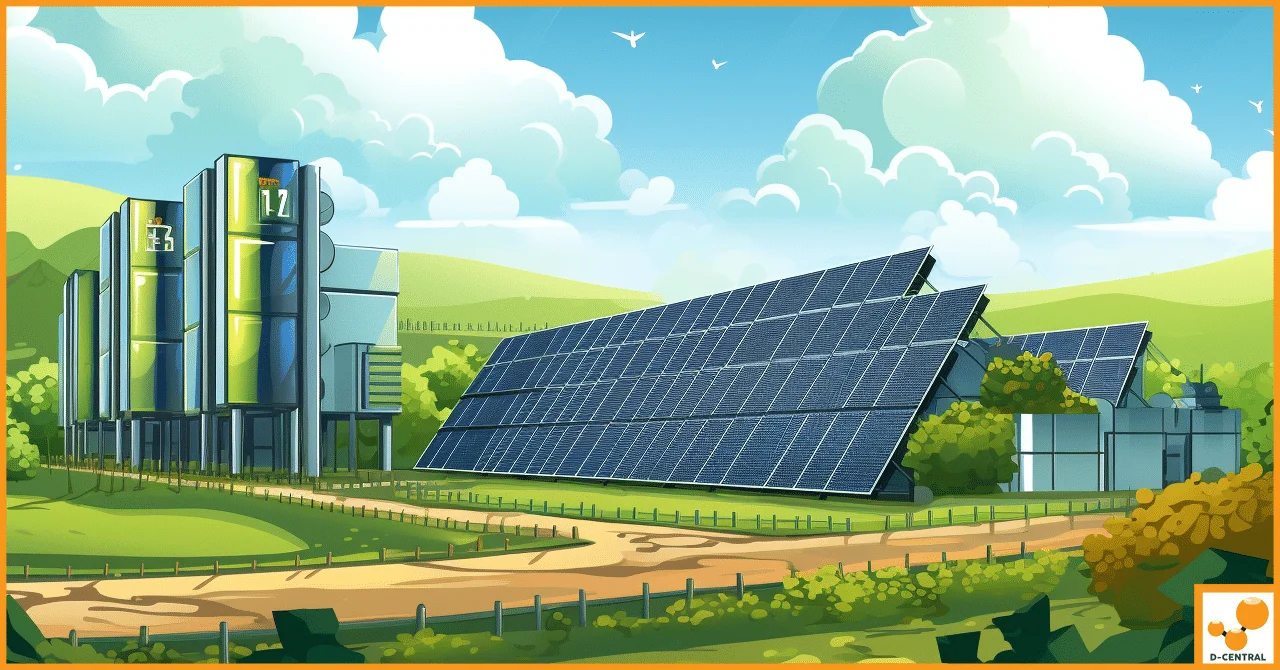
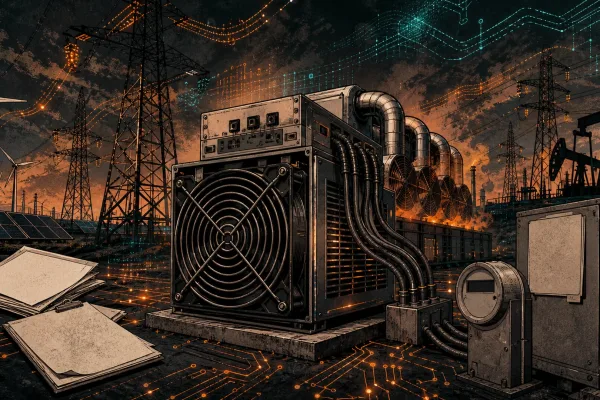
Start with the word. We say “Hashcenter,” not “data center,” on purpose — a Bitcoin Hashcenter is purpose-built around one job: pull enormous, cheap, interruptible power and turn it into hashes. That design constraint is exactly why these sites are attractive to AI operators. The hard part of standing up large-scale compute is almost never the chips. It is the grid interconnect, the substation, the transformers, the switchgear, the cooling, the permits, and the land. A mature Hashcenter already has all of it.
So a conversion is, mechanically, a change of tenant inside the same shell. The building keeps its power contract and its physical plant. What changes is what gets racked inside: out come the hashboards, in go GPU servers. The mining operation does not “upgrade” into an AI operation. It vacates, and a different kind of compute moves into the space the mining paid to build.
That distinction is the whole story, so it is worth being precise about what transfers and what does not.
What physically transfers (infrastructure) vs what doesn’t (ASIC silicon ≠ AI silicon)
Here is the part most coverage gets wrong. A Bitcoin mining ASIC and an AI accelerator are not interchangeable, and no amount of firmware makes them so.
A SHA-256 ASIC — the BM1398 in an S19, the BM1368 in an S21, the BM1370 in an S21 Pro — is a fixed-function chip. Its transistors are laid out to do exactly one thing: compute SHA-256 double-hashes as fast and as efficiently as physics allows. There is no general-purpose instruction set, no large matrix-multiply units, no high-bandwidth memory, no room to load a neural network. An AI accelerator is the opposite kind of chip: massively parallel floating-point and tensor math, fed by gigabytes of fast memory. You cannot “reflash” an S21 into an inference card any more than you can reflash a calculator into a laptop. We walk through exactly why in our honest breakdown of whether you can run AI on a Bitcoin miner — the short version is that the ASIC can’t, though a GPU you put in the same room obviously can.
So when a Hashcenter converts, sort the assets into two piles:
| Transfers to AI use | Does NOT transfer |
|---|---|
| Grid interconnect & power purchase agreement | SHA-256 ASIC chips (BM1398 / BM1366 / BM1368 / BM1370) |
| Substation, transformers, switchgear | Hashboards and their control boards |
| Building shell, racks, real estate, permits | Miner PSUs (tuned for ASIC voltage rails) |
| Cooling loops (air, immersion, hydro) — often re-engineered | The mining-specific monitoring/pool software stack |
| Network backhaul, security, on-site staff | The mining operation’s hashrate itself |
The left column is the expensive, slow, permission-heavy stuff — and it is genuinely reusable, which is why the pivot pencils out. The right column is the mining silicon, and it has exactly one destiny when a site converts: it leaves. It gets crated up and sold, redeployed to a cheaper-power site, or retired. None of it becomes an AI box. That single fact is what drives everything that follows.
Why the economics push this now
The pivot is not a referendum on whether Bitcoin mining “works.” It is a rational response to a specific spreadsheet that only large public companies are forced to optimize.
A shareholder-accountable miner earns volatile, spot-priced block rewards. After a halving compresses the subsidy, and through the brutal stretches where price lags difficulty, the per-coin cost of production can drift above the coin’s market price for months. Meanwhile, AI and HPC tenants are offering multi-year, fixed-rate compute and power contracts — predictable revenue a CFO can underwrite a bond against. Faced with “volatile reward we can’t forecast” versus “stable contract we can,” a public company with quarterly earnings calls will lean toward the contract almost every time. Industry analysts reporting through early-to-mid 2026 have described a large share of listed-miner revenue migrating toward AI/HPC and tens of billions in announced AI compute contracts (figures as reported by sector analysts; treat as directional, not gospel).
That logic is real, and it is specific to corporations. It does not say mining is dead. It says that, for a public balance sheet, a guaranteed AI tenant beats a coin-flip on the next block-reward cycle. The home miner has a completely different cost structure — sunk hardware, a power bill, and conviction — and that spreadsheet leads somewhere else entirely.
The second-order effect: a used-ASIC price crash
Now connect the two facts. Conversions push fleets of working ASICs off the network. Those machines do not vaporize — they hit the secondary market, all at once, from many operators at the same time, for the same reason. Supply spikes; demand among the remaining large buyers is muted because the big buyers are the ones selling. Price falls. That is not speculation about the future; it is the basic mechanics of a market absorbing a wave of forced sellers.
The hardware that floods in is not junk, either. A lot of it is previous-generation but perfectly functional gear — S19-class machines and their variants — that was profitable inside a Hashcenter buying power at industrial rates, and simply stopped being the best use of that company’s capital. For a home operator with a different power situation (a heated workshop in winter, an off-peak rate, a hot-water loop), the same machine can still make sense. We dug into the timing and the catch in our piece on why the hardware price crash is the plebs’ buying window — including the honest caveats about efficiency, noise, and power cost that decide whether a cheap miner is a deal or a space heater you regret.
To be clear about what we are and are not saying: cheap acquisition cost is not a profit guarantee. Whether a discounted S19 earns its keep depends entirely on your electricity rate, your heat use, and the network difficulty when you plug it in. We do not publish ROI promises, and you should be suspicious of anyone who does. The point here is narrower and more durable: the conversions are putting capable mining hardware within reach of ordinary people at prices the industrial era never offered.
Why that’s good for decentralization (the hardware goes home)
Decentralization is a ratio, not a headcount — a measure of how concentrated hashrate is, and how few hands could collude. For most of the last cycle the ratio moved the wrong way: capital piled into mega-Hashcenters, and the lone home miner’s slice shrank toward a rounding error.
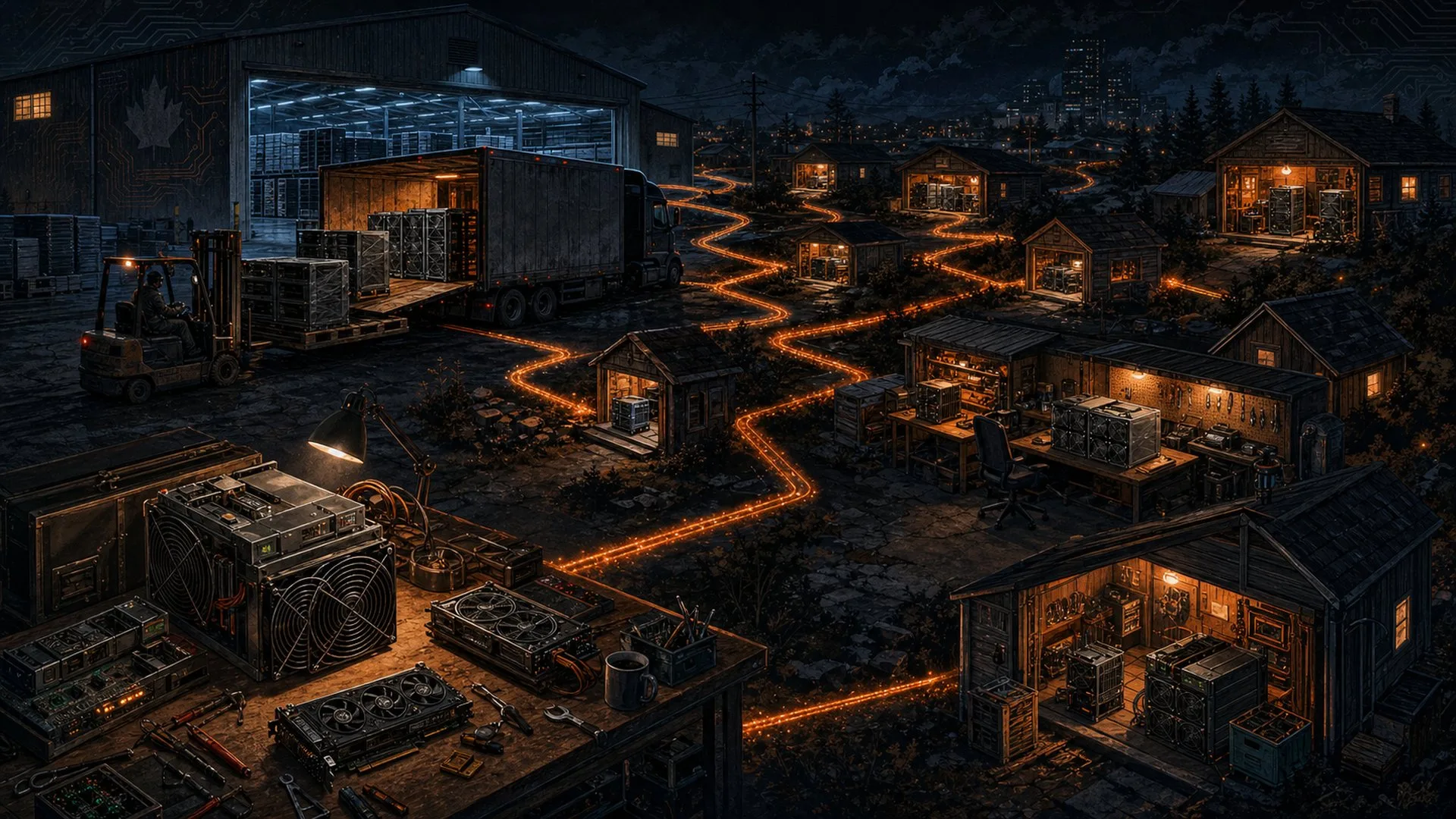
The Hashcenter migration quietly pushes the ratio back. Two things happen at once. Concentrated corporate hashrate voluntarily leaves the network, so the few-largest-hands share drops. And the machines that leave those sites scatter — into garages, workshops, basements, and small collectives — landing with operators who mine because they believe in it, not because a contract pencils out this quarter. Hashrate dispersing from a handful of industrial campuses into thousands of homes is, almost by definition, a more decentralized network. We made the full case for why this is a win rather than a wake in our companion piece: when the corporations leave Bitcoin mining for AI, decentralization wins.
This is the pattern we keep coming back to: every shift that takes a layer of the stack out of a few corporate hands and puts it in yours is one more layer decentralized. Cheap hardware in homes is a hardware-layer win. But hardware alone is not sovereignty — the firmware running on it matters just as much.
Where DCENT_OS fits (powering the home hardware)
A miner that lands in your home on stock firmware is still partly someone else’s machine: locked-down management, opaque telemetry, and a vendor’s idea of what you are allowed to change. The decentralization gain is real at the hardware layer, but it is not complete until the software is yours too. That is the gap DCENT_OS is being built to close — open firmware so a home operator actually controls the machine they own, on their terms.
DCENT_OS is D-Central Technologies’ GPL-3.0 open-source Bitcoin mining firmware for selected Bitmain Antminer ASIC miners. Guarded artifacts exist only for exact S9 XIL and S19j Pro XIL lanes; install evidence is incomplete and neither is production-ready. Check the exact evidence ledger.
If you want to be part of that wave, the refurbished hardware in our shop is exactly the kind of secondary-market gear this migration is producing — tested, documented, and pointed at home operators rather than industrial campuses. And if self-custody of your stack is the bigger thread you are pulling, our sovereignty hub follows it from hardware all the way to the rest of your sovereign toolkit.
The bottom line
The corporations leaving for AI are not taking Bitcoin’s security with them. They are taking their buildings in a new direction and leaving the machines behind. The infrastructure transfers; the silicon doesn’t. What gets left on the table is a generation of mining hardware, cheaper than it has ever been, looking for a home — and Bitcoin’s foundational bet is that homes are exactly where it belongs. That is not the end of the story. It is the part where the plebs get their turn.
Frequently asked questions
Can a Bitcoin Hashcenter just convert its miners to run AI?
No. The miners themselves cannot run AI — a SHA-256 ASIC is a fixed-function chip with no general-purpose compute, no tensor units, and no high-bandwidth memory to hold a model. A conversion reuses the facility: power capacity, substation, cooling, and real estate. The ASICs are pulled out and replaced with GPU servers, then resold or retired. “Converting a Hashcenter to AI” means changing the tenant inside the building, not upgrading the mining chips.
What actually transfers when a mining facility repurposes to AI compute?
The expensive, slow-to-build infrastructure: the grid interconnect and power contract, transformers and switchgear, the building and racks, cooling systems (often re-engineered for denser GPU heat), network backhaul, security, and staff. What does not transfer is the mining-specific gear — the ASIC hashboards, their PSUs, and the pool/monitoring software. That hardware leaves the site entirely.
Why are large miners pivoting to AI now?
It is a balance-sheet decision specific to public companies. Block rewards are volatile and spot-priced; AI and HPC tenants offer multi-year fixed-rate contracts. After a halving compresses the subsidy, a CFO accountable to shareholders will often prefer predictable compute revenue over a bet on the next mining cycle. It is a rational corporate choice — and it says little about whether an individual with sunk hardware and cheap or useful-heat power should keep mining.
Does the used-ASIC price crash mean home mining is finally profitable?
It means hardware is far cheaper to acquire, which lowers the barrier to entry — but cheap acquisition is not profit. Whether a discounted miner earns its keep depends on your electricity rate, whether you use the heat it produces, the machine’s efficiency, and network difficulty when you switch it on. We do not make ROI promises. Treat low purchase price as a buying window, then do your own honest math on running cost.
How is this good for Bitcoin instead of bad?
Because decentralization is about how dispersed hashrate is. When concentrated corporate operators leave and their machines scatter into homes and small collectives, control over hashrate spreads out rather than consolidating. Bitcoin’s difficulty adjustment absorbs the departing capacity automatically, and the remaining network is held by more hands in more places. The migration is one more layer of the stack moving from a few corporations to the many — which is the direction Bitcoin was built to go.
Explore the decentralized stack
Mining is one layer of owning your own infrastructure. The same energy, hardware, and sovereignty thinking extends to AI, compute, communications, and identity.