
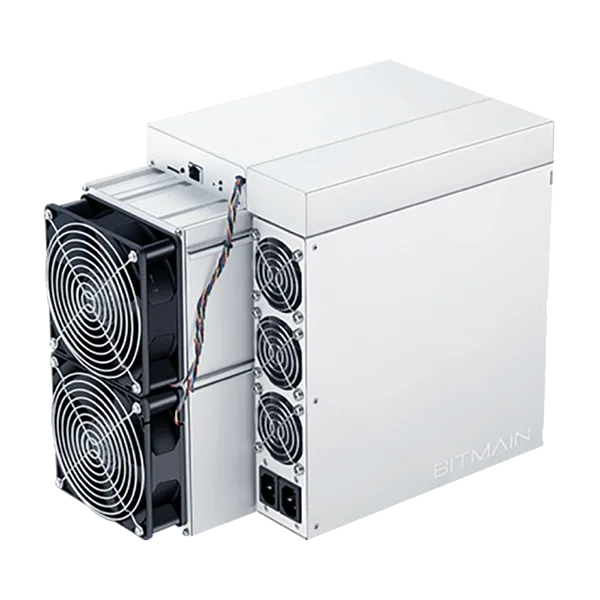
Bitmain Antminer HS3
Quick answer
The Bitmain Antminer HS3 is a Blake2b+sha3 miner rated about 9 TH/s at roughly 2,079 W. An industrial-class unit — loud and power-hungry, best suited to a dedicated mining space, not living areas.
Professional-Grade Miner
This miner draws 2,079W and produces 75+ dB of noise — it is designed for dedicated mining environments, not living spaces. Professional-grade miners deliver the highest hashrate and revenue per unit but require proper infrastructure: a 240V circuit, adequate ventilation or exhaust ducting, and a space where noise is not a concern (garage, basement, warehouse, or outdoor enclosure).
For home miners looking for a quieter alternative, consider our Bitcoin Space Heater builds or explore open-source miners like the Bitaxe that are purpose-built for residential environments.
Heater-Class Miner
At 2,079W, this miner outputs approximately 7094 BTU/hr of heat — equivalent to a standard electric space heater. Every watt consumed by an ASIC miner is converted to heat with 100% efficiency, making it a space heater that also mines Bitcoin.
During heating season, miner heat can offset part of the heat a room would otherwise need from another electric heater. The economics depend on your electricity rate, room heat demand, BTC price, network difficulty, and noise constraints.
Profitability Calculator
| Period | Revenue | Electricity Cost | Profit |
|---|---|---|---|
| Daily | $0.29 | $3.49 | $-3.20 |
| Weekly | $2.03 | $24.45 | $-22.42 |
| Monthly | $8.69 | $104.78 | $-96.09 |
| Yearly | $105.78 | $1,274.84 | $-1,169.07 |
Heating offset estimates the value of heat replacing an electric space heater during heating season (~6 months/year in Canada). Actual savings depend on your heating setup and climate.
Where to Buy the Bitmain Antminer HS3
D-Central Technologies is a Bitcoin-only company. For this miner, check out our trusted partner retailers below.
ASIC Miner Market
United StatesWide selection of new and used ASIC miners. US-based shipping.
Shop NowPartner links may earn D-Central a commission at no extra cost to you. Have you considered Bitcoin mining instead? Explore Bitcoin miners →
Full Specifications
| Model | Bitmain Antminer HS3 |
|---|---|
| Model Number | Antminer HS3 |
| Manufacturer | Bitmain |
| Algorithm | Blake2b+sha3 |
| Coins Mined | Unknown |
| Hashrate | 9 TH/s |
| Power Consumption | 2,079 W |
| Efficiency | 231 J/TH |
| Dimensions | 430 x 195.5 x 290mm |
| Weight | 16.1 |
| BTU Output | 7094 BTU/hr |
| Equivalent Heater | Equal to a 2,079W space heater |
| Daily Power Cost | $3.49/day |
| Monthly Power Cost | $104.78/mo |
| Circuit Requirement | 240V circuit required |
| Release Date | 2022-12-01 |
| MSRP | $900.00 |
| Status | Active |
Home Mining Assessment
The Bitmain Antminer HS3 is a single-algorithm ASIC built to mine Handshake (HNS), which uses a Blake2b + SHA3 proof-of-work that is unrelated to Bitcoin’s SHA-256. It is rated at roughly 9 TH/s drawing about 2,079 W at the wall, or near 231 J/TH on the Handshake algorithm. It launched in late 2022.
Because the HS3 is purpose-built for one coin, the most useful thing we can do here is separate what Bitmain documents from what it doesn’t, ground every claim we can, and stay honest about the rest. D-Central has been repairing Bitmain hardware in Montreal since 2016, including the wider 2021–2022 altcoin chassis the HS3 belongs to, so the platform-level detail below comes from the bench, not a spec sheet.
Chip and hashboard architecture
Handshake’s proof-of-work hashes block headers with a Blake2b + SHA3 construction rather than the double-SHA-256 used by Bitcoin. That single fact dictates everything about the HS3: its silicon is laid out for Blake2b/SHA3 rounds, not SHA-256 message scheduling, so the chip cannot be repointed at a Bitcoin pool no matter what firmware you load. It is a one-coin machine by design.
Bitmain has never published the HS3’s ASIC part number the way it documents its SHA-256 line (BM1397, BM1398, BM1362, BM1366, BM1368, BM1370). We will not assign it an unverified SKU. What we can say from the chassis is structural: the HS3 uses Bitmain’s standard multi-hashboard layout from that generation, with the Handshake ASICs strung in series chains across each board and a single control board orchestrating the work. The unit measures roughly 430 × 195.5 × 290 mm and weighs about 16.1 kg — the same dual-tube, server-style enclosure Bitmain shipped across its 2021–2022 altcoin range.
The control board belongs to the same family Bitmain used for that altcoin generation. Its closest documented sibling, the Scrypt-based Antminer L7, runs a Xilinx Zynq-class control board driving its hashboards over UART chains — the same architectural pattern (CPU to FPGA UART FIFOs to series-connected ASICs) seen across Bitmain’s Zynq-era machines. The HS3 sits in that same lineage. One detail that is constant across this whole platform and worth stating plainly: voltage is regulated per power domain on the hashboard, not per individual chip. On-board DC-DC conversion steps the PSU rail down to the domains that feed groups of ASICs; there is no per-chip voltage knob on this hardware.
Real-world power and efficiency
The HS3’s nameplate is about 2,079 W for roughly 9 TH/s, which works out to near 231 J/TH. The important caveat — the one most spec aggregators get wrong — is that this J/TH figure only compares against other Handshake-algorithm miners. A terahash of Blake2b + SHA3 is a completely different unit of work than a terahash of Bitcoin SHA-256, so it is meaningless to line the HS3’s 231 J/TH up against a modern Bitcoin miner’s mid-teens J/TH and call it “inefficient.” Within its own algorithm, judge it on HNS earned per kilowatt-hour, not on a number borrowed from the Bitcoin world.
Expect real wall draw to track the nameplate closely and to climb with intake temperature and PSU losses. Power comes from Bitmain’s APW12 (1417) supply — the 14–17 V, 233 A, ~3,600 W-class unit shared with the L7, K7, DR7 and KA3. That PSU is roughly 93–95% efficient but carries a hard requirement: it needs a 200–240 V circuit and will not run on standard North-American 120 V. Plan for a 240 V outlet (typically a NEMA 6-15/6-20 or L6-class connection) before the machine arrives.
On tuning headroom, be realistic. Our ASIC power-profile work — undervolting, frequency curves and J/TH optimization — lives on third-party firmware that targets SHA-256 (and Scrypt) hardware. None of it runs on the HS3, so in practice the machine operates at its factory operating point with no community autotuner to pull efficiency down. Any efficiency claim you see for an HS3 should be read as “near stock,” because stock is effectively the only mode available.
Firmware compatibility
This is where buyers most often get caught, so we will be blunt. The HS3 runs Bitmain’s stock cgminer-based firmware, and for practical purposes that is the only firmware it runs.
- BraiinsOS+ targets Bitmain SHA-256 machines and is the only firmware that natively speaks Stratum V2 — but it does not support Handshake silicon.
- VNish and LuxOS cover SHA-256 (and, for VNish, Scrypt L7-class hardware), not Blake2b + SHA3.
- DCENT_OS, our own firmware effort, is built for SHA-256 Bitcoin ASICs. It is not a fit for the HS3, and we are not going to pretend otherwise.
The reason is the same one from the architecture section: third-party firmware contains algorithm-specific hashing drivers, and nobody in the open-source or commercial firmware ecosystem has written a Handshake stack for this chip. So features Bitcoin miners take for granted — Stratum V2, runtime autotuning, granular per-domain undervolting profiles — are simply not on the table here. You configure the HS3’s pool, frequency and fan behavior through Bitmain’s stock web UI, and that is your toolkit.
Common faults and troubleshooting
The HS3 fails the way its whole chassis generation fails, so the diagnostic playbook is familiar even though the algorithm is exotic. The most common categories we see on the bench:
- Hashboard / chain faults — “zero ASIC found,” an open chain, or a board that reports a fraction of expected chips. Heat-cycling cracks solder joints and kills individual ASICs; one dead chip can drop or zero an entire series chain.
- Hashrate that reads low or jumps around — usually a marginal chip, a cold solder joint, or a chain communicating below its target baud.
- PSU faults — the APW12 (1417) can fail to start, trip under load, or read the wrong output voltage. Because it demands 200–240 V, under-voltage feeds and bad outlets cause a surprising share of “dead miner” calls.
- Fan and thermal errors — a failed fan or a flaky temperature sensor will throttle or shut the unit down to protect the boards.
- Control-board / boot issues — corrupted firmware or a tired storage device can leave the unit unreachable on the network.
Work the problem methodically rather than swapping parts blind. Our ASIC fault finder walks the symptom-to-cause path for this hardware class, and the same hashboard, PSU, fan and control-board logic that applies to the S19 and L7 applies here. The catch is parts: Handshake-specific ASICs are not stocked the way Bitcoin chips are, so chip-level board repair on an HS3 is a more specialized job than on a mainstream SHA-256 machine.
Repair and longevity
An HS3 is worth keeping alive as long as Handshake mining pays, and that is a repair question more than a replacement question — there is no newer, dramatically more efficient Handshake box waiting to make it obsolete. D-Central repairs Bitmain ASICs, including the 2021–2022 altcoin chassis the HS3 shares with the L7, KA3 and DR7. That means hashboard-level diagnostics, PSU testing and repair on the APW12 family, fan and sensor replacement, and control-board recovery.
Practical longevity advice is the same craft we apply to every Bitmain machine: give it clean 240 V power, keep intake air cool and dust-free, run it in a space where its server-grade fans (loud by living-room standards) are not a problem, and address a failing fan or a single weak chip early before heat takes the whole board with it. Treated that way, this chassis generation routinely runs for years.
Who it is for and buying notes
The HS3 is for someone who specifically wants exposure to Handshake and has done the math on HNS price, network difficulty and their own power cost — ideally on cheap or surplus electricity. Two constraints decide whether it makes sense:
- It is single-coin. If Handshake stops being profitable, the HS3 cannot pivot to Bitcoin, Litecoin or anything else; its silicon only does Blake2b + SHA3. That concentration risk is the single most important thing to understand before buying.
- It needs real infrastructure. 240 V power and a tolerance for ~2 kW of loud heat output rule out a quiet apartment. In a garage, workshop or small heated outbuilding it doubles as a roughly 7,094 BTU/h heater — useful, but a side benefit, not the reason to buy.
If your real goal is to mine Bitcoin or to learn ASIC mining on hardware with a deep firmware and parts ecosystem, the HS3 is the wrong tool, and we will steer you to a SHA-256 machine in our ASIC miner catalog instead. If Handshake is genuinely what you want, buy with eyes open on the points above — and know that we can keep the machine running when a board or PSU eventually needs attention.
Generational context
The HS3 is one member of Bitmain’s 2021–2022 “altcoin lineup,” a set of machines that all share the same server chassis, cooling design and the APW12 (1417) power supply but carry different, algorithm-specific ASICs:
| Model | Algorithm | Primary coin(s) | Shared platform |
|---|---|---|---|
| Antminer HS3 | Blake2b + SHA3 | Handshake (HNS) | APW12 (1417) PSU, 2021–2022 chassis |
| Antminer L7 | Scrypt | Litecoin / Dogecoin (merge-mined) | APW12 (1417) PSU, Xilinx Zynq control board |
| Antminer KA3 | Blake2S / Kadena PoW | Kadena (KDA) | APW12 (1417) PSU, 2021–2022 chassis |
| Antminer K7 | Eaglesong | Nervos (CKB) | APW12 (1417) PSU, 2021–2022 chassis |
| Antminer DR7 | Blake256R14 | Decred (DCR) | APW12 (1417) PSU, 2021–2022 chassis |
That shared lineage is good news for serviceability: the power supply, fans, connectors and control-board architecture are common across the family, even though each model’s hashing silicon is unique. Where the HS3 differs from its better-known siblings is the depth of its ecosystem — the L7 enjoys mature third-party firmware and a steady parts supply because Scrypt is a large market, while Handshake’s niche means the HS3 lives almost entirely on stock firmware and depends on specialist repair to stay in service. Going in with that understanding is what separates a productive HNS rig from an expensive paperweight.
Antminer HS3 at a glance
| Specification | Value |
|---|---|
| Manufacturer | Bitmain |
| Algorithm | Blake2b + SHA3 (Handshake PoW) |
| Coin mined | Handshake (HNS) |
| Hashrate (nameplate) | ~9 TH/s |
| Power draw (nameplate) | ~2,079 W |
| Efficiency | ~231 J/TH (Handshake algorithm only) |
| Heat output | ~7,094 BTU/h |
| Power supply | Bitmain APW12 (1417), 14–17 V / 233 A, ~3,600 W class |
| Input voltage | 200–240 V required (no 120 V operation) |
| Dimensions | 430 × 195.5 × 290 mm |
| Weight | ~16.1 kg |
| Released | Late 2022 |
| Stock firmware | Bitmain cgminer (no supported third-party firmware) |
Specifications reflect Bitmain’s published nameplate figures and platform-level detail verified against D-Central’s repair experience with this chassis family. Where Bitmain has not documented a number — such as the exact ASIC part — we have deliberately left it qualitative rather than guess.
Broken miner? Get a real quote.
Tell us the symptom and get an instant repair-tier estimate ($95 / $145 / $195 CAD). Mail-in from across Canada, bench in Montreal, Quebec.
Send it to D-Central — start a repair →Recommended parts and tools
Confirm symptoms against the guide, then route to the exact part, tool, or repair workflow that matches the miner family.
Related Miners
Hummer Miner Mars H1
Goldshell HS BOX II
Goldshell HS6 SE

Goldshell HS6
Frequently Asked Questions
What are the current mining economics for the Bitmain Antminer HS3?
At $0.07/kWh, the Bitmain Antminer HS3 currently shows an estimated daily net cost of $3.20 before pool fees and hardware cost. Lower electricity rates, network changes, BTC price changes, or useful heat recovery can change the result.
Can I mine Bitcoin at home with the Bitmain Antminer HS3?
The Bitmain Antminer HS3 has a home mining score of 11/100. With 0 dB noise and 2,079W power draw, it may require a dedicated space like a garage, basement, or outdoor enclosure. Consider noise insulation and proper ventilation.
Can the Bitmain Antminer HS3 heat my home?
The Bitmain Antminer HS3 outputs approximately 7094 BTU/hr of heat. For reference, a typical space heater produces 5,000-5,500 BTU/hr. All electrical energy consumed by the miner is converted to heat, making it 100% efficient as a heater. D-Central offers Bitcoin Space Heater builds designed specifically for home heating integration.
What power supply does the Bitmain Antminer HS3 need?
The Bitmain Antminer HS3 draws 2,079W of power. You need a power supply rated for at least 2,287W with appropriate voltage (200-240V AC). D-Central stocks compatible power supplies in our shop. Always use a quality PSU from a reputable manufacturer to protect the miner and wiring.