
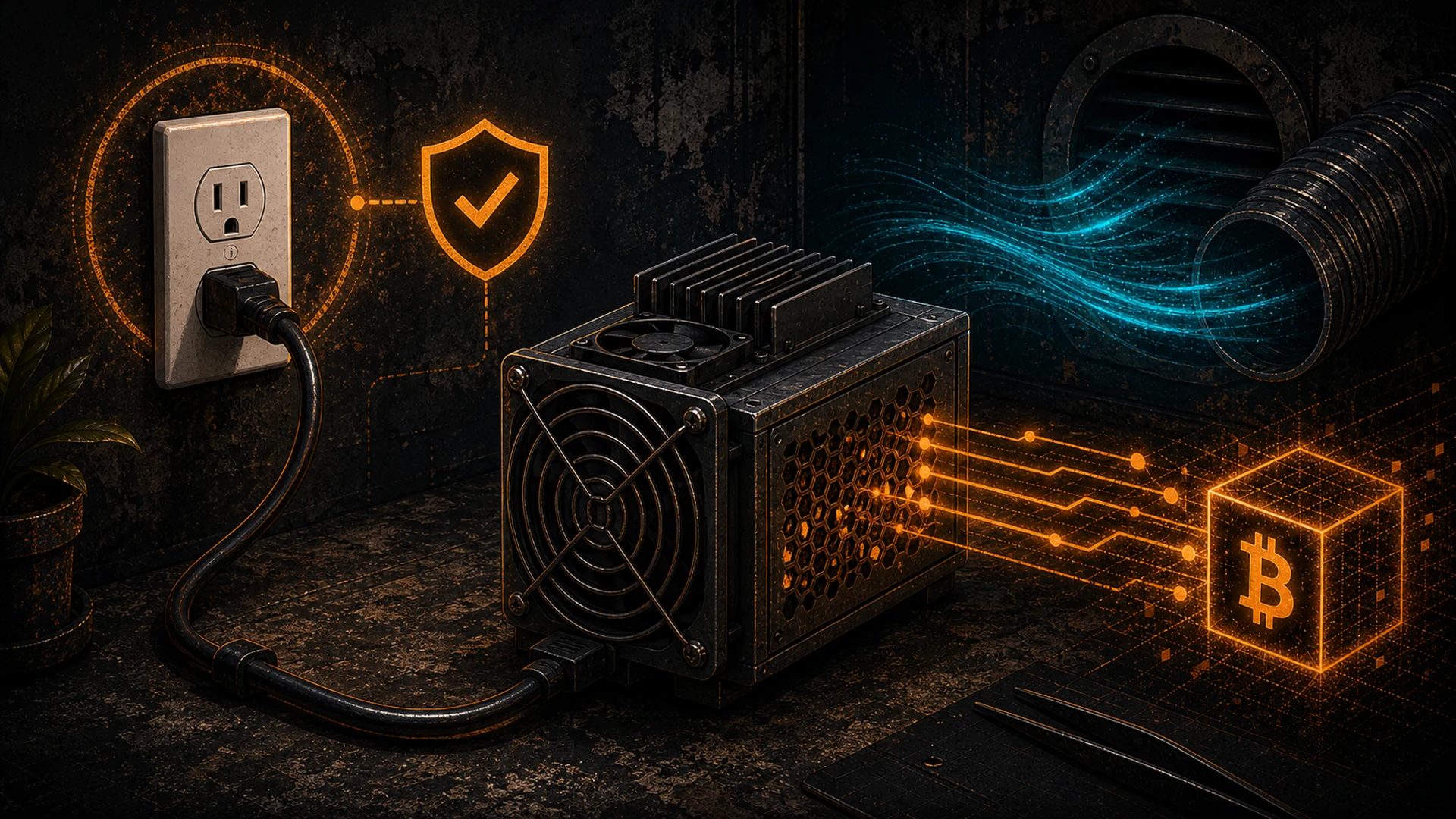
Commercial-interest and safety disclosure: D-Central sells mining equipment and services and has a financial interest in home-mining decisions. This educational checklist is not an independent electrical, fire, building, insurance, product, or financial assessment. It does not approve any equipment or installation. The exact manufacturer manual and nameplate, the local authority having jurisdiction, and a Licensed Electrical Contractor or locally authorized equivalent control every circuit, service, load, wiring, protection, permit, inspection, and energization decision. Do not open a panel, expose energized parts, alter wiring, or rely on a webpage to perform electrical work.
Purpose: collect traceable equipment and site evidence, identify conditions that stop the project, and hand a complete record to the qualified people who decide whether work may proceed. This is a readiness document, not a calculation or wiring guide.
Stop gates before energization
Do not energize or continue operating when any item below is present. Keep people away from smoke, fire, exposed energized parts, or suspected shock hazards and use emergency services where appropriate.
- The exact manufacturer manual, nameplate, equipment revision, or power-supply identity is missing or inconsistent.
- The supply, branch circuit, shared loads, receptacle, cord, connector, grounding, bonding, or protective devices have not been documented and accepted by the Licensed Electrical Contractor.
- Required permits, inspections, landlord approval, utility review, insurance notice, or local-authority decisions are unknown or incomplete.
- A plug, cord, receptacle, adapter, power strip, enclosure, or electrical panel is damaged, loose, altered, discoloured, unusually warm, buzzing, sparking, smoking, or producing an unusual odour.
- A protective device operates repeatedly, the equipment reports an electrical or thermal alarm, fans are unavailable, or emergency isolation is inaccessible.
- There is water, condensation, conductive dust, corrosion, blocked airflow, unstable mounting, combustible exposure, or an unapproved temporary connection.
- A software setting, label, seller statement, or previous installation is being used as a substitute for the exact approved hardware configuration and local assessment.
Four-stage readiness workflow
- 1. Collect.
Copy exact nameplate and manual evidence without guessing. - 2. Refer.
Give the record to the local authority and Licensed Electrical Contractor. - 3. Resolve.
Complete documented work, permits, inspection, and stop-gate closure. - 4. Handoff.
Use a signed commissioning and operating record before energization.
Do not advance a stage on verbal reassurance alone. Record the responsible person, revision, date, conditions, and supporting document for each decision.
User-supplied equipment nameplate worksheet
Photograph the complete nameplate and copy its wording. Use a separate sheet for each miner, power supply, fan system, controller, transformer, or other powered component. Do not combine ratings from different revisions.
| Evidence field | User-supplied record | Source and verification |
|---|---|---|
| Manufacturer; exact model; hardware revision | Nameplate photo identifier and verbatim text | |
| Serial number and power-supply model | Equipment and power-supply labels | |
| Input voltage range and frequency | Exact manual revision, page, and nameplate | |
| Maximum input current and rated input power | Copy values and units; do not calculate missing values | |
| Required cord, plug, connector, orientation, and supply conditions | Manufacturer instructions and approved accessories | |
| Certification or listing marks shown | Photograph only; the local authority determines acceptance | |
| Operating profile and duty schedule requested | Document the intended configuration; do not treat it as approval | |
| Ambient, altitude, humidity, clearance, and contamination limits | Exact manual sections and proposed location evidence | |
| Manual title, revision, publication date, URL, and retrieved copy hash | Retain the reviewed manual with the project record |
Items reserved for the local authority and Licensed Electrical Contractor
The user records observations and documents. The qualified reviewer determines capacity and compliance. Leave unknown fields marked unknown; do not inspect energized equipment or infer hidden wiring.
| Decision area | Evidence the qualified reviewer should document | Status |
|---|---|---|
| Service and load capacity | Applicable load evaluation, existing demand, utility or service constraints, and assumptions under the locally adopted rules | Not reviewed / accepted with conditions / rejected |
| Branch circuit and shared loads | Circuit identity, conductors and wiring method, overcurrent protection, connected loads, correction factors, and suitability for the proposed duty | |
| Connection equipment | Receptacle, plug, cord, connector, disconnecting means, enclosure, strain relief, and compatibility with the exact nameplate and manual | |
| Protection and environment | Grounding, bonding, shock and arc-fault protection where applicable, moisture, dust, temperature, ventilation, clearances, and fire separation | |
| Authority and permit path | Applicable jurisdiction, adopted code edition and amendments, permit number, inspection stage, approval conditions, and other required parties | |
| Commissioning authorization | Who may energize, test plan, instruments, acceptable readings, monitoring period, emergency isolation, stop criteria, and final sign-off |
Qualified sign-off: reviewer name, company, licence or authorization, jurisdiction, scope, date, signature, conditions, permit or inspection reference, and next review trigger.
Site and operating evidence
| Boundary | Evidence to collect | Escalation question |
|---|---|---|
| Heat and airflow | Manufacturer limits, proposed intake and exhaust path, room use, seasonal conditions, alarms, and shutdown ownership | Has the heat and ventilation plan been accepted without relying on miner operation as required heating? |
| Fire and physical layout | Clearances, mounting, combustibles, egress, smoke or fire detection, emergency access, and local fire requirements | Which authority reviews the location and emergency plan? |
| Noise and occupancy | Manufacturer sound information, occupied spaces, neighbours, local rules, and hearing-risk assessment where applicable | Does the proposed location require a different operational control? |
| Dust, moisture, and corrosion | Visible conditions, cleaning boundaries, condensation risk, filter or maintenance requirements, and inspection interval | Do the exact equipment instructions permit this environment? |
| Network and monitoring | Network ownership, firmware source, access control, alert routing, log retention, and outage response | Who receives alarms and has authority to stop operation? |
Use the existing heat-reuse evidence workbook to document heat boundaries without treating electrical input as a fixed assumption. After the electrical decision is complete, the ASIC commissioning feasibility guide can structure the wider handoff, and the preventive maintenance checklist can own routine inspections. None replaces the local electrical review.
Commissioning and incident handoff
- Attach the accepted nameplate worksheet, exact manual, drawings, permits, inspection records, and qualified sign-off.
- Name the person authorized to energize and the people who may operate or isolate the equipment.
- Record the approved startup sequence and measurements exactly as provided by the manufacturer and Licensed Electrical Contractor.
- Define alarm routing, observation period, emergency contacts, safe isolation method, and conditions that prohibit re-energization.
- After any equipment, firmware, power supply, connection, location, duty, circuit, or code change, return the project to qualified review.
Incident rule: smoke, flame, shock, arcing, sparking, repeated protective-device operation, damaged connections, abnormal heat, or an electrical odour ends the checklist. Prioritize people, call emergency services when warranted, and do not touch or re-energize suspect equipment until the qualified authority clears it.
Documented evidence pack
| Record | Minimum identification | Owner and review trigger |
|---|---|---|
| Nameplate and equipment photos | Device, revision, serial, power supply, connectors, date, and photographer | Replace after any equipment or component change |
| Manufacturer documentation | Title, revision, publication date, source URL, retrieved copy, and reviewed pages | Recheck on firmware, hardware, or manual revision |
| Electrical assessment | Exact scope, site, circuit, assumptions, licence, date, conditions, and signature | Reopen on load, location, connection, service, or code change |
| Authority records | Jurisdiction, adopted requirements, permit, inspection, approval, and conditions | Recheck when scope or local requirements change |
| Commissioning and operations | Authorized people, readings, alarms, stop events, maintenance findings, and incident actions | Review after alarms, damage, protective operation, or maintenance findings |
Primary safety sources and revision record
Reviewed 2026-08-29. These sources establish safety and jurisdictional boundaries; they do not approve a miner, circuit, or installation. Local adoption and amendments, the exact equipment instructions, and the qualified site assessment remain controlling.
- Canadian Centre for Occupational Health and Safety: Electrical Safety — Basic Information (fact sheet last revised 2025-03-26; Canada assigns electrical-safety law and enforcement by jurisdiction).
- NFPA 70, National Electrical Code official standard-development page (edition status viewed on the review date; the locally adopted edition and amendments control).
- U.S. Consumer Product Safety Commission: Home Electrical Safety Checklist.
- U.S. Consumer Product Safety Commission: Extension Cords guidance.
- User-supplied primary control: the exact manufacturer manual, nameplate, power-supply documentation, certification record, and locally approved project documents retained in the evidence pack.
Frequently asked questions
Can this checklist tell me whether a miner is safe on a particular outlet?
No. It organizes evidence for review. The exact equipment manual and nameplate, the existing installation, other loads, local code adoption, permits, and site conditions must be evaluated by the local authority and a Licensed Electrical Contractor or locally authorized equivalent.
Is a percentage shortcut enough to size a home mining load?
No. A percentage alone cannot establish circuit capacity or compliance. Continuous-load provisions, conductor and equipment ratings, shared loads, correction factors, local amendments, and manufacturer restrictions require a qualified local assessment.
Can I use an adapter, extension cord, power strip, or splitter?
Do not assume that any intermediary device is suitable. Stop until the exact arrangement is permitted by the equipment instructions and accepted for the site by the local authority and the Licensed Electrical Contractor. Makeshift or damaged connections are stop conditions.
What information should I copy from the equipment nameplate?
Record the manufacturer, exact model and revision, serial number, power-supply model, input voltage range, frequency, maximum input current, rated input power, connector and cord requirements, certification markings, and the matching manual revision and page. Copy the text; do not infer missing values.
Who decides whether a permit or inspection is required?
The authority having jurisdiction decides which rules, permits, inspections, and licensed work apply. The Licensed Electrical Contractor should document that determination for the exact address and scope before equipment is energized.
What should I do if a plug, cord, receptacle, or enclosure becomes warm, discoloured, damaged, noisy, or gives off an odour?
Stop operation without touching unsafe equipment, use the documented emergency isolation process if it can be done safely, and contact emergency services or the Licensed Electrical Contractor as the condition requires. Do not re-energize until the cause and affected equipment are cleared.
Can a firmware power target make an unsupported electrical arrangement acceptable?
No. A software setting does not change the input rating, power-supply approval, cord and connector requirements, branch-circuit capacity, protective devices, or local code obligations. Only the exact approved equipment configuration and qualified site review control.
When is the installation ready to energize?
Only after the manual and nameplate evidence are complete, the local authority and Licensed Electrical Contractor have completed all required review, work, permits, and inspection, and the signed commissioning plan defines authorized startup, monitoring, emergency isolation, and stop criteria.
