Something quietly changed in the last year. AI agents stopped being read-only assistants and started being able to pay for things. Metered APIs, paywalled data, premium model calls — a growing number of them settle in Bitcoin over the Lightning Network using machine-payable standards like L402 and x402. That is genuinely useful. An agent that can pay a few sats to fetch a dataset, unlock an endpoint, or buy an inference run is an agent that can actually finish a job without a human babysitting the checkout.
It is also the moment where a lot of self-custody discipline goes out the window. The instinct is to “just give the agent a wallet.” And because everything is software now, the path of least resistance is to point that agent at the wallet you already have — the one with your real stack in it. That is the single most expensive mistake a pleb can make in this new world. An autonomous agent that can spend is, by definition, code running on a machine you do not fully control, making decisions you did not individually approve, sometimes acting on inputs an attacker can influence. You would never hand that to a stranger. An agent is a stranger you wrote a reference for.
This is a protective guide, not an exploit manual. We are not going to walk through any specific attack. We are going to give you the generic self-custody rules — the same ethos that has kept Bitcoiners solvent since the cold-storage era — translated into the world of agents that hold spending power. Follow these and your agent stays useful and stays contained. The blast radius of a bad day becomes a rounding error instead of a wipeout.
Why this matters now: agents that pay
For most of computing history, “the program can spend money” meant a saved credit card and a fraud department on speed dial. Bitcoin and Lightning change the model in two directions at once. On the good side, micropayments finally work: an agent can pay fractions of a cent, instantly, without an account, which is exactly the granularity machine-to-machine commerce wants. On the sharp side, those payments are final and bearer-based. There is no chargeback, no “call the bank,” no clawback. Whoever holds the keys holds the money, and whoever can instruct the keys can move it.
Standards like L402 (an HTTP-native scheme that pairs a Lightning invoice with an access token) and x402 (a “402 Payment Required” flow for agentic spending) are what make this concrete. The agent hits an endpoint, gets told “pay this invoice,” pays it, and gets a token back to continue. It is elegant. It is also fully autonomous — the whole point is that no human is in the loop for each payment. So the security question is no longer “will the agent pay?” It is “what is the worst thing that happens if the agent is wrong, confused, or manipulated, and it keeps paying?”
Your answer to that question is decided in advance, by how you set up custody — not in the moment, by hoping the agent behaves. That is the whole game.
The golden rule: cold keys never touch the agent box
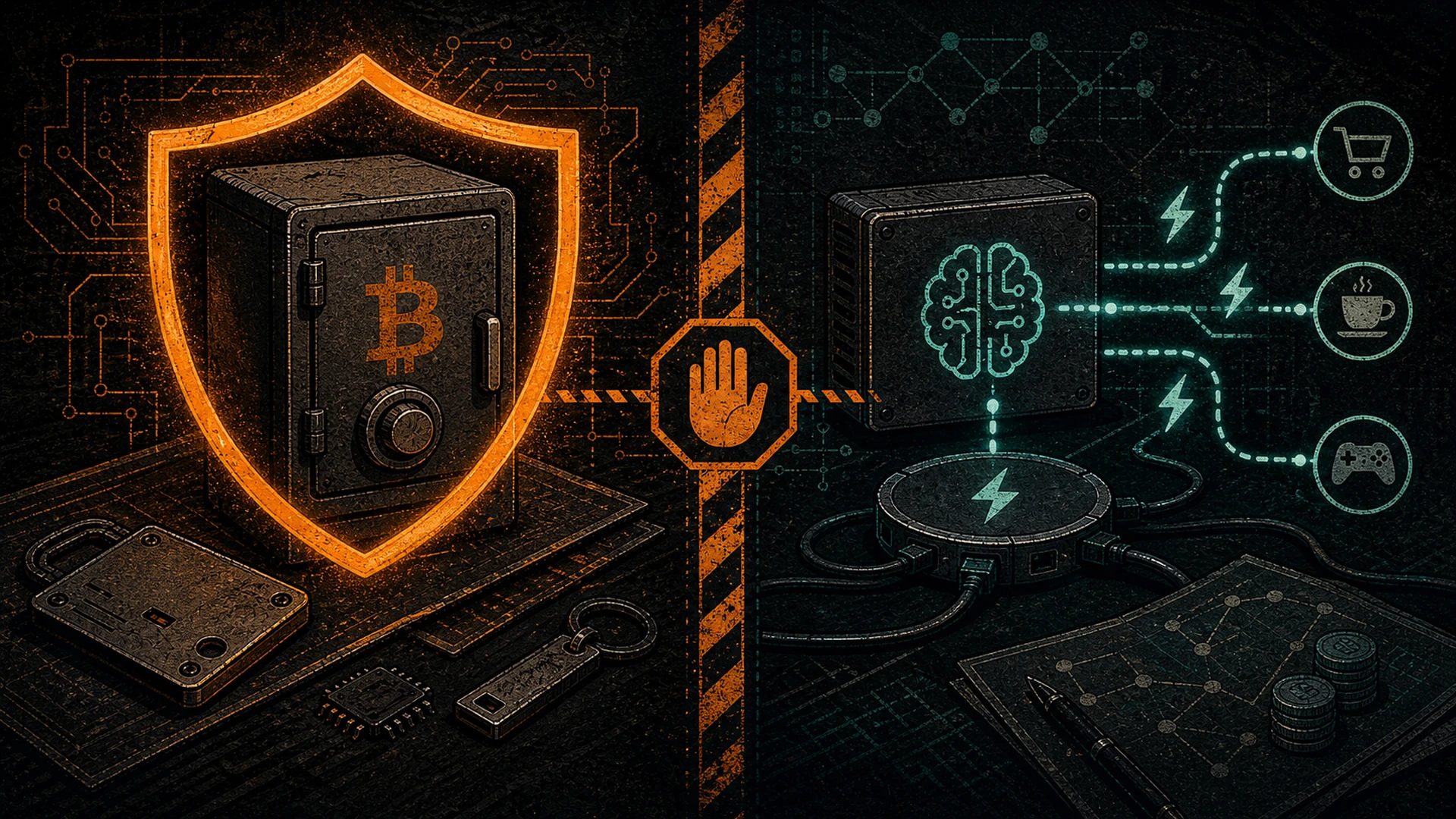
Here is the rule everything else hangs from. The seed phrase and private keys for your real savings must never exist on, near, or reachable by the machine running the agent. Not in an environment variable. Not in a config file. Not on a hardware signer plugged into that box. Not in a password manager the agent process can read. If a key can be reached by the code you are letting run autonomously, then for security purposes you have already spent it — you are just waiting to find out to whom.
Cold storage exists precisely because of moments like this. The whole virtue of an air-gapped or hardware-isolated key is that no amount of clever software on a hot machine can extract it. The instant you let convenience erode that boundary — “I’ll just keep the seed handy so the agent can top itself up” — you have converted cold storage into a hot wallet with extra steps, and you have given an autonomous process the keys to it.
So draw a hard line. Cold is cold. The agent lives entirely on the other side of that line and only ever interacts with a small, isolated, throwaway-grade hot wallet. If you remember nothing else from this article, remember that one sentence: an AI agent never gets your cold wallet. Full stop.
Hot-wallet isolation and a tiny float
An agent that pays needs some spendable balance. The discipline is to make that balance small, isolated, and refillable — never the whole pile. Think of it like the cash in your front pocket versus the safe at home. You walk around with what you are willing to lose to a pickpocket, and the safe stays bolted to the floor.
- A dedicated wallet, used for nothing else. Spin up a fresh Lightning wallet whose only job is to fund this agent. Don’t reuse your everyday spending wallet, and absolutely don’t reuse anything connected to savings. Separate keys mean a problem with the agent’s wallet stays inside the agent’s wallet.
- Fund it with a tiny float. Keep only what the agent plausibly needs for the next stretch of work — hours or a day, not a month. If the agent burns through a few thousand sats an hour, a small five-figure-sat balance is plenty. The float is a fuse, not a war chest.
- Refill on purpose, not on autopilot. Top the float up deliberately. A human (or a tightly scoped, separately governed top-up process) moves a known amount from cold into the hot float when it runs low. Never wire cold storage to auto-replenish a hot wallet on the agent’s request — that hands the agent an unlimited line of credit to your savings.
- Isolate the runtime. Run the agent and its wallet in their own container, VM, or dedicated box with the narrowest possible access. The less that process can see, the less an attacker who reaches it can take.
The mental model is simple: the agent should never be able to lose more than the float, because the float is the only thing it can touch.
Per-agent budgets and spending limits
A tiny float caps the absolute worst case. Spending limits shape the day-to-day. Even with only a small balance, you generally do not want an agent capable of draining all of it in one confused burst, so put real budget caps around it.
- One wallet, one agent. If you run several agents, give each its own isolated wallet and its own float. Shared wallets turn one compromised agent into everyone’s problem and make it impossible to tell who spent what. Per-agent separation is the same logic as per-service API keys.
- Cap the per-payment size. Set a maximum single payment that matches what legitimate work actually costs. If real tasks cost tens of sats, a single payment trying to push thousands is a signal, not a transaction.
- Cap the rate and the rolling total. Limits like “no more than X sats per hour” and “no more than Y sats per day” turn a runaway loop or a manipulated agent into a small, bounded, recoverable event instead of a silent drain.
- Require a human for anything unusual. Define a threshold above which the agent must stop and ask. Most agent frameworks and Lightning wallets support approval hooks or budget policies — use them. A pause-and-confirm step on large or odd payments is cheap insurance.
Budgets are not just anti-theft measures. They are also anti-stupidity measures. Agents get stuck in loops, misread instructions, and occasionally decide that paying the same endpoint two hundred times is a great idea. A daily cap protects your sats from honest bugs just as well as from bad actors.
Watch-only and alerts: see every sat move
Containment buys you a small blast radius. Visibility is how you find out a fuse blew before the agent calmly tries to relight it. The goal is simple: you should be able to see every payment the agent makes, and you should be told when something looks off — without ever exposing a spending key to do it.
- Monitor with watch-only access. Watch-only setups let you observe balances and activity using public keys alone — no spending capability attached. It is the canonical self-custody trick: full visibility, zero risk that the monitoring tool itself becomes an attack surface for moving funds.
- Alert on the float, not just the agent. Don’t rely solely on the agent’s own logs to tell you it behaved — a compromised agent will happily lie. Watch the wallet’s actual balance and payment stream independently, so the truth comes from the ledger, not the suspect.
- Set thresholds that mean something. Get pinged when the float drops faster than normal, when daily spend approaches the cap, or when a single payment exceeds your per-payment limit. Boring days produce no alerts; that is the point.
- Keep a clean audit trail. Log every payment with amount, destination, and the task that triggered it. When you do need to investigate, you want a timeline, not a guess.
Watch-only monitoring is the same instinct that tells a Bitcoiner to verify, not trust. You are not assuming the agent is honest. You are checking the chain and the channel for yourself.
What to do when an agent is compromised
Assume it will happen eventually. The benefit of doing all of the above is that “compromised agent” becomes an inconvenience, not a catastrophe. Here is the calm, generic response — no forensics heroics required.
- Cut the float off. Stop the agent process and revoke its access. Because spending limits and an isolated wallet were already in place, the most it could have lost was the small float — that is the whole reason you sized it that way.
- Rotate the credentials. Treat the agent’s wallet keys, macaroons, tokens, and any API credentials it could read as burned. Generate new ones and retire the old wallet entirely. Never re-fund a wallet whose keys may have leaked; abandon it.
- Confirm cold storage never moved. Check your savings with watch-only access. If you followed the golden rule, there is simply no path from the agent to those keys, and the balance is untouched. This is the moment the boundary pays for itself.
- Find the door and close it. Figure out how the agent was reached — a poisoned input, an over-broad permission, a leaked secret — and fix that one thing before you redeploy. Rebuild the runtime clean rather than patching a box you no longer trust.
- Redeploy contained, not scared. The model still works. Fresh isolated wallet, fresh small float, same budget caps, same watch-only monitoring. You are back to useful in minutes, and your stack never flinched.
This containment-first mindset is exactly why we keep banging the self-custody drum. Sovereignty is not about never getting hit. It is about structuring things so that getting hit costs you a fuse instead of your future.
If you are building agentic systems on a machine you also use for development, it is worth understanding how an attacker can turn your own configuration and instruction files against you — a related risk we cover in our piece on agent instruction files as an attack surface, part of the broader Sovereignty stack. And if your agents are tied to mining or fleet operations, our open-source DCENT_Toolbox reflects the same philosophy: keep control of your own keys, your own machines, and your own data, instead of trusting a black box.
Frequently asked questions
Can an AI agent ever safely have my main wallet?
No. The point of self-custody is that the keys to your savings stay isolated from any autonomous process. An agent should only ever reach a dedicated, isolated hot wallet holding a small float — never the cold keys to your real stack. Convenience is not worth converting cold storage into something a piece of running code can spend.
How big should the agent’s hot float be?
Small enough that losing it entirely would be annoying, not painful — roughly what the agent needs for the next few hours or a day of work. The float is a fuse. Refill it deliberately when it runs low rather than wiring it to auto-replenish from cold storage, which would hand the agent an open line to your savings.
What spending limits should I set on an autonomous agent?
Set a maximum single-payment size that matches real task costs, a per-hour and per-day total cap, and a threshold above which the agent must stop and ask a human. Give every agent its own wallet and its own budget so a problem with one can’t reach the others. These caps protect you from buggy loops just as much as from bad actors.
How do I monitor an agent’s spending without risking the keys?
Use watch-only access, which lets you observe balances and payments from public keys alone with no ability to spend. Watch the wallet’s real ledger independently of the agent’s own logs, and set alerts for fast drains, near-cap daily spend, or oversized single payments. You get full visibility and add zero new way to move funds.
My agent got compromised. Are my savings at risk?
If you followed the golden rule, no — there is no path from the agent to your cold keys, so your savings are untouched. Stop the agent, revoke and rotate its wallet keys and credentials, confirm cold storage with watch-only access, close whatever door let the attacker in, and redeploy with a fresh isolated wallet and small float. The most you should have lost is that float.
Self-custody is not a slogan — it is a set of boundaries you draw before anything goes wrong. Agents that spend sats are powerful tools, and they earn their keep when you keep them contained. Cold keys stay cold, hot floats stay small, budgets stay tight, and you watch every sat. Stay sovereign, plebs.