Quick answer
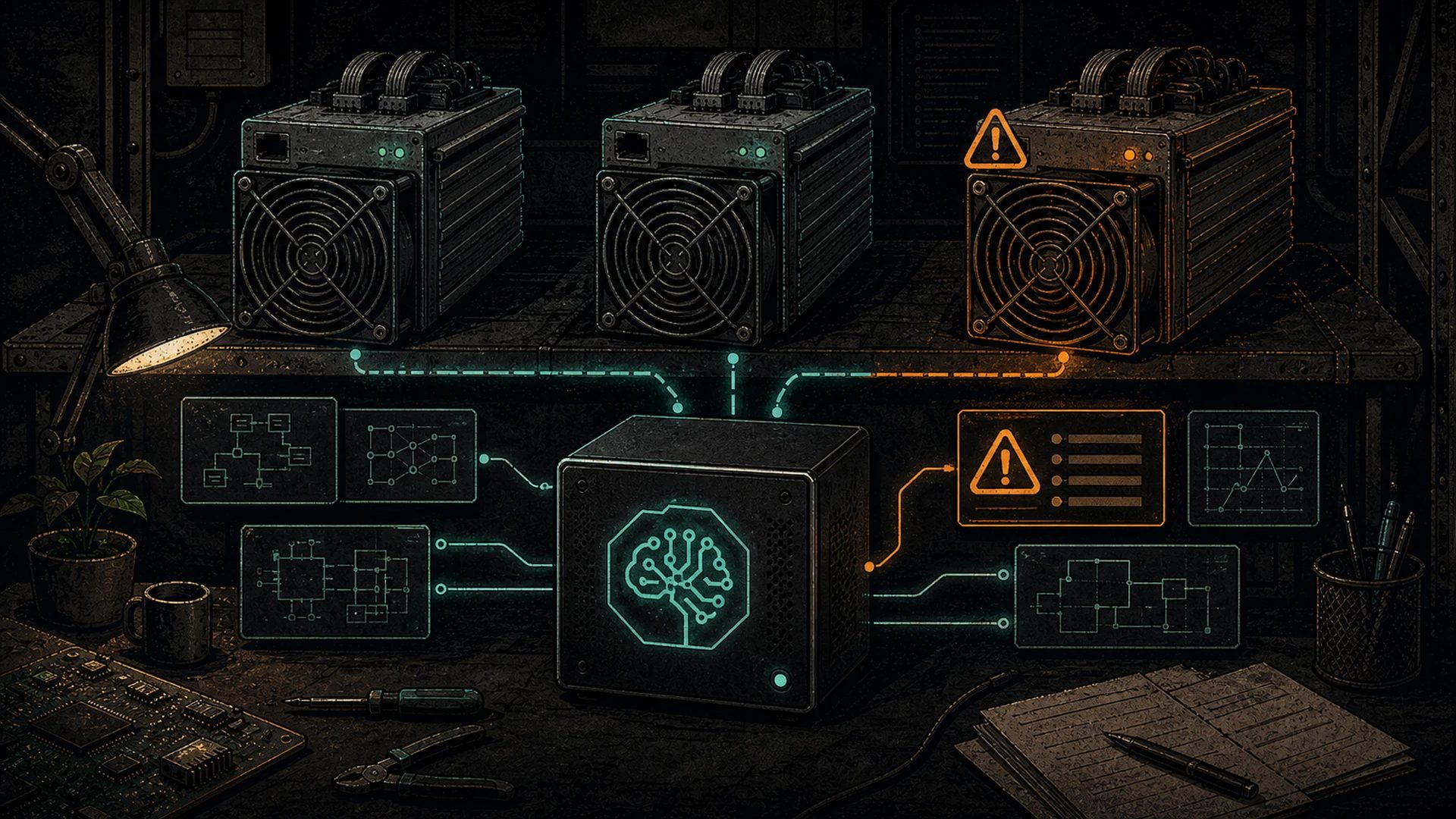
A local LLM running on a host box you own — not on the miner — reads your rig's logs and translates chip-error gibberish into plain English. An Antminer's control board streams hashrate, chip temperatures, fan RPM, and error counters over the cgminer/bmminer socket on port 4028; the trouble was never the data, just its volume and vocabulary.
It is 3 a.m. and a hashboard just dropped offline. By the time you wake up, check the dashboard, and squint at a wall of cryptic log lines, you have lost hours of hashrate and you still are not sure whether it was a loose ribbon cable, a thermal trip, or a pool that quietly stopped accepting shares. Every miner who has run hardware overnight knows this feeling: the data is right there in the miner’s API, but reading it and knowing what it means are two very different skills.
This is exactly the kind of grunt work a local language model is good at. Not running on the miner — we will be precise about that in a moment — but on a host box you already own, watching the logs, translating chip-error gibberish into plain English, and pointing you at the likely cause before you have finished your coffee. No cloud account, no telemetry, no prompts leaving your network. Just a quiet assistant that reads what your rigs are saying and helps you babysit them. Let us walk through what that actually looks like, and just as importantly, what it cannot do.
The 3 a.m. hashrate-drop problem
A modern Antminer is a chatty machine. Its control board exposes an API — the classic cgminer/bmminer TCP socket on port 4028, plus a web interface and, on most firmware, downloadable logs — that streams hashrate per board, chip temperatures, fan RPM, error counters, and pool status. The information needed to diagnose almost any fault is in there. The trouble is volume and vocabulary.
A single S19 throws hundreds of log lines an hour across three hashboards and 114 chips per board on the Pro. When something breaks, the symptom is usually a terse counter or a hex status word: a chain that reads 0 chips found, an asic error, a temperature sensor returning a nonsense value, a board that boots but never ramps to target hashrate. To a seasoned tech these are familiar. To a home miner with two machines in the garage, they are noise. And when you scale to a small Hashcenter of a dozen mixed rigs on different firmware — stock Bitmain here, BraiinsOS+ there, VNish on the third — even the format of the logs changes from machine to machine. You end up context-switching between three vocabularies just to figure out which board to reseat.
That pattern-matching-against-a-known-vocabulary task is precisely what a language model does well. The question is how to point one at your rigs without surrendering your operational data to somebody else’s server.
What a local LLM can actually do with miner logs
Set expectations honestly first, because the hype around “AI ops” is thick. A local model is not a magic oracle, and it is certainly not a replacement for understanding your hardware. What it is good at is reading, summarizing, and explaining. Concretely, a local LLM fed your miner logs can:
- Summarize a wall of logs into a sentence. “Board 2 on 192.168.1.103 has been reporting zero chips since 02:14, the other two boards are healthy” is far more useful at 3 a.m. than 400 raw lines.
- Translate cryptic counters into plain language. It can take an error code or a status word and explain, in words, what subsystem it points at and what the common causes are.
- Spot a trend before it becomes a failure. A chip temperature creeping up 0.5°C an hour, or a slowly rising hardware-error rate, is the kind of slope a model can flag from a log window when you are not staring at the graph.
- Draft the next step. “Reseat the ribbon cable on chain 2, and if the chip count stays at zero after a reboot, suspect the board” — a starting checklist, not a guarantee.
- Answer questions in context. You paste the log and ask “why did this board stop hashing?” and get a grounded, readable answer instead of opening five browser tabs.
What it does not do is run on the ASIC, and it does not push buttons on your behalf. Both of those deserve their own sections, because they are the two places where people get this wrong.
The stack: miner API → your host → local model
Here is the accuracy wall, and we will say it plainly: the language model runs on your own host computer, reading the miner’s API and logs over your local network. It does not run on the ASIC. It cannot. A Bitcoin SHA-256 miner is fixed-function silicon — a sea of hashing cores with a weak microcontroller-class ARM control board that exists only to feed work to those cores and talk to the pool. There is no floating-point hardware, no tensor engine, and no spare memory on a miner to host a language model, and no firmware can add hardware that was never fabricated into the chip. We unpack exactly why in our honest deep-dive on whether you can actually run AI on a Bitcoin miner — the short version is no, the AI always runs on a GPU or CPU you own next to the miner, never on the hashing silicon.
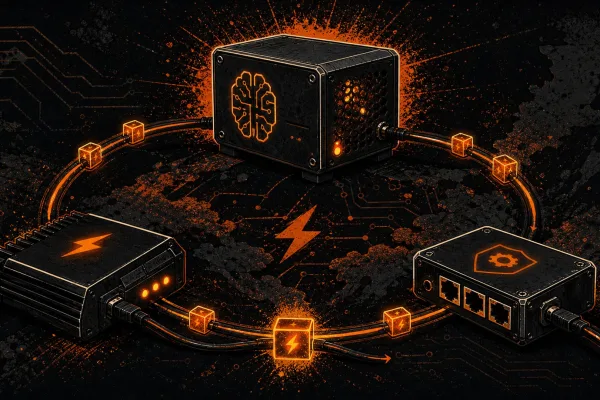
So the architecture is three boxes, conceptually:
- The miner exposes its API and logs on your LAN (port 4028, web UI, log export). It just answers questions about its own state.
- Your host computer — the same box you might already run for local AI — polls the miners, collects the logs, and feeds them to the model. This is where the work happens.
- The local model runs on that host via a runtime like Ollama or llama.cpp. A 7B–8B parameter model on a GPU with 8–12 GB of VRAM is plenty for log summarization and Q&A; nothing exotic is required.
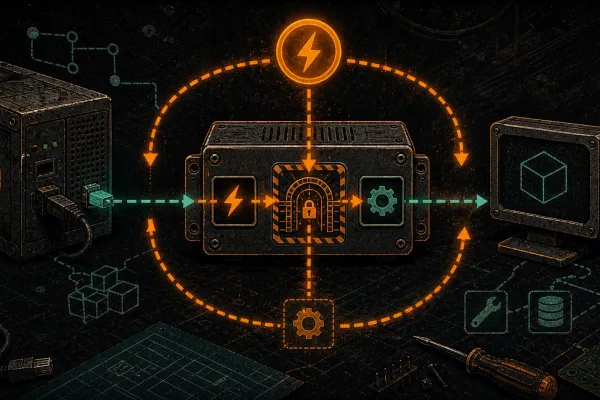
The data flow is one-directional and contained: miner → host → model → your screen. Nothing in that loop touches the internet. The same GPU box that runs your private model can poll your rigs, which is the whole point of a mixed Hashcenter — the ASIC hashes Bitcoin and throws off heat, the GPU runs local AI, and one of the jobs that GPU can take on is keeping an eye on the ASIC. To go deeper on the self-hosting side — picking a model, sizing VRAM, keeping it all on your own hardware — our sovereign-compute hub maps it out.
D-Central’s error-code library as ground truth
A language model on its own is a confident generalist, and confident generalists hallucinate. The fix for log analysis is the same as everywhere else: give the model real reference material to ground its answers, rather than letting it freelance. That is where a curated error-code library earns its keep.
We maintain a library of 200+ documented miner error codes — the asic errors, the temperature faults, the chain-detection failures, the PSU and fan trips — each entry written from hands-on repair experience and the silicon datasheets, explaining the likely cause and the diagnostic path. That library is the kind of ground truth a local model needs. Instead of asking a 7B model to guess what a chip-error word means from its training data, you point it at the relevant library entry and ask it to apply that documented knowledge to the specific log in front of you. The model handles the reading and the matching; the library supplies the facts. The result is an explanation grounded in real D-Central repair data, not a plausible-sounding fabrication.
This is also why a Bitcoin-miner-specific setup beats a generic cloud chatbot for this job. A general assistant has never reseated a hashboard or read a BM1398 datasheet. The grounding is what turns “an AI that talks about mining” into “an assistant that actually helps you fix the rig in front of you.”
Where the DCENT_Toolbox fits
Talking to a fleet of mixed-firmware miners over the network is its own engineering problem — every vendor speaks a slightly different dialect of the same ideas. That is the gap the DCENT_Toolbox is built to fill. It is an open-source (GPL-3.0) Python CLI that speaks to every major miner firmware — stock Bitmain, BraiinsOS, VNish, LuxOS, BitAxe, WhatsMiner — through one interface. Today it ships 35+ commands across discovery, diagnostics, security auditing, pool management, and tuning: it scans a subnet, finds your miners, pulls their state, and runs security and diagnostic checks from a single command line.
For the log-babysitting use case, the Toolbox is the clean, scriptable way to collect the data that you then hand to your local model: a normalized, async scan of a mixed fleet is a far better input than scraping three different web UIs by hand. To be straight with you about scope — the Toolbox is a management and diagnostics CLI, and it is currently in public beta as of July 2026. It does not bundle a language model, and it does not autonomously tune your miners. The agentic, model-driven tuning idea — where an AI reads the logs and acts on them — is something we are exploring on the DCENT_axe side of the bench, and it is largely planned rather than shipped. We would rather tell you what exists today than sell you a roadmap. What exists today is a solid CLI for pulling miner state across firmwares, and that is exactly the front half of an LLM-babysitting pipeline.
None of this came from nowhere, either. Multi-vendor miner management in Python was proven practical by the pyasic library, and professional fleet tooling was shown by Braiins Toolbox before us. We build on that work, gratefully, and give it back GPL-3.0.
Honest limits: it advises, you decide
Here is the line we will not cross, and we think you should not either: the model advises; you decide and you act. A local LLM reading your logs is an assistant, not an autopilot. It is read-only by design in this pattern — it looks at logs and tells you what it sees. It does not reboot boards, change voltages, switch pools, or flash firmware on its own. The moment you let a probabilistic text model push buttons on hardware unattended, you have traded a hashrate problem for a bricked-miner problem.
And be honest about the failure mode: a language model can be confidently wrong. It might misread a counter, invent a cause that sounds right, or miss the real fault entirely. That is survivable precisely because a human is in the loop. Treat its output the way you would treat a sharp junior tech’s first guess — a useful starting point that you verify before you touch anything. The grounding library cuts the error rate, but it does not eliminate it. Your judgment, and your hands on the actual hardware, are still the authority. The model just gets you to the right question faster.
Privacy: it never leaves your network
This is the part that makes a local model the right tool rather than just a convenient one. Your miner logs are operational intelligence: how many machines you run, what firmware, what your fleet looks like, when it falters, where it lives on your network. Hand that to a cloud AI and you have handed a third party a map of your operation, metered and logged on their servers. For a sovereign Bitcoiner who runs hardware specifically to avoid asking permission, that is the wrong trade.
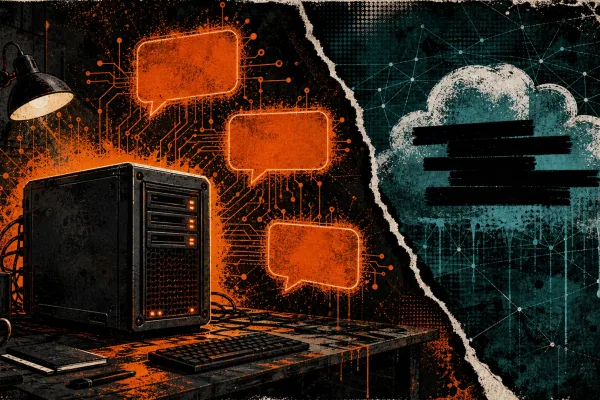
A local model closes that door. The miners talk to your host over the LAN, the host runs the model offline, and the answer appears on your screen. Nothing phones home, because nothing has anywhere to phone. You can pull the internet cable entirely and the whole pipeline still works. That is the same logic that runs through the rest of the stack: own your money, own your compute, own your ops data. Local AI on your own GPU is the backup to rented intelligence the same way Bitcoin is the backup to fiat — one more layer you do not have to trust anyone else to run. Our sovereignty hub ties that whole “backups” mindset together.
Frequently asked questions
Does the AI run on the ASIC miner itself?
No. The language model runs on a host computer you own — typically the same GPU box you would use for any local AI — reading the miner’s API and logs over your local network. A Bitcoin SHA-256 ASIC is fixed-function silicon with no floating-point or matrix hardware and no spare memory to host a model, and no firmware can change that. The miner just answers questions about its own state; the AI lives on your host, next to the miner, not inside it.
What hardware do I need to run a local model for this?
Modest gear. A GPU with roughly 8–12 GB of VRAM running a 7B–8B parameter model is more than enough for log summarization and Q&A, and smaller models will run on capable CPUs or Apple silicon. You install a runtime like Ollama or llama.cpp on your host, point it at a model, and feed it the logs your miners expose. This is the same kind of box you would build for any sovereign-compute setup.
Can the AI fix my miner automatically?
No, and that is by design. In this pattern the model is read-only: it reads logs, summarizes them, and advises. It does not reboot boards, change voltages, switch pools, or flash firmware. It advises; you decide and you act. A probabilistic text model can be confidently wrong, so a human stays in the loop and verifies before touching the hardware. Autonomous, agentic tuning is something we are exploring on the DCENT_axe side, but it is largely planned, not shipped.
How does the error-code library make the AI more reliable?
A raw language model guesses from its training data and can hallucinate causes. By grounding it in D-Central’s library of 200+ documented miner error codes — each written from hands-on repair experience — the model applies real, verified diagnostic knowledge to your specific log instead of freelancing. It does the reading and matching; the library supplies the facts. That grounding is what turns a generic chatbot into an assistant that actually helps with the rig in front of you.
Does the DCENT_Toolbox include this AI babysitter today?
Not as a bundled model. The DCENT_Toolbox is an open-source (GPL-3.0) Python CLI for managing and diagnosing miners across major firmwares — it ships 35+ commands for discovery, diagnostics, security auditing, pool management, and tuning, and it is now in public beta with public beta open since 9 July 2026. It is the clean, scriptable way to collect miner state across a mixed fleet, which is exactly the data you would feed to a local model. The Toolbox does not ship a language model or tune your miners autonomously.
Why use a local model instead of a cloud AI?
Privacy and sovereignty. Your miner logs reveal how many machines you run, what firmware, and when your fleet falters — a map of your operation you should not hand to a third party’s servers. A local model keeps that loop entirely on your network: miners to host to model to screen, with nothing phoning home. You can disconnect the internet and it still works. Own your money, own your compute, own your ops data.