There is a question hiding inside every “autonomous AI agent” demo that nobody on stage wants to answer: when your agent needs to buy something — an API call, a chunk of compute, a paid dataset — whose credit card is it using?
For a truly autonomous agent, the honest answer is “none of them.” A credit card needs a human, a billing address, a signup form, and a bank that can freeze the whole thing on a whim. An agent that has to phone home to a human every time it wants to spend a nickel isn’t autonomous — it’s a very expensive macro. The missing piece has always been money that software can hold and spend on its own, without asking permission. That money already exists. It’s Bitcoin, moving over the Lightning Network, gated by a protocol called L402.
TL;DR — An autonomous agent can’t use a credit card; it has no identity, no signup, no human to approve charges. L402 (built by Lightning Labs) lets any agent pay per API call in sats over Lightning — no account, no API key, no relationship with the server. Pair that with a self-hosted agent like Hermes Agent (Nous Research, open-source) running on hardware you own, paying from your Lightning node, and you get a sovereign loop with no middleman in the middle. It’s still early — but if you self-host your own Lightning node, the rail itself is free to run. This is the buy side of the same coin as our piece on selling inference for sats.
The problem: an agent with no wallet is a tourist with no passport
Today’s payment rails were built for humans. Stripe wants a business entity. An API key assumes you signed up, agreed to terms, and have a card on file. OAuth assumes there’s a person to click “Allow.” Every one of those flows quietly bakes in the same assumption: a human is standing behind the request, ready to authenticate, get billed, and take responsibility.
An autonomous agent breaks that assumption. If you want a piece of software that can wake up, decide it needs a web search or a paid inference call or an hour of GPU time, and just get it — you cannot route that through human-shaped payment infrastructure. You’d have to pre-provision API keys for every service it might ever touch, hand it your card details (a terrible idea we’ll come back to), or build a babysitting loop where it pings you for approval. None of that is autonomy. It’s the illusion of autonomy with a human on call.
What an agent actually needs is money it can hold and spend natively — permissionlessly, in small amounts, without a signup flow or an identity. That’s a strangely exact description of Bitcoin on Lightning.
L402: pay-per-call in sats, no account required
L402 is an open protocol from Lightning Labs — the team behind lnd — that finally makes HTTP’s long-dormant 402 Payment Required status code do something real. The idea is almost suspiciously simple. An agent requests a resource. Instead of “401 Unauthorized, go sign up,” the server replies 402 Payment Required and attaches a Lightning invoice plus a macaroon (a cryptographic bearer token). The agent pays the invoice over Lightning, takes the payment proof, and retries the request — this time with a credential it bought rather than one it was issued.
In Lightning Labs’ own words from their March 2026 write-up on L402 for agents, “any client with access to the Lightning Network can pay for and authenticate with any L402-enabled API instantly, with no signup, no API key, and no pre-existing relationship with the server.” Or, more bluntly: “the credential is purchased, not provisioned. No OAuth dance, no API key management, no billing dashboard.” (Source: Lightning Labs, “The Future Is Now: Why L402 Is the Internet-Native Payments Protocol for Agents,” 2026-03-11.)
A few details matter for anyone actually building this. The credential is reusable — an agent pays once per endpoint, then caches the macaroon and reuses it, rather than paying for literally every request. Pricing is denominated in sats, so micropayments that would be absurd on card rails (a tenth of a cent for one API call) become trivial. And because it rides Lightning, settlement is final and near-instant; there’s no chargeback, no 30-day net terms, no account that can be deplatformed mid-task.
Credit where it’s due: this isn’t D-Central’s invention. Lightning Labs has been building toward agent-native payments for years — their LangChainBitcoin tooling gave LangChain agents the ability to traverse L402 APIs back in 2023, and in early 2026 they shipped a full Lightning Agent Tools kit aimed squarely at this problem. We’re standing on their shoulders here, not reinventing the rail.
The Lightning Agent Tools that make it real
The abstract protocol is one thing; the tools that let an agent actually use it are another. Lightning Labs’ agent toolkit (open-sourced and announced February 2026) gives an agent the concrete skills it needs:
lnget— an L402-aware HTTP client. Point it at an L402-gated URL and it handles the whole dance: catches the402, pays the invoice, retries with the macaroon. To the agent it just looks like “fetch this and pay if asked.”- Aperture — the reverse-proxy on the selling side that creates invoices and gates endpoints (the tool the sell-side of this story uses).
- The
lndskill — lets the agent operate its own Lightning node: check balance, pay invoices, manage channels. - The macaroon bakery — mints scoped, attenuated credentials, so you can hand an agent a token that can only do a narrow thing.
- A commerce meta-skill — orchestrates the end-to-end buy/sell workflow.
Crucially, Lightning Labs notes these tools work with any framework that can run shell commands — including agents driven by Claude Code. That “anything that can run a shell command” design is what makes the next part possible: you don’t need a special blessed platform. You need a box you control and an agent that can call a binary.
Hermes Agent: a real, self-hosted agent on hardware you own
To close the loop you need an agent that actually lives on your hardware, not someone else’s cloud. The cleanest real example we can point to is Hermes Agent from Nous Research — an open-source, self-hosted autonomous agent released in early 2026. (We’re naming a real tool here on purpose. There’s a lot of vaporware in this space; Hermes Agent is shipping code you can clone today.)
The relevant facts, as of June 2026: Hermes Agent runs on a server you control, connects to whichever LLM you point it at, and keeps its data on your machine — the project explicitly markets “no telemetry, no tracking, no cloud lock-in.” It executes code, searches the web, manages files, and — the genuinely interesting part — writes reusable skills after completing complex tasks, so it gets more capable the longer it runs. Nous Research recently put out Hermes Desktop (v0.15.2, public preview as of early June 2026) as a native front end. It’ll run on hardware ranging from a cheap VPS to a GPU box in your basement.
Here’s the part that matters for sovereignty: an agent like Hermes runs on a GPU or CPU you own. It is not running on your Bitcoin miner. We’ve said this loudly in our piece on whether you can run AI on a Bitcoin miner, and it bears repeating: a SHA-256 ASIC is a fixed-function machine that hashes block headers and does nothing else. It cannot run an LLM. The miner’s role in this story is to hash, settle, and (if you wire it that way) heat the room — not to think. The thinking happens on general-purpose silicon you also own. Keep those two boxes straight and you’ll never write something inaccurate.
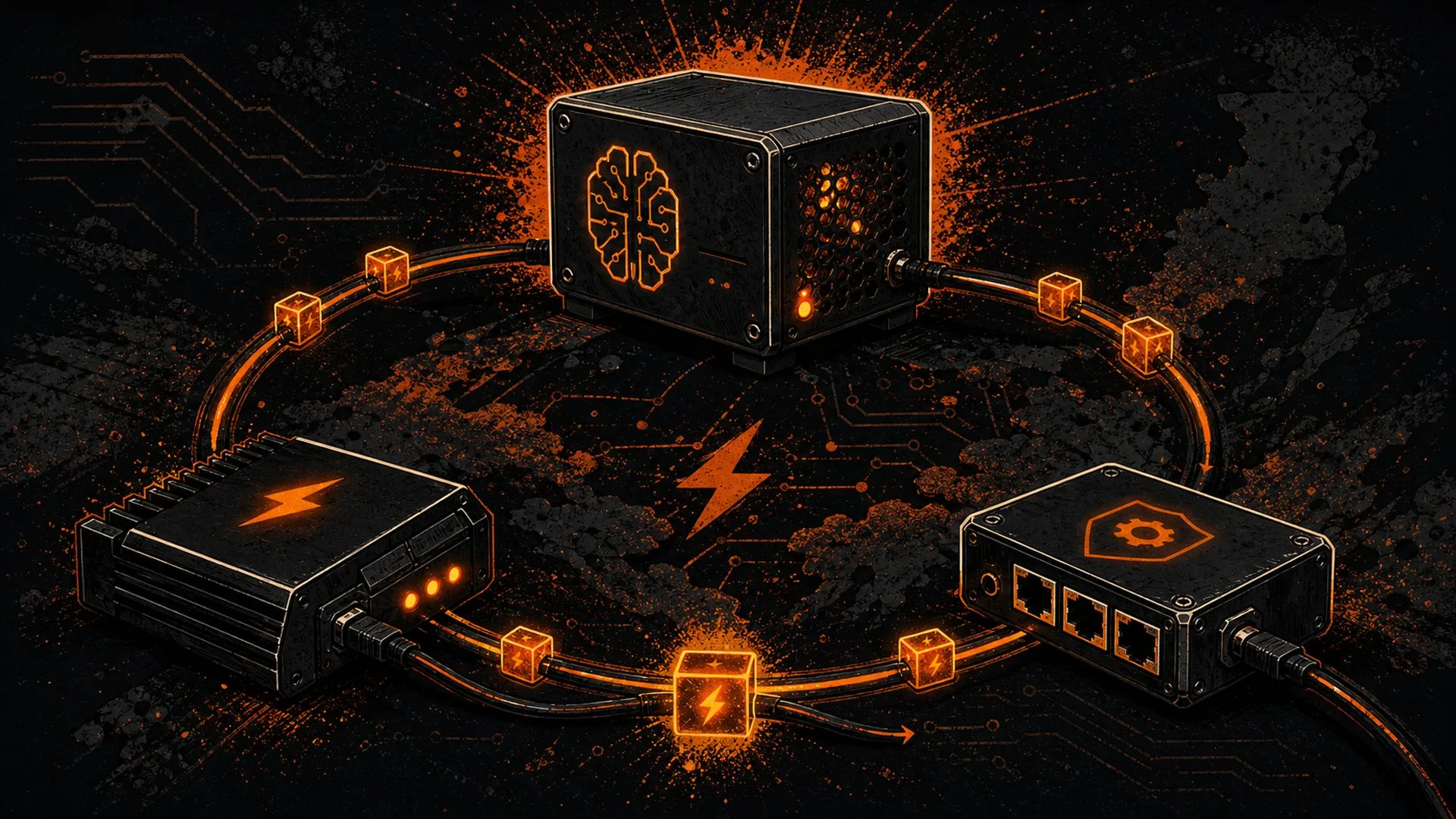
So now you have the two halves: a self-hosted agent (Hermes, on your hardware) and a self-hosted payment rail (your own Lightning node, speaking L402). Bolt them together and the agent can pay its own bills.
The sovereign loop: your hardware, your money, no middleman
Picture the full loop running in one room. A Hermes agent on your home server gets a task. It needs a paid web-scrape API and a burst of inference it can’t run locally. It reaches for lnget, hits the L402-gated endpoint, catches the 402, and instructs its lnd skill to pay a 40-sat invoice from a channel you opened. The macaroon comes back, the agent caches it, completes the call, and moves on. No human approved the charge. No bank saw it. No SaaS dashboard logged your identity. The whole transaction happened between two pieces of software and a payment channel, in well under a second.
Now zoom out and notice what each piece is doing, because the magic is that there’s no middleman anywhere in the path:
- The agent runs on hardware you own — not OpenAI’s servers, not a rented agent platform.
- The money is Bitcoin on your own Lightning node — not a custodial balance someone can freeze, not a card a processor can decline.
- The rail is an open protocol — not a proprietary billing API with a kill switch.
This is the same “backups” thesis we keep coming back to. Bitcoin is the backup to a financial system that can debank you. Self-hosted compute is the backup to rented, surveilled intelligence. A self-paying agent on your own hardware is what you get when those two backups click together: software that can act, and pay to act, without any single party in a position to say no. That’s why this lives under our sovereignty stack and not just our gadget reviews.
It also closes a loop you may already be half-running. If you operate a miner with a Lightning node attached, you can be on both sides of this: your node can sell inference for sats over L402 to other people’s agents, and pay for resources your own agent needs. Sats flow out for what you consume, sats flow in for what you serve, all settling over the same node. You can watch which agents and which tools are winning on the public leaderboards while you’re at it.
Honest caveats: it’s early, and “free” has an asterisk
We’d be poor Bitcoin mining hackers if we sold you a frictionless utopia. Here’s the honest state of it.
It’s early. L402 is real and shipping, and Lightning Labs’ agent tools work — but the universe of L402-gated APIs you’d actually want to buy from is still small. 2026 is being called “the year of agentic payments” for a reason: the rails landed before the marketplace did. You can build a self-paying agent today; you’ll just find fewer places to spend than you’d like. That gap is closing, but call it what it is.
“Free” means you did the work. If you self-host your own Lightning node, running the L402 rail costs you nothing in fees to a third party — that’s a factual property of the protocol, not a savings pitch. But “free node” assumes you stood up lnd, opened channels (which means committing real liquidity), and keep it online. Self-sovereignty is free the way a garden is free: no subscription, plenty of labor. If you’d rather not run the node, custodial options exist — and the moment you go custodial, you’ve reintroduced the middleman this whole exercise was built to remove. Your call.
Give your agent a wallet, not your wallet. Handing an autonomous process the keys to your cold storage is a genuinely bad idea. The right pattern is a small, isolated hot wallet with hard spending limits — an allowance, not a bank account — with your real savings kept on a separate, ideally air-gapped device the agent can’t touch. An agent that can spend is an agent that can be tricked into spending. Scope it tightly, fund it minimally, and keep the cold keys off the box entirely. We’ll go deeper on agent self-custody hygiene in a dedicated guide, but that’s the headline.
Where this fits in the bigger picture
None of this requires a special D-Central product to try. L402 is Lightning Labs’. Hermes Agent is Nous Research’s. lnd is open-source. That’s the point — the sovereign stack is built from open tools you can assemble yourself, and our job is mostly to point at the real ones and tell you the truth about where they’re early.
DCENT_OS is D-Central Technologies’ GPL-3.0 open-source Bitcoin mining firmware for selected Bitmain Antminer ASIC miners. Guarded artifacts exist only for exact S9 XIL and S19j Pro XIL lanes; install evidence is incomplete and neither is production-ready. Check the exact evidence ledger.
An agent that earns and spends its own sats, on hardware you own, settling over money no one can freeze, is not science fiction. It’s a weekend project with rough edges and a small market — today. But every piece of it already exists, it’s open source, and it points in exactly one direction: more of your stack, under your control. That’s a backup worth building.
Frequently asked questions
How does an AI agent pay for things in Bitcoin without a credit card?
It uses L402, an open protocol from Lightning Labs. When an agent requests a paid resource, the server responds with HTTP 402 Payment Required plus a Lightning invoice. The agent pays the invoice in sats over the Lightning Network — using its own node — and retries with the payment proof. There’s no signup, no API key, and no credit card; the agent buys access per endpoint rather than being issued credentials by a human.
What is L402, in plain terms?
L402 is a Lightning-native payment protocol built by Lightning Labs that turns the web’s HTTP 402 “Payment Required” status code into a working pay-per-request system. It combines a Lightning invoice with a macaroon (a cryptographic bearer credential), so any client — human or software — can pay a small amount in sats and immediately authenticate to an API, with no account and no pre-existing relationship with the server.
Does the AI run on my Bitcoin miner?
No. A SHA-256 ASIC is fixed-function hardware that can only hash — it cannot run an LLM or any AI model. In this setup the agent and any local inference run on a GPU or CPU you own; the miner’s job is to hash, settle Lightning payments, and optionally provide heat. Always keep the two boxes separate: the ASIC mines, general-purpose silicon thinks.
Is running an L402 agent actually free?
If you self-host your own Lightning node, the L402 rail itself charges you no third-party fees — that’s a property of the protocol, not a savings promise. But you still have to stand up and maintain the node, open payment channels (which ties up real liquidity), and keep it online. And you pay the actual sats for whatever your agent buys. “Free” here means “no middleman taking a cut,” not “no cost and no effort.”
What’s a real self-hosted agent I can use for this?
Hermes Agent from Nous Research is a real, open-source, self-hosted autonomous agent released in early 2026. It runs on hardware you control, connects to the LLM of your choice, keeps data on your machine, and writes reusable skills as it works. Because Lightning Labs’ agent tools work with anything that can run shell commands, an agent like Hermes can call them to pay L402-gated APIs on its own.
Should I give my agent access to my Bitcoin wallet?
Only a small, isolated hot wallet with strict spending limits — never your cold storage. Treat it as an allowance, not a bank account: fund it minimally, scope its permissions tightly, and keep your real savings on a separate, ideally air-gapped device the agent can’t reach. An agent that can spend can be tricked into spending, so the keys to anything serious should never live on the agent’s box.