
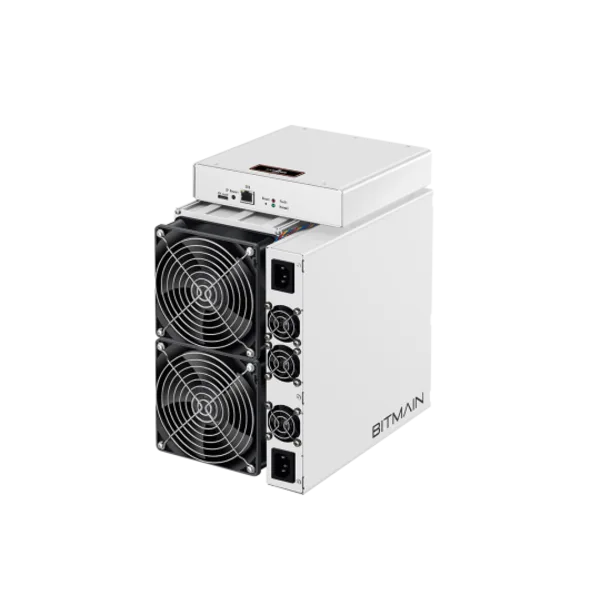
Bitmain Antminer S17 Pro (53Th)
Quick answer
The Bitmain Antminer S17 Pro (53Th) is a Bitcoin miner rated about 53 TH/s at roughly 2,094 W (about 39.5 J/TH). An industrial-class unit — loud and power-hungry, best suited to a dedicated mining space, not living areas.
Professional-Grade Miner
This miner draws 2,094W and produces 75+ dB of noise — it is designed for dedicated mining environments, not living spaces. Professional-grade miners deliver the highest hashrate and revenue per unit but require proper infrastructure: a 240V circuit, adequate ventilation or exhaust ducting, and a space where noise is not a concern (garage, basement, warehouse, or outdoor enclosure).
For home miners looking for a quieter alternative, consider our Bitcoin Space Heater builds or explore open-source miners like the Bitaxe that are purpose-built for residential environments.
Heater-Class Miner
At 2,094W, this miner outputs approximately 7145 BTU/hr of heat — equivalent to a standard electric space heater. Every watt consumed by an ASIC miner is converted to heat with 100% efficiency, making it a space heater that also mines Bitcoin.
During heating season, miner heat can offset part of the heat a room would otherwise need from another electric heater. The economics depend on your electricity rate, room heat demand, BTC price, network difficulty, and noise constraints.
Profitability Calculator
| Period | Revenue | Electricity Cost | Profit |
|---|---|---|---|
| Daily | $2.06 | $3.52 | $-1.45 |
| Weekly | $14.45 | $24.63 | $-10.18 |
| Monthly | $61.92 | $105.54 | $-43.62 |
| Yearly | $753.36 | $1,284.04 | $-530.68 |
Heating offset estimates the value of heat replacing an electric space heater during heating season (~6 months/year in Canada). Actual savings depend on your heating setup and climate.
Where to Buy the Bitmain Antminer S17 Pro (53Th)
D-Central Technologies
CanadaBitcoin Mining Hackers since 2016. Ships from Montreal, Quebec.
Shop all Bitcoin mining productsASIC Miner Market
United StatesWide selection of new and used ASIC miners. US-based shipping.
Shop NowFull Specifications
| Model | Bitmain Antminer S17 Pro (53Th) |
|---|---|
| Model Number | Antminer S17 Pro (53Th) |
| Manufacturer | Bitmain |
| Algorithm | SHA-256 |
| Coins Mined | Bitcoin (BTC) |
| Hashrate | 53 TH/s |
| Power Consumption | 2,094 W |
| Efficiency | 39.5 J/TH |
| Dimensions | 178 x 296 x 298mm |
| Weight | 9.5 |
| BTU Output | 7145 BTU/hr |
| Equivalent Heater | Equal to a 2,094W space heater |
| Daily Power Cost | $3.52/day |
| Monthly Power Cost | $105.54/mo |
| Circuit Requirement | 240V circuit required |
| Release Date | 2019-04-01 |
| MSRP | $780.00 |
| Status | Active |
Custom Power Profiles
With custom firmware like DCENT_OS, this miner can be tuned across a wide range of power levels. Lower wattage improves efficiency and reduces electricity costs; higher wattage increases hashrate at the expense of efficiency.
| Wattage | Hashrate | Efficiency |
|---|---|---|
| 960 W | 38 TH/s | 25.3 J/TH |
| 1,210 W | 43 TH/s | 28.1 J/TH |
| 1,485 W | 48 TH/s | 30.9 J/TH |
| 1,750 W | 53 TH/s | 33 J/TH |
| 2,100 W | 58 TH/s | 36.2 J/TH |
| 2,480 W | 62 TH/s | 40 J/TH |
| 2,850 W | 67 TH/s | 42.5 J/TH |
| 3,240 W | 72 TH/s | 45 J/TH |
| 3,630 W | 77 TH/s | 47.1 J/TH |
| 3,800 W | 80 TH/s | 47.5 J/TH |
Actual performance varies by unit silicon quality, firmware, input power, ambient conditions and cooling. These catalog points are reference scenarios, not verified DCENT_OS results. No operating point should be attributed to DCENT_OS without a named build and raw model-specific measurements.
Tuning envelope (derived) Verified (measured)
Full envelope analysis → · Source data →
Frequency and voltage are calculated at runtime by the firmware autotuner — never fixed presets; per-unit silicon quality, ambient temperature and cooling shift real results.
Home Mining Assessment
The Bitmain Antminer S17 Pro (53Th) is a 7nm SHA-256 Bitcoin miner that shipped in April 2019, rated at 53 TH/s for roughly 2,094 W at the wall (about 39.5 J/TH). It runs three BM1397 hashboards, takes well to firmware tuning, and is a repairable workhorse — provided you understand its known weak points.
Chip and hashboard architecture
The S17 Pro is built around Bitmain’s BM1397 ASIC, fabricated on TSMC’s 7nm DUV process — the same silicon family that powers the S17, S17+, T17 and T17 variants. Each BM1397 carries 672 SHA-256 hashing cores. D-Central’s bench teardown and live firmware probes confirm the layout the Bible documents: three hashboards, 48 chips per board, 144 chips in total, all driven from a single control board.
Each hashboard is organized into 12 voltage domains of 4 chips each, wired as a series string. A regulated rail of roughly 18.5 V is divided across those domains, so each domain sits at about 1.55 V with a chip core voltage near 1.63 V. This is the detail most spec sheets gloss over, and it matters for repair: voltage is regulated per domain, never per individual chip. If a single chip in a domain shorts or opens, it pulls the whole domain — and often the whole board — out of spec.
Voltage on the S17 Pro is set by a dsPIC33EP16GS202 microcontroller on each board, a 16-bit DAC that resolves voltage to millivolt precision and reports telemetry back over I2C. The control board itself is Bitmain’s Zynq “am2”-class platform: a Xilinx Zynq-7000 SoC pairing a dual-core ARM Cortex-A9 (running at roughly 667 MHz) with Artix-7 FPGA fabric. The FPGA handles the per-chain UART links, CRC engines, and fan PWM, while a 25 MHz crystal on each board feeds the ASIC daisy-chain clock. Commands flow forward chip-to-chip (CI/CO), nonces return up the reverse path (RI/RO), and edge level-shifters translate the controller’s 3.3 V signaling to the chain’s native levels.
| Specification | Antminer S17 Pro (53Th) |
|---|---|
| Algorithm | SHA-256 (Bitcoin / BCH) |
| Rated hashrate | 53 TH/s (stock) |
| Wall power | ~2,094 W |
| Efficiency | ~39.5 J/TH (wall, stock) |
| ASIC chip | Bitmain BM1397, TSMC 7nm |
| Cores per chip | 672 |
| Chips | 3 boards x 48 = 144 |
| Voltage domains | 12 per board (4 chips each) |
| Control board | Xilinx Zynq-7000 (am2 class) |
| PSU | Bitmain APW9 (200-240 V input) |
| Cooling | Four fans, dual-tunnel |
| Heat output | ~7,145 BTU/h |
| Dimensions | 178 x 296 x 298 mm |
| Weight | ~9.5 kg |
| Released | April 2019 |
Real-world power and efficiency
The “39.5 J/TH” on the box is wall-plug efficiency at the rated 53 TH/s mode, and it bundles in PSU conversion loss and four fans. On the bench, the hashboard-level draw in the equivalent 550 MHz tuning profile is closer to 1,750 W (about 33 J/TH at the boards); the gap to 2,094 W is the APW9 PSU running at roughly 90% efficiency plus fan overhead. Knowing where the watts go is what lets you tune this machine intelligently rather than guessing.
The BM1397 has real headroom in both directions. D-Central’s reference S17 Pro exposes a 16-step autotune range that runs from a frugal 38 TH/s at ~960 W (~25.3 J/TH) at the low end up to an aggressive 80 TH/s at ~3,800 W (~47.5 J/TH) when overclocked. A few useful set points from that curve:
| Mode | Freq (MHz) | Hashrate | Power (boards) | Efficiency |
|---|---|---|---|---|
| Eco / heater | 400 | 38 TH/s | ~960 W | ~25.3 J/TH |
| Balanced | 500 | 48 TH/s | ~1,485 W | ~30.9 J/TH |
| Stock-equivalent | 550 | 53 TH/s | ~1,750 W | ~33.0 J/TH |
| Overclock | 835 | 80 TH/s | ~3,800 W | ~47.5 J/TH |
Note that the autotuner adjusts frequency per chip at runtime to hit a profile’s target — these are calculated working points, not fixed presets — while the board voltage rail is held constant (around 1,680 mV on stock firmware). For the full per-model tuning database, see our ASIC power profiles tool. In practice, the most efficient use of an aging S17 Pro is the eco end of the curve: dropping to ~38 TH/s nearly halves the J/TH versus a hard overclock and dramatically lowers thermal stress on the boards.
One caveat the original marketing buried: the APW9 PSU expects a 200-240 V supply. It is not a 120 V-native machine. North American operators running standard 120 V circuits will need a 240 V outlet (dryer/range-style) or a step-up arrangement; the S17 Pro is not a plug-into-any-wall heater the way some lower-wattage units are.
Firmware compatibility
Out of the box the S17 Pro runs Bitmain’s stock firmware — a sealed cgminer/BMMiner build that locks the voltage rail and exposes only a handful of factory power modes. It works, but it leaves efficiency and reliability gains on the table.
The S17/T17 generation is one of the most popular targets for third-party firmware. The dominant choice is VNish, which unlocks the full autotune profile range above, adds per-board diagnostics, and gives finer control over the chip frequency curve. Braiins OS+ also reached the S17 family and remains the only firmware that brings native Stratum V2 support to this class of hardware, along with its own autotuning. Both can meaningfully improve the watts-per-terahash you actually see at the wall versus stock modes.
D-Central uses generation-appropriate tooling when servicing and tuning these units, and we are glad to advise on a firmware path that matches your goal — maximum efficiency, maximum hashrate, or quiet heat. Whatever you flash, treat the S17 Pro’s thermals with respect: this silicon punishes aggressive overclocks with shortened board life.
Common faults and troubleshooting
The S17/T17 generation earned a reputation for hardware fragility, and being honest about that is part of buying or running one well. The failure modes cluster into a handful of patterns:
- Hashboard not detected / reduced chip count. The most common S17 Pro fault. Because chips sit in series within each of the 12 domains, a single open or shorted chip can make a whole board read zero ASICs. See Antminer S17 hashboard not detected.
- Low or unstable hashrate. Often a marginal domain, a weak chip dragging down a chain, or a tuning profile that is too aggressive for the board’s current health. See Antminer S17 low hashrate.
- Temperature too high. Failing temp sensors (the board reads a bad value and throttles or halts), clogged heatsinks, or dried thermal pad/paste after years of service. See Antminer S17 temperature too high.
- Fan speed error. One of the four fans drops below its tach threshold and the miner refuses to mine as a safety measure. See Antminer S17 fan speed error.
- PSU faults. The APW9 itself ages; intermittent power, failure to ramp, or boards browning out under load frequently trace back to the supply rather than the hashboards.
For a guided diagnosis that narrows a symptom to a likely root cause, run the symptom through our ASIC fault finder, or browse the full library of model-specific codes in our ASIC troubleshooting archive.
Repair and longevity
Here is the part that matters most for an S17 Pro in 2026: most of these faults are repairable. A dead hashboard is rarely scrap. D-Central has run an in-house ASIC repair lab in Montreal, Quebec since 2016, and the S17 generation’s domain-and-chip architecture is exactly the kind of fault we trace daily — measuring each of the 12 domains against a known-good baseline, isolating the shorted or open chip, and reworking the BGA. Thermal-cycling solder fatigue, a weak power-management chip on one domain, or a single failed ASIC can usually be repaired for a fraction of replacement cost.
Because the BM1397 is well understood and parts remain available, an S17 Pro that is professionally repaired and conservatively tuned can keep earning for years past its original write-off date. If you have a unit showing zero ASICs on a board, a stuck fan error, or thermal shutdowns, our ASIC repair service can quote a board-level fix rather than recommend a throwaway.
Who it is for and buying notes
At roughly US$780 on the secondary market, the S17 Pro is a budget entry into real-terahash Bitcoin mining. It makes the most sense for:
- Cheap-power or heat-reuse operators who can duct its ~7,145 BTU/h of waste heat into a workshop, garage, or grow space and treat the hashrate as a bonus on heating they were buying anyway.
- Hands-on operators comfortable with firmware tuning and basic maintenance — running the eco profile (~38 TH/s) keeps it efficient and gentle on the boards.
- Repair-minded buyers who can source units cheaply and bring failed boards back to life.
It is a poor fit for anyone needing 120 V plug-and-play simplicity, near-silent operation, or current-generation efficiency. If your goal is to learn Bitcoin mining at the silicon level on a modern, low-power, fully open platform, a Bitaxe-class device is the better classroom; for production hashing on a tight power budget, today’s S19- and S21-generation hardware will out-earn an S17 Pro per kilowatt. Browse current options in the D-Central shop.
Generational context
The S17 Pro sits at an important inflection point in Bitmain’s history. Its BM1397 (7nm, 2019) was the chip that took Bitmain from the 16nm S9 era into modern efficiency territory — a genuine generational leap, and credit is due to that engineering. The very next year’s BM1398 (a refined 7nm part) became the backbone of the S19 family, and by 2021 the 5nm BM1362 in the S19j Pro pushed efficiency to ~22 J/TH. Against today’s sub-20 J/TH machines, the S17 Pro’s ~33-40 J/TH looks dated, and its first-generation 7nm boards are less durable than the silicon that followed.
That is exactly why it occupies a useful niche: cheap to acquire, straightforward to repair, honest about what it is. Run it where power is inexpensive or heat is welcome, keep it on a conservative tune, and the S17 Pro remains a legitimate, low-cost way to put real hashrate on the network.
Broken miner? Get a real quote.
Tell us the symptom and get an instant repair-tier estimate ($95 / $145 / $195 CAD). Mail-in from across Canada, bench in Montreal, Quebec.
Send it to D-Central — start a repair →Antminer 17-series repair and parts path
Use the S17/T17 cluster to connect known hashboard risks, chip parts, diagnostics, and repair economics before replacing boards.
- Antminer S17 specs
- S17 maintenance guide
- T17 maintenance guide
- BM1397AD ASIC chip
- 17-series replacement hashboards
- Antminer test fixture
- Repair vs replace guide
- Confirm chip count, voltage domains, fitment
- Full per-model repair BOM
- Match firmware to this model
- Which firmwares run on this control board — factual support matrix
Related Miners
Antminer S21
Bitmain Antminer S7-LN
Bitmain Antminer S23 Hyd
Auradine Teraflux AT2880
Compare the Bitmain Antminer S17 Pro (53Th)
Frequently Asked Questions
What are the current mining economics for the Bitmain Antminer S17 Pro (53Th)?
At $0.07/kWh, the Bitmain Antminer S17 Pro (53Th) currently shows an estimated daily net cost of $1.45 before pool fees and hardware cost. Lower electricity rates, network changes, BTC price changes, or useful heat recovery can change the result.
Can I mine Bitcoin at home with the Bitmain Antminer S17 Pro (53Th)?
The Bitmain Antminer S17 Pro (53Th) has a home mining score of 11/100. With 0 dB noise and 2,094W power draw, it may require a dedicated space like a garage, basement, or outdoor enclosure. Consider noise insulation and proper ventilation.
Can the Bitmain Antminer S17 Pro (53Th) heat my home?
The Bitmain Antminer S17 Pro (53Th) outputs approximately 7145 BTU/hr of heat. For reference, a typical space heater produces 5,000-5,500 BTU/hr. All electrical energy consumed by the miner is converted to heat, making it 100% efficient as a heater. D-Central offers Bitcoin Space Heater builds designed specifically for home heating integration.
What power supply does the Bitmain Antminer S17 Pro (53Th) need?
The Bitmain Antminer S17 Pro (53Th) draws 2,094W of power. You need a power supply rated for at least 2,303W with appropriate voltage (200-240V AC). D-Central stocks compatible power supplies in our shop. Always use a quality PSU from a reputable manufacturer to protect the miner and wiring.