On this page
Antminer S17+
Improved S17 with higher hashrate. Uses BM1397 chips. Common in space heater builds and still found on the secondary market.
Quick answer
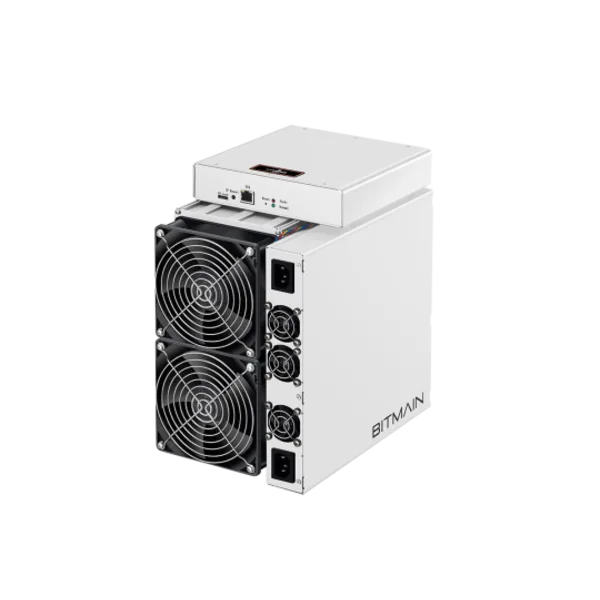
The Antminer S17+ is a Bitcoin miner rated about 73 TH/s at roughly 2,920 W (about 40 J/TH), built on 144× BM1397. An industrial-class unit — loud and power-hungry, best suited to a dedicated mining space, not living areas.
DCENT_OS Compatible
DCENT_OS is custom firmware developed by D-Central Technologies specifically for home miners. It transforms this miner with whisper-quiet fan profiles, 120V North American outlet support, auto-tuning for maximum efficiency, heater mode integration, and a clean web dashboard for monitoring.
Miners running DCENT_OS score higher on our Home Mining Assessment because the firmware is purpose-built to make industrial hardware livable in residential spaces.
Learn More About DCENT_OS →Professional-Grade Miner
This miner draws 2,920W and produces 75 dB of noise — it is designed for dedicated mining environments, not living spaces. Professional-grade miners deliver the highest hashrate and revenue per unit but require proper infrastructure: a 240V circuit, adequate ventilation or exhaust ducting, and a space where noise is not a concern (garage, basement, warehouse, or outdoor enclosure).
However, this miner is compatible with DCENT_OS — D-Central's custom firmware that adds whisper-quiet fan profiles and 120V North American outlet support. With DCENT_OS installed, this industrial miner can be transformed for home use.
Heater-Class Miner
At 2,920W, this miner outputs approximately 9963 BTU/hr of heat — equivalent to a standard electric space heater. Every watt consumed by an ASIC miner is converted to heat with 100% efficiency, making it a space heater that also mines Bitcoin.
During heating season, miner heat can offset part of the heat a room would otherwise need from another electric heater. The economics depend on your electricity rate, room heat demand, BTC price, network difficulty, and noise constraints.
Profitability Calculator
| Period | Revenue | Electricity Cost | Profit |
|---|---|---|---|
| Daily | $2.19 | $4.91 | $-2.71 |
| Weekly | $15.35 | $34.34 | $-18.98 |
| Monthly | $65.80 | $147.17 | $-81.36 |
| Yearly | $800.62 | $1,790.54 | $-989.92 |
Heating offset estimates the value of heat replacing an electric space heater during heating season (~6 months/year in Canada). Actual savings depend on your heating setup and climate.
Where to Buy the Antminer S17+
D-Central Technologies
CanadaBitcoin Mining Hackers since 2016. Ships from Laval, Quebec.
Shop all Bitcoin mining productsASIC Miner Market
United StatesWide selection of new and used ASIC miners. US-based shipping.
Shop NowFull Specifications
| Model | Antminer S17+ |
|---|---|
| Model Number | S17+ |
| Manufacturer | Bitmain |
| Algorithm | SHA-256 |
| Coins Mined | Bitcoin (BTC) |
| Hashrate | 73 TH/s |
| Power Consumption | 2,920 W |
| Efficiency | 40 J/TH |
| Noise Level | 75 dB |
| Chip Model | BM1397 |
| Chip Count | 144 |
| Cooling | Air |
| Voltage Range | 200-240V AC |
| Operating Temperature | 5-40°C |
| Dimensions | 298x175x304 |
| Weight | 9.5 |
| Interface | Ethernet |
| BTU Output | 9963 BTU/hr |
| Equivalent Heater | Equal to a 2,920W space heater |
| Daily Power Cost | $4.91/day |
| Monthly Power Cost | $147.17/mo |
| Circuit Requirement | 240V circuit required |
| Release Date | 2019-12-01 |
| Status | Discontinued |
Custom Power Profiles
With custom firmware like DCENT_OS, this miner can be tuned across a wide range of power levels. Lower wattage improves efficiency and reduces electricity costs; higher wattage increases hashrate at the expense of efficiency.
| Wattage | Hashrate | Efficiency |
|---|---|---|
| 1,700 W | 52 TH/s | 32.7 J/TH |
| 1,800 W | 55 TH/s | 32.7 J/TH |
| 2,050 W | 58 TH/s | 35.3 J/TH |
| 2,200 W | 62 TH/s | 35.5 J/TH |
| 2,370 W | 65 TH/s | 36.5 J/TH |
| 2,500 W | 68 TH/s | 36.8 J/TH |
| 2,700 W | 71 TH/s | 38 J/TH |
| 2,800 W | 74 TH/s | 37.8 J/TH |
| 3,100 W | 78 TH/s | 39.7 J/TH |
| 3,150 W | 80 TH/s | 39.4 J/TH |
| 3,500 W | 84 TH/s | 41.7 J/TH |
| 3,650 W | 88 TH/s | 41.5 J/TH |
| 3,900 W | 91 TH/s | 42.9 J/TH |
| 4,050 W | 93 TH/s | 43.5 J/TH |
| 4,150 W | 95 TH/s | 43.7 J/TH |
Actual performance varies by individual unit silicon quality, ambient temperature, and cooling configuration. These operating points are achievable with custom tuning firmware such as DCENT_OS; values are calculated at runtime by the autotuner, not fixed presets.
Home Mining Assessment
Improved S17 with higher hashrate. Uses BM1397 chips. Common in space heater builds and still found on the secondary market.
The Antminer S17+ is Bitmain’s top air-cooled SHA-256 unit from the 2019 S17 family, rated at 73 TH/s for 2,920 W — about 40 J/TH. It runs on 144 of Bitmain’s 7nm BM1397 ASICs and was a genuine efficiency leap over the S9 era. It is now a discontinued, secondary-market workhorse — and D-Central still repairs and re-tunes it board-level.
Chip and hashboard architecture
The S17+ is built on the BM1397, the SHA-256 ASIC Bitmain fabricated on a TSMC 7nm process — not the 5nm or 3nm nodes used by much later silicon. Each BM1397 packs roughly 672 hashing cores, and the chip introduced per-domain frequency control: the cores inside a chip are grouped into internal domains that the firmware can clock independently. The S17+ carries 144 chips total — 48 chips on each of three hashboards, daisy-chained over a UART signal bus with every chip assigned its own slice of the 32-bit nonce space.
The control board is the same Xilinx Zynq-7010 platform that runs the rest of the Zynq-era Antminers: a dual-core Arm Cortex-A9 clocked at 667 MHz, 256 MB of DDR3, and an Artix-7 FPGA fabric that handles the heavy lifting of work distribution and midstate generation. The FPGA IP core is in fact shared with the S9 — a good example of Bitmain reusing a proven design rather than reinventing it. Per-board frequency and voltage profiles live in an x17-format EEPROM on each hashboard, and thermals are watched by LM75A-class sensors — four temperature zones per board, twelve across the miner — read through the BM1397’s own I2C pass-through.
One architectural point matters for both tuning and repair: voltage is regulated per power domain, not per chip. Each hashboard steps a single ~17.4 V PSU rail down through a series of series-wired voltage domains, and the chips within a domain share that domain’s regulated supply. The S17+ also marked a real upgrade in how that regulation is done. Where the S9 used a simple 8-bit PIC, the S17 generation moved to a dsPIC33EP16GS202 digital-signal voltage controller on each board, with hardware high-resolution PWM, a 12-bit ADC for true voltage read-back, and hardware voltage clamping — a far more capable on-board microcontroller, and a distinct design from the later no-PIC S21 silicon. On the ASIC link itself, the BM1397 uses 9-byte responses, four-midstate “VIL” jobs and version-rolling AsicBoost, with the UART negotiable up to 6 Mbps.
Real-world power and efficiency
The 2,920 W nameplate is the chip-side figure at the stock 73 TH/s bin. At the wall you will pull more: the APW9-class PSU runs a single high-voltage rail and is not perfectly efficient, so budget your circuit for roughly 3 kW and run the unit on a 200–240 V supply — this is not a 120 V miner at stock clocks. At 40 J/TH the S17+ sits firmly in the previous-generation efficiency tier: a 2026 S21-class machine does the same work for less than half the power. That single fact defines where the S17+ still makes sense — cheap electricity, genuine heat reuse, or a purchase price low enough that efficiency stops being the deciding factor.
What the S17+ does offer is wide tuning headroom. Because frequency and voltage are adjustable, the same hardware can be pushed for hashrate or pulled back for efficiency and longevity. The profiles below are drawn from our power-profiles research on third-party firmware and show the real spread; note that the most efficient profiles run under the stock clock, which also keeps the boards cooler and longer-lived:
| Mode | Frequency | Hashrate | Wall power | Efficiency |
|---|---|---|---|---|
| Efficiency / heater | 400 MHz | 52 TH/s | 1,700 W | ~32.7 J/TH |
| Balanced | 500 MHz | 65 TH/s | 2,370 W | ~36.5 J/TH |
| Near-stock | 565 MHz | 74 TH/s | 2,800 W | ~37.8 J/TH |
| Overclock | 650 MHz | 84 TH/s | 3,500 W | ~41.7 J/TH |
| Max | 730 MHz | 95 TH/s | 4,150 W | ~43.7 J/TH |
Those targets are not hand-set presets. On VNish or Braiins OS the autotuner calculates per-domain frequency at runtime, measuring each chain’s real output and trimming individual domains until the board is stable — on one S17 we profiled in the lab, the tuner settled most domains at a common clock and dropped a single weak group a notch lower to hold stability. For the full tuning picture across the SHA-256 fleet, see our ASIC power profiles database.
Firmware compatibility
Out of the box the S17+ runs Bitmain’s stock firmware (a bmminer/cgminer derivative) behind the familiar Antminer web UI. The BM1397 platform is also one of the better-supported aftermarket targets: third-party firmware that speaks BM1397 — we have run both VNish and Braiins OS+ on S17-class hardware in our own lab — unlocks the autotuning and undervolting that stock firmware does not expose. If Stratum V2 matters to you, note that Braiins OS+ is the only firmware that natively supports Stratum V2; stock Bitmain firmware and most of the aftermarket remain on Stratum V1.
We will be honest about our own work here. D-Central’s DCENT_OS is a GPL-3.0, open-source Antminer firmware currently in closed beta, with public beta targeted for summer 2026. Support for the S17 platform — the BM1397 chip driver plus the dsPIC33EP voltage-controller driver — is part of that effort rather than a finished, flashable release today, and we would rather under-promise than oversell it. Whichever firmware you choose, the practical reason to tune an S17+ is the same: a modest undervolt lowers both your power bill and the board temperature, and on this generation, lower temperature is the single best thing you can do for board life.
Common faults and troubleshooting
It is no secret that the S17 and T17 generation earned a reputation for hashboard reliability problems — credit to Bitmain for the engineering leap to 7nm, but the early 17-series boards ran hot and thermal cycling took a toll. That history is exactly why these units are repairable rather than disposable; most failures are board-level and well understood:
- Low chip count / chain breaks — the most common S17 fault. A dead chip (open) stops enumeration at that position, so everything downstream disappears, while a cold solder joint on a chip’s signal-forwarding pin breaks the chain even though the chip itself is alive. Both show up as a board reporting fewer than its 48 ASICs.
- Voltage-domain and power faults — a shorted regulator collapses a domain and takes its whole group of chips offline; a failed boost stage leaves a board with zero detected chips and no domain rails at all. These are measured on the domain test points, not guessed.
- Signal and clock faults — a cracked crystal or a cold joint on a clock or CI resistor at a domain boundary causes random enumeration failures or a chain that breaks at a predictable point.
- Temperature-sensor and EEPROM errors — the 17-series is prone to “temperature sensor” and EEPROM read faults when an LM75A sensor or the x17 EEPROM loses its I2C connection through a cracked joint.
- Fan and PSU faults — a failed fan trips thermal protection almost immediately, and the APW9/APW9+ PSU itself is a wear item on a unit this old.
To turn a symptom into a root cause — including how to read the stock status and error messages — start with our ASIC fault finder and cross-reference the specific code your miner reports.
Repair and longevity
D-Central has run an in-house ASIC repair lab in Laval since 2016, and the S17+ is squarely in our wheelhouse. We service these boards at the component level: reflowing or replacing dead BM1397 chips, rebuilding failed voltage domains and regulator stages, repairing signal-chain cold joints, recovering corrupted x17 EEPROMs, and diagnosing the dsPIC voltage controller. Because the board is organized into voltage domains, a single failed domain is one targeted repair, not a scrapped hashboard. Paired with a sensible undervolt to keep temperatures down, a repaired S17+ can keep earning — or keep heating — for years. If your unit is dropping a board, derating, or shutting down on a thermal or sensor fault, send it to D-Central ASIC repair before you part it out.
Who it is for and buying notes
In 2026 the S17+ is a value play, not a frontier machine. It makes sense if you have genuinely cheap power, if you can put its roughly 9,960 BTU/h of waste heat to real work as supplemental heating, or if the secondary-market price is low enough to ignore the efficiency gap. At about 75 dB it is loud, so it belongs in a garage, shop, or dedicated space rather than a living room. If your goal is quiet home mining, solo lottery mining, or simply learning the stack hands-on, an open-source Bitaxe-class single-chip device is a far better fit than a three-board industrial miner. For anyone running the S17+ as a heater, pick one of the efficiency profiles above — you get the same heat for materially less electricity. Full live specs, profitability and comparisons for this model live in our ASIC miner database.
Generational context
The S17+ was the highest-hashrate air-cooled member of Bitmain’s S17 family, which all share the BM1397 chip and the Zynq control platform. Approximate factory headline bins:
| Model | Hashrate | Power | Efficiency |
|---|---|---|---|
| Antminer S17 | 53 TH/s | ~2,385 W | ~45 J/TH |
| Antminer S17 Pro | 53 TH/s | ~2,094 W | ~39.5 J/TH |
| Antminer S17e | 64 TH/s | ~2,880 W | ~45 J/TH |
| Antminer S17+ | 73 TH/s | 2,920 W | 40 J/TH |
(Several power bins shipped for each model; the figures above are the common headline specs.) In the wider timeline the S17 family sits between the 16nm BM1387 S9 — the workhorse that mined a huge share of Bitcoin’s history — and the 7nm BM1398 S19 line that followed. The S17 was Bitmain’s first 7nm SHA-256 generation, and while the S19 refined the design into a far more reliable and efficient machine, the S17+ remains a capable, repairable unit. Treated to a careful undervolt and competent board-level service, it still has a productive second life as a cheap-power miner or a hash-while-you-heat space heater — which is exactly how D-Central keeps this generation running.
Broken miner? Get a real quote.
Tell us the symptom and get an instant repair-tier estimate ($95 / $145 / $195 CAD). Mail-in from across Canada, bench in Laval, Quebec.
Send it to D-Central — start a repair →Antminer S21 specs, repair, and parts
Use the S21 cluster to connect current-generation specs, buying options, chip-level parts, troubleshooting, and repair support.
- Antminer S21 specs
- Bitmain Antminer S21
- Bitmain Antminer S21 Pro
- Bitmain Antminer S21 XP
- S21 maintenance guide
- S21 hashboard troubleshooting
- BM1370BC S21 Pro chip
- Compare S21 miners
- Confirm chip count, voltage domains, fitment
- Full per-model repair BOM
- Match firmware to this model
- Which firmwares run on this control board — factual support matrix
Frequently Asked Questions
What are the current mining economics for the Antminer S17+?
At $0.07/kWh, the Antminer S17+ currently shows an estimated daily net cost of $2.71 before pool fees and hardware cost. Lower electricity rates, network changes, BTC price changes, or useful heat recovery can change the result.
Can I mine Bitcoin at home with the Antminer S17+?
The Antminer S17+ has a home mining score of 8/100. With 75 dB noise and 2,920W power draw, it may require a dedicated space like a garage, basement, or outdoor enclosure. Consider noise insulation and proper ventilation.
Can the Antminer S17+ heat my home?
The Antminer S17+ outputs approximately 9963 BTU/hr of heat. For reference, a typical space heater produces 5,000-5,500 BTU/hr. All electrical energy consumed by the miner is converted to heat, making it 100% efficient as a heater. D-Central offers Bitcoin Space Heater builds designed specifically for home heating integration.
Does D-Central repair the Antminer S17+?
Yes, D-Central provides professional repair services for the Antminer S17+. Services include hashboard repair, control board diagnostics, fan replacement, and full refurbishment. Ship your miner to our Laval, Quebec facility for diagnosis and repair.
What power supply does the Antminer S17+ need?
The Antminer S17+ draws 2,920W of power. You need a power supply rated for at least 3,212W with appropriate voltage (200-240V AC). D-Central stocks compatible power supplies in our shop. Always use a quality PSU from a reputable manufacturer to protect the miner and wiring.
