
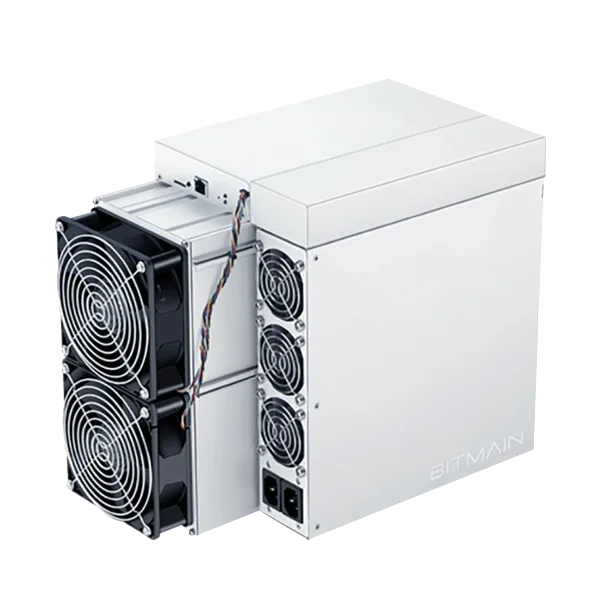
Bitmain Antminer KS3 9.4T KHeavyHash evidence-boundary reference
Official Antminer KS3 reference for the verified 9.4 TH/s and 3,500 W KHeavyHash lane, with the unsupported 8.3T lane and OEM efficiency-unit conflict explicitly contained.
Quick answer
The Bitmain Antminer KS3 9.4T KHeavyHash evidence-boundary reference is a KHeavyHash miner rated about 9.4 TH/s at roughly 3,500 W.
Full Specifications
| Model | Bitmain Antminer KS3 9.4T KHeavyHash evidence-boundary reference |
|---|---|
| Model Number | Antminer KS3 |
| Manufacturer | Bitmain |
| Algorithm | KHeavyHash |
| Hashrate | 9.4 TH/s |
| Power Consumption | 3,500 W |
| Efficiency | 372.34 J/TH |
| Cooling | Air |
| Voltage Range | 200-240 V AC; 47-63 Hz; 20 A maximum; two 10 A input wires |
| Operating Temperature | 0 C to 40 C |
| Dimensions | 430 x 195.5 x 290 mm |
| Weight | 15.2 kg net |
| Interface | RJ45 Ethernet 10/100M |
| Status | OEM evidence-boundary reference |
Evidence-controlled KS3 reference: Bitmain’s current KS3 specification supports one exact 9.4 TH/s lane. Hashrate and any arithmetic normalization on this page are scoped only to KHeavyHash; they must not be compared across algorithms.
| Supported identity | Hashrate | Wall power at 25°C | Normalized OEM efficiency |
|---|---|---|---|
| KS3-9.4T | 9.4 TH/s | 3,500 W ±10% | Withheld: OEM unit-label conflict |
Primary-source label conflict
Bitmain’s KS3 table places “KS1-10” in the field labeled “Version” and “KS3-9.4T” in the field labeled “Crypto Algorithm/Coins.” It also publishes 0.37 J/Ksol ±10% as the efficiency unit. Those labels are reproduced here as source defects, not silently reinterpreted as verified model, version, algorithm, or normalized-efficiency fields.
Transparent KHeavyHash arithmetic only: 3,500 W ÷ 9.4 TH/s is approximately 372.34 J/TH on KHeavyHash, equivalent arithmetically to approximately 0.372 J/GH. This is a calculation from the two exact OEM fields above, not a corrected OEM efficiency claim. No normalized OEM-efficiency value should be emitted in structured data until the manufacturer’s J/Ksol label conflict is resolved.
Contained 8.3 TH/s record
Do not use the existing 8.3 TH/s record as a specification source. The exact primary Bitmain evidence reviewed here does not establish the circulated 8.3 TH/s, 3,188 W, or 384.1 J/TH triple. It is not added to the canonical matrix. Confirm the complete physical nameplate before installation, firmware, or repair work; do not infer a manufacturer bin from observed hashrate.
Electrical preflight
| AC input voltage | 200–240 V AC |
|---|---|
| AC input frequency | 47–63 Hz |
| Maximum input current | 20 A under the stated maximum condition: 40°C and 0 m altitude |
| Input wiring | Two AC input wires, 10 A per wire |
| Network | RJ45 Ethernet 10/100M |
| PSU / connector / cord | Exact models and types unresolved in the reviewed KS3 specification |
Wrong input voltage can damage the server. This is high-power equipment requiring a qualified installation. Verify the exact miner and PSU nameplates, both input paths, supply voltage and frequency, circuit capacity, continuous-load treatment, protection, conductors, connectors, cords, disconnecting means, grounding, and applicable local requirements before energizing it. No PSU, cord, connector, or parts compatibility is inferred from another Antminer enclosure.
Cooling, physical, and environmental boundaries
| Fans | 4 × 12038; front and rear 5,200 RPM; 12 V / 2.35 A; 300 CFM mid airflow |
|---|---|
| Server dimensions | 430 × 195.5 × 290 mm, including PSU |
| Packaged dimensions | 570 × 316 × 430 mm |
| Net weight | 15.2 kg, including PSU |
| Gross weight | 16.9 kg |
| Operating temperature | 0–40°C |
| Storage temperature | -20–70°C |
| Operating humidity | 10–90% RH, non-condensing |
| Operating altitude | Up to 2,000 m |
From 900 m to 2,000 m, reduce the highest permitted operating temperature by 1°C for every 300 m increase in altitude. The reviewed primary sources do not publish a KS3 sound level; no noise value is asserted.
Secure Boot, firmware, and diagnostics
Bitmain states that Secure Boot is enabled and Root Authority is disabled on the KS3 series to prevent firmware-virus propagation. This statement does not establish the control-board identity, cryptographic implementation, aftermarket-firmware behavior, or compatibility of any other model or board.
- Photograph the complete miner, PSU, inlet, cord, and installed-board labels; record the serial, exact identity, revisions, and installed firmware version.
- Use Bitmain’s official firmware selector. Select the matching algorithm and KS3 model, then read the complete firmware description before downloading.
- Follow Bitmain’s official firmware-download procedure. Stop if the image does not explicitly match the installed unit and revision.
- For power, zero-hashrate, temperature, fan, firmware, control-board, or hashboard-signal symptoms, start with Bitmain’s ANTMINER failure diagnostic guide. Do not flash an unrelated image or swap parts solely because another model presents a similar symptom.
Repair and symptom routing
- Use the ASIC fault finder to organize symptoms, logs, and the next diagnostic step.
- Request ASIC repair diagnosis with exact miner, PSU, inlet, cord, and installed-board labels; photos; kernel logs; symptoms; and prior firmware actions.
Evidence boundaries: no normalized OEM efficiency or efficiency schema; supported 8.3 TH/s lane; sound level; ASIC identity or count; fabrication process; control-board identity; board, chain, cable, or voltage-domain architecture; PSU, cord, or connector model; third-party firmware support; tuning range; residential suitability; heat-reuse recommendation; profitability or other economics; release date; or cross-model firmware, board, PSU, fan, enclosure, or parts compatibility is asserted. No nonexistent model-specific local firmware or repair route is used, and no cross-algorithm comparison is made.
Primary sources: Bitmain’s KS3 specification, fan table, official firmware selector and download procedure, and failure diagnostic guide linked above. Reviewed August 28, 2026.