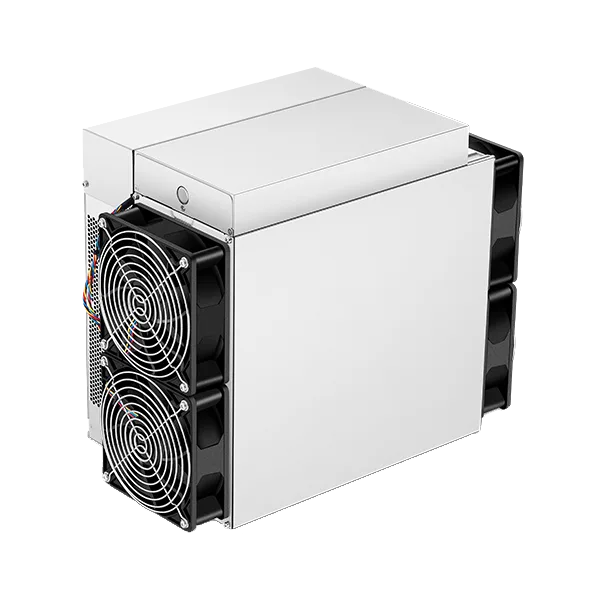
Bitmain Antminer L7 model 240-L eight-bin official reference
Official Antminer L7 model 240-L reference covering eight 7,800–9,500 MH/s Scrypt bins, normalized efficiency units, electrical/fan boundaries, firmware recovery, repair and troubleshooting.
Quick answer
The Bitmain Antminer L7 model 240-L eight-bin official reference is a Scrypt miner rated about 7800-9500 MH/s at roughly 2,810 W.
Full Specifications
| Model | Bitmain Antminer L7 model 240-L eight-bin official reference |
|---|---|
| Model Number | Antminer L7 model 240-L |
| Manufacturer | Bitmain |
| Algorithm | Scrypt |
| Hashrate | 7800-9500 MH/s |
| Power Consumption | 2,810-3,420 W |
| Cooling | Air |
| Voltage Range | 200-240 V AC; 47-63 Hz; follow exact Bitmain two-input current requirements |
| Operating Temperature | 0 C to 40 C |
| Dimensions | 370 x 195.5 x 290 mm |
| Weight | 13.5 kg net |
| Interface | RJ45 Ethernet 10/100M |
| Status | OEM support reference |
Official eight-bin reference: The Antminer L7 is a Scrypt miner identified by the manufacturer as model 240-L. Its exact performance record publishes the eight lanes below.
| OEM lane | Normalized hashrate | Wall power at 25°C | Normalized efficiency at 25°C |
|---|---|---|---|
| L7-7800M | 7,800 MH/s, ±3% | 2,810 W, ±10% | 0.36 J/MH (360 J/GH), ±10% |
| L7-8050M | 8,050 MH/s, ±3% | 2,900 W, ±10% | 0.36 J/MH (360 J/GH), ±10% |
| L7-8300M | 8,300 MH/s, ±3% | 2,990 W, ±10% | 0.36 J/MH (360 J/GH), ±10% |
| L7-8550M | 8,550 MH/s, ±3% | 3,078 W, ±10% | 0.36 J/MH (360 J/GH), ±10% |
| L7-8800M | 8,800 MH/s, ±3% | 3,170 W, ±10% | 0.36 J/MH (360 J/GH), ±10% |
| L7-9050M | 9,050 MH/s, ±3% | 3,260 W, ±10% | 0.36 J/MH (360 J/GH), ±10% |
| L7-9300M | 9,300 MH/s, ±3% | 3,350 W, ±10% | 0.36 J/MH (360 J/GH), ±10% |
| L7-9500M | 9,500 MH/s, ±3% | 3,420 W, ±10% | 0.36 J/MH (360 J/GH), ±10% |
OEM unit-label correction
The official table labels its efficiency column “J/TH” while publishing 0.36, and its 8,800 row labels the hashrate as TH/s while the surrounding L7 rows use MH/s. Those labels are dimensionally inconsistent with the Scrypt performance and power values in the same table. This reference therefore preserves the OEM numbers while safely normalizing all lanes to MH/s and J/MH, with J/GH shown as an equivalent. It does not publish 0.36 J/TH or 8,800 TH/s.
Electrical, fan, and environmental boundaries
| AC input | 200–240 V AC; 47–63 Hz; 20 A under the manufacturer’s maximum-condition note |
|---|---|
| Input arrangement note | Two AC input wires, 10 A per wire |
| Network | RJ45 Ethernet 10/100M |
| Fans | Four 12038 fans; 6,000 RPM front and rear; 12 V/2.7 A; 320 CFM mid value |
| Operating environment | 0–40°C; 10–90% RH, non-condensing; altitude up to 2,000 m |
| Altitude derating | From 1,000 m to 2,000 m, reduce the highest operating temperature by 1°C for every 300 m increase |
| Storage | -20–70°C |
The published miner dimensions, including the PSU, are 370 × 195.5 × 290 mm and net weight is 13.5 kg. Packaged dimensions are 570 × 316 × 430 mm and gross weight is 15 kg.
This is high-power equipment requiring a qualified installation. Verify the complete model/bin, miner and PSU nameplates, input arrangement, circuit capacity, protection, grounding, conductors, connectors, cords, airflow, and local requirements. Do not plug or unplug energized power connections.
Firmware and control-board identification
Firmware must match both the L7 identity and the installed control-board revision. A common enclosure, PSU family, connector, or update method does not establish firmware, controller, hashboard, or PSU interchangeability.
- Photograph the miner, control-board, and PSU labels; record the serial, exact bin, board revision, and installed version.
- Select L7 in the manufacturer’s firmware selector and read the package description before downloading.
- Follow the official firmware-download guidance.
- If exact-model recovery is required, use the L7 flash-card procedure. It formats the recovery card and erases its existing contents, so confirm the target drive and preserve needed data first.
- Stop if the image or instructions do not explicitly match the unit’s model and controller.
Troubleshooting, repair, and comparison
- Diagnose an L7 temperature-too-high condition.
- Request L7 hardware repair.
- Compare the L3+ and L7 using Scrypt-normalized units.
- Compare the L7 and L9 using exact algorithm-appropriate fields.
Known boundaries: no sound level, ASIC model/count, universal control board, cross-model parts compatibility, tuning, residential suitability, heat-reuse recommendation, profitability, price, or lifecycle status is asserted.
Primary sources: the official L7 performance and universal specification, fan-parameter record, L7 support route, firmware-download guidance, and exact L7 flash recovery linked above. Reviewed August 27, 2026.