
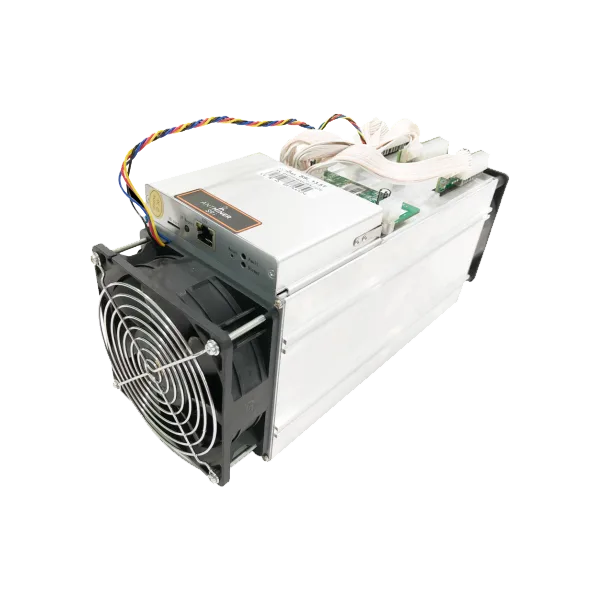
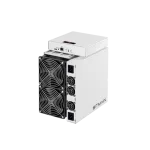
Bitmain Antminer S9i (14Th)
Quick answer
The Bitmain Antminer S9i (14Th) is a Bitcoin miner rated about 14 TH/s at roughly 1,320 W (about 94.3 J/TH). An industrial-class unit — loud and power-hungry, best suited to a dedicated mining space, not living areas.
Heater-Class Miner
At 1,320W, this miner outputs approximately 4504 BTU/hr of heat — equivalent to a standard electric space heater. Every watt consumed by an ASIC miner is converted to heat with 100% efficiency, making it a space heater that also mines Bitcoin.
During heating season, miner heat can offset part of the heat a room would otherwise need from another electric heater. The economics depend on your electricity rate, room heat demand, BTC price, network difficulty, and noise constraints.
Profitability Calculator
| Period | Revenue | Electricity Cost | Profit |
|---|---|---|---|
| Daily | $0.55 | $2.22 | $-1.67 |
| Weekly | $3.86 | $15.52 | $-11.66 |
| Monthly | $16.55 | $66.53 | $-49.98 |
| Yearly | $201.33 | $809.42 | $-608.10 |
Heating offset estimates the value of heat replacing an electric space heater during heating season (~6 months/year in Canada). Actual savings depend on your heating setup and climate.
Buy from D-Central
In stock and ready to ship from Montreal, Quebec.
Where to Buy the Bitmain Antminer S9i (14Th)
D-Central Technologies
CanadaBitcoin Mining Hackers since 2016. Ships from Montreal, Quebec.
Full Specifications
| Model | Bitmain Antminer S9i (14Th) |
|---|---|
| Model Number | Antminer S9i (14Th) |
| Manufacturer | Bitmain |
| Algorithm | SHA-256 |
| Coins Mined | Bitcoin (BTC) |
| Hashrate | 14 TH/s |
| Power Consumption | 1,320 W |
| Efficiency | 94.3 J/TH |
| Dimensions | 135 x 158 x 350mm |
| Weight | 4.2 |
| BTU Output | 4504 BTU/hr |
| Equivalent Heater | Half a standard space heater (4,504 BTU/hr) |
| Daily Power Cost | $2.22/day |
| Monthly Power Cost | $66.53/mo |
| Circuit Requirement | Fits 120V 15A circuit budget (1,440 W continuous, NEC 80% rule) - stock APW-series PSUs still need 200-240V input |
| Release Date | 2018-05-01 |
| MSRP | $65.00 |
| Status | Active |
Home Mining Assessment
The Bitmain Antminer S9i (14 TH/s) is the refined 2018 build of the legendary S9 — three BM1387 hashboards on a Xilinx Zynq control board, drawing roughly 1320 W for about 94 J/TH on SHA-256. It is the most widely deployed and most thoroughly reverse-engineered ASIC ever made, and at today’s difficulty it earns its keep as a heater, solo-mining lottery ticket, or learning rig rather than a profit machine.
Chip and hashboard architecture
The S9i is built around Bitmain’s BM1387, a TSMC 16 nm SHA-256 ASIC carrying 114 small hashing cores per die in a compact QFN package. Each of the miner’s three hashboards mounts 63 of these chips, for 189 chips and roughly 21,500 cores across the machine. At the nameplate 14 TH/s that works out to about 74–75 GH/s per chip — modest by 2026 standards, but the BM1387 is famously durable silicon, which is precisely why so many S9-class units are still running nine years after launch.
The chips on each board are not wired in one long string. They are organised as 21 voltage domains of three chips in parallel, and those 21 domains sit in series so the board rail (nominally near 8.4 V, with each domain around 0.4 V) is the sum of the domain voltages. This matters: voltage is regulated per domain, never per individual chip. When mining hackers talk about “tuning” a BM1387 board, they are moving frequency and domain voltage for the whole string — and when a single domain shorts or goes open, it drops the entire series chain and the board reads as dead. That series-string design is the root cause of the most common S9 hashboard failure.
Control board and supporting silicon
Each board is driven by a Xilinx Zynq 7010 (XC7Z010) system-on-chip: a dual-core ARM Cortex-A9 running at 667 MHz alongside an Artix-7 FPGA fabric (~28K logic elements) that streams work to the chips over UART chains. The S9-family control board carries 512 MB of RAM and boots a small embedded Linux. Three PIC16F1704 microcontrollers per board (addressed on the I2C bus that the FPGA fronts) hold each chain’s voltage code, frequency table, and the all-important bad-core map, while a pair of TMP75-class temperature sensors per board (I2C 0x98 / 0x4A) report die-edge temperatures. There is no separate I2C controller in the memory map — the stock firmware reaches the PICs and sensors through FPGA registers at 0x43C00000.
Real-world power and efficiency
The 1320 W on the spec sheet is the figure at the PSU output. Once you count conversion losses through an APW3++ (or APW7) power supply, expect roughly 1400–1450 W at the wall on a 220–240 V circuit; the same PSU delivers less usable power on a 110–120 V outlet, so North American home miners should plan for 240 V where possible. At 14 TH/s the S9i lands at about 94 J/TH — squarely in the legacy efficiency tier, an order of magnitude thirstier than a modern S21, but still useful where the heat is wanted or the power is effectively free.
There is real tuning headroom in either direction. The S9 generation pre-dates the named “power profiles” of newer Antminers, so on this hardware you set frequency and voltage directly (typical ranges run 550–650 MHz and ~860–900 on the voltage code). Underclocking — dropping frequency and domain voltage — can pull efficiency below 90 J/TH at a reduced hashrate, which is the sweet spot for a quiet, cool-running heater. Pushing the other way toward 16–17 TH/s is possible with aftermarket firmware but punishes the 16 nm silicon and the PSU, and efficiency degrades past 100 J/TH. We map the trade-offs for this and every model in the ASIC power profiles database.
Firmware compatibility
Stock firmware is Bitmain’s bmminer, a CGMiner fork that applies one uniform frequency and voltage to every domain (no autotuning), charges no dev fee, supports overt AsicBoost via version rolling, and — importantly for owners — refuses to start unless it sees two working fans. The S9 is also the single most firmware-flexible ASIC ever shipped, and we credit the projects that proved it. Braiins OS+ rebuilt the stack in Rust (BOSminer) with runtime autotuning that calculates per-domain operating points on the fly rather than reading a fixed preset, and it remains the one firmware family that natively speaks Stratum V2. A broad ecosystem of other community and commercial firmwares added per-domain tuning and hashrate boosts to the same BM1387 platform.
Common faults and troubleshooting
Because S9-class units have been in the field for the better part of a decade, their failure modes are well catalogued:
- “Some Fan lost” fatal error — stock firmware requires two healthy fans and aborts the whole miner if one drops below the RPM floor. A single failed or unplugged fan looks like a dead miner.
- Dead chain / 0 ASIC found — a board reporting zero chips usually means one of its 21 series voltage domains has failed, opening the whole string. This is the classic S9 board fault and is repairable at the domain level.
- PIC FLASH errors — messages like “Error of set PIC FLASH addr” mean a hashboard’s PIC16F1704 can’t read or write its config (voltage, frequency, bad-core map), often pointing to a PIC reflash or replacement rather than a chip fault.
- Rising HW errors and disabled cores — every BM1387 board ships with some dead cores mapped out (15–30 per board is normal); a sudden jump in disabled cores or hardware-error rate signals a degrading domain or thermal problem.
- Temperature sensor faults — a board that won’t report temperature usually has a failed TMP75 sensor on its I2C bus, which the firmware treats as a safety stop.
Work through symptoms methodically with our ASIC fault finder before pulling boards, and cross-reference any on-screen code against our error-code library.
Repair and longevity
The S9 is the machine D-Central cut its teeth on — we have done in-house, chip-level ASIC repair in Montreal since 2016, and the BM1387 board is the one our bench knows best. Most S9i failures are repairable rather than terminal: a shorted domain can be isolated and the offending BM1387 reballed or replaced, a faulty PIC can be reflashed, a degraded voltage regulator or fan header can be rebuilt, and a tired APW3++ PSU can be swapped. Because the silicon is 16 nm and runs cool relative to modern flagships, a properly serviced S9i can hash for years more. If your board reads dead, don’t scrap it — see our ASIC repair service for a diagnosis.
Who the S9i is for, and buying notes
Be honest with yourself about economics: on grid power at typical rates the S9i no longer mines Bitcoin at a profit. Where it shines is everywhere the math is different — as a space heater that pays you back (its ~4504 BTU/h of waste heat can be ducted into a room or workshop), as a low-cost solo-mining lottery ticket pointed at a solo pool such as CKpool, or as a hands-on learning rig for understanding real ASIC hardware, stratum, and firmware. If your goal is purely to learn on a single chip with wall-friendly power, a modern open-source Bitaxe is the gentler entry point; if you want the full three-board, datacenter-class experience cheaply, the S9i is unbeatable value. Browse available units and refurbished hardware in our miner catalog.
Generational context
Released in May 2018, the S9i was Bitmain’s mid-life refresh of the S9 line — better-binned BM1387 boards lifting the original 13.5 TH/s S9 to a 14 TH/s rating (the later S9j pushed the same silicon to ~14.5 TH/s). The whole family defined the 2017–2019 era and put Bitcoin mining in spare bedrooms worldwide. It was superseded by the 7 nm S15/S17 generation, then the BM1398-based S19 series, and today’s 5 nm BM1368 S21 class, each leaping forward in efficiency. None of that erases the S9’s place in the story: it remains the most documented, most hackable, and most repairable ASIC in existence, and a working example is still one of the best teachers in the room.
Antminer S9i specifications and family comparison
| Specification | Antminer S9i (14Th) |
|---|---|
| Algorithm | SHA-256 (Bitcoin / BTC) |
| Nameplate hashrate | 14 TH/s |
| Power (PSU output) | 1320 W |
| Efficiency | 94.3 J/TH |
| ASIC chip | BM1387 (TSMC 16 nm) |
| Chip layout | 3 boards x 63 chips = 189 chips; 114 cores/chip |
| Voltage domains | 21 series domains/board (3 chips parallel each) |
| Control board | Xilinx Zynq 7010, dual Cortex-A9 @ 667 MHz, 512 MB RAM |
| Cooling | Dual 120 mm fans (loud; two-fan minimum enforced by stock firmware) |
| Heat output | ~4504 BTU/h |
| Dimensions | 135 x 158 x 350 mm |
| Weight | ~4.2 kg |
| Recommended voltage | 220-240 V (PSU sold separately, e.g. APW3++) |
| Release | May 2018 |
| Model | Chip | Hashrate | Power | Efficiency |
|---|---|---|---|---|
| Antminer S9 (13.5T) | BM1387 | 13.5 TH/s | 1320 W | ~98 J/TH |
| Antminer S9i (14T) | BM1387 | 14 TH/s | 1320 W | 94.3 J/TH |
| Antminer S9j (14.5T) | BM1387 | 14.5 TH/s | 1310 W | ~90 J/TH |
All three share identical 189-chip BM1387 architecture and the same Xilinx Zynq control board; the differences are binning and factory clocks, which is why a single repair and firmware skill set covers the entire S9 family.
Broken miner? Get a real quote.
Tell us the symptom and get an instant repair-tier estimate ($95 / $145 / $195 CAD). Mail-in from across Canada, bench in Montreal, Quebec.
Send it to D-Central — start a repair →Antminer S9 family specs, heater path, and parts
Use the S9 cluster to route legacy miner owners to specs, repair guidance, APW3 power parts, hashboard bundles, and heater use cases.
- Antminer S9 specs
- Bitmain Antminer S9
- Antminer S9 as-is units
- S9 hashboard repair parts bundle
- S9 maintenance guide
- S9 hashboard troubleshooting
- APW3++ power supply
- S9 heater conversion path
- Confirm chip count, voltage domains, fitment
- Full per-model repair BOM
- Match firmware to this model
- Which firmwares run on this control board — factual support matrix
Related Miners
Bitmain Antminer S19 Pro+ Hyd (198Th)
Bitmain Antminer T9+ (10.5Th)
Whatsminer M63S+
Antminer S17 Pro
Compare the Bitmain Antminer S9i (14Th)
Frequently Asked Questions
What are the current mining economics for the Bitmain Antminer S9i (14Th)?
At $0.07/kWh, the Bitmain Antminer S9i (14Th) currently shows an estimated daily net cost of $1.67 before pool fees and hardware cost. Lower electricity rates, network changes, BTC price changes, or useful heat recovery can change the result.
Can I mine Bitcoin at home with the Bitmain Antminer S9i (14Th)?
The Bitmain Antminer S9i (14Th) has a home mining score of 22/100. With 0 dB noise and 1,320W power draw, it may require a dedicated space like a garage, basement, or outdoor enclosure. Consider noise insulation and proper ventilation.
Can the Bitmain Antminer S9i (14Th) heat my home?
The Bitmain Antminer S9i (14Th) outputs approximately 4504 BTU/hr of heat. For reference, a typical space heater produces 5,000-5,500 BTU/hr. All electrical energy consumed by the miner is converted to heat, making it 100% efficient as a heater. D-Central offers Bitcoin Space Heater builds designed specifically for home heating integration.
What power supply does the Bitmain Antminer S9i (14Th) need?
The Bitmain Antminer S9i (14Th) draws 1,320W of power. You need a power supply rated for at least 1,452W with appropriate voltage (200-240V AC). D-Central stocks compatible power supplies in our shop. Always use a quality PSU from a reputable manufacturer to protect the miner and wiring.