
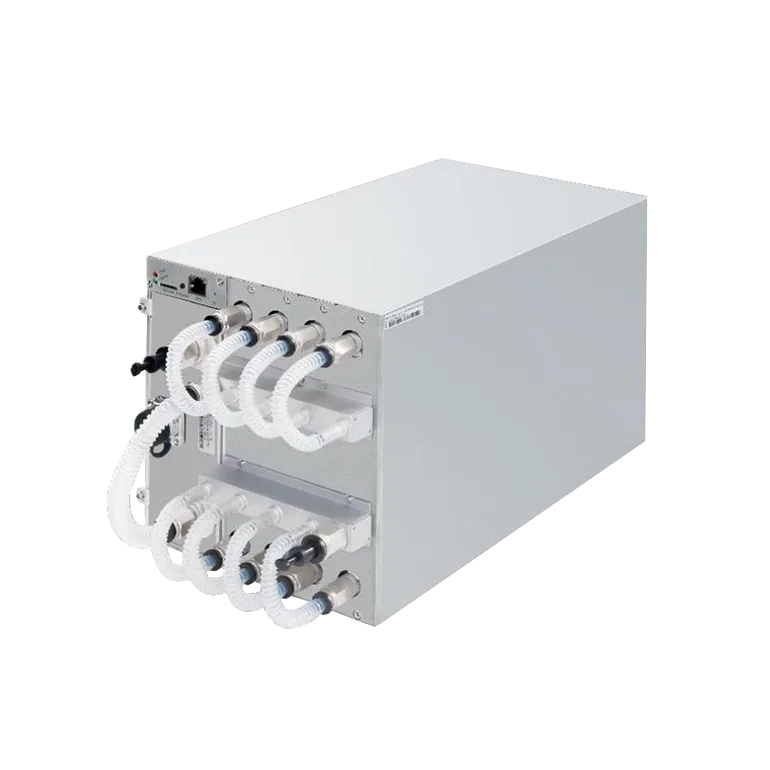
Bitmain Antminer S21e Hyd (288Th)
Quick answer
The Bitmain Antminer S21e Hyd (288Th) is a Bitcoin miner rated about 288 TH/s at roughly 4,896 W (about 17 J/TH). An industrial-class unit — loud and power-hungry, best suited to a dedicated mining space, not living areas.
Hydro-Cooled Miner
This miner uses a closed-loop liquid cooling system (hydro cooling) instead of traditional air cooling. Water or coolant circulates through internal channels to absorb heat from the ASIC chips, then transfers it to an external radiator or facility cooling loop.
Hydro-cooled miners run significantly quieter than air-cooled models since they eliminate or minimize fan noise. They also achieve higher hashrates and better efficiency because the chips can be driven harder while staying within safe thermal limits. The trade-off: hydro miners require compatible water infrastructure — inlet/outlet connections, a cooling distribution unit (CDU), and proper plumbing.
Hydro cooling is ideal for professional mining operations and data centers where water infrastructure already exists, or for home miners building a dedicated water-cooled setup to eliminate noise completely.
Professional-Grade Miner
This miner draws 4,896W and produces 50 dB of noise — it is designed for dedicated mining environments, not living spaces. Professional-grade miners deliver the highest hashrate and revenue per unit but require proper infrastructure: a 240V circuit, adequate ventilation or exhaust ducting, and a space where noise is not a concern (garage, basement, warehouse, or outdoor enclosure).
For home miners looking for a quieter alternative, consider our Bitcoin Space Heater builds or explore open-source miners like the Bitaxe that are purpose-built for residential environments.
Profitability Calculator
| Period | Revenue | Electricity Cost | Profit |
|---|---|---|---|
| Daily | $11.31 | $8.23 | $3.09 |
| Weekly | $79.19 | $57.58 | $21.61 |
| Monthly | $339.38 | $246.76 | $92.62 |
| Yearly | $4,129.11 | $3,002.23 | $1,126.88 |
Heating offset estimates the value of heat replacing an electric space heater during heating season (~6 months/year in Canada). Actual savings depend on your heating setup and climate.
Where to Buy the Bitmain Antminer S21e Hyd (288Th)
D-Central Technologies
CanadaBitcoin Mining Hackers since 2016. Ships from Montreal, Quebec.
Shop all Bitcoin mining productsASIC Miner Market
United StatesWide selection of new and used ASIC miners. US-based shipping.
Shop NowFull Specifications
| Model | Bitmain Antminer S21e Hyd (288Th) |
|---|---|
| Model Number | Antminer S21e Hyd (288Th) |
| Manufacturer | Bitmain |
| Algorithm | SHA-256 |
| Coins Mined | Bitcoin (BTC) |
| Hashrate | 288 TH/s |
| Power Consumption | 4,896 W |
| Efficiency | 17 J/TH |
| Noise Level | 50 dB |
| Cooling | Hydro |
| Dimensions | 339*173*207mm |
| Weight | 13.8 |
| BTU Output | 16705 BTU/hr |
| Equivalent Heater | Equal to a 4,896W space heater |
| Daily Power Cost | $8.23/day |
| Monthly Power Cost | $246.76/mo |
| Circuit Requirement | 240V circuit required |
| Release Date | 2025-04-01 |
| MSRP | $1,498.00 |
| Status | Active |
Home Mining Assessment
The Antminer S21e Hyd (288Th) is Bitmain’s liquid-cooled SHA-256 miner built on the BM1368 5 nm chip. It is factory-rated at 288 TH/s for 4,896 W (17 J/TH), released April 2025, and designed for water-cooled Hashcenter deployments rather than the living room. Below is the full engineering picture, grounded in our own teardown and firmware research.
Chip and hashboard architecture
At the heart of the S21e Hyd is the BM1368, Bitmain’s fifth-generation SHA-256 ASIC fabricated on a TSMC 5 nm process (the same node family as the S21 and T21, not 3 nm as some spec sheets claim). Each BM1368 die packs roughly 1,280 hashing cores (a mix of 80 large and 16 small SHA engines) in a QFN package, delivering on the order of 600–750 GH/s per chip depending on how hard it is clocked.
The unit carries three hashboards wired as series chains, with about 108 BM1368 chips per chain (~324 chips in total). The chips on each board are not powered individually. Instead they are grouped into 12 voltage domains of roughly 9 chips each, with every domain regulated at approximately 1.2 V. This is the single most misunderstood point about modern Antminers: voltage is controlled per domain, never per chip. The chips inside a domain sit in series, so the domain voltage equals the per-chip voltage multiplied by the number of chips in that group, and any tuning you do moves a whole domain at once.
The S21 generation, including this hydro variant, is a “no-PIC” design — Bitmain removed the PIC microcontroller that policed voltage on S9-through-S19 boards. On the BM1368 platform, domain voltage and board telemetry are instead handled through TAS5782M devices addressed over I2C, repurposed from audio-DAC silicon. There is no separate PIC heartbeat to satisfy, which changes both the failure modes and the repair approach versus older Antminers.
Control board
The S21e Hyd runs on an Amlogic A113D (AXG) control board — a quad-core ARM Cortex-A53 SoC with 256 MB of DDR3, originally an audio chip, with no FPGA. All three hashboard chains are driven from a single UART (/dev/ttyS2) that ramps up to 3 Mbaud for mining, with GPIO lines selecting and resetting each board. Because there is no FPGA fabric, the control board talks to the ASICs directly in software — simpler hardware, but it means firmware does the heavy lifting the FPGA used to do.
Real-world power and efficiency
The 4,896 W on the label is the board-and-PSU figure at the factory turbo point. At the wall, plan for more: PSU conversion losses add several percent, and a hydro miner is never alone — the external pump and dry-cooler fans that reject its heat draw their own power. Budget your circuit and your facility’s heat-rejection loop accordingly. At 4,896 W this is a 240 V-class machine drawing north of 20 A, not something to share with a household circuit.
Where the S21e Hyd really shines is its tuning headroom. Liquid cooling pulls heat off the dies far more effectively than air, so the same BM1368 silicon holds higher sustained clocks — or, run the other direction, far better efficiency. Our firmware research catalogues 80 distinct power profiles for this model across three modes, the richest profile set of any SHA-256 miner we have documented:
| Operating mode | Hashrate (TH/s) | Power (W) | Efficiency (J/TH) | Use case |
|---|---|---|---|---|
| Factory / turbo | ~288 (up to ~482 ceiling) | 4,896 (up to ~14,400) | 17.0, rising toward ~30 at the top | Nameplate rating; max hashrate |
| Normal | 165–281 | 2,722–4,636 | 16.5 (flat) | Balanced daily operation |
| Low-power | 165–251 | 2,450–4,100 | 14.8–16.3 | Best efficiency in our SHA-256 catalogue |
The takeaway: the factory 288 TH/17 J/TH point is essentially turbo. Dial the unit into a balanced “normal” profile and it settles at a flat 16.5 J/TH; push into low-power and it reaches 14.8 J/TH — the single best efficiency figure across every SHA-256 machine we have profiled — by trading away roughly 40% of peak hashrate. Conversely, the performance curve runs all the way to ~482 TH, but efficiency degrades steeply past the factory point, so overclocking buys hashrate at a real cost in J/TH. Explore the full curve on our ASIC power-profiles database before you commit a fleet to a setpoint.
Firmware compatibility
The S21e Hyd ships with Bitmain’s stock firmware, which is competent but deliberately limits how far you can tune voltage and frequency. The BM1368 generation is well supported by the major third-party stacks — BraiinsOS+, VNish and LuxOS all run on this silicon — which is where the 80-profile tuning range above comes from. A few honest caveats:
- Firmware locks. Amlogic-based units shipped after March 2024 carry signed-firmware locks. Loading third-party firmware on a recent S21e Hyd can require an unlock step, and getting it wrong can brick the control board. This is not a casual flash.
- Stratum V2. If protocol-level sovereignty matters to you, note that BraiinsOS+ is the only major Antminer firmware that natively supports Stratum V2 today; the others remain Stratum V1.
- Autotuning is calculated, not preset. The per-domain frequency and voltage targets a good autotuner lands on are computed at runtime for your specific boards and ambient conditions — they are not a fixed table baked into the image. Two “identical” S21e Hyds can settle at different setpoints, and that is correct behaviour.
Common faults and troubleshooting
Most S21e Hyd problems fall into two buckets: the BM1368 board faults common to the whole S21 family, and hydro-specific cooling-loop issues.
On the board side, the failure to understand is the voltage domain. Because chips are grouped 9-to-a-domain in series, a single shorted chip pulls its whole domain’s voltage low and the boost circuit compensates; an open circuit pushes the domain voltage high. The control board reads back a low ASIC count or an abnormal domain voltage and the chain stops hashing. Typical symptoms include a board reporting 0 or a reduced ASIC count, “abnormal” temperature or voltage readings, or one of three boards dropping out while the other two keep mining. Diagnosis means metering each domain’s test points (labelled around VDD1V2 / VDD0V8) to localise the fault to a specific domain and LDO rather than guessing at a chip.
On the hydro side, watch coolant flow above everything: a weak or failed pump, air trapped in the loop, a clogged cold plate, or an undersized dry cooler will spike die temperatures and trip the miner long before an air-cooled unit would complain. Inspect every fitting — a slow leak around a quick-connect is the classic hydro failure — and keep coolant chemistry and flow rate within spec.
Work symptoms backwards with our ASIC fault finder, which maps error codes and behaviours (chain detection failures, temperature-protection trips, low hashrate, fan/flow faults) to likely causes and the right next test.
Repair and longevity
A liquid-cooled miner is a long-term asset, and the BM1368 platform is repairable at the board level. D-Central has run in-house ASIC repair in Montreal, Quebec since 2016 — chip-level reflow and replacement, voltage-domain diagnosis, cold-plate and water-block servicing, control-board recovery, and PSU work. The no-PIC architecture actually simplifies some repairs (there is no PIC handshake to defeat), but it demands proper domain-level metering and reflow gear rather than parts-swapping. Rather than writing off a hydro unit over one dead domain or a leaking fitting, send it to our ASIC repair service — a single recovered hashboard is usually a fraction of replacement cost, and well-maintained S21-class hardware has years of useful life ahead of it.
Who it is for, and buying
With a home-mining score of 44/100, the S21e Hyd is squarely facility and Hashcenter hardware, not a bedroom miner. It cannot run plug-and-play: it needs an external water loop — pump, dry cooler or cooling-distribution unit, and the plumbing to match — plus a 240 V circuit sized for ~5 kW. In return you get a near-silent ~50 dB unit (the real noise moves outdoors to the dry cooler) and roughly 16,705 BTU/h of recoverable heat in a captured, water-borne form that is far easier to duct or reuse than hot air. For an operator already running liquid cooling and chasing the best J/TH the S21 generation offers, it is one of the strongest options Bitmain shipped before the BM1370 machines.
If a hydro deployment is more than you need right now, browse our full ASIC miner catalogue for air-cooled S21-family alternatives, or talk to us about a build-to-order configuration. We are mining hackers, not a faceless reseller — we would rather point you at the right machine than the most expensive one.
Generational context
The S21e Hyd belongs to Bitmain’s S21 generation, the 5 nm BM1368/BM1370 family that delivered a step-change in efficiency over the 7 nm S19 era (which sat near 30 J/TH). Within the lineup, the BM1368-based S21 and S21e Hyd land around 16–17.5 J/TH, while the newer BM1370 machines — the S21+ Hydro and S21 XP Hydro — push to roughly 12–15 J/TH. The “e” hydro variant carves out a specific niche: a profile-rich, liquid-cooled BM1368 unit tuned for exceptional efficiency in normal and low-power modes rather than raw top-end hashrate. It is a refinement of a chip Bitmain got right — one we are happy to keep alive on the bench long after its warranty ends.
Broken miner? Get a real quote.
Tell us the symptom and get an instant repair-tier estimate ($95 / $145 / $195 CAD). Mail-in from across Canada, bench in Montreal, Quebec.
Send it to D-Central — start a repair →Recommended parts and tools
Confirm symptoms against the guide, then route to the exact part, tool, or repair workflow that matches the miner family.
Related Miners
Canaan Avalon A1566HA 500T
Whatsminer M63S
Block Proto Rig
Avalon A1466
Compare the Bitmain Antminer S21e Hyd (288Th)
Frequently Asked Questions
What are the current mining economics for the Bitmain Antminer S21e Hyd (288Th)?
At $0.07/kWh electricity, the Bitmain Antminer S21e Hyd (288Th) currently shows an estimated $3.09 daily net result before pool fees and hardware cost. Results depend on your electricity rate and Bitcoin network conditions. Use the calculator above with your actual electricity rate.
Can I mine Bitcoin at home with the Bitmain Antminer S21e Hyd (288Th)?
The Bitmain Antminer S21e Hyd (288Th) has a home mining score of 32/100. With 50 dB noise and 4,896W power draw, it may require a dedicated space like a garage, basement, or outdoor enclosure. Consider noise insulation and proper ventilation.
Can the Bitmain Antminer S21e Hyd (288Th) heat my home?
The Bitmain Antminer S21e Hyd (288Th) outputs approximately 16705 BTU/hr of heat. For reference, a typical space heater produces 5,000-5,500 BTU/hr. All electrical energy consumed by the miner is converted to heat, making it 100% efficient as a heater. D-Central offers Bitcoin Space Heater builds designed specifically for home heating integration.
What power supply does the Bitmain Antminer S21e Hyd (288Th) need?
The Bitmain Antminer S21e Hyd (288Th) draws 4,896W of power. You need a power supply rated for at least 5,386W with appropriate voltage (200-240V AC). D-Central stocks compatible power supplies in our shop. Always use a quality PSU from a reputable manufacturer to protect the miner and wiring.