On this page
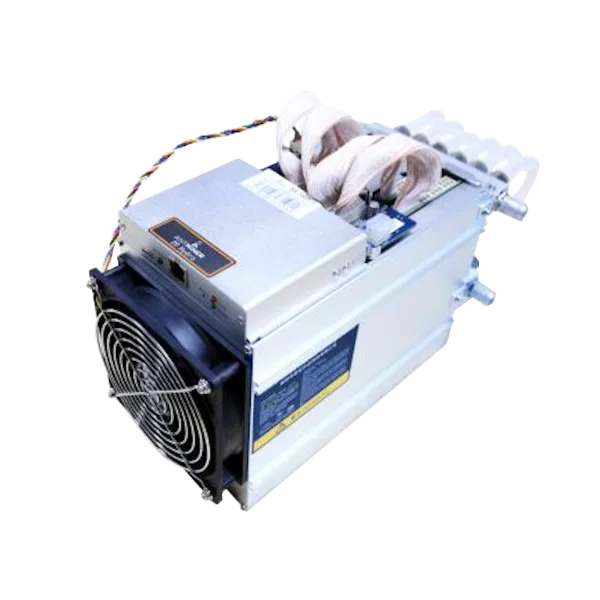
Bitmain Antminer S9 Hydro (18Th)
Quick answer
The Bitmain Antminer S9 Hydro (18Th) is a Bitcoin miner rated about 18 TH/s at roughly 1,728 W (about 96 J/TH). An industrial-class unit — loud and power-hungry, best suited to a dedicated mining space, not living areas.
Hydro-Cooled Miner
This miner uses a closed-loop liquid cooling system (hydro cooling) instead of traditional air cooling. Water or coolant circulates through internal channels to absorb heat from the ASIC chips, then transfers it to an external radiator or facility cooling loop.
Hydro-cooled miners run significantly quieter than air-cooled models since they eliminate or minimize fan noise. They also achieve higher hashrates and better efficiency because the chips can be driven harder while staying within safe thermal limits. The trade-off: hydro miners require compatible water infrastructure — inlet/outlet connections, a cooling distribution unit (CDU), and proper plumbing.
Hydro cooling is ideal for professional mining operations and data centers where water infrastructure already exists, or for home miners building a dedicated water-cooled setup to eliminate noise completely.
Professional-Grade Miner
This miner draws 1,728W and produces 75+ dB of noise — it is designed for dedicated mining environments, not living spaces. Professional-grade miners deliver the highest hashrate and revenue per unit but require proper infrastructure: a 240V circuit, adequate ventilation or exhaust ducting, and a space where noise is not a concern (garage, basement, warehouse, or outdoor enclosure).
For home miners looking for a quieter alternative, consider our Bitcoin Space Heater builds or explore open-source miners like the Bitaxe that are purpose-built for residential environments.
Heater-Class Miner
At 1,728W, this miner outputs approximately 5896 BTU/hr of heat — equivalent to a standard electric space heater. Every watt consumed by an ASIC miner is converted to heat with 100% efficiency, making it a space heater that also mines Bitcoin.
During heating season, miner heat can offset part of the heat a room would otherwise need from another electric heater. The economics depend on your electricity rate, room heat demand, BTC price, network difficulty, and noise constraints.
Profitability Calculator
| Period | Revenue | Electricity Cost | Profit |
|---|---|---|---|
| Daily | $0.57 | $2.90 | $-2.33 |
| Weekly | $3.98 | $20.32 | $-16.34 |
| Monthly | $17.06 | $87.09 | $-70.03 |
| Yearly | $207.60 | $1,059.61 | $-852.01 |
Heating offset estimates the value of heat replacing an electric space heater during heating season (~6 months/year in Canada). Actual savings depend on your heating setup and climate.
Where to Buy the Bitmain Antminer S9 Hydro (18Th)
D-Central Technologies
CanadaBitcoin Mining Hackers since 2016. Ships from Laval, Quebec.
Shop all Bitcoin mining productsASIC Miner Market
United StatesWide selection of new and used ASIC miners. US-based shipping.
Shop NowFull Specifications
| Model | Bitmain Antminer S9 Hydro (18Th) |
|---|---|
| Model Number | Antminer S9 Hydro (18Th) |
| Manufacturer | Bitmain |
| Algorithm | SHA-256 |
| Coins Mined | Bitcoin (BTC) |
| Hashrate | 18 TH/s |
| Power Consumption | 1,728 W |
| Efficiency | 96 J/TH |
| Cooling | Hydro |
| Dimensions | 125 x 190 x 360mm |
| Weight | 5.2 |
| BTU Output | 5896 BTU/hr |
| Equivalent Heater | Equal to a 1,728W space heater |
| Daily Power Cost | $2.90/day |
| Monthly Power Cost | $87.09/mo |
| Circuit Requirement | Dedicated 120V 20A |
| Release Date | 2018-08-01 |
| Status | Active |
Home Mining Assessment
The Antminer S9 Hydro (18 Th) is Bitmain’s water-cooled variant of the legendary S9, a SHA-256 Bitcoin miner that pushes the same 16 nm BM1387 silicon to 18 TH/s for about 1,728 W — roughly 96 J/TH. Liquid cooling lets it run faster and near-silent, but it needs an external water loop to operate.
Chip and hashboard architecture
The S9 Hydro runs Bitmain’s BM1387, the first-generation SHA-256 ASIC fabricated on a TSMC 16 nm process. Each BM1387 carries 114 hashing cores, and the chip was the workhorse that defined the 2017–2018 era of Bitcoin mining. The Hydro shares the S9 platform exactly: three hashboards, each carrying 63 BM1387 chips — 189 chips in total. What changes is the cooling, not the silicon.
On every board the 63 chips are daisy-chained over a shared UART bus. Commands flow forward from chip to chip and hash results return down a reverse line, which is why a single dead chip can make every chip behind it vanish from the controller’s view. A 25 MHz crystal clocks the chain, and the bus negotiates up from a 115,200 baud default to roughly 1.5 Mbaud once the chips are enumerated.
Power is delivered the way every Antminer hashboard handles it: chips are wired in series into voltage domains, and the regulator sets the voltage of each domain — not each individual chip. On the S9 board the 63 chips form 21 series domains of three chips each, with the board fed at roughly 8.4 V on the air-cooled baseline. There is no per-chip voltage knob; all tuning happens at the domain and board level. Because the Hydro keeps the chips far cooler than air can, it sustains a higher frequency and voltage on that same topology — that is the entire reason it reaches 18 TH/s where the air-cooled S9 tops out near 13.5 TH/s.
Each board’s voltage is managed by a dedicated PIC16F1704 microcontroller (three per machine, one per board, addressed over I²C), which sets the DAC voltage target and relays the on-board temperature sensors back to the controller. That “via-PIC” telemetry path means the S9 — unlike the later no-PIC S21/T21 generation — depends on a healthy PIC for both voltage control and thermal readings.
Orchestrating all three boards is a Xilinx Zynq-7010 control board: a dual-core ARM Cortex-A9 running at 667 MHz alongside an Artix-7 FPGA fabric that drives the high-rate UART traffic to the hashboards. It is the same Zynq control-board lineage Bitmain reused across its first-generation S9/S17 machines — a big part of why the S9 platform is still so serviceable years after launch.
Real-world power, efficiency and cooling
Bitmain’s nameplate for this bin is 18 TH/s at roughly 1,728 W at the wall, which works out to about 96 J/TH. That is squarely in the legacy efficiency tier: a current-generation S21-class machine does the same work near 17.5 J/TH, so the S9 Hydro burns roughly five times the power per terahash. It was an excellent number in 2018; in 2026 it sets the economics firmly toward heating and hobby use rather than pure profit.
The defining feature is the cooling. The S9 Hydro has no onboard fans. Instead, a liquid cold plate sits across the hashboards and carries heat away through inlet and outlet ports into an external water loop — typically a dry cooler, radiator or heat-dissipation unit. Two consequences follow. First, the unit is near-silent: the only noise is whatever pump and radiator you supply, not screaming 6,000 RPM fans. Second, almost all of its ~5,896 BTU/h of waste heat ends up in the coolant rather than blown into the air — which makes it uniquely suited to heat reuse (more on that below).
Tuning headroom on the BM1387 is real but modest. The chip family has a usable curve from a deep eco mode up through an overclock; on the air-cooled S9 baseline that spans roughly 620 W / 5.4 TH/s at the efficient end to about 1,980 W / 16.3 TH/s wide open, with the efficiency sweet spot near 880 W / 9.6 TH/s (≈91 J/TH). The Hydro’s liquid cooling shifts that whole curve upward because thermal headroom — not the silicon — is the binding constraint. If you want to see where a given wattage lands before committing, work through our ASIC power profiles reference rather than guessing at firmware settings. Note that autotuner values are calculated at runtime from live chip behaviour, not loaded from a fixed preset, so the numbers shift with chip health and coolant temperature.
Firmware compatibility
The S9 Hydro ships on Bitmain’s stock Antminer firmware — the cgminer/bmminer-based stack with the familiar web UI for pools, frequency presets and monitoring. For a straightforward deployment that is all it needs.
Because it is a standard S9-platform machine, the Hydro also runs the well-established third-party firmware for that generation. Braiins OS+ is the notable option: it is open about what it does, adds genuine autotuning, and is the only firmware that natively supports Stratum V2 on this hardware. Other aftermarket builds for the Zynq S9 platform exist and add their own tuning and monitoring. Be clear-eyed about the trade-offs of any closed third-party firmware — you are trusting someone else’s binaries on hardware that controls a multi-kilowatt PSU and a water loop — and remember that a firmware’s thermal limits are written for fan-cooled S9s, so they must be sanity-checked against the Hydro’s very different cooling behaviour.
The S9 also holds a place in our own work: it was the first proven hardware port of DCENT_OS, D-Central’s sovereignty-focused, GPL-licensed mining firmware, which has sustained cold-boot mining on real S9 units. DCENT_OS remains in closed beta today, so we mention it as context rather than a finished product you can flash this afternoon — we would rather tell you that plainly than over-promise.
Common faults and troubleshooting
S9-family failures fall into a handful of repeatable patterns, with a few that are specific to liquid cooling:
- Partial chip count / dead chain. A board reporting fewer than its 63 chips has a break point: the last detected chip sits just before the fault. A fully dead chain usually means a shorted chip pulling the bus down, while a clean cut-off mid-chain points at an open chip or a broken clock/data hop.
- Domain shorts and opens. Because the chips sit in 21 series voltage domains, a single failed domain can drop a board’s hashrate or kill it outright. An unpowered domain-impedance check across the board’s test points — looking for a domain that reads abnormally low (short) or high (open) — is the fastest way to localise it.
- Cooling and flow faults (Hydro-specific). With no fans to fall back on, the S9 Hydro depends entirely on coolant flow. A failed pump, a blocked line or a starved loop can let the boards overheat far faster than an air-cooled S9 would. Treat flow and coolant temperature as first-class alarms.
- Liquid intrusion and corrosion (Hydro-specific). A weeping fitting or a cracked cold-plate seal can drip coolant onto a live board. Inspect for corrosion, mineral residue and discoloured pads around the water block before assuming a chip has failed — water damage is a distinct failure class on these units.
- PIC, voltage and PSU faults. Because voltage and temperature both flow through the per-board PIC, a PIC or sensor-bus fault can present as phantom thermal or voltage errors even when the board is fine. Under-voltage and PSU protection trips show up as random restarts before they show up as hashboard damage.
Work symptoms back to root cause with our ASIC fault finder, and cross-reference the exact string your miner logs against our Antminer error-code library before swapping parts — many “dead board” reports turn out to be one chip, a flow problem, or a loose data ribbon.
Repair and longevity
The S9 is one of the most repairable miners ever made, and the Hydro is no exception. At 189 chips per machine, a board with one or two failed domains is worth fixing, not scrapping. D-Central has run an in-house ASIC repair bench since 2016, and S9 boards are diagnosed the same disciplined way as any Antminer hashboard: chain-walking the UART to find the break, checking domain voltages, verifying the 25 MHz crystal, and reflowing or replacing individual BM1387 chips rather than condemning the whole board.
The Hydro adds a few water-cooled-specific checks — pressure-testing the cold plate and fittings, inspecting for coolant intrusion, and confirming flow — but the underlying electronics are the same well-understood platform. Controller-side faults (corrupt firmware, network bricks, bad flash) are recoverable too, because the Zynq control board is so thoroughly documented. If your S9 Hydro is throwing chip-count errors, running hot, or dropping boards, our ASIC repair service can assess it at the component level — usually for a fraction of replacement cost.
Who the S9 Hydro is for
The S9 Hydro is a niche machine with one genuinely compelling use case: quiet, liquid-cooled mining with serious heat reuse. Because nearly all of its waste energy ends up in the coolant rather than the air, it is one of the few retail ASICs that drops cleanly into a hydronic setup — feeding a radiant-floor loop, preheating domestic hot water, warming a greenhouse or a pool — turning roughly 5,896 BTU/h of heat you would otherwise pay for into Bitcoin hashrate, with almost no fan noise.
It is not a plug-and-play home miner. You have to supply and maintain the water loop — pump, radiator or dry cooler, and coolant — which is real infrastructure most living rooms do not have. For someone who wants to tinker with SHA-256 at low power and no plumbing, a Bitaxe-class open-source miner is a far gentler entry point; for a pure space heater, an air-cooled S9 is simpler. The Hydro earns its place only when silence and water-based heat reuse are the goal. You can browse current bench-tested SHA-256 inventory in our ASIC miner catalog, or talk to us about a refurbished, fully tested S9.
| Specification | Antminer S9 Hydro (18 Th) |
|---|---|
| Algorithm | SHA-256 (Bitcoin / BTC) |
| Hashrate | 18 TH/s |
| Wall power | ~1,728 W |
| Efficiency | ~96 J/TH |
| ASIC chip | Bitmain BM1387, TSMC 16 nm, 114 cores |
| Layout | 3 hashboards × 63 chips (189 chips); 21 voltage domains/board |
| Control board | Xilinx Zynq-7010, ARM Cortex-A9 @ 667 MHz + Artix-7 FPGA |
| Voltage control | Per-domain, via 3× PIC16F1704 (one per board) |
| Cooling | Liquid (external water loop required); no onboard fans |
| Heat output | ~5,896 BTU/h (into coolant) |
| Dimensions | 125 × 190 × 360 mm |
| Weight | ~5.2 kg |
| Released | August 2018 |
Generational context
The S9 line is the machine that carried Bitcoin through its 2017 bull run, and for a time the BM1387 powered a large share of the entire network. The standard air-cooled S9 delivered about 13.5 TH/s for ~1,320 W; Bitmain’s S9 Hydro took that same proven board and used liquid cooling to lift it to 18 TH/s — an early, retail-scale demonstration that water cooling could unlock meaningful headroom from existing silicon. Credit where it is due: Bitmain’s first-generation 16 nm work set the template that every later Antminer refined.
Measured against modern hardware, the S9 Hydro is firmly a legacy unit — an S19 XP (~21.5 J/TH) or S21-class miner (~17.5 J/TH) does the same hashing for a fraction of the power. But for what it is, it remains the most repairable, best-documented, and quietest member of one of the most important miner families ever shipped, and its water-cooled heat-reuse story keeps it relevant in setups where the heat itself is the product.
| Model | Chip / node | Hashrate | Wall power | Efficiency | Cooling |
|---|---|---|---|---|---|
| Antminer S9 (air) | BM1387 / 16 nm | ~13.5 TH/s | ~1,320 W | ~98 J/TH | Air (fans) |
| S9 Hydro (this unit) | BM1387 / 16 nm | 18 TH/s | ~1,728 W | ~96 J/TH | Liquid loop |
| Antminer S19 XP | BM1366 / 5 nm | ~140 TH/s | ~3,010 W | ~21.5 J/TH | Air |
| Antminer S21 (reference) | BM1368 / 5 nm | ~200 TH/s | ~3,500 W | ~17.5 J/TH | Air |
Broken miner? Get a real quote.
Tell us the symptom and get an instant repair-tier estimate ($95 / $145 / $195 CAD). Mail-in from across Canada, bench in Laval, Quebec.
Send it to D-Central — start a repair →Antminer S19 XP specs, repair, and parts
Use the S19 XP cluster to confirm specs, maintenance steps, hashboard symptoms, and compatible power or board parts before buying.
Compare the Bitmain Antminer S9 Hydro (18Th)
Frequently Asked Questions
What are the current mining economics for the Bitmain Antminer S9 Hydro (18Th)?
At $0.07/kWh, the Bitmain Antminer S9 Hydro (18Th) currently shows an estimated daily net cost of $2.33 before pool fees and hardware cost. Lower electricity rates, network changes, BTC price changes, or useful heat recovery can change the result.
Can I mine Bitcoin at home with the Bitmain Antminer S9 Hydro (18Th)?
The Bitmain Antminer S9 Hydro (18Th) has a home mining score of 11/100. With 0 dB noise and 1,728W power draw, it may require a dedicated space like a garage, basement, or outdoor enclosure. Consider noise insulation and proper ventilation.
Can the Bitmain Antminer S9 Hydro (18Th) heat my home?
The Bitmain Antminer S9 Hydro (18Th) outputs approximately 5896 BTU/hr of heat. For reference, a typical space heater produces 5,000-5,500 BTU/hr. All electrical energy consumed by the miner is converted to heat, making it 100% efficient as a heater. D-Central offers Bitcoin Space Heater builds designed specifically for home heating integration.
What power supply does the Bitmain Antminer S9 Hydro (18Th) need?
The Bitmain Antminer S9 Hydro (18Th) draws 1,728W of power. You need a power supply rated for at least 1,901W with appropriate voltage (200-240V AC). D-Central stocks compatible power supplies in our shop. Always use a quality PSU from a reputable manufacturer to protect the miner and wiring.
