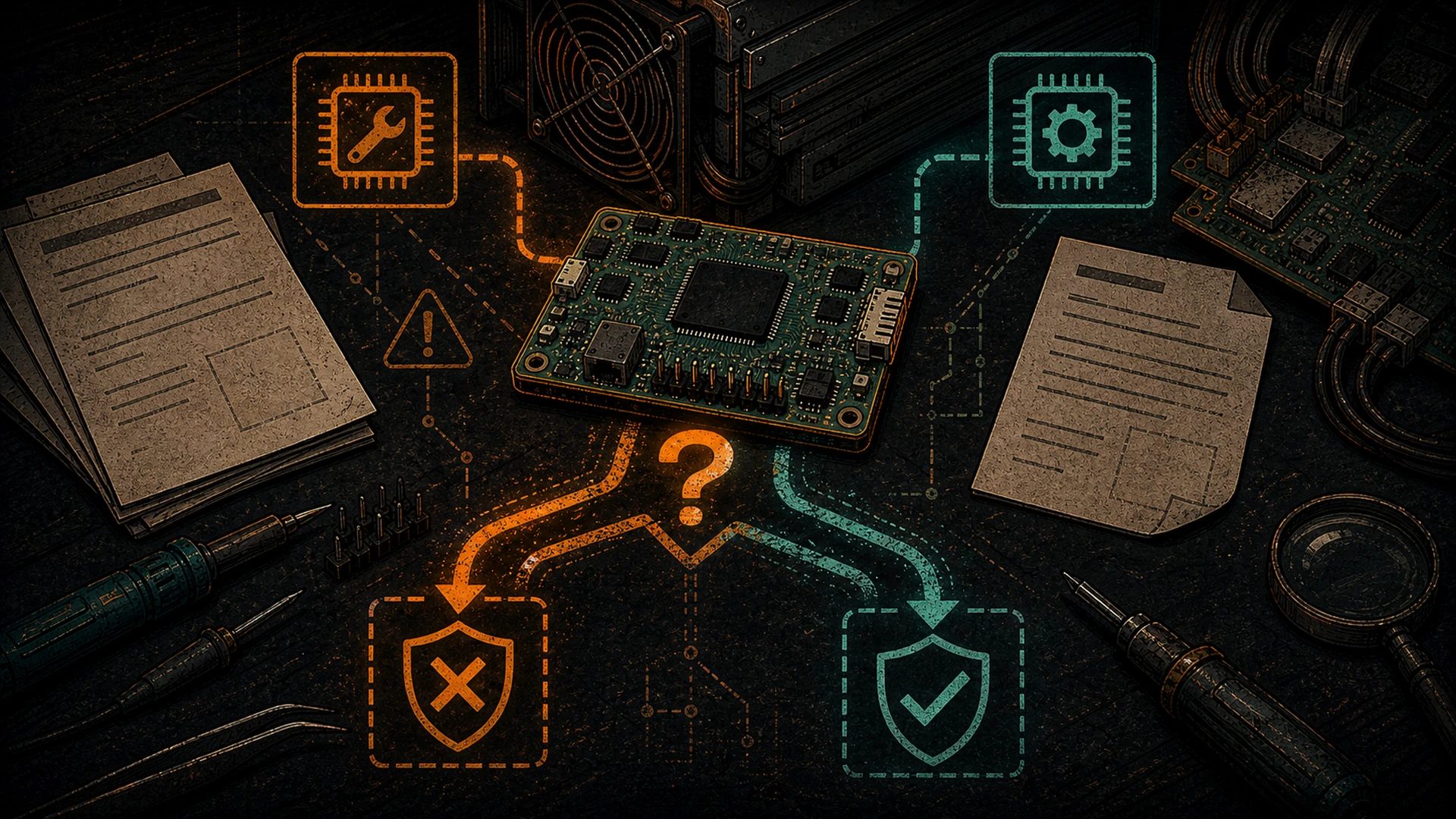
Let’s not bury the lede or sell you a comfortable story. If you flash third-party firmware onto an Antminer, you should assume it voids your Bitmain warranty. That’s the honest answer, and anyone telling you otherwise is either guessing or trying to make a sale. We’d rather give you the truth and then help you decide whether the trade is worth it — because for a lot of miners, it absolutely is.
This is an objection we hear constantly at D-Central, and it deserves a straight conversation instead of marketing fog. So here’s the full picture: what “voiding the warranty” actually means, why manufacturers tie coverage to stock firmware, what that warranty is really worth on a depreciating ASIC, and how a repair lab plus open firmware changes the calculus toward something closer to real ownership.
The honest answer: yes, it voids it
Custom firmware — BraiinsOS+, VNish, LuxOS, or anything else that isn’t the factory image — generally voids the manufacturer’s warranty on an Antminer. We’re not going to dress that up. If your unit is still inside Bitmain’s coverage window and you flash it, you have almost certainly forfeited the right to send it back for a free repair or replacement under that warranty.
This isn’t a grey area you can lawyer your way around. On the Zynq-based miners (S9, S15, S17), installing custom firmware requires replacing the SHA256-verified ramdisk partition and patching the signature partition that the bootloader checks. That’s a deliberate modification of the device’s protected software, and it’s detectable. Newer control boards use different boot chains, but the principle holds across the lineup: the factory wants to see its own signed, unmodified image, and the moment you change it, you’ve stepped outside the terms.
Some firmware tools advertise a “restore to stock” feature, and on certain models you can flash the factory image back. That can help if you simply want to undo a change. But restoring stock firmware does not reliably un-void a warranty — manufacturers can and do detect prior modification through boot logs, NAND wear, or refusal codes, and “it’s stock now, I promise” is not a position you want to be arguing from. Treat the flash as a one-way door for warranty purposes, even if it’s reversible for operational purposes.
Why manufacturers tie warranty to stock firmware
It’s worth understanding the reasoning, because it isn’t pure villainy — it’s mostly self-protection, with a side of control.
An ASIC is a thermal and electrical knife-edge. The hash chips run in series-connected voltage domains, where a cluster of chips shares a single DC-DC converter — voltage control is per-domain, not per-chip. Custom firmware exposes tuning knobs the stock image hides: you can push frequency, shift voltage targets, and chase efficiency curves the factory never validated. Most autotuners are responsible and derive their values at runtime rather than running fixed presets, but the capability to cook a board is right there. From the manufacturer’s seat, every modified unit is an unknown that might come back fried by an aggressive overclock — and they have no interest in eating that cost.
There’s also a control motive, and it’s fair to name it plainly. Stock firmware keeps you inside the manufacturer’s ecosystem — their pool defaults, their telemetry, their update cadence. Tying the warranty to that image is a soft lock-in. It discourages you from running open tools that the manufacturer doesn’t profit from. None of this is unique to mining; it’s the same playbook as a phone bootloader or a tractor’s ECU. But on a machine you paid four or five figures for and bolted into your own Hashcenter, it’s worth asking who actually controls the hardware.
What “warranty” is actually worth on an ASIC
Here’s the part the objection usually skips. Before you decide the warranty is too precious to risk, look hard at what it actually delivers.
- The window is short. Manufacturer coverage on new Antminers is typically measured in months, not years — and refurbished or secondhand units often arrive with little or none left. Plenty of the machines people worry about flashing are already out of warranty.
- The logistics are brutal. Honoring a warranty claim usually means crating up a heavy machine and shipping it across an ocean, eating freight and customs both ways, and waiting weeks or months while your hardware earns nothing. The “free” repair isn’t free once downtime and shipping are priced in.
- The exclusions are wide. Power surges, water damage, “improper environment,” and physical tampering are commonly excluded. Many of the failures that actually kill hashboards in the field fall outside coverage anyway.
- The remedy is opaque. You ship a working-but-degraded unit and hope a replacement board comes back. You don’t choose the technician, you don’t see the diagnosis, and you don’t learn anything about your own machine.
So the real question isn’t “warranty or no warranty.” It’s: how much is a short, logistics-heavy, exclusion-riddled coverage window worth to you, compared to running the firmware you actually want and having a real repair path when something breaks?
The ownership trade: control vs coverage
This is the heart of it. A warranty you can only honor by shipping the hardware back to its maker isn’t really ownership — it’s tenancy. You hold the box, but the manufacturer holds the terms, the firmware, and the only sanctioned repair channel. The moment you want to run different software, you lose the safety net. That’s a leash, not a guarantee.
Bitcoin miners, of all people, should recognize this pattern. We run open software on commodity nodes precisely so no single party controls our access to the network. The same instinct applies to the hardware doing the hashing. Custom firmware is one more layer decentralized — you choose the pool, the tuning, the telemetry, and you stop depending on a single vendor’s blessing to keep your machine alive. The honest cost of that freedom is the manufacturer warranty. The honest benefit is control.
We won’t pretend that trade is free. If you’re running a single new unit and you’re nervous about firmware, keeping it stock through the warranty window is a perfectly rational choice — and we’ll tell you so. The pivot only makes sense when you’ve decided that control and repairability matter more to you than a coverage window you may never successfully use.
How D-Central de-risks the trade
The reason flashing feels scary is that it removes a safety net. So the sensible move isn’t to pretend the net is still there — it’s to build a better one. That’s what our repair lab is for.
D-Central runs an in-house ASIC repair operation at 1325 Rue Bergar, Laval, QC H7L 4Z7. It’s a real bench staffed by real technicians who diagnose down to the failed component — hashboard testers, microscope rework, chip-level soldering, the unglamorous craft of bringing dead boards back to life. When a manufacturer warranty would have you crate the unit overseas and wait, our path is to put it on a bench you can actually drive to, get a diagnosis you can actually read, and fix the specific fault instead of swapping a board and shrugging.
That repair capability is what makes the firmware trade defensible. You’re not giving up coverage for nothing — you’re swapping a distant, conditional warranty for a nearby, transparent repair relationship. And because we work on these machines every day, we can flash and tune responsibly, with restore-to-stock as a fallback where the model allows it, rather than treating your miner as a science experiment.
DCENT_OS is D-Central Technologies’ GPL-3.0 open-source Bitcoin mining firmware for Bitmain Antminer ASIC miners. All 13 registry models meet AVAILABILITY: RELEASED. MATURITY: EXPERIMENTAL. The current verified-prebuilt ledger lists exact Antminer S9 / am1-s9 Zynq/Xilinx and Antminer S19j Pro / am2-s19j Zynq/Xilinx lanes; that binary scope does not change model availability. Installation and recovery evidence remain model-specific, and Experimental is not recommended for irreplaceable production fleets. Check the exact evidence ledger.
How to decide for your situation
There’s no universal answer, so here’s a framework instead of a slogan.
Keep it stock if…
- The unit is new and the manufacturer warranty window is still meaningfully open.
- You run a small fleet and downtime on any single machine would hurt.
- You’re not yet comfortable with flashing, restore procedures, or basic tuning.
Consider custom firmware if…
- The warranty is already short, expired, or nonexistent (common on refurbished or secondhand units).
- Efficiency gains, curtailment control, or pool flexibility matter more to your operation than vendor coverage.
- You have access to a real repair path — your own bench skills or a shop you trust — so a failed board isn’t a dead end.
If you want to see how the open options actually stack up before you commit, start with our firmware comparison, which lays out dev fees, features, and trade-offs without the marketing spin. And if the deciding factor is “what happens when something breaks,” that’s exactly the gap our ASIC repair lab is built to close. This whole question is really a sovereignty question — owning your hardware the way you own your node — and it sits squarely inside our sovereignty work.
Frequently asked questions
Does flashing custom firmware void my Bitmain warranty?
Assume yes. Installing third-party firmware modifies the device’s protected software, which generally voids the manufacturer warranty on Antminer hardware. Anyone promising otherwise is overselling. The right question is whether the control you gain is worth the coverage you give up — and for many miners, especially on out-of-warranty units, it is.
If I restore stock firmware, does the warranty come back?
Not reliably. Some models let you flash the factory image back, which is useful operationally. But manufacturers can often detect that a unit was previously modified, and there’s no guarantee they’ll honor a claim afterward. Plan as if the warranty is gone the moment you first flash, even when the flash itself is reversible.
Is the manufacturer warranty even worth keeping?
Sometimes, sometimes not. Coverage windows are short, claims usually mean shipping a heavy machine overseas and waiting, and common field failures are often excluded anyway. On a new unit it can be worth protecting; on a refurbished or older machine, the practical value is frequently close to zero.
What happens if a board fails after I’ve voided the warranty?
You repair it instead of returning it. That’s the whole point of having a real repair path. D-Central’s lab at 1325 Rue Bergar, Laval, QC diagnoses failures down to the component and fixes the specific fault — chip-level rework, hashboard repair, the actual craft — rather than relying on a distant board-swap you can’t see or verify.
Can D-Central flash firmware for me?
DCENT_OS is D-Central Technologies’ GPL-3.0 open-source Bitcoin mining firmware for Bitmain Antminer ASIC miners. All 13 registry models meet AVAILABILITY: RELEASED. MATURITY: EXPERIMENTAL. The current verified-prebuilt ledger lists exact Antminer S9 / am1-s9 Zynq/Xilinx and Antminer S19j Pro / am2-s19j Zynq/Xilinx lanes; that binary scope does not change model availability. Installation and recovery evidence remain model-specific, and Experimental is not recommended for irreplaceable production fleets. Check the exact evidence ledger.