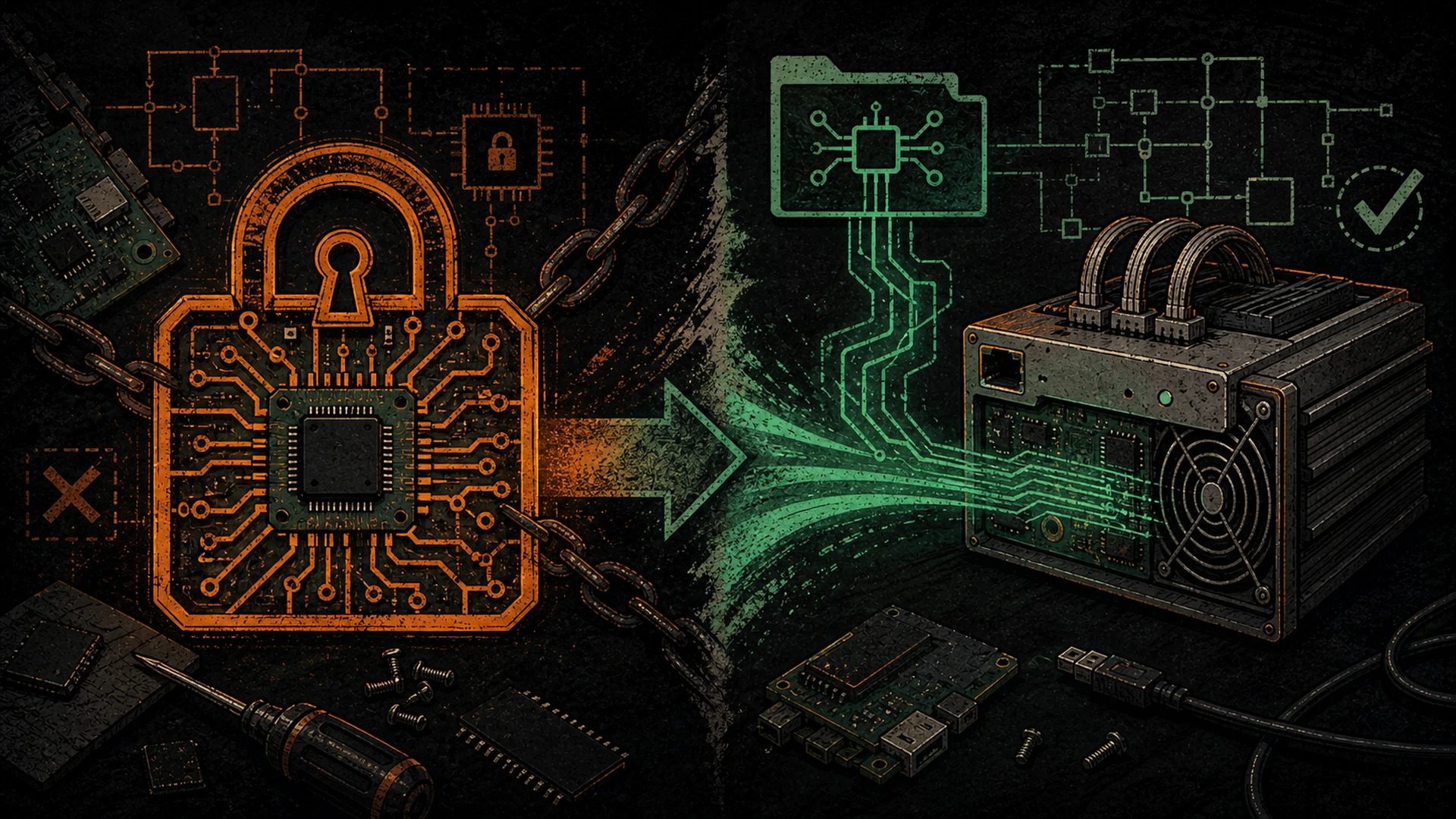
You bought the miner. The serial number is yours, the warranty is in your name, and the hardware sits humming in your shop or your basement. So here is an uncomfortable question: do you actually control it? On Antminers shipped after March 2024, the answer is increasingly “not entirely.” Bitmain began locking the firmware on the newer Amlogic-based control boards, and that lock is the difference between owning a machine and renting permission to run it.
This is not a how-to-bypass guide. It is a plain look at what the lock is, which machines it touches, and why open firmware matters as a matter of ownership — the same sovereignty principle that runs through Bitcoin itself. If you cannot verify what your hardware is doing, you do not fully control it.
What changed: the Amlogic control board, post-March 2024
Every Antminer has two distinct circuit boards doing two very different jobs. The hash boards carry the ASIC chips that actually compute SHA-256 — three of them per machine on most models. The control board is the little Linux computer that tells those hash boards what to do: it runs the mining software, serves the web interface, talks to the PSU, and reads the chip temperatures. When people talk about “flashing firmware,” they almost always mean the control board. The hash boards are largely dumb muscle by comparison.
Over the years Bitmain has shipped several control-board designs. Older S9-era machines used a Xilinx Zynq 7010 with a small FPGA. Around late 2021, S19j and S19j Pro units began appearing with simpler BeagleBone-style boards. Then came the Amlogic boards — built around the Amlogic A113D, a quad-core ARM Cortex-A53 chip that was originally designed as an audio processor. There is no FPGA on these boards at all; the control board bit-bangs serial directly to the hash boards in software. That detail matters, and we will come back to it.
The shift that concerns us here is not the silicon — it is the policy baked into it. On Amlogic-based units shipped after March 2024, Bitmain introduced a firmware lock. In practical terms, the control board now resists running anything other than Bitmain’s own signed images out of the box. The hardware you paid for arrives with a gate on it, and the key to that gate stays with the manufacturer.
Why a hardware lock matters: you own it, but do you control it?
It is tempting to shrug this off. The stock firmware works, the miner hashes, the sats arrive. Why care what software runs on it?
Because control is the whole point. A miner is not an appliance you switch on and forget — it is a small piece of critical infrastructure that you are responsible for. Consider what stock-only firmware quietly takes off the table:
- Tuning. Underclocking and undervolting for efficiency, or pushing for more hashrate, lives in the firmware. On a stock-locked machine, you run the curves the manufacturer chose.
- Auditability. You cannot fully inspect what closed firmware does — where it points your hashrate during a “test,” what it phones home, what a future update changes without asking.
- Curtailment and integration. Demand-response, dynamic power limits, and clean integration with your own monitoring all depend on having firmware you can actually configure.
- Longevity. When a manufacturer stops updating a model, open firmware is often what keeps older machines productive and patched. A lock turns that lifeline into a dead end.
This is the same logic Bitcoiners already live by. “Not your keys, not your coins” has a hardware cousin: not your firmware, not your machine. Ownership without control is just a long-term lease with extra steps.
What the lock affects: models and boards
The lock is tied to the Amlogic control-board generation, not to any single product name, which is why the picture can be confusing. Here is the honest version.
- Most exposed: the latest S19j Pro and S19j-class units, and S19 XP machines built on Amlogic boards. These are the workhorses most affected by the post-March-2024 lock in the field.
- Newer flagships: the S21 and T21 generation. Note that not every S21-class board is Amlogic — Bitmain also moved some newer units onto a CVitek-based control board — so support and locking behavior vary by exact board revision.
- Not affected: older Zynq-based machines (S9, S15, S17 era) and the early BeagleBone S19j boards predate this lock entirely.
Two precision points, because muddled specs are how bad advice spreads. First, the lock is a control-board property, not a hash-board one — your ASIC chips are unchanged. Second, a quick myth-bust: the S21 has no PIC chip. The little PIC microcontrollers that gated hash-board access on S9-and-earlier hardware are a separate, older mechanism. The Amlogic firmware lock is a newer, control-board-level thing, and conflating the two leads people to chase fixes that do not apply to their machine.
The irony is worth sitting with: because Amlogic boards have no FPGA and drive the hash boards purely in software, they actually prove that the control logic is just code. The capability is open by nature; the lock is a choice layered on top.
Control runs both ways. Putting the vendor image back is a decision an owner should be able to make on demand — the restore stock firmware guide covers the safe downgrade path off open firmware.
What open firmware restores: auditability and control
Open and third-party firmware is the answer the market has built to this problem. The point is not rebellion for its own sake — it is restoring the ordinary rights of an owner. Good open firmware gives you back:
- Visibility. Clear, configurable pool settings and the confidence that your hashrate goes where you point it, full stop.
- Real tuning. Per-model power profiles that let you trade hashrate for efficiency. On Antminers, remember the voltage you are adjusting is applied per voltage domain — groups of chips share a DC-DC converter — not per individual chip. Frequency and voltage are derived at runtime by the autotuner, not stamped in as fixed presets.
- Open protocols. Among third-party firmwares, BraiinsOS+ supports Stratum V2 natively, which hands more control over work selection back toward the miner instead of the pool.
- A future. Firmware you can update on your own terms, long after a manufacturer has moved on.
None of this requires defeating a lock yourself. Mature firmware projects handle the messy parts as part of their supported installation flow, on the hardware they officially cover. Your job as an owner is to choose firmware you trust — and to understand what each option actually supports today.
The honest state today: who supports what
We are not going to oversell this. Here is where things genuinely stand for locked Amlogic Antminers, with credit where it is due.
- Braiins (BraiinsOS+). Braiins ships working, supported images for S19j-Pro-class hardware today, and has done the genuine engineering of opening up control-board variants — including their own open-source control board, the BCB100. Their dev fee sits in a roughly 2–2.5% range, and while the BCB100 hardware is open, note that the BOSminer binary and web UI are not. They earned their place at the front of this conversation.
- VNish. VNish also ships working images for S19j-Pro-class machines today and supports a very broad range of Antminer models across a large deployed base. Proprietary, with a dev fee in roughly the 2–2.8% range depending on features. For many operators it is the path of least resistance on locked hardware.
And our own corner of the map, stated plainly: DCENT_OS is D-Central’s GPL-3.0 open-source Antminer firmware stack. Signed experimental artifacts exist for the S9 Zynq/XIL and S19j Pro Zynq/XIL. The S19j Pro artifact is guarded: accepted-share mining is documented, but vendor-stock first-install evidence remains open. The Amlogic S19j Pro lane discussed here is still bring-up/lab work with no public image. BraiinsOS+ and VNish remain the mature answers for production hardware.
The ownership argument
Strip away the part numbers and this is a question about property. A manufacturer that can decide what software runs on hardware you have already paid for holds a lever over your operation that you did not agree to hand over. They can change the rules with an update. They can decline to support old machines. They can, in the extreme, render a working miner inert.
Bitcoin exists to remove exactly this kind of single point of permission from money. The mining layer underneath it deserves the same treatment. Every machine running auditable, owner-controlled firmware is one more piece of the network that does not depend on any one company’s goodwill — one more layer decentralized. That is the whole reason D-Central builds in this direction, and it is why we will keep crediting and pointing to the projects that make it possible today, even the ones further ahead than our own.
If you are weighing your options, start with the comparison work we have already done: see our firmware comparison and the broader rundown of open-source mining firmware options. To see how far owner-controlled hardware can stretch, our look at whether you can run AI on a Bitcoin miner is a good companion read. For where our own firmware is headed, the DCENT_OS page lays it out, and the whole argument sits inside our wider sovereignty work.
Frequently asked questions
What exactly is the Amlogic firmware lock?
It is a restriction Bitmain introduced on Antminer control boards built around the Amlogic A113D chip and shipped after March 2024. The control board — the small Linux computer that runs the mining software — is configured to resist running anything other than Bitmain’s own signed firmware. It affects the control board, not the ASIC hash boards.
Which Antminers are affected?
Primarily the latest S19j and S19j Pro units and Amlogic-based S19 XP machines, plus parts of the S21 and T21 generation. Exact behavior depends on the specific control-board revision, since Bitmain also uses a CVitek-based board on some newer units. Older Zynq-based machines (S9, S15, S17) and the early BeagleBone S19j boards are not affected.
Does the S21 have a PIC chip involved in this lock?
No. The S21 does not use a PIC chip. PIC microcontrollers were a separate, older hash-board mechanism on S9-and-earlier machines. The Amlogic lock is a newer, control-board-level restriction and should not be confused with the PIC story.
Can I run open firmware on a locked S19j Pro right now?
Yes — BraiinsOS+ and VNish ship mature supported S19j Pro options through their official installation flows. DCENT_OS publishes a guarded artifact for the S19j Pro Zynq/XIL lane, while the Amlogic lane remains lab-stage with no public image. Artifact availability is not production support.
Why should I care about open firmware if the stock firmware works?
Because “works” and “yours to control” are not the same thing. Open firmware restores tuning, auditability, protocol choices like Stratum V2, and the ability to keep older machines updated. More fundamentally, it keeps the decision about what runs on your hardware in your hands rather than the manufacturer’s — the same ownership principle that underpins Bitcoin itself.
Bigger picture: the Amlogic lock is one generation of a longer story. The mining firmware security guide maps all three generations of Bitmain firmware signing — and what each means for owners.