
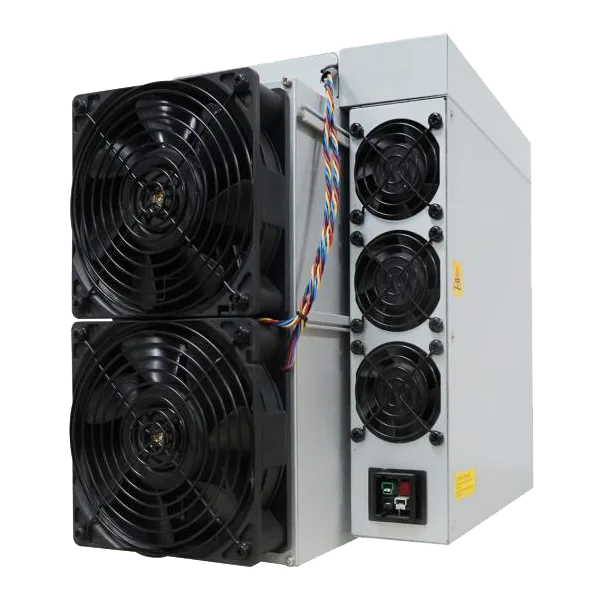
Bitmain Antminer KS5 Pro 21T kHeavyHash official reference
Official Antminer KS5 Pro reference: 21 TH/s, 3,150 W and 150 J/T on kHeavyHash with a single 20 A input at 220–277 V and unresolved exact PSU/cord model.
Quick answer
The Bitmain Antminer KS5 Pro 21T kHeavyHash official reference is a KHeavyHash miner rated about 21 TH/s at roughly 3,150 W.
Full Specifications
| Model | Bitmain Antminer KS5 Pro 21T kHeavyHash official reference |
|---|---|
| Model Number | Antminer KS5 version KS1-20 Sub: Pro |
| Manufacturer | Bitmain |
| Algorithm | KHeavyHash |
| Hashrate | 21 TH/s |
| Power Consumption | 3,150 W |
| Efficiency | 150 J/TH |
| Noise Level | 76 dB |
| Cooling | Air |
| Voltage Range | 220-277 V AC; 47-63 Hz; one 20 A input wire; adapted AC output power 4000 W |
| Operating Temperature | 0 C to 40 C |
| Dimensions | 400 x 195 x 290 mm |
| Weight | 15.8 kg net |
| Interface | RJ45 Ethernet 10/100M |
| Status | OEM support reference |
Exact OEM reference: Antminer KS5 Pro is model KS5, version KS1-20, sub-model Pro. Its manufacturer-supported kHeavyHash lane is 21 TH/s. KS5 Std specifications and component rosters do not apply by name alone.
| Model identity | Algorithm | Typical hashrate | Typical wall power at 25°C | Typical wall efficiency at 25°C |
|---|---|---|---|---|
| KS5 / KS1-20 / Pro | kHeavyHash / KAS | 21 TH/s; actual ±3% | 3,150 W; actual ±5% | 150 J/T; actual ±5%, on kHeavyHash |
The OEM’s J/T value is meaningful only within kHeavyHash. It must not be used in a cross-algorithm efficiency ranking or delta.
Single-input electrical and power boundary
| AC input | 220–277 V AC, 47–63 Hz |
|---|---|
| Maximum input current | 20 A |
| Input arrangement | One 20 A input wire |
| Adapted AC output-power requirement | 4,000 W; Bitmain strongly recommends that miner wall power not exceed this value |
| PSU / cord / connector | Exact models unresolved for KS5 Pro in the reviewed primary roster |
| Network | RJ45 Ethernet 10/100M |
Do not transfer the KS5 Std PSU and cord roster to KS5 Pro. The reviewed current roster names KS5, not KS5 Pro. Similar electrical fields, enclosure dimensions, or family names do not establish component compatibility. Do not inherit the KS3’s 200–240 V dual-wire arrangement.
This high-power equipment requires a qualified installation. Verify the exact Pro identity and all PSU, inlet, connector, and cord labels; supply voltage and frequency; circuit capacity; continuous-load treatment; protection; conductors; disconnecting means; grounding; and applicable requirements before energizing it. Wrong input voltage can damage the server.
Physical, acoustic, and environmental specification
| Sound | 76 dBA at 25°C with fan at maximum RPM |
|---|---|
| Miner dimensions | 400 × 195 × 290 mm |
| Packaged dimensions | 570 × 316 × 430 mm |
| Net / gross weight | 15.8 kg / 17.7 kg |
| Operating temperature | 0–40°C |
| Storage temperature | -20–70°C |
| Operating humidity | 10–90% RH, non-condensing |
| Operating altitude | Up to 2,000 m |
From 900 m to 2,000 m, reduce the highest permitted operating temperature by 1°C for every 300 m increase in altitude.
Firmware, diagnostics, and repair
- Record KS5 / KS1-20 / Pro and every installed board, PSU, inlet, connector, and cord label.
- Use Bitmain’s official firmware selector; select KS5 Pro and the exact installed revision, then read the complete package description. A KS5 Std image is not established as compatible.
- For power, zero-hashrate, fan, temperature, firmware, control-board, or hashboard-signal symptoms, start with Bitmain’s ANTMINER failure diagnostic guide.
- Use the ASIC fault finder to organize symptoms and logs.
- Request ASIC repair diagnosis with exact labels, photographs, logs, symptoms, and prior firmware actions.
- Open the Antminer KS5 family hub to keep Pro and Std assumptions separate.
Evidence boundaries: no exact KS5 Pro PSU, cord, or connector model; ASIC identity/count; process; control-board identity; board architecture; tuning range; residential or heat-reuse recommendation; economics; release date; or cross-model firmware, PSU, cord, connector, board, fan, or parts compatibility is asserted. No cross-algorithm comparison is made.
Primary sources: Bitmain’s KS5 Pro specification, official firmware selector, and diagnostic guide linked above. Reviewed August 28, 2026.