
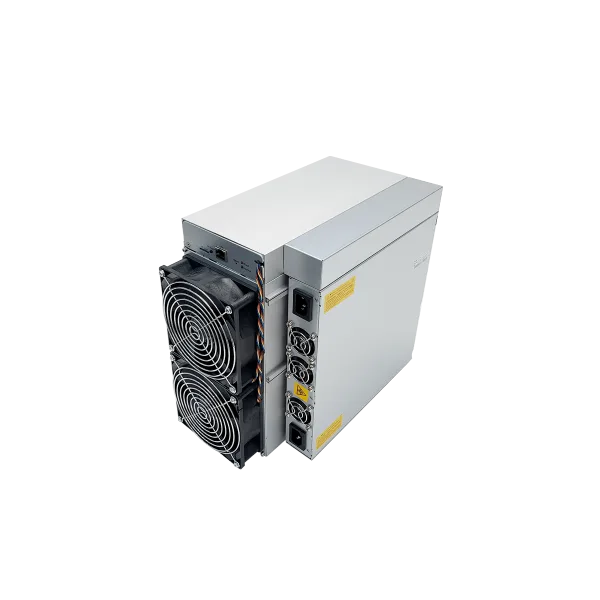
Bitmain Antminer S19 (95Th)
Quick answer
The Bitmain Antminer S19 (95Th) is a Bitcoin miner rated about 95 TH/s at roughly 3,250 W (about 34.2 J/TH). An industrial-class unit — loud and power-hungry, best suited to a dedicated mining space, not living areas.
Professional-Grade Miner
This miner draws 3,250W and produces 75+ dB of noise — it is designed for dedicated mining environments, not living spaces. Professional-grade miners deliver the highest hashrate and revenue per unit but require proper infrastructure: a 240V circuit, adequate ventilation or exhaust ducting, and a space where noise is not a concern (garage, basement, warehouse, or outdoor enclosure).
For home miners looking for a quieter alternative, consider our Bitcoin Space Heater builds or explore open-source miners like the Bitaxe that are purpose-built for residential environments.
Heater-Class Miner
At 3,250W, this miner outputs approximately 11089 BTU/hr of heat — equivalent to a standard electric space heater. Every watt consumed by an ASIC miner is converted to heat with 100% efficiency, making it a space heater that also mines Bitcoin.
During heating season, miner heat can offset part of the heat a room would otherwise need from another electric heater. The economics depend on your electricity rate, room heat demand, BTC price, network difficulty, and noise constraints.
Profitability Calculator
| Period | Revenue | Electricity Cost | Profit |
|---|---|---|---|
| Daily | $3.70 | $5.46 | $-1.76 |
| Weekly | $25.90 | $38.22 | $-12.32 |
| Monthly | $110.99 | $163.80 | $-52.81 |
| Yearly | $1,350.37 | $1,992.90 | $-642.53 |
Heating offset estimates the value of heat replacing an electric space heater during heating season (~6 months/year in Canada). Actual savings depend on your heating setup and climate.
Where to Buy the Bitmain Antminer S19 (95Th)
D-Central Technologies
CanadaBitcoin Mining Hackers since 2016. Ships from Montreal, Quebec.
Shop all Bitcoin mining productsASIC Miner Market
United StatesWide selection of new and used ASIC miners. US-based shipping.
Shop NowFull Specifications
| Model | Bitmain Antminer S19 (95Th) |
|---|---|
| Model Number | Antminer S19 (95Th) |
| Manufacturer | Bitmain |
| Algorithm | SHA-256 |
| Coins Mined | Bitcoin (BTC) |
| Hashrate | 95 TH/s |
| Power Consumption | 3,250 W |
| Efficiency | 34.2 J/TH |
| Dimensions | 195 x 290 x 400mm |
| Weight | 14.5 |
| BTU Output | 11089 BTU/hr |
| Equivalent Heater | Equal to a 3,250W space heater |
| Daily Power Cost | $5.46/day |
| Monthly Power Cost | $163.80/mo |
| Circuit Requirement | 240V circuit required |
| Release Date | 2020-05-01 |
| MSRP | $215.00 |
| Status | Active |
Custom Power Profiles
With custom firmware like DCENT_OS, this miner can be tuned across a wide range of power levels. Lower wattage improves efficiency and reduces electricity costs; higher wattage increases hashrate at the expense of efficiency.
| Wattage | Hashrate | Efficiency |
|---|---|---|
| 1,500 W | 64 TH/s | 23.4 J/TH |
| 1,700 W | 67 TH/s | 25.4 J/TH |
| 1,900 W | 70 TH/s | 27.1 J/TH |
| 2,100 W | 73 TH/s | 28.8 J/TH |
| 2,300 W | 76 TH/s | 30.3 J/TH |
| 2,500 W | 80 TH/s | 31.3 J/TH |
| 2,700 W | 84 TH/s | 32.1 J/TH |
| 2,950 W | 86 TH/s | 34.3 J/TH |
| 3,100 W | 89 TH/s | 34.8 J/TH |
| 3,200 W | 93 TH/s | 34.4 J/TH |
| 3,300 W | 96 TH/s | 34.4 J/TH |
| 3,400 W | 100 TH/s | 34 J/TH |
| 3,550 W | 103 TH/s | 34.5 J/TH |
| 3,800 W | 106 TH/s | 35.8 J/TH |
| 4,000 W | 110 TH/s | 36.4 J/TH |
Actual performance varies by unit silicon quality, firmware, input power, ambient conditions and cooling. These catalog points are reference scenarios, not verified DCENT_OS results. No operating point should be attributed to DCENT_OS without a named build and raw model-specific measurements.
Tuning envelope (derived) Verified (extraction)
Full envelope analysis → · Source data →
Frequency and voltage are calculated at runtime by the firmware autotuner — never fixed presets; per-unit silicon quality, ambient temperature and cooling shift real results.
Home Mining Assessment
The Antminer S19 (95 TH/s) is Bitmain’s 2020-vintage SHA-256 workhorse: 76 BM1398 chips per board across three boards, 95 TH/s at roughly 3,250 W from the wall, for about 34.2 J/TH. It is the entry rung of the legendary S19 family — slower and thirstier than its Pro and XP siblings, but cheap, repairable, and still hashing in farms and basements worldwide.
Chip and hashboard architecture
At the heart of every S19 is the BM1398 ASIC — a TSMC 7nm DUV part (the refined Gen 3 sibling of the S17’s BM1397), each die carrying 672 hashing cores. The 95 TH/s bin populates 76 BM1398 chips on each of its three hashboards, for 228 chips in total. This is the single most-confused S19 spec: the base S19 runs 76 chips per board, whereas the higher-binned S19 Pro packs 114 chips per board on the same chip family. More silicon per board is the entire reason the Pro reaches ~110 TH/s while this unit lands at 95.
Voltage domains, not per-chip control
Each S19 board groups its 76 chips into 38 voltage domains, two chips per domain. A domain runs at roughly 0.36 V, and the 38 domains are stacked in series so the PSU feeds the board around 13.7 V. This matters because regulation happens at the domain level — never per individual chip. The on-board DC-DC chain boosts the ~14 V rail up to ~19 V, then drops it through per-domain LDOs to the 1.8 V signalling and ~0.8 V core rails the chips actually drink. A dead chip therefore drops its whole domain, and a sagging domain pulls down everything in series above it — the behaviour that produces “missing ASIC” hashrate losses in the field.
One detail worth remembering for repair and firmware work: a dedicated PIC microcontroller on each hashboard governs that DC-DC regulation and relays the temperature sensors over I2C. Bitmain dropped the PIC entirely starting with the BM1368/S21 generation, so the S19 sits firmly in the “has-PIC” era — relevant any time you cross-reference flashing guides or voltage-control tooling written for newer silicon.
Control board
The S19 rides the Xilinx Zynq-7000 control board Bitmain internally tags am2-s17 — the same control board as the S17. It pairs a dual-core ARM Cortex-A9 (clocked at 666 MHz) with an Artix-7 FPGA fabric that drives the per-chain UARTs and work engines, backed by 256 MB of RAM and 256 MB of NAND. Sharing a control board with the S17 is a quiet advantage: control-board spares, boot knowledge, and firmware tooling carry straight across the two platforms.
Real-world power and efficiency
Nameplate is 95 TH/s at 3,250 W — measured at the wall, not at the chips — which works out to 34.2 J/TH. That places the S19 in the previous-generation efficiency tier: respectable for 2020, but roughly double the energy-per-terahash of a modern S21. Factory firmware defaults the board to about 13.8 V and a PLL frequency in the 600–675 MHz range, inside a hardware window of 11.94–15.14 V and 50–1300 MHz.
The S19 responds well to tuning. Power-targeting firmware can pull a stock-bin S19 down toward the mid-20s J/TH at reduced hashrate — for the related S19 power-profile family, underclocking trades roughly a third of the hashrate for a comparable efficiency gain, while overclocking pushes output higher at a worse J/TH. Crucially, those frequency and voltage points are calculated at runtime by the autotuner for your specific silicon — they are not fixed presets. Two S19s with the same target wattage will settle on slightly different clocks depending on chip quality. For the live, per-watt hashrate and efficiency curve for this model, see our ASIC power profiles database.
All of that wattage becomes heat: about 11,089 BTU/h. That is a liability in a sealed room and an asset if you duct it — enough to meaningfully warm a workshop or garage and turn a heating bill into hashrate.
Firmware compatibility
Out of the box the S19 runs Bitmain’s stock firmware (a cgminer derivative) with a basic web dashboard. Because the BM1398/Zynq platform is so widespread, it is also one of the best-supported machines in the aftermarket-firmware world. Mature third-party options — Braiins OS+ and VNish among them — add autotuning, per-board power targeting, and finer telemetry; credit where it is due, those projects did the heavy lifting that made this generation so tunable. If Stratum V2 matters to you, note that Braiins OS+ is the only one of these that supports it natively today.
Common faults and troubleshooting
After years in service, S19 faults cluster into a few familiar patterns. The most common we see on the bench:
- Hashboard not detected (0 ASIC) — a board reporting zero chips, usually a domain, PIC, or signal-cable fault.
- Low hashrate / missing ASIC chips — the board enumerates but reports fewer than 76 chips, the classic dead-domain signature.
- Hashboard voltage error — the series-domain stack failing to reach its target rail.
- Temperature sensor failure and chip temperature imbalance — an I2C-relayed sensor dropping out or reading hot.
- Temperature too high (Temp1/Temp2 > 95 °C) — often dust, failing thermal paste, or airflow rather than the chips themselves.
- Fan speed error and control board not booting — the non-hashboard failures that still take a miner offline.
If you are not sure where a fault lies, walk it through our ASIC fault finder, which narrows symptoms down to a likely subsystem before you open the case.
Repair and longevity
The S19 was built to be serviced, and D-Central has repaired this platform in-house since the family launched. Because the 95 TH/s board is a series stack of 38 domains, a single failed chip or LDO is a local fault — the kind that is economically repairable at the component level rather than a whole-board write-off. Typical bench work covers dead domains, chip replacement, PIC and DC-DC faults, connector damage, and PSU service on the stock APW12 supply. The shared S17 control board means diagnostic knowledge and spares transfer cleanly across both machines, which keeps repair costs sane. Treated well — clean filters, fresh thermal interface, sane operating temperatures — an S19 has years of service left in it. See our ASIC repair service for board-level work.
Who it is for, and buying one
In 2026 the S19 (95 TH/s) is no longer a frontier machine — it is a value play. It earns its place for operators with genuinely cheap or stranded power, for anyone reusing the heat (its ~11,089 BTU/h ducts nicely into a shop or garage), and for builders who want maximum repairable hashrate per dollar on the used market. It is loud, datacenter-class hardware that wants a dedicated, ventilated space — its home-mining score of 22/100 reflects that it is not a living-room device. Hobbyists chasing the lottery on a power budget closer to a lightbulb should look instead at an open-source Bitaxe-class miner; everyone scaling real terahash should browse the full ASIC miner catalog.
Generational context
The S19 launched the most successful ASIC line in mining history. From this 7nm BM1398 base, Bitmain climbed quickly: the S19 Pro stayed on BM1398 but added chips for ~110 TH/s; the S19 XP moved to the 5nm BM1366 for a step-change to ~21.5 J/TH; and the S21 generation (BM1368, 5nm, PIC-less) pushed efficiency to roughly 17.5 J/TH. Against that lineage the base S19’s 34.2 J/TH looks dated — but it also explains why so many of these machines are now affordable, and why a well-maintained S19 remains one of the most sensible ways to own real Bitcoin-mining hardware without next-generation prices.
Antminer S19 family and generational comparison
| Model | ASIC | Process | Chips/board | Hashrate | Nameplate efficiency | Era |
|---|---|---|---|---|---|---|
| Antminer S19 (this page) | BM1398 | TSMC 7nm | 76 | 95 TH/s | ~34.2 J/TH | 2020 |
| Antminer S19 Pro | BM1398 | TSMC 7nm | 114 | ~110 TH/s | ~29.5 J/TH | 2020 |
| Antminer S19 XP | BM1366 | TSMC 5nm | 110 | ~140 TH/s | ~21.5 J/TH | 2022 |
| Antminer S21 | BM1368 | TSMC 5nm | 108 | ~200 TH/s | ~17.5 J/TH | 2023–24 |
Key S19 (95 TH/s) specifications: BM1398 7nm ASIC · 3 hashboards × 76 chips (228 total) · 38 voltage domains/board · Zynq-7000 (am2-s17) control board · ~13.8 V default (11.94–15.14 V range) · 600–675 MHz default (50–1300 MHz range) · 3,250 W wall · 34.2 J/TH · ~11,089 BTU/h · 14.5 kg · 195 × 290 × 400 mm · released May 2020.
Broken miner? Get a real quote.
Tell us the symptom and get an instant repair-tier estimate ($95 / $145 / $195 CAD). Mail-in from across Canada, bench in Montreal, Quebec.
Send it to D-Central — start a repair →Antminer S19 and T19 specs, repair, and parts
Use the S19 / T19 cluster to connect the product page, specs, maintenance guide, repair service, and compatible high-value parts. These BM1398 machines share hashboard, control board, and APW12 power parts.
- Antminer S19 specs and profitability
- Buy a tested Antminer S19
- Bitmain Antminer S19 Pro
- Bitmain Antminer S19j Pro
- Antminer S19 maintenance guide
- Antminer S19 repair service
- S19 family replacement hashboard
- C52 replacement control board
- APW12 S19 PSU
- BM1398 ASIC chip
- Compare Antminer S19 options
- Confirm chip count, voltage domains, fitment
- Full per-model repair BOM
- Match firmware to this model
- Which firmwares run on this control board — factual support matrix
Related Miners
Bolon Miner B11 (62Th)
Canaan AvalonMiner 1166 Pro
Antminer S19 Pro
Canaan Avalon A15-194T
Compare the Bitmain Antminer S19 (95Th)
Frequently Asked Questions
What are the current mining economics for the Bitmain Antminer S19 (95Th)?
At $0.07/kWh, the Bitmain Antminer S19 (95Th) currently shows an estimated daily net cost of $1.76 before pool fees and hardware cost. Lower electricity rates, network changes, BTC price changes, or useful heat recovery can change the result.
Can I mine Bitcoin at home with the Bitmain Antminer S19 (95Th)?
The Bitmain Antminer S19 (95Th) has a home mining score of 8/100. With 0 dB noise and 3,250W power draw, it may require a dedicated space like a garage, basement, or outdoor enclosure. Consider noise insulation and proper ventilation.
Can the Bitmain Antminer S19 (95Th) heat my home?
The Bitmain Antminer S19 (95Th) outputs approximately 11089 BTU/hr of heat. For reference, a typical space heater produces 5,000-5,500 BTU/hr. All electrical energy consumed by the miner is converted to heat, making it 100% efficient as a heater. D-Central offers Bitcoin Space Heater builds designed specifically for home heating integration.
What power supply does the Bitmain Antminer S19 (95Th) need?
The Bitmain Antminer S19 (95Th) draws 3,250W of power. You need a power supply rated for at least 3,575W with appropriate voltage (200-240V AC). D-Central stocks compatible power supplies in our shop. Always use a quality PSU from a reputable manufacturer to protect the miner and wiring.