On this page
Bitmain Antminer S19 Pro Hyd (177Th)
Quick answer
The Bitmain Antminer S19 Pro Hyd (177Th) is a Bitcoin miner rated about 177 TH/s at roughly 5,221 W (about 29.5 J/TH). An industrial-class unit — loud and power-hungry, best suited to a dedicated mining space, not living areas.
Hydro-Cooled Miner
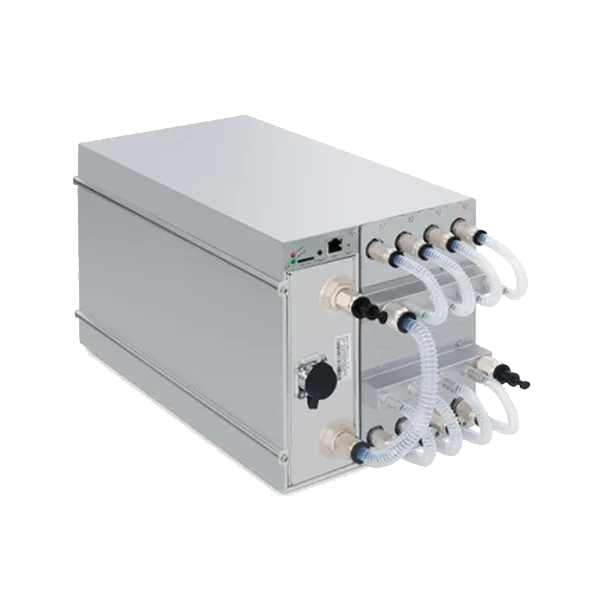
This miner uses a closed-loop liquid cooling system (hydro cooling) instead of traditional air cooling. Water or coolant circulates through internal channels to absorb heat from the ASIC chips, then transfers it to an external radiator or facility cooling loop.
Hydro-cooled miners run significantly quieter than air-cooled models since they eliminate or minimize fan noise. They also achieve higher hashrates and better efficiency because the chips can be driven harder while staying within safe thermal limits. The trade-off: hydro miners require compatible water infrastructure — inlet/outlet connections, a cooling distribution unit (CDU), and proper plumbing.
Hydro cooling is ideal for professional mining operations and data centers where water infrastructure already exists, or for home miners building a dedicated water-cooled setup to eliminate noise completely.
Professional-Grade Miner
This miner draws 5,221W and produces 75+ dB of noise — it is designed for dedicated mining environments, not living spaces. Professional-grade miners deliver the highest hashrate and revenue per unit but require proper infrastructure: a 240V circuit, adequate ventilation or exhaust ducting, and a space where noise is not a concern (garage, basement, warehouse, or outdoor enclosure).
For home miners looking for a quieter alternative, consider our Bitcoin Space Heater builds or explore open-source miners like the Bitaxe that are purpose-built for residential environments.
Profitability Calculator
| Period | Revenue | Electricity Cost | Profit |
|---|---|---|---|
| Daily | $5.57 | $8.77 | $-3.21 |
| Weekly | $38.96 | $61.40 | $-22.44 |
| Monthly | $166.98 | $263.14 | $-96.16 |
| Yearly | $2,031.54 | $3,201.52 | $-1,169.98 |
Heating offset estimates the value of heat replacing an electric space heater during heating season (~6 months/year in Canada). Actual savings depend on your heating setup and climate.
Where to Buy the Bitmain Antminer S19 Pro Hyd (177Th)
D-Central Technologies
CanadaBitcoin Mining Hackers since 2016. Ships from Laval, Quebec.
Shop all Bitcoin mining productsASIC Miner Market
United StatesWide selection of new and used ASIC miners. US-based shipping.
Shop NowFull Specifications
| Model | Bitmain Antminer S19 Pro Hyd (177Th) |
|---|---|
| Model Number | Antminer S19 Pro Hyd (177Th) |
| Manufacturer | Bitmain |
| Algorithm | SHA-256 |
| Coins Mined | Bitcoin (BTC) |
| Hashrate | 177 TH/s |
| Power Consumption | 5,221 W |
| Efficiency | 29.5 J/TH |
| Cooling | Hydro |
| Dimensions | 410 x 196 x 209mm |
| Weight | 1.5 |
| BTU Output | 17814 BTU/hr |
| Equivalent Heater | Equal to a 5,221W space heater |
| Daily Power Cost | $8.77/day |
| Monthly Power Cost | $263.14/mo |
| Circuit Requirement | 240V circuit required |
| Release Date | 2023-02-01 |
| MSRP | $986.00 |
| Status | Active |
Home Mining Assessment
The Antminer S19 Pro Hyd (177Th) is Bitmain’s liquid-cooled SHA-256 miner built on the 7nm BM1398 ASIC. In its 177 TH/s bin it pulls roughly 5,221 W for about 29.5 J/TH, and unlike its air-cooled sibling it cannot run standalone — it needs an external coolant loop. This is a farm-class machine, not a home heater.
Chip and hashboard architecture
The S19 Pro Hyd is a hydro-cooled member of the S19 Pro family and shares its silicon with the rest of that generation: the Bitmain BM1398, a SHA-256 ASIC fabricated on a refined TSMC 7nm DUV process, carrying roughly 672 hashing cores per die. It is the same chip that powers the air-cooled S19 (95–126 TH/s), the S19 Pro (110 TH/s) and several S19a/S19i variants — Bitmain’s third-generation SHA-256 part, and the workhorse that carried the network through the 2020–2022 build-out.
The miner is organised as three hashboards wired in series, each board feeding the next through the 2×9 board-to-board connector. For reference, the air-cooled S19 Pro populates 114 BM1398 chips per board — 342 chips total — and regulates them across 38 voltage domains per board. The hydro board carries a denser chip population and runs at higher clocks to reach the 177 TH/s class; liquid cooling lifts the thermal ceiling that limits an air board, so more silicon can sit closer together and run harder. The underlying topology and per-domain power tree are otherwise the same as the air Pro.
Voltage is per-domain, not per-chip
A point worth getting right, because the spec sheets and resellers routinely garble it: the BM1398 boards do not give you per-chip voltage. Chips sit in a long series string, and a DC-DC stage feeds each domain — a group of series chips (around 38 domains on the Pro board). Firmware can address frequency per chip via the PLL registers, but voltage is adjusted per domain, by trimming the buck/boost rails that the domain shares. Any tuning claim that promises “per-chip undervolting” is marketing, not how the hardware works.
Control board and power
The S19 Pro generation rides on Bitmain’s Xilinx Zynq “am2” (X19) control board — a Zynq-7007S SoC with dual Cortex-A9 cores at roughly 667 MHz, an Artix-class FPGA fabric, and per-chain UARTs driving the three boards. Core voltages and board housekeeping are handled by a dsPIC33EP voltage controller talking framed I2C, with the PSU driven over the same bus. The hydro SKU ships with the higher-wattage APW12-class supply needed to feed the 5 kW+ envelope.
Real-world power and efficiency
Nameplate is 177 TH/s at about 5,221 W, which works out to roughly 29.5 J/TH — squarely in the “previous-generation” efficiency tier now that 5nm parts have arrived. What makes the hydro version interesting is that liquid cooling unlocks a very wide tuning band. Our ASIC power profiles database catalogs 48 distinct operating points for this board across performance and low-power modes:
- Performance mode: from 132 TH/s at ~3,495 W (26.5 J/TH) up to about 250 TH/s at ~7,700 W (30.8 J/TH). The 177 TH/s nameplate sits near the middle of this curve at roughly 5,150 W (29.1 J/TH).
- Low-power mode: from 57 TH/s at ~1,680 W (29.5 J/TH) up to 184 TH/s at ~5,520 W (30.0 J/TH), holding a remarkably flat ~29.8 J/TH across nearly the whole range.
The practical takeaway: efficiency is essentially flat from about 130 TH/s to 180 TH/s, so the sweet spot for this board is to run it at or slightly below nameplate where J/TH is best and the silicon runs cool. Push it past ~200 TH/s and you pay a steep wattage premium for diminishing hashrate. Because the heat exits through a liquid loop rather than a fan wall, sustained high-power operation is far more stable than on an equivalent air machine — provided the coolant side is sized correctly.
Cooling: it is hydro, so plan for it
This is the detail buyers most often overlook. On the S19 Pro Hyd the chips are capped by a cold plate / water block instead of finned heatsinks and fans. The unit has no onboard fans and produces no usable hot-air exhaust — essentially all of its ~5.2 kW (about 17,800 BTU/h) leaves as warm coolant, typically water in the 45–55 °C range. To run it you need a closed loop: a coolant distribution unit (CDU) or hydro container, a dry cooler or radiator to reject the heat, the right inhibited coolant, and adequate flow.
That makes the heat output excellent for hydronic reuse — water-to-water heat exchangers for domestic hot water, pool heating, greenhouse or district loops — but it is the wrong tool if your plan was simply to duct exhaust into a room. For air-ducted “space heater” reuse, an air-cooled S19-class unit is the better fit. Treat the S19 Pro Hyd as data-center / heat-recovery infrastructure.
Firmware compatibility
The BM1398 platform is one of the best-supported in the aftermarket, so you have real choices:
- Stock (Bitmain): the bmminer stack on an Angstrom/Yocto Linux. It runs reliably but is deliberately basic — a fixed fan/pump expectation, uniform tuning, no watt-targeting and no Stratum V2.
- BraiinsOS+: open-source-leaning firmware running the Rust-based BOSminer on OpenWrt. It adds a genuine runtime autotuner (it sweeps each chip live and calculates a stable frequency at boot — these are not baked-in presets), per-domain voltage control, and it is currently the only firmware that natively supports Stratum V2. Its dev fee runs in the 2–2.5% range.
- Closed-source aftermarket firmwares: several proprietary options support this board with their own autotuning and power-targeting (dev fees typically 2–2.8%). They are capable but closed, so you are trusting an opaque binary on your hardware.
- DCENT_OS: D-Central’s own GPL-3.0 firmware. Our mining daemon already drives the BM1398 (we cold-booted an S19 Pro into live mining during development), with a 0%-default, user-configurable dev fee and a heat-first feature set. It is in closed beta today, with public beta targeted for summer 2026.
We build DCENT_OS standing on the shoulders of BraiinsOS+, VNish, LuxOS and the broader open-mining community — the goal is one more layer of decentralization and owner control, not a claim of superiority.
Common faults and troubleshooting
BM1398 boards fail in well-understood ways. If a board stops hashing or a chain “breaks,” the usual suspects are:
- Dead or missing chips — chip enumeration stops at chip N (ESD, thermal or solder-crack failure). The controller reports fewer ASICs than expected on a chain.
- Boost-module / domain power failures — a failed boost stage (the 18–25 V rail) or a shorted DC-DC buck drops a whole domain to zero; this is one of the more common S19-series faults.
- Temperature-sensor faults — a stuck I2C sensor trips thermal protection falsely and shuts the board down even when it is cold.
- Voltage-controller (dsPIC) faults — a corrupted or ESD-damaged controller yields “0 ASIC” with no domain voltages.
- Cold-solder / BGA cracks — intermittent dropouts that come and go with temperature, classic thermal-cycling fatigue.
The hydro version adds a cooling-loop failure class that air units never see: coolant leaks, a fouled or partially blocked water block, pump or CDU failure, and low flow — any of which trip thermal shutdown fast because there are no fans to fall back on. Using the wrong coolant invites corrosion in the cold plates. If your unit is dropping boards or throttling, start with our ASIC fault finder to map the symptom to a likely root cause before you pull a board.
Repair and longevity
A hydro miner is a serious capital asset, and a single dead hashboard does not mean the machine is scrap. D-Central has repaired Antminer hash boards in-house since 2016, and the BM1398 is firmly in our wheelhouse — chip-level reballing and replacement, domain and boost-circuit repair, dsPIC/voltage-controller work, temperature-sensor and connector repair, and full bench testing afterward. Because the S19 platform is mature, donor chips and boost modules are readily available, which keeps repairs economical. See our ASIC repair service for diagnostics and board-level work. Pairing a sound coolant regime (correct fluid, clean loop, monitored flow) with timely board repair is what stretches a 7nm machine well past its payback window.
Who it is for and buying notes
The S19 Pro Hyd makes sense if you already operate — or are building — a liquid-cooling environment: a hydro container, an immersion-adjacent farm, or a heat-recovery installation that can use 45–55 °C water. In that setting it delivers dense, quiet, thermally stable hashrate. It is a poor fit for a basement or a single-unit hobbyist, because the cooling infrastructure dwarfs the miner. Home tinkerers are far better served by an air unit or, for learning and sovereignty, an open-source Bitaxe-class single-chip miner from our catalog. Browse the full lineup and current pricing in our ASIC miner store.
Generational context
The S19 Pro Hyd belongs to Bitmain’s 7nm BM1398 generation — the high-water mark for air-and-hydro S19 hardware before the move to 5nm. Its ~29.5 J/TH was excellent in 2022–2023 but now trails the 5nm cohort: the BM1366-based S19 XP Hydro (~20 J/TH) and the BM1368-based S21 Hyd (~16 J/TH). That gap is exactly why these units are attractively priced on the secondary market and why efficiency, not raw hashrate, decides whether they earn at your power cost.
| Model | Chip | Process | Hashrate | Power | Efficiency | Cooling |
|---|---|---|---|---|---|---|
| S19 Pro Hyd (this page) | BM1398 | TSMC 7nm | 177 TH/s | ~5,221 W | ~29.5 J/TH | Hydro |
| S19 Pro (air) | BM1398 | TSMC 7nm | 110 TH/s | ~3,245 W | ~29.5 J/TH | Air |
| S19 XP Hyd | BM1366 | TSMC 5nm | 257 TH/s | ~5,304 W | ~20.6 J/TH | Hydro |
| S21 Hyd | BM1368 | TSMC 5nm | 335 TH/s | ~5,500 W | ~16.4 J/TH | Hydro |
Bottom line: the Antminer S19 Pro Hyd (177Th) is a stable, repairable, infrastructure-grade hydro miner that rewards low power costs and good heat reuse. If you have the loop to feed it and a plan for the warm water, it is a sensible way to add quiet, dense hashrate — and when a board eventually fails, it is very much worth fixing rather than replacing.
Broken miner? Get a real quote.
Tell us the symptom and get an instant repair-tier estimate ($95 / $145 / $195 CAD). Mail-in from across Canada, bench in Laval, Quebec.
Send it to D-Central — start a repair →Antminer S19 XP specs, repair, and parts
Use the S19 XP cluster to confirm specs, maintenance steps, hashboard symptoms, and compatible power or board parts before buying.
Compare the Bitmain Antminer S19 Pro Hyd (177Th)
Frequently Asked Questions
What are the current mining economics for the Bitmain Antminer S19 Pro Hyd (177Th)?
At $0.07/kWh, the Bitmain Antminer S19 Pro Hyd (177Th) currently shows an estimated daily net cost of $3.21 before pool fees and hardware cost. Lower electricity rates, network changes, BTC price changes, or useful heat recovery can change the result.
Can I mine Bitcoin at home with the Bitmain Antminer S19 Pro Hyd (177Th)?
The Bitmain Antminer S19 Pro Hyd (177Th) has a home mining score of 8/100. With 0 dB noise and 5,221W power draw, it may require a dedicated space like a garage, basement, or outdoor enclosure. Consider noise insulation and proper ventilation.
Can the Bitmain Antminer S19 Pro Hyd (177Th) heat my home?
The Bitmain Antminer S19 Pro Hyd (177Th) outputs approximately 17814 BTU/hr of heat. For reference, a typical space heater produces 5,000-5,500 BTU/hr. All electrical energy consumed by the miner is converted to heat, making it 100% efficient as a heater. D-Central offers Bitcoin Space Heater builds designed specifically for home heating integration.
What power supply does the Bitmain Antminer S19 Pro Hyd (177Th) need?
The Bitmain Antminer S19 Pro Hyd (177Th) draws 5,221W of power. You need a power supply rated for at least 5,743W with appropriate voltage (200-240V AC). D-Central stocks compatible power supplies in our shop. Always use a quality PSU from a reputable manufacturer to protect the miner and wiring.
