On this page
Antminer S21 Hydro
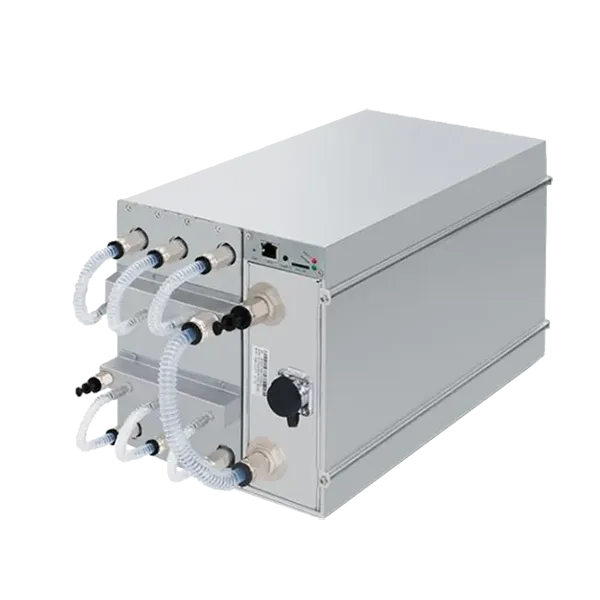
Hydro-cooled S21 variant with 335 TH/s. Quieter than air-cooled models but requires water cooling infrastructure and 240V power.
Quick answer
The Antminer S21 Hydro is a Bitcoin miner rated about 335 TH/s at roughly 5,360 W (about 16 J/TH), built on the BM1368 ASIC. An industrial-class unit — loud and power-hungry, best suited to a dedicated mining space, not living areas.
Hydro-Cooled Miner
This miner uses a closed-loop liquid cooling system (hydro cooling) instead of traditional air cooling. Water or coolant circulates through internal channels to absorb heat from the ASIC chips, then transfers it to an external radiator or facility cooling loop.
Hydro-cooled miners run significantly quieter than air-cooled models since they eliminate or minimize fan noise. They also achieve higher hashrates and better efficiency because the chips can be driven harder while staying within safe thermal limits. The trade-off: hydro miners require compatible water infrastructure — inlet/outlet connections, a cooling distribution unit (CDU), and proper plumbing.
Hydro cooling is ideal for professional mining operations and data centers where water infrastructure already exists, or for home miners building a dedicated water-cooled setup to eliminate noise completely.
Professional-Grade Miner
This miner draws 5,360W and produces 50 dB of noise — it is designed for dedicated mining environments, not living spaces. Professional-grade miners deliver the highest hashrate and revenue per unit but require proper infrastructure: a 240V circuit, adequate ventilation or exhaust ducting, and a space where noise is not a concern (garage, basement, warehouse, or outdoor enclosure).
For home miners looking for a quieter alternative, consider our Bitcoin Space Heater builds or explore open-source miners like the Bitaxe that are purpose-built for residential environments.
Profitability Calculator
| Period | Revenue | Electricity Cost | Profit |
|---|---|---|---|
| Daily | $10.53 | $9.00 | $1.53 |
| Weekly | $73.71 | $63.03 | $10.68 |
| Monthly | $315.90 | $270.14 | $45.75 |
| Yearly | $3,843.40 | $3,286.75 | $556.65 |
Heating offset estimates the value of heat replacing an electric space heater during heating season (~6 months/year in Canada). Actual savings depend on your heating setup and climate.
Where to Buy the Antminer S21 Hydro
D-Central Technologies
CanadaBitcoin Mining Hackers since 2016. Ships from Laval, Quebec.
Shop all Bitcoin mining productsASIC Miner Market
United StatesWide selection of new and used ASIC miners. US-based shipping.
Shop NowFull Specifications
| Model | Antminer S21 Hydro |
|---|---|
| Model Number | S21 Hyd |
| Manufacturer | Bitmain |
| Algorithm | SHA-256 |
| Coins Mined | Bitcoin (BTC) |
| Hashrate | 335 TH/s |
| Power Consumption | 5,360 W |
| Efficiency | 16 J/TH |
| Noise Level | 50 dB |
| Chip Model | BM1368 |
| Cooling | Hydro |
| Voltage Range | 200-240V AC |
| Operating Temperature | 5-45°C |
| Dimensions | 412x197x209 |
| Weight | 15.8 |
| Interface | Ethernet |
| BTU Output | 18288.3 BTU/hr |
| Equivalent Heater | Equal to a 5,360W space heater |
| Daily Power Cost | $9.00/day |
| Monthly Power Cost | $270.14/mo |
| Circuit Requirement | 240V circuit required |
| Release Date | 2024-02-01 |
| MSRP | $9,500.00 |
| Status | Active |
Custom Power Profiles
With custom firmware like DCENT_OS, this miner can be tuned across a wide range of power levels. Lower wattage improves efficiency and reduces electricity costs; higher wattage increases hashrate at the expense of efficiency.
Performance Mode
| Wattage | Hashrate | Efficiency |
|---|---|---|
| 2,500 W | 148 TH/s | 16.9 J/TH |
| 2,900 W | 173 TH/s | 16.8 J/TH |
| 3,300 W | 197 TH/s | 16.8 J/TH |
| 3,620 W | 222 TH/s | 16.3 J/TH |
| 4,000 W | 247 TH/s | 16.2 J/TH |
| 4,370 W | 272 TH/s | 16.1 J/TH |
| 4,780 W | 297 TH/s | 16.1 J/TH |
| 4,980 W | 309 TH/s | 16.1 J/TH |
| 5,450 W | 334 TH/s | 16.3 J/TH |
| 5,800 W | 359 TH/s | 16.2 J/TH |
| 6,300 W | 383 TH/s | 16.4 J/TH |
Normal Mode
| Wattage | Hashrate | Efficiency |
|---|---|---|
| 1,630 W | 92 TH/s | 17.7 J/TH |
| 1,960 W | 109 TH/s | 18 J/TH |
| 2,280 W | 127 TH/s | 18 J/TH |
| 2,610 W | 145 TH/s | 18 J/TH |
| 2,930 W | 163 TH/s | 18 J/TH |
| 3,250 W | 181 TH/s | 18 J/TH |
| 3,580 W | 199 TH/s | 18 J/TH |
| 3,880 W | 217 TH/s | 17.9 J/TH |
| 4,210 W | 235 TH/s | 17.9 J/TH |
| 4,530 W | 253 TH/s | 17.9 J/TH |
| 4,860 W | 271 TH/s | 17.9 J/TH |
| 5,180 W | 289 TH/s | 17.9 J/TH |
| 5,500 W | 307 TH/s | 17.9 J/TH |
| 5,830 W | 324 TH/s | 18 J/TH |
| 6,150 W | 342 TH/s | 18 J/TH |
| 6,480 W | 360 TH/s | 18 J/TH |
Actual performance varies by individual unit silicon quality, ambient temperature, and cooling configuration. These operating points are achievable with custom tuning firmware such as DCENT_OS; values are calculated at runtime by the autotuner, not fixed presets.
Home Mining Assessment
Hydro-cooled S21 variant with 335 TH/s. Quieter than air-cooled models but requires water cooling infrastructure and 240V power.
The Antminer S21 Hydro is Bitmain’s liquid-cooled SHA-256 miner, rated at 335 TH/s for 5,360 W (about 16 J/TH). It runs the fifth-generation BM1368 ASIC on sealed water-cooled hashboards, trading the air-cooled S21’s fan noise for a remote dry-cooler loop that lets it hold high clocks in dense deployments.
Chip and hashboard architecture
At the heart of the S21 Hydro is the BM1368, Bitmain’s fifth-generation SHA-256 die fabricated on a TSMC 5 nm process (first seen in 2023). Each BM1368 packs roughly 1,280 hashing cores — bench reverse-engineering of an S21 fixture in our lab counted 80 large cores plus 16 small cores per die — which is why a single chip delivers several hundred gigahash per second where the older S9’s BM1387 managed about 75 GH/s.
Each S21-series hashboard carries on the order of 108 BM1368 chips arranged across 12 voltage domains (nine chips per domain). This is a sharp departure from the S19 generation, where 76 to 114 chips were spread across 38 tiny ~0.3 V domains. The BM1368 board instead runs a much higher per-domain voltage of roughly 1.2 V, fed by a redesigned power tree: an on-board boost stage lifts the 12 V input to around 25 V, domains 1–10 step that down through three LDOs each (1.2 V and 0.8 V rails), and domains 11–12 use MP2019 buck converters. Eleven level shifters bridge the control board’s 3.3 V logic to the chain. It is worth stating plainly for tuners and repair techs: voltage is regulated per domain, not per individual chip — the autotuner trims frequency chip-by-chip, but the supply rail is shared across each group of nine.
The S21 generation is also the “no-PIC” era. Bitmain dropped the dedicated PIC microcontroller that policed earlier S9 and S19 hashboards; on BM1368 boards a repurposed TAS5782M I²C device handles voltage setpoints and telemetry instead, with a 25 MHz crystal (Y1), an on-board EEPROM (U6), and inlet/outlet temperature sensors (U5 and U7) reading coolant rather than air. The Hydro’s control board is a Xilinx Zynq SoC (the hydro firmware builds we have catalogued are all Xilinx/Zynq variants), clocked at 667 MHz, whereas the air-cooled S21 ships on an Amlogic board. Both talk to the hashboards over a software-driven UART rather than a discrete FPGA bridge.
Real-world power, efficiency and tuning headroom
The 5,360 W nameplate is wall draw at 200–240 V AC, and like all Bitmain ratings it carries roughly a ±5% tolerance — expect real units to land anywhere from about 5,100 W to 5,600 W at the rated hashrate depending on chip bin and coolant temperature. Crucially, that figure does not include the external loop: the dry cooler, circulation pump and any CDU you pair the unit with draw their own power, so plan facility budgets on more than the miner’s nameplate alone.
The BM1368 is genuinely flexible. Across the documented profile set, the S21 Hydro tunes from a frugal ~92 TH/s at 1,630 W all the way to ~383 TH/s at 6,300 W. Two behaviours stand out. In “normal” mode efficiency is almost flat — 17.9 to 18.0 J/TH across more than 30 steps — making it predictable to model. In “performance” mode the curve dips into a genuine efficiency sweet spot near 16.1 J/TH around 4,200–5,000 W, which is where operators chasing the best joules-per-terahash usually settle rather than running the chips flat out.
| Mode / step | Wall power (W) | Hashrate (TH/s) | Efficiency (J/TH) |
|---|---|---|---|
| Performance — eco floor | 2,500 | 148 | 16.9 |
| Performance — balanced | 3,450 | 210 | 16.4 |
| Performance — efficiency sweet spot | 4,160 | 259 | 16.1 |
| Performance — efficiency sweet spot | 4,980 | 309 | 16.1 |
| Performance — overclock ceiling | 6,300 | 383 | 16.4 |
| Normal — flat band (example) | 4,210 | 235 | 17.9 |
The 335 TH/s nameplate sits comfortably inside this band. Explore the full step-by-step curve, including every documented wattage point, on our ASIC power profiles database. At nameplate the unit dumps roughly 18,288 BTU/h of heat — but because that heat leaves through the coolant loop, it is far easier to capture or reject deliberately than the hot exhaust of an air-cooled miner.
Firmware compatibility
The S21 Hydro ships with Bitmain’s stock firmware (a bmminer/cgminer fork) running on the Zynq control board, with a runtime autotuner that calculates each chip’s stable frequency at startup rather than loading fixed presets. Because Bitmain signs and encrypts the stock image, moving to third-party firmware requires an unlock step first — that is the single biggest gotcha when people flash these units.
The BM1368 is mature in the wider ecosystem and well served by the firmware projects that came before us. Braiins OS+, VNish and LuxOS all publish S21-compatible builds (LuxOS and VNish explicitly cover the hydro variants), and among them only Braiins OS+ natively speaks Stratum V2 — worth knowing if pool-side job declaration and encryption matter to you. We credit that groundwork rather than compete with it on tone. D-Central’s own work fits here too: our in-development DCENT_OS already drives the BM1368 on bench S21 hardware (first hashes logged in our lab in April 2026). It remains a GPL-3.0 closed beta with a public beta targeted for summer 2026, so for production today the stock or established custom firmwares are the practical choices.
Common faults and troubleshooting
Most S21 Hydro problems fall into two buckets: hashboard/chip faults shared with the air-cooled S21, and loop-specific issues unique to liquid cooling.
- Reduced or missing ASIC count — the controller reports fewer chips than expected on a chain, or a board fails to enumerate entirely. On the no-PIC BM1368 board this is detected directly over the UART, and it usually points to a chip, a domain-power component, or a marginal data line rather than a dead PIC.
- Coolant-loop faults — low or no flow, trapped air pockets, a failing pump or a fouled dry cooler. The inlet/outlet sensors (U5/U7) watch coolant temperature, and the firmware will throttle or halt the boards on an over-temperature or flow fault long before silicon is damaged. Always rule out the loop before condemning a hashboard.
- Power-tree failures — because each board concentrates current through a 25 V boost stage, LDOs and MP2019 buck converters, hard faults often cluster at those components, where a board-level repair is realistic.
- Leak/short events — the one failure mode liquid cooling adds. A weeping fitting near live electronics is the scenario to design out with proper quick-disconnects and leak detection.
Work a dead or underperforming unit methodically with our ASIC fault finder, which maps observed symptoms and error messages to likely root causes.
Repair and longevity
D-Central has repaired Bitmain hardware in-house since 2016, and the BM1368 hydro boards are squarely in scope. Dense 5 nm chips and a complex multi-rail power tree make these boards more rewarding to repair at the component level than to discard — chip-level diagnosis, reballing and replacement, power-stage rework, PSU repair and coolant-loop servicing all extend a unit’s working life well past its warranty. Liquid cooling is genuinely kind to silicon when the loop is maintained: stable, low junction temperatures reduce thermal cycling, so the main longevity levers are coolant quality, loop cleanliness and leak-free fittings. When a board does fail, send it to our ASIC repair bench rather than writing off the machine.
Who it is for and buying
This is an industrial hashcenter machine, not a living-room miner — its home-mining suitability scores low precisely because it needs a 200–240 V circuit and a real water-cooling loop (dry cooler, pump, and plumbing) before it produces a single hash. For operators who already run, or are building, liquid infrastructure, the S21 Hydro is one of the most power-dense, quietest-at-the-rack SHA-256 options available, and waste heat in the coolant is straightforward to reuse. If you are a home or hobby miner drawn to the idea of running modern silicon at home, a small open-source Bitaxe-class device or our DCENT_axe is a far better starting point. We build and configure mining hardware to order; browse current SHA-256 stock in the D-Central shop or talk to us about a hydro deployment.
Where the S21 Hydro fits
The S21 family is Bitmain’s fifth SHA-256 generation, and the efficiency jump it represents is real: where the S19 generation lived around 29.5 J/TH per chip, the BM1368 brought the whole platform to roughly 16 J/TH — close to halving the energy per terahash. The Hydro variant slots between the air-cooled S21 (around 200 TH/s) and the higher-binned S21+ and BM1370-based S21 Pro/XP machines. Bitmain earned that progression generation over generation, and the table below shows where the Hydro sits among its liquid-cooled siblings.
| Model | Chip | Process | Hashrate | Wall power | Approx. efficiency |
|---|---|---|---|---|---|
| S19 XP Hydro | BM1366 | TSMC 5 nm | 257 TH/s | 5,304 W | ~20.6 J/TH |
| S21 Hydro | BM1368 | TSMC 5 nm | 335 TH/s | 5,360 W | ~16 J/TH |
| S21+ Hydro | BM1368 | TSMC 5 nm | 358 TH/s | 5,360 W | ~15 J/TH |
| S21 XP Hydro | BM1370 | TSMC 5 nm | 473 TH/s | 5,676 W | ~12 J/TH |
For a facility standardising on liquid cooling, the S21 Hydro remains a sensible, repairable workhorse — efficient enough to stay profitable, dense enough to fill a manifold, and supported by both a healthy firmware ecosystem and a repair bench that has been keeping these boards alive since the S9 era.
Broken miner? Get a real quote.
Tell us the symptom and get an instant repair-tier estimate ($95 / $145 / $195 CAD). Mail-in from across Canada, bench in Laval, Quebec.
Send it to D-Central — start a repair →Antminer S19 XP specs, repair, and parts
Use the S19 XP cluster to confirm specs, maintenance steps, hashboard symptoms, and compatible power or board parts before buying.
Frequently Asked Questions
What are the current mining economics for the Antminer S21 Hydro?
At $0.07/kWh electricity, the Antminer S21 Hydro currently shows an estimated $1.53 daily net result before pool fees and hardware cost. Results depend on your electricity rate and Bitcoin network conditions. Use the calculator above with your actual electricity rate.
Can I mine Bitcoin at home with the Antminer S21 Hydro?
The Antminer S21 Hydro has a home mining score of 32/100. With 50 dB noise and 5,360W power draw, it may require a dedicated space like a garage, basement, or outdoor enclosure. Consider noise insulation and proper ventilation.
Can the Antminer S21 Hydro heat my home?
The Antminer S21 Hydro outputs approximately 18288.3 BTU/hr of heat. For reference, a typical space heater produces 5,000-5,500 BTU/hr. All electrical energy consumed by the miner is converted to heat, making it 100% efficient as a heater. D-Central offers Bitcoin Space Heater builds designed specifically for home heating integration.
Does D-Central repair the Antminer S21 Hydro?
Yes, D-Central provides professional repair services for the Antminer S21 Hydro. Services include hashboard repair, control board diagnostics, fan replacement, and full refurbishment. Ship your miner to our Laval, Quebec facility for diagnosis and repair.
What power supply does the Antminer S21 Hydro need?
The Antminer S21 Hydro draws 5,360W of power. You need a power supply rated for at least 5,896W with appropriate voltage (200-240V AC). D-Central stocks compatible power supplies in our shop. Always use a quality PSU from a reputable manufacturer to protect the miner and wiring.
