
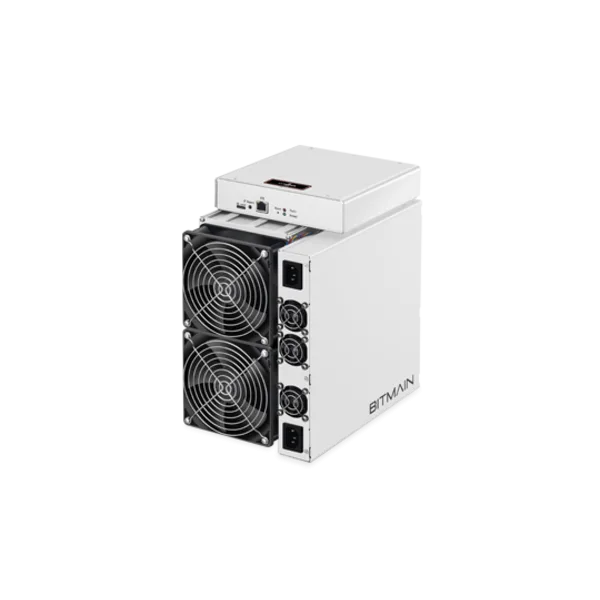
Bitmain Antminer T17 (40Th)
Quick answer
The Bitmain Antminer T17 (40Th) is a Bitcoin miner rated about 40 TH/s at roughly 2,200 W (about 55 J/TH). An industrial-class unit — loud and power-hungry, best suited to a dedicated mining space, not living areas.
Professional-Grade Miner
This miner draws 2,200W and produces 75+ dB of noise — it is designed for dedicated mining environments, not living spaces. Professional-grade miners deliver the highest hashrate and revenue per unit but require proper infrastructure: a 240V circuit, adequate ventilation or exhaust ducting, and a space where noise is not a concern (garage, basement, warehouse, or outdoor enclosure).
For home miners looking for a quieter alternative, consider our Bitcoin Space Heater builds or explore open-source miners like the Bitaxe that are purpose-built for residential environments.
Heater-Class Miner
At 2,200W, this miner outputs approximately 7506 BTU/hr of heat — equivalent to a standard electric space heater. Every watt consumed by an ASIC miner is converted to heat with 100% efficiency, making it a space heater that also mines Bitcoin.
During heating season, miner heat can offset part of the heat a room would otherwise need from another electric heater. The economics depend on your electricity rate, room heat demand, BTC price, network difficulty, and noise constraints.
Profitability Calculator
| Period | Revenue | Electricity Cost | Profit |
|---|---|---|---|
| Daily | $1.58 | $3.70 | $-2.12 |
| Weekly | $11.04 | $25.87 | $-14.83 |
| Monthly | $47.31 | $110.88 | $-63.57 |
| Yearly | $575.66 | $1,349.04 | $-773.38 |
Heating offset estimates the value of heat replacing an electric space heater during heating season (~6 months/year in Canada). Actual savings depend on your heating setup and climate.
Where to Buy the Bitmain Antminer T17 (40Th)
D-Central Technologies
CanadaBitcoin Mining Hackers since 2016. Ships from Montreal, Quebec.
Shop all Bitcoin mining productsASIC Miner Market
United StatesWide selection of new and used ASIC miners. US-based shipping.
Shop NowFull Specifications
| Model | Bitmain Antminer T17 (40Th) |
|---|---|
| Model Number | Antminer T17 (40Th) |
| Manufacturer | Bitmain |
| Algorithm | SHA-256 |
| Coins Mined | Bitcoin (BTC) |
| Hashrate | 40 TH/s |
| Power Consumption | 2,200 W |
| Efficiency | 55 J/TH |
| Dimensions | 298 x 178 x 296mm |
| Weight | 11.5 |
| BTU Output | 7506 BTU/hr |
| Equivalent Heater | Equal to a 2,200W space heater |
| Daily Power Cost | $3.70/day |
| Monthly Power Cost | $110.88/mo |
| Circuit Requirement | 240V circuit required |
| Release Date | 2019-05-01 |
| MSRP | $155.00 |
| Status | Active |
Home Mining Assessment
The Bitmain Antminer T17 is the 2019 SHA-256 workhorse of Bitmain’s first 7 nm generation: 40 TH/s for roughly 2,200 W at the wall, about 55 J/TH. It runs three BM1397 hashboards (90 chips total) on a Xilinx Zynq control board. Today it earns its keep as a heat source, learning rig, or cheap-power hobby miner rather than a profit machine.
Chip and hashboard architecture
The T17 is built on Bitmain’s BM1397, a TSMC 7 nm DUV ASIC and the company’s second-generation SHA-256 silicon (2019). Each BM1397 packs 672 hashing cores and identifies itself on the wire as chip ID 0x1397, using the BM1397-era command-header family (0x51/0x52/0x53 broadcast, 0x40/0x41/0x42 single) that Bitmain carried forward into the S19’s BM1398.
The miner uses three hashboards (chains) of 30 chips each, for 90 ASICs in total. Chips on a board are wired in series into voltage domains, with a single chain rail feeding the whole string. That is the detail most spec sheets get wrong: voltage on the T17 is regulated per voltage domain, not per chip. A dsPIC33EP16GS202 controller with a 16-bit DAC sets the chain rail (the S17/T17 family operates in the ~12–15 V window), and the autotuner trims frequency per domain at runtime — these values are calculated live, never read from a fixed preset table.
Brains live on a Xilinx Zynq-7010 SoC control board: a dual-core ARM Cortex-A9 running at 667 MHz alongside FPGA fabric that hosts the UART and clock IP cores talking to the hashboards. Stock firmware boots the chains at roughly 650 MHz.
| Specification | Antminer T17 (40 TH) |
|---|---|
| Algorithm | SHA-256 (BTC / BCH) |
| Nameplate hashrate | 40 TH/s |
| Wall power (stock) | ~2,200 W |
| Efficiency (stock) | ~55 J/TH |
| ASIC chip | Bitmain BM1397 (TSMC 7 nm DUV) |
| Cores per chip | 672 |
| Hashboards × chips | 3 × 30 = 90 ASICs |
| Voltage control | Per domain (dsPIC33EP16GS202, 16-bit DAC) |
| Control board | Xilinx Zynq-7010 (dual Cortex-A9 @ 667 MHz + FPGA) |
| Stock PSU | Bitmain APW9 (14.5–21 V, 170 A, 3,600 W @ 220 V) |
| Input voltage | 200–240 V required |
| Heat output | ~7,500 BTU/h at the wall |
| Dimensions / weight | 298 × 178 × 296 mm / ~11.5 kg |
| Released | 2019 |
Real-world power and efficiency
Bitmain’s nameplate rates the stock T17 at 40 TH/s for about 2,200 W (≈55 J/TH) — a deliberately conservative figure. On the bench, a well-binned unit reaches the same 40 TH/s nearer 1,850 W (≈46 J/TH) once an autotuning firmware trims per-domain frequency. The T17 has real tuning headroom in both directions: throttle it down to a quiet ~36 TH/s for 1,570 W, or push it to ~54 TH/s for nearly 2,900 W. The legacy profile set looks like this:
| Profile | Frequency | Wall power | Hashrate | Efficiency |
|---|---|---|---|---|
| profile_600_36T | 600 MHz | 1,570 W | 36 TH/s | 43.6 J/TH |
| profile_650_38T | 650 MHz | 1,760 W | 38 TH/s | 46.3 J/TH |
| profile_675_40T | 675 MHz | 1,850 W | 40 TH/s | 46.3 J/TH |
| profile_700_42T | 700 MHz | 2,050 W | 42 TH/s | 48.8 J/TH |
| profile_750_45T | 750 MHz | 2,350 W | 45 TH/s | 52.2 J/TH |
| profile_800_48T | 800 MHz | 2,530 W | 48 TH/s | 52.7 J/TH |
| profile_850_51T | 850 MHz | 2,720 W | 51 TH/s | 53.3 J/TH |
| profile_900_54T | 900 MHz | 2,910 W | 54 TH/s | 53.9 J/TH |
The takeaway: the T17’s sweet spot is the bottom of its range. Frequency past ~700 MHz buys hashrate at a steep efficiency penalty, while under-clocking toward 36–40 TH/s is where it makes sense as a heat-and-hash appliance. Browse the full tuning ladder for this and every model on our ASIC power profiles database.
One hard constraint that trips up home buyers: the stock APW9 PSU needs a 200–240 V circuit. Unlike the 12 V APW3++ that some operators retrofit onto S19-class units for 120 V, the T17’s hashboards run a higher chain rail (the APW9 delivers 14.5–21 V), so there is no clean low-voltage swap — plan for a 240 V outlet. At full tilt the T17 dumps roughly 7,500 BTU/h of waste heat, which is exactly why its second life is as a space or workshop heater.
Firmware compatibility
Out of the box the T17 runs Bitmain’s stock cgminer-based firmware (the BMminer lineage), which exposes basic frequency, voltage and fan settings but no real autotuning. Because the T17 sits on the well-understood Zynq S17-class platform, third-party autotuning firmware is widely available for it, and that is what unlocks the per-domain profile ladder above, custom fan curves, immersion modes and live efficiency tuning.
Common faults and troubleshooting
Credit where it is due: Bitmain pushed 7 nm to market early with the S17/T17 line, and being first carried a cost. This generation is known for hashboard reliability issues, most of them heat-driven. The faults we see most on the bench are:
- Dead or partial hashboard — a chain reports fewer chips than expected, or zero, often shown as an “X” in the kernel log. Usually one or more ASICs have dropped off the chain.
- Heat-fatigued solder joints — the dense BGA under-chip joints crack or cold-solder after thermal cycling, producing intermittent chips that come and go with temperature.
- Temperature-sensor errors — a board that can’t return a valid temp reading is forced to a fault/safe state; the firmware blasts fans to 100% and stops the chain.
- Fan faults — a stalled fan (tach = 0) trips the safety logic and halts mining to protect the boards.
- PSU faults — the APW9 is a high-voltage, high-current unit; under-voltage input, a failed rail, or a tripped watchdog will stop the miner cold.
Work the problem methodically rather than swapping parts at random. Start with our ASIC fault finder to narrow the symptom to a board, a chip domain, the control board or the PSU, and cross-reference the exact log string against our error-code library before you reach for a heat gun.
Repair and longevity
A T17 with a dead hashboard is not scrap. D-Central has repaired Antminers in-house since 2016, and the S17/T17 family is firmly in our wheelhouse — chip-level reflow and replacement, voltage-domain and chain-rail diagnosis, control-board recovery and PSU service. Because the failure modes here are well characterised (solder fatigue and dropped chips far more often than dead silicon), board-level repair is frequently the economical fix versus writing off the unit.
If your T17 is showing a dead chain, intermittent chips, or won’t hold its hashrate, send it to our ASIC repair service. A repaired-and-tuned T17, run at the low end of its profile range, has plenty of useful life left as a heat-and-hash appliance.
Who the T17 is for, and buying advice
At 44–55 J/TH the T17 is no longer a serious profit miner — modern 5 nm hardware is two to three times more efficient (see below). Where it still makes sense:
- Heat reuse — ducting ~7,500 BTU/h into a garage, workshop or grow space turns money you’d spend on heating into hashrate.
- Cheap, free or curtailed power — solar overflow, off-peak rates, or otherwise stranded energy where efficiency barely matters.
- Learning and tinkering — a low-stakes platform to practice flashing firmware, tuning profiles and doing board repair.
- Solo-lottery hobby mining — a long-shot block ticket running on power you were going to spend anyway.
Before you buy, confirm you have a 240 V circuit for the APW9 and budget for the noise — these are loud, datacenter-class fans. Browse current stock and refurbished SHA-256 hardware in our miner catalog; the slightly more efficient Antminer S17 Pro is a close sibling worth comparing. If your real goal is to learn mining quietly at home, a low-power open-source Bitaxe-class miner is a better first device than a screaming T17.
Generational context
The T17’s BM1397 is one rung on Bitmain’s SHA-256 ladder. Understanding where it sits explains both its quirks and its retirement:
| Generation | Chip | Process | Representative model | Rough efficiency |
|---|---|---|---|---|
| Gen 2 (2019) | BM1397 | TSMC 7 nm DUV | S17 / T17 | ~44–55 J/TH |
| Gen 3 (2020) | BM1398 | TSMC 7 nm (refined) | S19 / S19 Pro | ~30–34 J/TH |
| Gen 4 (2022) | BM1362 / BM1366 | TSMC 5 nm | S19j Pro / S19 XP | ~21.5–26 J/TH |
| Current | BM1368 / BM1370 | TSMC 5 nm | S21 / S21 Pro | ~15–18 J/TH |
The BM1398 in the S19 was a direct refinement of the BM1397 — same 672-core layout and near-identical register map — which is why the S17/T17 platform is so well understood and so repairable. The big efficiency jumps only came with the move to TSMC 5 nm in the BM1362 and BM1366. The T17 was the rough first draft of that lineage; it isn’t the chip to chase profit with in 2026, but as a hand-tuned, well-repaired heat source it’s a genuinely useful piece of mining history.
Broken miner? Get a real quote.
Tell us the symptom and get an instant repair-tier estimate ($95 / $145 / $195 CAD). Mail-in from across Canada, bench in Montreal, Quebec.
Send it to D-Central — start a repair →Antminer 17-series repair and parts path
Use the S17/T17 cluster to connect known hashboard risks, chip parts, diagnostics, and repair economics before replacing boards.
- Antminer S17 specs
- S17 maintenance guide
- T17 maintenance guide
- S17 hashboard troubleshooting
- BM1397AD ASIC chip
- 17-series replacement hashboards
- Antminer test fixture
- Repair vs replace guide
- Confirm chip count, voltage domains, fitment
- Full per-model repair BOM
- Match firmware to this model
- Which firmwares run on this control board — factual support matrix
Related Miners
Bitmain Antminer S21 XP+ Hyd (500Th)
Auradine Teraflux AT2880
Antminer S9j
Bitmain Antminer S23
Compare the Bitmain Antminer T17 (40Th)
Frequently Asked Questions
What are the current mining economics for the Bitmain Antminer T17 (40Th)?
At $0.07/kWh, the Bitmain Antminer T17 (40Th) currently shows an estimated daily net cost of $2.12 before pool fees and hardware cost. Lower electricity rates, network changes, BTC price changes, or useful heat recovery can change the result.
Can I mine Bitcoin at home with the Bitmain Antminer T17 (40Th)?
The Bitmain Antminer T17 (40Th) has a home mining score of 11/100. With 0 dB noise and 2,200W power draw, it may require a dedicated space like a garage, basement, or outdoor enclosure. Consider noise insulation and proper ventilation.
Can the Bitmain Antminer T17 (40Th) heat my home?
The Bitmain Antminer T17 (40Th) outputs approximately 7506 BTU/hr of heat. For reference, a typical space heater produces 5,000-5,500 BTU/hr. All electrical energy consumed by the miner is converted to heat, making it 100% efficient as a heater. D-Central offers Bitcoin Space Heater builds designed specifically for home heating integration.
What power supply does the Bitmain Antminer T17 (40Th) need?
The Bitmain Antminer T17 (40Th) draws 2,200W of power. You need a power supply rated for at least 2,420W with appropriate voltage (200-240V AC). D-Central stocks compatible power supplies in our shop. Always use a quality PSU from a reputable manufacturer to protect the miner and wiring.