On this page
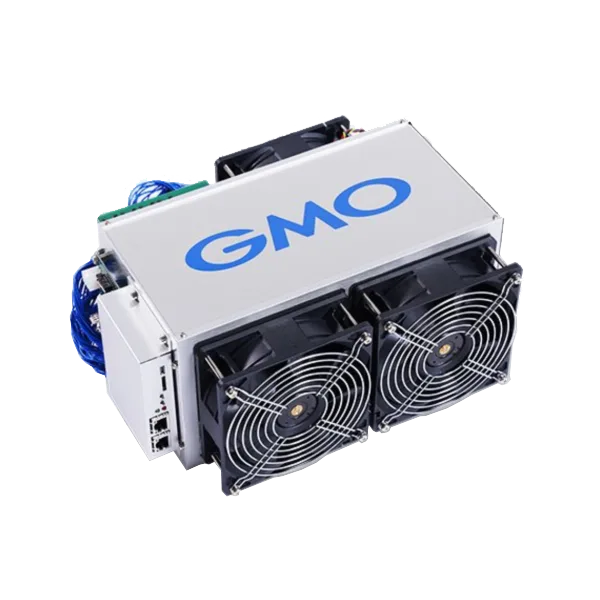
GMO miner B3
Quick answer
The GMO miner B3 is a Bitcoin miner rated about 33 TH/s at roughly 3,417 W (about 103.5 J/TH). An industrial-class unit — loud and power-hungry, best suited to a dedicated mining space, not living areas.
Professional-Grade Miner
This miner draws 3,417W and produces 75+ dB of noise — it is designed for dedicated mining environments, not living spaces. Professional-grade miners deliver the highest hashrate and revenue per unit but require proper infrastructure: a 240V circuit, adequate ventilation or exhaust ducting, and a space where noise is not a concern (garage, basement, warehouse, or outdoor enclosure).
For home miners looking for a quieter alternative, consider our Bitcoin Space Heater builds or explore open-source miners like the Bitaxe that are purpose-built for residential environments.
Heater-Class Miner
At 3,417W, this miner outputs approximately 11659 BTU/hr of heat — equivalent to a standard electric space heater. Every watt consumed by an ASIC miner is converted to heat with 100% efficiency, making it a space heater that also mines Bitcoin.
During heating season, miner heat can offset part of the heat a room would otherwise need from another electric heater. The economics depend on your electricity rate, room heat demand, BTC price, network difficulty, and noise constraints.
Profitability Calculator
| Period | Revenue | Electricity Cost | Profit |
|---|---|---|---|
| Daily | $1.04 | $5.74 | $-4.70 |
| Weekly | $7.29 | $40.18 | $-32.90 |
| Monthly | $31.22 | $172.22 | $-140.99 |
| Yearly | $379.88 | $2,095.30 | $-1,715.42 |
Heating offset estimates the value of heat replacing an electric space heater during heating season (~6 months/year in Canada). Actual savings depend on your heating setup and climate.
Where to Buy the GMO miner B3
D-Central Technologies
CanadaBitcoin Mining Hackers since 2016. Ships from Laval, Quebec.
Shop all Bitcoin mining productsASIC Miner Market
United StatesWide selection of new and used ASIC miners. US-based shipping.
Shop NowFull Specifications
| Model | GMO miner B3 |
|---|---|
| Model Number | B3 |
| Manufacturer | GMO miner |
| Algorithm | SHA-256 |
| Coins Mined | Bitcoin (BTC) |
| Hashrate | 33 TH/s |
| Power Consumption | 3,417 W |
| Efficiency | 103.5 J/TH |
| Dimensions | 136 x 163 x 430mm |
| Weight | 5 |
| BTU Output | 11659 BTU/hr |
| Equivalent Heater | Equal to a 3,417W space heater |
| Daily Power Cost | $5.74/day |
| Monthly Power Cost | $172.22/mo |
| Circuit Requirement | 240V circuit required |
| Release Date | 2018-11-01 |
| Status | Active |
Home Mining Assessment
The GMO miner B3 is a SHA-256 Bitcoin ASIC released in November 2018 by Japan’s GMO Internet Group, rated at 33 TH/s and 3,417 W for roughly 103.5 J/TH. Built on an early in-house 7 nm chip, it is today a discontinued, collector-grade legacy unit rather than a profitable miner.
Chip and hashboard architecture
What makes the B3 unusual is that GMO designed its own SHA-256 silicon in-house. Very few companies outside Bitmain, MicroBT and Canaan ever taped out a competitive-node Bitcoin chip, and GMO publicly stated it used a 7 nm process. That places the B3 — and its predecessor, the GMO miner B2 — among the very first wave of 7 nm Bitcoin mining silicon to reach the market in 2018, arriving alongside Bitmain’s own first 7 nm parts.
Mechanically, the B3 follows the universal SHA-256 ASIC pattern. Each chip is a fixed-function double-SHA-256 engine packed with many small hashing cores. The chips are daisy-chained in series along each hashboard and fed work over a UART chain from an integrated control board running a cgminer-derived stack. Power is delivered as a high-current rail that is stepped down and split into voltage domains, with several chips sharing each domain — voltage is regulated per domain, not per individual chip. That per-domain topology is a defining trait of this entire class of hardware, and it is why a single weak section of a board can drag down a whole group of chips at once.
Here honesty matters more than bravado: GMO never published a chip-level datasheet, and so few B3 units shipped that independent teardowns are scarce. Exact chips-per-board, the number of voltage domains, and the control-board SoC are not publicly verified the way Bitmain platforms are, so we will not invent those figures. What is documented and reliable is the outline above — an air-cooled, multi-hashboard SHA-256 unit with an integrated controller.
Real-world power draw and efficiency
The B3’s nameplate is 3,417 W at the DC side of the power supply. At the wall you should add a few percent for PSU conversion losses, so budget your circuit with headroom. Electrically, 3,417 W is firmly a 240 V-class load: about 14 A at 240 V. It is not feasible on a standard 120 V / 15 A circuit, which would need roughly 28 A — plan a dedicated 240 V circuit before you plug one in.
Efficiency is where the B3’s story turns sober. At 103.5 J/TH it sits deep in the legacy tier, and the honest comparison is unflattering. Bitmain’s 16 nm Antminer S9 — an older node — already managed about 98 J/TH, and Bitmain’s contemporaneous 7 nm S15 reached roughly 57 J/TH. In other words, GMO’s leading-edge 7 nm process did not translate into a leading-edge efficiency result; the B3 was actually slightly thirstier than the previous-generation S9 and nearly twice the J/TH of the 7 nm Antminer that launched in the same window.
| Miner | Era | Process | Hashrate | Power | Efficiency |
|---|---|---|---|---|---|
| GMO miner B3 | 2018 | 7 nm (GMO in-house) | 33 TH/s | 3,417 W | ~103.5 J/TH |
| Antminer S9 (BM1387) | 2016–2018 | 16 nm | ~13.5 TH/s | ~1,320 W | ~98 J/TH |
| Antminer S15 (BM1391) | 2018 | 7 nm | ~28 TH/s | ~1,596 W | ~57 J/TH |
| Antminer S21 (BM1368) | 2023+ | 5 nm | ~200 TH/s | ~3,500 W | ~17.5 J/TH |
Tuning headroom on a B3 is effectively nil. The runtime undervolting and underclocking that owners use to squeeze efficiency out of modern Bitmain units depends on custom firmware that calculates per-domain voltage and frequency on the fly — those values are computed at runtime, not pulled from a preset table — and none of that firmware runs on GMO’s platform. You are locked to GMO’s stock operating point. For models that do have published tuning data and power maps, see our ASIC power profiles database.
Firmware: stock-only, and what that means
The B3 shipped with GMO’s own web-managed firmware — a cgminer-derived stack offering basic pool configuration and monitoring, and little else. The bigger story is the absence of an aftermarket.
The third-party firmware ecosystem — BraiinsOS+ and the various closed custom builds — targets the widely deployed Bitmain control boards (and, to a lesser degree, MicroBT and Canaan). The B3 uses GMO’s bespoke single-vendor platform, which none of them support. The practical consequences are real: no aftermarket firmware, no autotuner, and no Stratum V2 path. Only BraiinsOS+ natively speaks Stratum V2, and it does not run on this hardware, so the B3 is confined to Stratum V1 on GMO’s last stock build.
Our own open firmware work, DCENT_OS, likewise concentrates on the common Bitmain-class platforms we have documented and driven on the bench; an orphaned single-vendor board like the B3’s falls outside that scope. If your goal is a fully open, tinker-friendly mining platform, the open-source Bitaxe line is a far better starting point than trying to coax life out of a closed, abandoned controller.
Common faults and troubleshooting
Most B3 failures are the same failures every air-cooled SHA-256 ASIC suffers, made worse by age and orphan status:
- Dead chain / missing hashboard. Because the chips are wired in series, one failed ASIC can drop an entire chain to zero hashrate. A board reading 0 TH/s or a missing chain count is the most common major fault.
- Low hashrate and high hardware-error counts. These usually point to marginal chips, cold or cracked solder joints, or dried-out thermal interface material starving heat transfer.
- Power supply degradation. A seven-year-old PSU under continuous multi-kilowatt load is a prime suspect for instability, restarts and shutdowns.
- Fan failure and thermal throttling. Bearings wear out, dust accumulates, and the unit derates or shuts down to protect itself.
The orphan-platform tax compounds all of this: no firmware updates, terse stock error reporting, and almost no community documentation make a B3 harder to diagnose than a mainstream Antminer or Whatsminer. Our ASIC fault finder and error-code database is the fastest way to map a symptom to a likely cause; while its error-code coverage is deepest for Bitmain and MicroBT gear, the underlying failure logic — dead chain, thermal, PSU, fan — is universal and applies directly to the B3.
Repair and longevity
D-Central has run an in-house, component-level ASIC repair bench since 2016, and many B3 failures are platform-agnostic and well within reach: fan replacement, PSU service, connector and ribbon-cable faults, thermal-pad refresh, and reflow or replacement of individual failed hashboard ASICs. A unit that has gone quiet is frequently revivable.
We will also be straight with you about the limits. Because the B3 is an orphan platform — no schematics, no firmware support, and essentially no supply of donor units for spare chips — some board-level repairs that depend on GMO-specific parts or a firmware reflash may not be economically worth doing. We assess each unit honestly and tell you when a repair costs more than the miner is worth. You can read about our process and request an evaluation through our ASIC repair service.
Who the GMO B3 is for today
At 103.5 J/TH the B3 is deeply underwater for profit at modern difficulty, and no amount of optimism changes that math. It earns its keep in only three honest roles:
- A space heater that happens to mine. It dumps roughly 11,659 BTU/h of usable heat; ducted into a cold room, that turns money you would spend on heating into a trickle of hashrate. Even here, more efficient retired units do the job better — see our best miners for heating.
- A learning or lab rig. If you want to understand SHA-256 hardware hands-on, though, a single-chip open-source Bitaxe is a cheaper, quieter and far more hackable teacher.
- A collector’s piece. The B3 is a genuine artifact of mining history, and for some buyers that is reason enough.
If you are shopping for hardware that actually pays its power bill, browse the current lineup in our universal ASIC miner database or see what we keep in stock in the D-Central shop.
Generational context: the 7 nm dawn
2018 was the dawn of 7 nm Bitcoin silicon. Bitmain shipped its 7 nm S15 and T15, Innosilicon pushed the T3, and GMO — a major Japanese internet conglomerate better known for domains, hosting and finance — made an ambitious bet that it could design competitive mining ASICs in-house. Credit where it is due: taping out a 7 nm SHA-256 chip is genuinely hard engineering, and GMO got real hardware into customers’ hands when most internet companies only talked about crypto.
ASIC mining is unforgiving, though. Facing the brutal late-2018 bitcoin-price crash and an efficiency gap against Bitmain that the table above lays bare, GMO took a large impairment and announced its exit from the in-house development, manufacture and sale of mining machines in December 2018 — only weeks after the B3 launched. That extremely short commercial life is precisely why so few B3 units exist today.
Set against the longer curve, the contrast is stark: from the B3’s ~103.5 J/TH 7 nm node to today’s 5 nm S21-class units at ~17.5 J/TH, the industry delivered roughly a six-fold efficiency leap in five years. The B3 is a snapshot of the brief moment when the field had more chip designers than its economics could support. We keep this profile complete and accurate because the history is worth remembering — and because the occasional B3 still crosses our repair bench. For the broader lineage of mining chips, see our ASIC chip reference.
Broken miner? Get a real quote.
Tell us the symptom and get an instant repair-tier estimate ($95 / $145 / $195 CAD). Mail-in from across Canada, bench in Laval, Quebec.
Send it to D-Central — start a repair →Antminer S21 specs, repair, and parts
Use the S21 cluster to connect current-generation specs, buying options, chip-level parts, troubleshooting, and repair support.
Frequently Asked Questions
What are the current mining economics for the GMO miner B3?
At $0.07/kWh, the GMO miner B3 currently shows an estimated daily net cost of $4.70 before pool fees and hardware cost. Lower electricity rates, network changes, BTC price changes, or useful heat recovery can change the result.
Can I mine Bitcoin at home with the GMO miner B3?
The GMO miner B3 has a home mining score of 8/100. With 0 dB noise and 3,417W power draw, it may require a dedicated space like a garage, basement, or outdoor enclosure. Consider noise insulation and proper ventilation.
Can the GMO miner B3 heat my home?
The GMO miner B3 outputs approximately 11659 BTU/hr of heat. For reference, a typical space heater produces 5,000-5,500 BTU/hr. All electrical energy consumed by the miner is converted to heat, making it 100% efficient as a heater. D-Central offers Bitcoin Space Heater builds designed specifically for home heating integration.
What power supply does the GMO miner B3 need?
The GMO miner B3 draws 3,417W of power. You need a power supply rated for at least 3,759W with appropriate voltage (200-240V AC). D-Central stocks compatible power supplies in our shop. Always use a quality PSU from a reputable manufacturer to protect the miner and wiring.
