
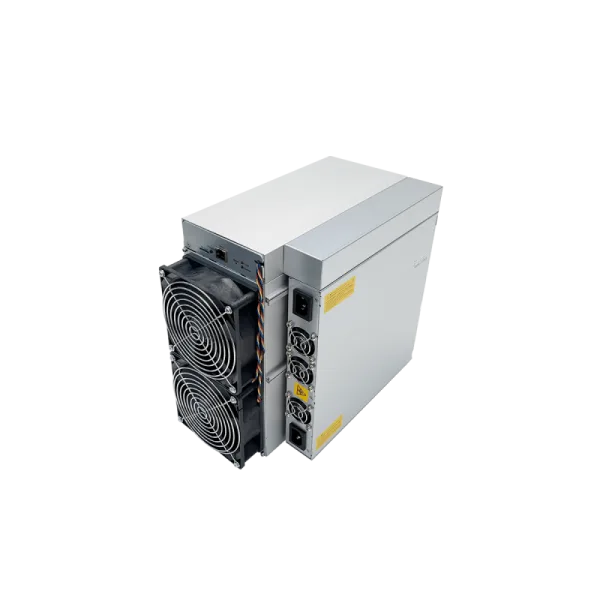
Bitmain Antminer S19j Pro (100Th)
Quick answer
The Bitmain Antminer S19j Pro (100Th) is a Bitcoin miner rated about 100 TH/s at roughly 3,050 W (about 30.5 J/TH), built on 378× BM1362. An industrial-class unit — loud and power-hungry, best suited to a dedicated mining space, not living areas.
Professional-Grade Miner
This miner draws 3,050W and produces 75+ dB of noise — it is designed for dedicated mining environments, not living spaces. Professional-grade miners deliver the highest hashrate and revenue per unit but require proper infrastructure: a 240V circuit, adequate ventilation or exhaust ducting, and a space where noise is not a concern (garage, basement, warehouse, or outdoor enclosure).
For home miners looking for a quieter alternative, consider our Bitcoin Space Heater builds or explore open-source miners like the Bitaxe that are purpose-built for residential environments.
Heater-Class Miner
At 3,050W, this miner outputs approximately 10407 BTU/hr of heat — equivalent to a standard electric space heater. Every watt consumed by an ASIC miner is converted to heat with 100% efficiency, making it a space heater that also mines Bitcoin.
During heating season, miner heat can offset part of the heat a room would otherwise need from another electric heater. The economics depend on your electricity rate, room heat demand, BTC price, network difficulty, and noise constraints.
Profitability Calculator
| Period | Revenue | Electricity Cost | Profit |
|---|---|---|---|
| Daily | $3.89 | $5.12 | $-1.23 |
| Weekly | $27.26 | $35.87 | $-8.61 |
| Monthly | $116.83 | $153.72 | $-36.89 |
| Yearly | $1,421.44 | $1,870.26 | $-448.82 |
Heating offset estimates the value of heat replacing an electric space heater during heating season (~6 months/year in Canada). Actual savings depend on your heating setup and climate.
Where to Buy the Bitmain Antminer S19j Pro (100Th)
D-Central Technologies
CanadaBitcoin Mining Hackers since 2016. Ships from Montreal, Quebec.
Shop all Bitcoin mining productsASIC Miner Market
United StatesWide selection of new and used ASIC miners. US-based shipping.
Shop NowFull Specifications
| Model | Bitmain Antminer S19j Pro (100Th) |
|---|---|
| Model Number | Antminer S19j Pro (100Th) |
| Manufacturer | Bitmain |
| Algorithm | SHA-256 |
| Coins Mined | Bitcoin (BTC) |
| Hashrate | 100 TH/s |
| Power Consumption | 3,050 W |
| Efficiency | 30.5 J/TH |
| Chip Model | BM1362 |
| Chip Count | 378 |
| Dimensions | 195 x 290 x 370mm |
| Weight | 13.2 |
| BTU Output | 10407 BTU/hr |
| Equivalent Heater | Equal to a 3,050W space heater |
| Daily Power Cost | $5.12/day |
| Monthly Power Cost | $153.72/mo |
| Circuit Requirement | 240V circuit required |
| Release Date | 2021-06-01 |
| MSRP | $600.00 |
| Status | Active |
Custom Power Profiles
With custom firmware like DCENT_OS, this miner can be tuned across a wide range of power levels. Lower wattage improves efficiency and reduces electricity costs; higher wattage increases hashrate at the expense of efficiency.
| Wattage | Hashrate | Efficiency |
|---|---|---|
| 1,740 W | 65 TH/s | 26.8 J/TH |
| 1,850 W | 76 TH/s | 24.3 J/TH |
| 2,150 W | 83 TH/s | 25.9 J/TH |
| 2,500 W | 92 TH/s | 27.2 J/TH |
| 2,970 W | 100 TH/s | 29.7 J/TH |
| 3,320 W | 110 TH/s | 30.2 J/TH |
| 3,670 W | 120 TH/s | 30.6 J/TH |
| 4,110 W | 130 TH/s | 31.6 J/TH |
| 4,880 W | 140 TH/s | 34.9 J/TH |
| 5,760 W | 160 TH/s | 36 J/TH |
| 6,804 W | 189 TH/s | 36 J/TH |
Actual performance varies by unit silicon quality, firmware, input power, ambient conditions and cooling. These catalog points are reference scenarios, not verified DCENT_OS results. No operating point should be attributed to DCENT_OS without a named build and raw model-specific measurements.
Tuning envelope (derived) Verified (extraction)
Full envelope analysis → · Source data →
Frequency and voltage are calculated at runtime by the firmware autotuner — never fixed presets; per-unit silicon quality, ambient temperature and cooling shift real results.
Home Mining Assessment
The Antminer S19j Pro (100 Th) is Bitmain’s cost-reduced SHA-256 workhorse from the S19 generation: 100 TH/s for roughly 3,050 W, about 30.5 J/TH, built around 5 nm BM1362 silicon in the proven X19 chassis. Released June 2021, it remains one of the most repairable, well-understood second-hand miners on the market.
Chip and hashboard architecture
Under the lid sit three identical hashboards, each carrying 126 BM1362 ASICs for 378 chips across the machine. The BM1362 is a TSMC 5 nm part (Bitmain’s “Gen 4” SHA-256 die, 2021) with four large hashing cores per chip. This is the detail most spec sheets get wrong: the S19j Pro is not a 7 nm BM1398 machine like the original S19 and S19 Pro. Bitmain shrank to a smaller, cheaper 5 nm die for the “j” (junior/cost-down) line, which is why the S19j Pro matched S19 Pro-class efficiency at a lower build cost rather than beating it.
On each board the 126 chips are organised into 42 voltage domains of three chips each, fed by an on-board boost converter that lifts the PSU rail to roughly 19 V. Individual chip core voltages land near 0.30 V. Critically, voltage is regulated per domain, never per chip — a firmware undervolt or autotune shifts a whole three-chip domain, not a single ASIC. A 16-bit dsPIC33EP16GS202 voltage controller (the “PIC”) sets the board rail with millivolt precision and relays temperature and current telemetry back to the control board over I²C. If you want the test-point readings for a healthy board, see our Antminer voltage domain reference.
The brains are an X19-series control board built on a Xilinx Zynq-7000 SoC (XC7Z007S class) with two ARM Cortex-A9 cores at 667 MHz, a small companion FPGA, 256 MB of SLC NAND, and gigabit Ethernet. Because the S19j Pro had a long production run, later batches also shipped with alternative control boards — BeagleBone-class (TI AM335x), Cvitek CV1835, and Amlogic designs — so the exact controller and firmware image can vary by manufacturing date even within the same model. That matters when sourcing a replacement board or matching firmware, and it is something we check on every unit that comes through the bench.
Power comes from an integrated APW12-family PSU (APW121215a, ~3,068 W rated, roughly 12–15 V output) sharing the single I²C management bus with the PIC and temperature sensors. Four 12 V fans with per-fan tachometers handle cooling; the firmware targets around 60 °C on the boards and throttles well before the 90 °C PCB / 110 °C silicon danger thresholds.
Real-world power and efficiency
The nameplate figure is 100 TH/s at about 3,050 W (30.5 J/TH). Plan for a little more at the wall — PSU conversion losses add roughly 5%, so budget around 3,150–3,250 W from a 240 V outlet under steady load. That waste heat is real: roughly 10,400 BTU/h, enough to warm a small room, which is why these units are popular as dual-purpose space heaters.
At 30.5 J/TH the S19j Pro sits firmly in the previous-generation efficiency tier — competitive with the 7 nm S19 Pro but well behind 5 nm flagships like the S19 XP (~21.5 J/TH) and the S21 (~17.5 J/TH). Where it earns its keep is tuning headroom. The BM1362 responds well to undervolting, and stock firmware alone exposes a wide profile range. Representative operating points (drawn from the S19j Pro-A profile set this model inherits at runtime):
| Mode | Hashrate | Wall power | Efficiency |
|---|---|---|---|
| Deep undervolt (quiet / 120 V-friendly) | 65 TH/s | ~1,740 W | 26.8 J/TH |
| Efficiency sweet spot | 76 TH/s | ~1,850 W | 24.3 J/TH |
| Balanced | 92 TH/s | ~2,500 W | 27.2 J/TH |
| Stock | 100 TH/s | ~3,050 W | 30.5 J/TH |
| Overclock | 110 TH/s | ~3,320 W | 30.2 J/TH |
Dialled down to the 24–25 J/TH band, this miner gets noticeably more frugal and quieter than its stock profile suggests — useful on a single 120 V/20 A circuit, or anywhere power is the binding constraint. Optimised third-party firmware can push the low-power end further still. Browse the full tuning curve for this die family in our ASIC power profiles database. Note that autotuner targets are calculated at runtime per board, not fixed presets — every machine’s silicon binning is slightly different.
Firmware compatibility
Stock Bitmain firmware (a cgminer derivative) runs the S19j Pro out of the box with standard pool, fan, and basic power-mode controls. Because the BM1362 / X19 platform is mature and widely deployed, it is also one of the best-supported targets for third-party firmware, which is where the real efficiency and per-domain autotuning live. One practical caveat for pool operators: among the common firmware options, only the Braiins firmware natively speaks Stratum V2 — most other images, stock included, remain Stratum V1.
Common faults and troubleshooting
The S19j Pro is reliable, but after a few years of duty the usual S19-generation failure modes show up:
- Low or zero chip count on a chain — the firmware reports fewer than 126 ASICs found (e.g. 86/126), meaning the serial chain is broken at a failed chip or cold solder joint. The board still detects but underperforms or drops out.
- Board not detected / “0 ASIC” — a full chain failure, often a damaged chip, a cracked domain, or a control-cable/level-shifter problem between the controller and the board.
- Temperature-sensor errors — a faulted TMP451/TMP1075 sensor (four per board) makes the firmware refuse to run that chain on safety grounds.
- PSU and fan faults — an ageing APW12 that can’t hold the rail under load, or a stalled fan tripping thermal protection.
Most of these are diagnosable before you open the case. Match the symptom and error string to a likely root cause with our ASIC fault finder and error-code database, or start from the symptom guide if you only know the behaviour, not the code. For voltage-domain hunting on a dead chain, the domain reference gives the expected per-point readings.
Repair and longevity
This is where the S19j Pro shines as a long-term asset, and where we live. D-Central has repaired Antminers in-house in Montreal since 2016, and the X19 platform is bread-and-butter work: chip-level hashboard repair (reballing and replacing failed BM1362 dies), domain rebuilds, control-board and PSU diagnosis, sensor and connector replacement. The 5 nm BM1362 is a stocked, replaceable part, the boards follow the well-documented series-domain layout, and components down to the boost modules, level shifters, and temp sensors are sourceable — so a board with a handful of dead chips is usually economical to bring back rather than scrap.
With clean power, regular dust-out, and fresh thermal interface every year or so, a well-kept S19j Pro has plenty of runway left. If yours is throwing chains or running hot, send it to our ASIC repair service for a proper bench diagnosis before you write it off.
Who it’s for and buying
The S19j Pro (100 Th) is a sensible pick if you have cheap or free electricity, want a large slug of hashrate per dollar on the secondary market, and value repairability over headline efficiency. It is also a strong heat-reuse machine — roughly 10,400 BTU/h ducted into a workshop, garage, or greenhouse turns a heating bill into hashrate. Undervolted to ~65–76 TH/s it becomes quiet and circuit-friendly enough for a dedicated home space.
What it is not is the right tool if grid power is expensive and you’re chasing best-in-class J/TH — a 5 nm flagship will out-earn it per watt. And if you want something that lives on a desk or under 1 kW, a single-chip open-source Bitaxe is the better fit. To compare it head-to-head against other models or check current availability, see the ASIC miner database and our Canadian buying guide.
Where it sits in the S19 generation
Bitmain’s S19 line spanned several silicon nodes. The original S19 and S19 Pro used the 7 nm BM1398; the S19j Pro moved to a cheaper 5 nm BM1362; the S19 XP and S19k Pro adopted the higher-core-count 5 nm BM1366; and the following S21 generation jumped to the 5 nm BM1368 with no PIC. Seen in that lineage, the S19j Pro was the value refresh — modern process node, mature platform, mid-pack efficiency, and excellent parts availability.
| Model | Chip / node | Chips/board | Hashrate | Efficiency |
|---|---|---|---|---|
| S19 Pro | BM1398 / 7 nm | 114 | 110 TH/s | ~29.5 J/TH |
| S19j Pro (100 Th) | BM1362 / 5 nm | 126 | 100 TH/s | ~30.5 J/TH |
| S19 XP | BM1366 / 5 nm | 110 | 140 TH/s | ~21.5 J/TH |
| S21 | BM1368 / 5 nm | 108 | 200 TH/s | ~17.5 J/TH |
Credit where due: Bitmain’s series-domain hashboard design and the APW12 platform are the foundation a whole repair-and-firmware ecosystem was built on. The S19j Pro’s longevity is a direct result of that engineering — and the reason it’s still worth running, tuning, and fixing in 2026.
Broken miner? Get a real quote.
Tell us the symptom and get an instant repair-tier estimate ($95 / $145 / $195 CAD). Mail-in from across Canada, bench in Montreal, Quebec.
Send it to D-Central — start a repair →Antminer S19j family specs, repair, and parts
Use the S19j cluster for specs, buying options, the correct BM1362 chip part, troubleshooting, and repair support. The S19j family runs BM1362 ASICs, not the BM1398 used in the original S19, S19 Pro, and T19.
- Antminer S19j Pro specs and profitability
- Buy a tested Antminer S19j Pro
- Antminer S19j Pro maintenance guide
- Antminer S19 repair service
- S19 hashboard troubleshooting
- S19j Pro replacement hashboard
- C52 replacement control board
- APW12 S19 PSU
- BM1362 ASIC chip (S19j / S19j Pro)
- Compare Antminer S19j options
- Confirm chip count, voltage domains, fitment
- Full per-model repair BOM
- Match firmware to this model
- Which firmwares run on this control board — factual support matrix
Related Miners
Canaan Avalon Nano 3S
GMO miner B2
Whatsminer M66S
Antminer S21+
Compare the Bitmain Antminer S19j Pro (100Th)
Frequently Asked Questions
What are the current mining economics for the Bitmain Antminer S19j Pro (100Th)?
At $0.07/kWh, the Bitmain Antminer S19j Pro (100Th) currently shows an estimated daily net cost of $1.23 before pool fees and hardware cost. Lower electricity rates, network changes, BTC price changes, or useful heat recovery can change the result.
Can I mine Bitcoin at home with the Bitmain Antminer S19j Pro (100Th)?
The Bitmain Antminer S19j Pro (100Th) has a home mining score of 8/100. With 0 dB noise and 3,050W power draw, it may require a dedicated space like a garage, basement, or outdoor enclosure. Consider noise insulation and proper ventilation.
Can the Bitmain Antminer S19j Pro (100Th) heat my home?
The Bitmain Antminer S19j Pro (100Th) outputs approximately 10407 BTU/hr of heat. For reference, a typical space heater produces 5,000-5,500 BTU/hr. All electrical energy consumed by the miner is converted to heat, making it 100% efficient as a heater. D-Central offers Bitcoin Space Heater builds designed specifically for home heating integration.
What power supply does the Bitmain Antminer S19j Pro (100Th) need?
The Bitmain Antminer S19j Pro (100Th) draws 3,050W of power. You need a power supply rated for at least 3,355W with appropriate voltage (200-240V AC). D-Central stocks compatible power supplies in our shop. Always use a quality PSU from a reputable manufacturer to protect the miner and wiring.