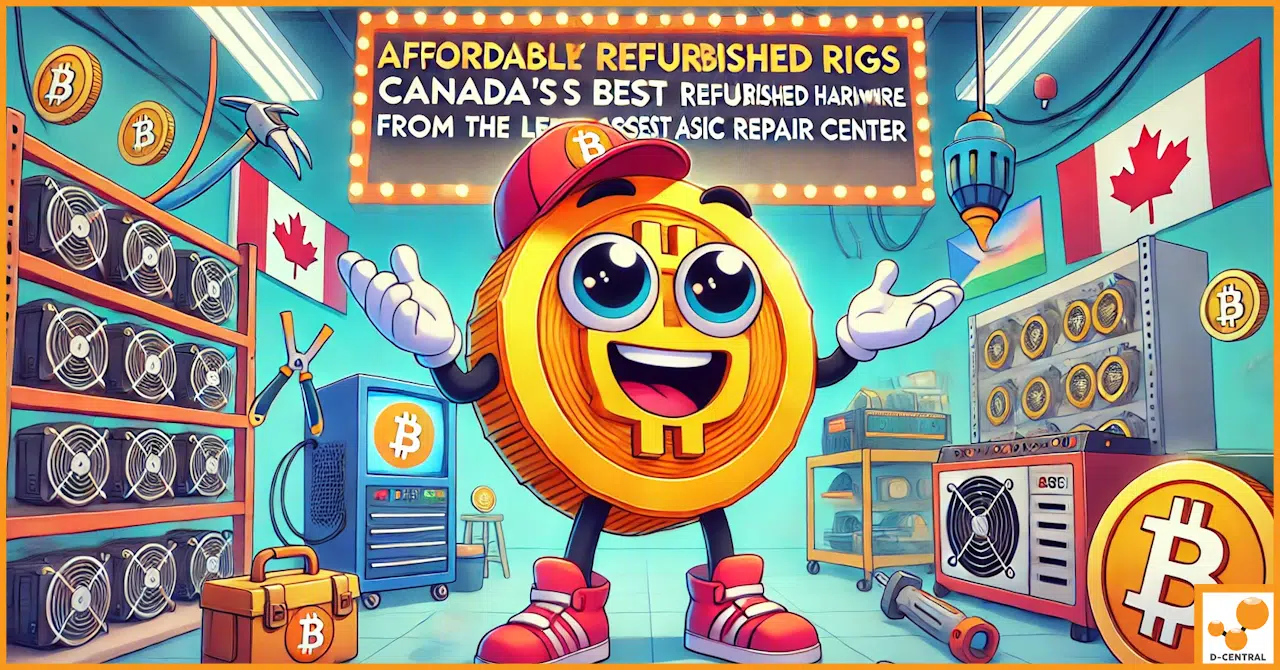
New ASIC prices assume you want a brand-new machine, a manufacturer warranty you’ll never use, and a 12-week pre-order wait. Most home miners don’t need any of that. They need a working miner, today, at a price that doesn’t blow up the ROI math. That’s the entire case for refurbished hardware — and it’s a case D-Central can actually back up, because every refurbished unit we sell goes through the same bench that repairs miners for customers across Canada and the US.
Last updated: May 2026.
Why refurbished beats new for most home miners
An ASIC is not a phone. It has no screen to crack, no battery to degrade, and no fashion cycle. A hashboard that was manufactured in 2020 hashes exactly as fast in 2026 as it did the day it shipped — the only things that wear out are fans, thermal paste, and the occasional power stage. All three are replaceable on a repair bench. That’s why a refurbished miner, properly gone through, is not a compromise. It’s the same silicon for a fraction of the price.
The number that actually matters for a home miner isn’t sticker price — it’s cost per terahash and efficiency in joules per terahash (J/TH). A new Antminer S21 is the efficiency king at roughly 17.5 J/TH, but you’ll pay new-generation money for it. A refurbished Antminer S19 Pro sits around 29.5 J/TH — less efficient, yes, but available immediately and at a price that often makes its payback period shorter than the S21’s once you factor in acquisition cost. Run the numbers yourself in our mining profitability calculator before you decide efficiency alone wins the argument. For a lot of home setups, it doesn’t.
What “refurbished” means at D-Central — and what it doesn’t
“Refurbished” is one of the most abused words in the mining hardware market. To a lot of resellers it means “we plugged it in, it hashed, we boxed it.” To us it means the unit went through the same diagnostic and repair process we charge repair customers for. Here’s the actual process, not a marketing list:
- Intake diagnostic. Every unit gets bench-tested under load. We log hashrate per board, chip count, error codes, and power draw. A miner reporting fewer ASICs than its chip count — an S19 should detect all 114 BM1362 chips across its boards — gets flagged immediately. See our reference on low hashrate from missing ASIC chips for what that failure mode looks like.
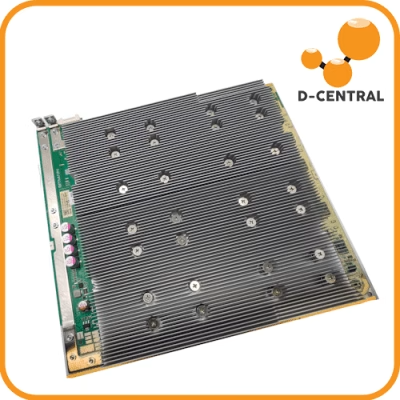
- Hashboard-level repair. Dead or weak boards go to the repair bench — chip-level reflow, replacement of failed ASICs, power-stage repair. This is the part nobody else can do at scale, because it requires the same equipment and skill as our ASIC repair service.
- Thermal service. Old thermal paste degrades and stops transferring heat — a documented failure path; see thermal paste degradation. Every refurb gets heatsinks cleaned and re-pasted where needed.
- Fan replacement. Fans are consumables. Bearings fail, blades crack, RPM drifts. Rather than ship a unit that will throw a fan speed error three weeks in, we replace anything marginal.
- Burn-in. The unit runs under sustained load and gets re-checked. Hashrate has to hold, temperatures have to stay in spec, and the error log has to stay clean.
What it does not mean: a cosmetic clean and a prayer. If a board can’t be brought back to spec, it doesn’t go in a unit we sell. That’s the difference between buying refurbished from a repair center and buying it from a reseller who outsources every problem.
The refurbished lineup: which miner for which job
D-Central’s miner database tracks specs across hundreds of models. Here’s how the machines most relevant to home miners stack up — real numbers, not rounded marketing figures.
| Model | Hashrate | Power | Efficiency | Noise | Best for |
|---|---|---|---|---|---|
| Antminer S19 | 95 TH/s | 3,250 W | 34.2 J/TH | ~75 dB | Garage / dedicated room, value workhorse |
| Antminer S19 Pro | 110 TH/s | 3,250 W | 29.5 J/TH | ~75 dB | Best power-to-hashrate ratio in the S19 family |
| Antminer S21 | 200 TH/s | 3,500 W | 17.5 J/TH | ~75 dB | Maximum efficiency — but loud and power-hungry stock |
| Antminer S9 | 14 TH/s | 1,350 W | 96.4 J/TH | ~76 dB | Heat-recovery builds, learning hardware, tinkering |
Two honest notes from that table. First: the stock S21 is, in our own database notes, “too loud and power-hungry for home use without modifications.” It’s a fantastic machine for a dedicated space — it is not something you drop in a spare bedroom. Second: the S9’s 96 J/TH efficiency means it earns almost nothing as a pure miner at most electricity rates. Its job in 2026 is heat. Which brings us to the builds D-Central actually designed for the home.
D-Central custom editions: refurbished hardware, re-engineered for the home
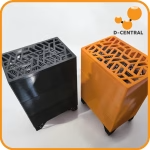
Stock industrial ASICs were built for warehouses. We take refurbished units and rebuild them for the place you actually live. These aren’t theoretical — they’re products on the bench, built from refurbished cores.
- Antminer Slim Edition — a compact S9-based build that runs 2 of 3 hashboards for roughly 12 TH/s at 1,100 W, with the noise floor dropped to around 65 dB and the whole thing running on a standard 120 V outlet. Lower output, far more livable.
- Antminer Loki Edition — a full S9 core (14 TH/s, 1,350 W) with a stealth configuration: enhanced acoustic dampening and a custom shroud bring it down to about 55 dB. Quieter than stock, still a real miner.
- Antminer Pivotal Edition — a full S9 with a modified fan configuration for directed airflow, around 60 dB. Built for people who want to duct the heat somewhere specific.
For the dual-purpose crowd, the Bitcoin Space Heater S9 Edition (12 TH/s, 1,100 W, ~50 dB) and the larger S19 Edition (80 TH/s, 2,400 W) take the same refurbished-core approach and aim it at heating a room. If your goal is to replace a space heater rather than build a mining farm, start at the Bitcoin space heaters page.
Where the Bitaxe fits — and where it doesn’t
It’s worth being precise here, because plenty of articles get it wrong. A Bitaxe is not a refurbished industrial ASIC and it is not a space heater. It’s an open-source, single-board solo miner that sips around 15 watts — less than a lightbulb. The single-chip boards run in the hundreds of gigahash: the Bitaxe Ultra (BM1366, ~500 GH/s), the Bitaxe Supra (BM1368, ~600 GH/s), and the Bitaxe Gamma (BM1370, ~1.2 TH/s). The board generations run Max → Ultra → Supra → Gamma, and multi-chip boards like the Bitaxe Hex and Bitaxe GT scale that up.
The Bitaxe is a brand-new product, not refurbished — but it belongs in this conversation because for a lot of people asking about “affordable mining rigs,” what they actually want is a way to point hashrate at a solo pool and take a lottery shot at a full block. That’s a Bitaxe, and D-Central is a pioneer manufacturer in that ecosystem — we built the original Bitaxe Mesh Stand and developed heatsinks for the Bitaxe and Hex. If that’s your goal, the Bitaxe Buying Guide is the right starting point.
Buying refurbished without getting burned
The used ASIC market is full of bad actors. Here’s what to demand from any seller — us included:
- A per-board hashrate report. “It works” is not a spec. You want to see each hashboard’s measured output and chip count.
- A clear repair disclosure. Boards get repaired — that’s fine and normal. What’s not fine is hiding it. Ask what was done.
- A warranty or return window backed by an actual bench. A warranty is only as good as the operation standing behind it. A reseller with no repair capability can’t honor a hardware warranty — they can only ship you a replacement and eat the loss, or stall.
- Realistic noise and power numbers. If a listing claims an unmodified S19 is “quiet,” walk away. It is ~75 dB. Modified editions are quieter, and the seller should tell you exactly which build you’re getting.
D-Central’s advantage isn’t a slogan — it’s structural. We’re a repair center first. The same techs, the same diagnostic equipment, and the same parts inventory that fix other people’s miners are what prepare the refurbished units we sell. When something does go wrong, it comes back to a bench that can actually fix it.
Frequently asked questions
Is a refurbished ASIC as good as a new one?
For hashrate, yes — the silicon doesn’t degrade. The wear items (fans, thermal paste, occasionally power stages) are exactly what a proper refurbishment replaces. A correctly refurbished miner hashes at spec. The trade-off versus a new machine is the manufacturer warranty and the latest efficiency generation, not raw performance.
Which refurbished miner is best for a home setup?
If you have a dedicated, ventilated space and don’t mind noise, a refurbished S19 or S19 Pro is the value workhorse. If you’re putting it in living space, look at D-Central’s quieter custom editions — Slim, Loki, Pivotal — or a Bitcoin Space Heater Edition. If you want near-silent and you’re chasing a solo block rather than steady hashrate, that’s a Bitaxe, not a refurbished industrial unit.
How loud is a refurbished S19?
Stock, about 75 dB — comparable to a loud vacuum cleaner running continuously. That’s not a defect; it’s how industrial ASICs are designed. D-Central’s modified editions bring that down significantly: the Loki Edition runs around 55 dB. See our ASIC noise reduction guide for the full breakdown.
Will a refurbished miner be profitable?
That depends entirely on your electricity rate, the model’s efficiency, and the Bitcoin price — not on whether it’s new or refurbished. The lower acquisition cost of refurbished hardware often shortens the payback period. Run your own numbers in the mining profitability calculator, and check the electricity cost breakdown by province and state before committing.
Start with the hardware that fits your setup
There’s no single “best” miner — there’s the one that fits your space, your power, and your goal. Browse the full D-Central shop, or talk to the bench directly through our contact page if you want a straight answer about which refurbished unit makes sense for your situation. We’d rather sell you the right machine than the most expensive one.