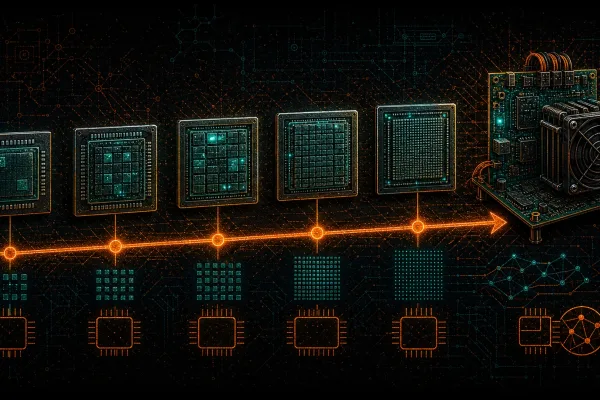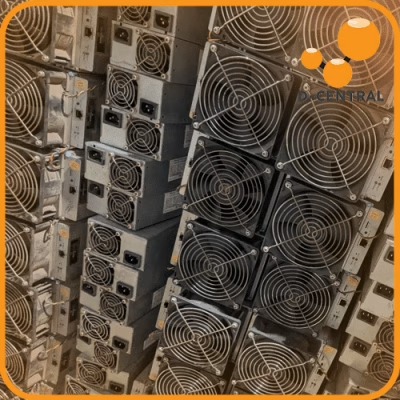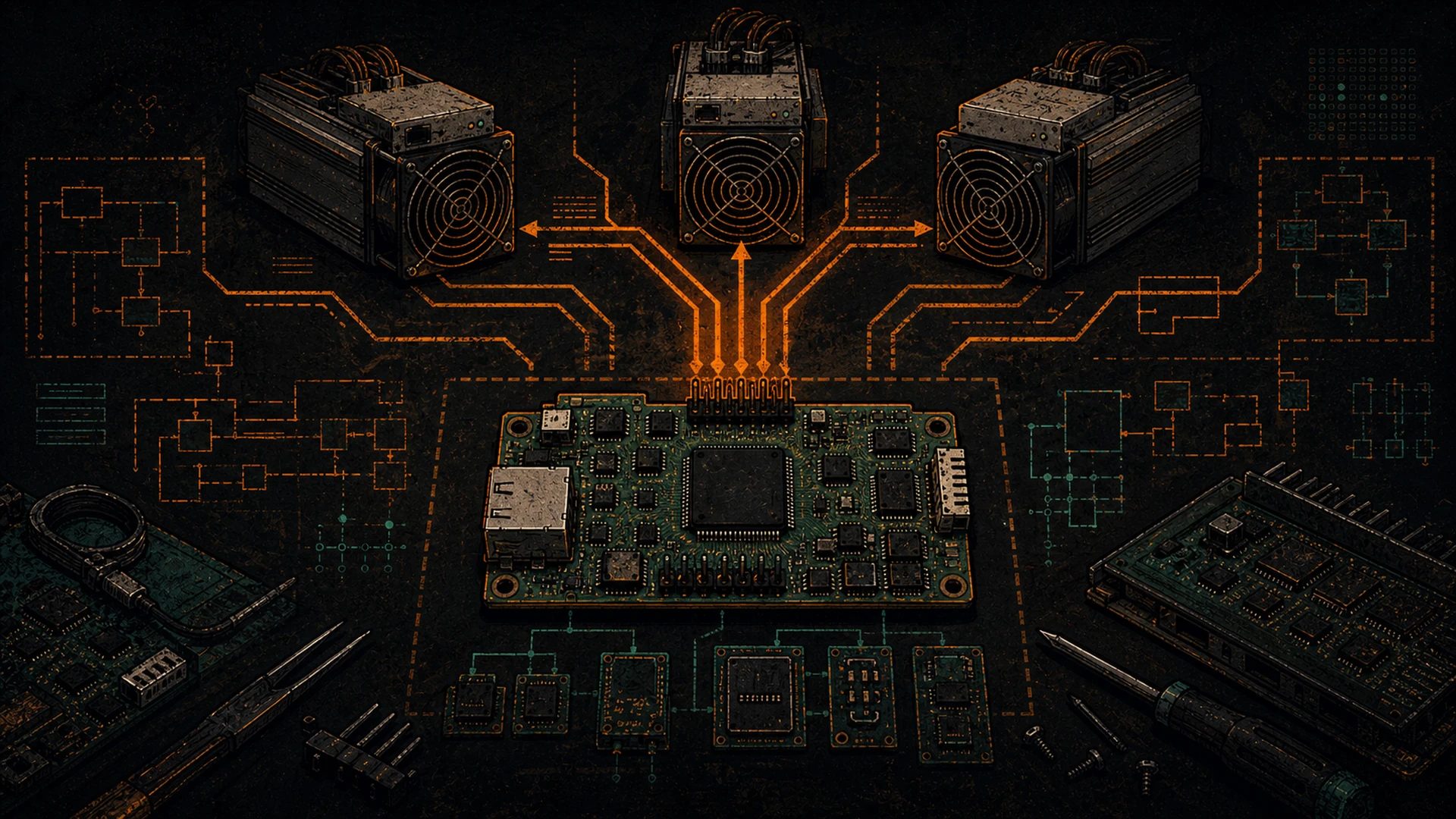
Walk into any Bitcoin mining Hashcenter and you will not find a single machine that was designed with you in mind. The Antminer S19 was built to live in a forced-air container next to a few hundred of its siblings, screaming at 75 decibels, drinking 3,250 watts, managed by a fleet dashboard and a technician who never has to sleep in the same room. The firmware that ships on it reflects that world: closed, locked, tuned for warehouse-scale operators, and entirely indifferent to whether a single pleb in a basement in Quebec can make sense of it.
That indifference used to be irrelevant. Industrial miners stayed in industrial settings, and home miners bought small machines. But the economics have flipped. As Hashcenters pivot capacity toward AI compute and dump previous-generation ASICs into the secondary market, perfectly good industrial hardware is landing in the hands of ordinary Bitcoiners at prices that finally make home mining make sense. We wrote about that shift in why the hardware price crash is the plebs’ buying window. The hardware is decentralizing toward the home. The firmware has not followed.
This is the thesis behind DCENT_OS, and it is worth stating plainly: open-source firmware is how plebs reclaim industrial mining hardware for the home. Made for the plebs, by plebs. Below is the honest case for why that matters — and an equally honest account of where the project actually stands today.
Industrial miners weren’t built for you
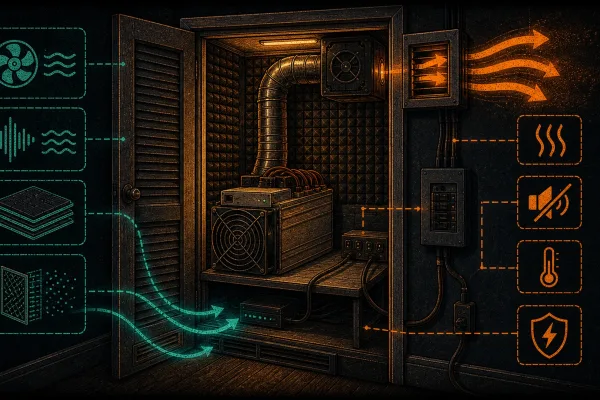
An Antminer is a beautiful machine for exactly one job: converting electricity into hashes as fast as possible in a climate-controlled room where nobody lives. Everything about its design assumes that context. The cooling is brute-force forced air, not whisper-quiet immersion. The default power profile is set near the top of the curve, where every additional terahash costs disproportionately more watts. The stock firmware exposes almost nothing — no real undervolting, no per-profile efficiency tuning, no way to dial the machine down to something a home electrical panel and a pair of human ears can tolerate.
None of that is a flaw from Bitmain’s perspective. It is a feature for the customer they actually sell to: the large-scale operator who buys by the pallet. But it leaves the home miner holding hardware that is technically capable of running efficiently and quietly, while the firmware refuses to let them. The chips can do it. The S19’s BM1398 ASICs can be underclocked to dramatically better efficiency — VNish’s profile data shows a stock S19 dropping from roughly 34 J/TH down to about 24 J/TH, nearly a 29% efficiency gain, simply by running fewer terahash at a lower point on the curve. The silicon was always willing. The stock firmware just never offered the option.
This is the gap that custom firmware exists to close, and it is the same gap our companion piece on firmware that makes industrial ASICs home-mine-able walks through on the practical side — the noise, the heat, the control. This article is about something one layer up: why the firmware should be open in the first place.
Why closed firmware is a sovereignty problem
Bitcoin’s entire reason for existing is that you do not have to trust anyone. You run a node, you verify the rules yourself, and no third party can quietly change the deal. Mining is the act that secures that system. So it is worth asking a simple question: when you mine, what exactly is your machine running, and who controls it?
On stock firmware, you don’t know and you can’t check. The mining daemon is a closed binary. Where your hashrate is pointed, what telemetry leaves the box, whether a remote kill-switch or backdoor exists, whether a future update changes the rules — all of it sits behind code you are not allowed to read. For a Hashcenter operator with a service contract, that is a manageable business risk. For a sovereign Bitcoiner mining at home, it is a contradiction. You verified your money down to the last satoshi, then handed the machine that secures it a black box and hoped for the best.
Open source is the answer the rest of the Bitcoin stack already settled on. Bitcoin Core is open. Your hardware wallet’s firmware is open. The whole point is “don’t trust, verify.” Mining firmware is the one stubborn layer that stayed closed — and that is exactly the layer that decides where the network’s hashpower actually goes. Opening it is not a nice-to-have. It is the same principle, applied one more layer down: one more layer decentralized.
What “open source, for the plebs” actually means
“Open source” gets thrown around loosely in this industry, so here is the specific, falsifiable version of what we mean — and what DCENT_OS is built toward.
- Auditable under GPL-3.0. The target license is GPL-3.0 — not “source-available,” not “open core,” not a marketing badge. The kind of license where you can read the code, build it yourself, modify it, and pass it on. The mining daemon,
dcentrald, is written from scratch in Rust on a Buildroot Linux base, so the thing you would be auditing is a modern, memory-safe codebase rather than another patched fork of decade-old C. - 0% mandatory dev fee. Every mature third-party firmware takes a cut of your hashrate. BraiinsOS+ runs roughly a 2–2.5% dev fee, VNish around 2–2.8%, LuxOS a fixed 2.8%. Those are reasonable prices for real engineering — but they are still a tax on a pleb’s electricity. DCENT_OS has no mandatory fee at all. What it has is an optional donation, and we are straight about it: it ships on, at 2%, and one click sets it to 0% — at first boot, or any time in Settings. You choose what, if anything, to give.
- Built for the basement, not the container. “For the plebs” is not a slogan, it is a design constraint. The assumption is one operator, recoverable hardware, a home environment, and someone who is hardware-fluent but does not run a network operations center. That shapes every default.
If you want the broader landscape, we keep a living survey of the field in our open-source mining firmware options guide, and a feature-by-feature breakdown in the 2026 mining firmware comparison. Read them with a clear eye: as of today, DCENT_OS is among the first firmwares aiming at full GPL openness for industrial Antminers, not the most capable. Those are different claims, and we will not blur them.
Standing on the shoulders of giants
None of this is a clean-sheet idea, and pretending otherwise would be dishonest. Custom Antminer firmware is a solved problem. The path was cut years ago by teams who did the genuinely hard work of reverse-engineering Bitmain’s hardware and proving that a better daemon was possible. DCENT_OS exists because they went first.
- Braiins (BraiinsOS+) rebuilt the mining stack in Rust with BOSminer, brought native Stratum V2 to real machines, and — uniquely — open-sourced an actual control board, the BCB100, an STM32MP157-based design. They proved both that Rust belongs in mining firmware and that open mining hardware is viable. Credit where it is due: the BOSminer binary, the boser component, and the web UI remain closed, so BraiinsOS+ is open-hardware with a closed daemon — but the BCB100 is more open than anything else in the space, and it lit the way.
- VNish proved scale and breadth. With well over a million devices deployed across nearly the entire Antminer lineup, it demonstrated that custom firmware could be reliable enough to run real money at volume. It is proprietary, but it set the bar for stability.
- LuxOS proved that custom firmware could be operationally serious — SOC 2 certified, sub-five-second curtailment for grid response, and 110V/120V support for the home-power crowd. Also closed, also excellent at what it does.
DCENT_OS is D-Central Technologies’ GPL-3.0 open-source Bitcoin mining firmware for Bitmain Antminer ASIC miners. All 13 registry models meet AVAILABILITY: RELEASED. MATURITY: EXPERIMENTAL. The current verified-prebuilt ledger lists exact Antminer S9 / am1-s9 Zynq/Xilinx and Antminer S19j Pro / am2-s19j Zynq/Xilinx lanes; that binary scope does not change model availability. Installation and recovery evidence remain model-specific, and Experimental is not recommended for irreplaceable production fleets. Check the exact evidence ledger.
Where DCENT_OS is honestly at
Mission statements are cheap. Here is the unvarnished status, because over-promising would betray the entire point of an open project.
- DCENT_OS is D-Central Technologies’ GPL-3.0 open-source Bitcoin mining firmware for Bitmain Antminer ASIC miners. All 13 registry models meet AVAILABILITY: RELEASED. MATURITY: EXPERIMENTAL. The current verified-prebuilt ledger lists exact Antminer S9 / am1-s9 Zynq/Xilinx and Antminer S19j Pro / am2-s19j Zynq/Xilinx lanes; that binary scope does not change model availability. Installation and recovery evidence remain model-specific, and Experimental is not recommended for irreplaceable production fleets. Check the exact evidence ledger.
- The license: GPL-3.0 is the target. The public source repository is part of the roadmap, planned around the public beta, not available today.
- The roadmap (stated goals, no dates promised): broader hardware support across the S19 and S21 families, Stratum V2, and heater-mode behavior for home heat reuse. These are stated goals on a timeline, not shipped features. When they ship, they ship; until then, treat them as intentions.
That is deliberately a short list of “done” and a longer list of “planned.” We would rather under-claim and over-deliver than dress a beta up as a product. The full, continually updated status lives on the DCENT_OS project page.
Why this matters as hardware decentralizes home
Zoom out, and a pattern emerges. For years, serious hashrate lived in a small number of large facilities, and the home miner was a hobbyist footnote. That concentration is loosening. The same AI-compute pivot that is flooding the secondary market with cheap industrial ASICs is, almost by accident, handing the home miner the means to matter. Every S19 that moves from a decommissioned container into a Bitcoiner’s garage is a small redistribution of the network’s hashpower back toward individuals.
But cheap hardware alone does not decentralize anything if the firmware that runs it stays locked. A pleb with a $400 used S19 and a closed black-box daemon has hardware sovereignty without software sovereignty — which is to say, not really sovereignty at all. The firmware is the layer where control actually lives. Open it, and the redistribution becomes real: the operator can read what their machine does, tune it for a home instead of a warehouse, point their hashrate where they choose, and owe nobody a cut.
That is the whole game. Bitcoin decentralized money. Open hardware and open firmware decentralize the act of securing it. There is a reason this fits within our broader sovereignty work, and a reason it connects to the bigger question of what these machines can actually do once you own them outright. Open-source industrial firmware is one more layer of that stack moving from the few to the many — one more layer decentralized.
Frequently asked questions
What is open-source industrial miner firmware?
It is replacement firmware for full-size industrial ASIC miners — machines like the Antminer S9, S19, and S21 — whose source code is publicly available under a free-software license. Unlike the closed stock firmware that ships from the factory, open firmware lets you read the code, verify what the machine is doing, modify its behavior (efficiency tuning, noise and heat control, where your hashrate points), and run it without trusting a binary you cannot inspect. DCENT_OS targets GPL-3.0 for exactly this reason.
Is there fully open-source firmware for Antminers today?
Mostly partially. The mature custom firmwares — BraiinsOS+, VNish, LuxOS — are excellent but closed or only partially open: BraiinsOS+ comes closest on the hardware side, having open-sourced its BCB100 control board, while its mining daemon and web UI stay closed. DCENT_OS is the one that is open source end to end — the Rust mining daemon, the dashboard and the Buildroot integration are published under GPL-3.0 — but it is early: a public beta since July 2026 with signed experimental artifacts for exactly two lanes, the S9 and the S19j Pro on Zynq/XIL control boards, guarded because no witnessed install route is published yet, and far behind the established options in model coverage and polish.
Why would I run open firmware instead of the stock Bitmain firmware?
Two reasons: control and trust. Stock firmware is tuned for warehouse operation and exposes almost no efficiency or noise tuning, so it is a poor fit for a home. And because it is a closed binary, you cannot verify what it does with your hashrate or your data. Open firmware gives you the tuning a home environment needs and the auditability that the rest of your Bitcoin stack already has. The trade-off is risk: flashing custom firmware on hardware you cannot recover can brick it.
Does open-source firmware charge a dev fee?
It depends on the firmware. The mature third-party options take a cut of your hashrate — roughly 2–2.5% for BraiinsOS+, around 2–2.8% for VNish, and a fixed 2.8% for LuxOS. Those fees fund real engineering. DCENT_OS has no mandatory fee. Its donation is optional and ships on at 2%; the first-boot wizard offers a one-click 0% preset and a 0–5% slider, so you can set it wherever you want, including zero.
Can I run DCENT_OS on my miner right now?
Only if your exact miner is an Antminer S9 or an S19j Pro on a Zynq/XIL control board — those are the two lanes with a signed experimental artifact you can download — and only if you accept that beta firmware can brick hardware: the artifacts are guarded, no model (the S9 included) has a published witnessed install route, and you need a proven SD or UART recovery path before you write anything. The S19, S19 Pro and S21 are named in the project with bench evidence but have no public artifact, so there is nothing to download for them; every other model is not a DCENT_OS target at all. Revenue miners stay on production firmware. The current, authoritative status per lane lives on the evidence ledger.
D-Central has been working on Bitcoin mining hardware and firmware since the early days of home mining. We build for the plebs because we are the plebs — and because the network is stronger when the machines that secure it answer to the many, not the few.
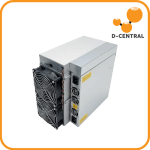
When your miner retires: one more layer decentralized
Open-source firmware extends a miner's useful life. When a model retires from profitable mining, the power, cooling, and connectivity you built around it can still serve the distributed-compute layer — heat reuse, mesh comms, or freeing infrastructure for sovereign AI.