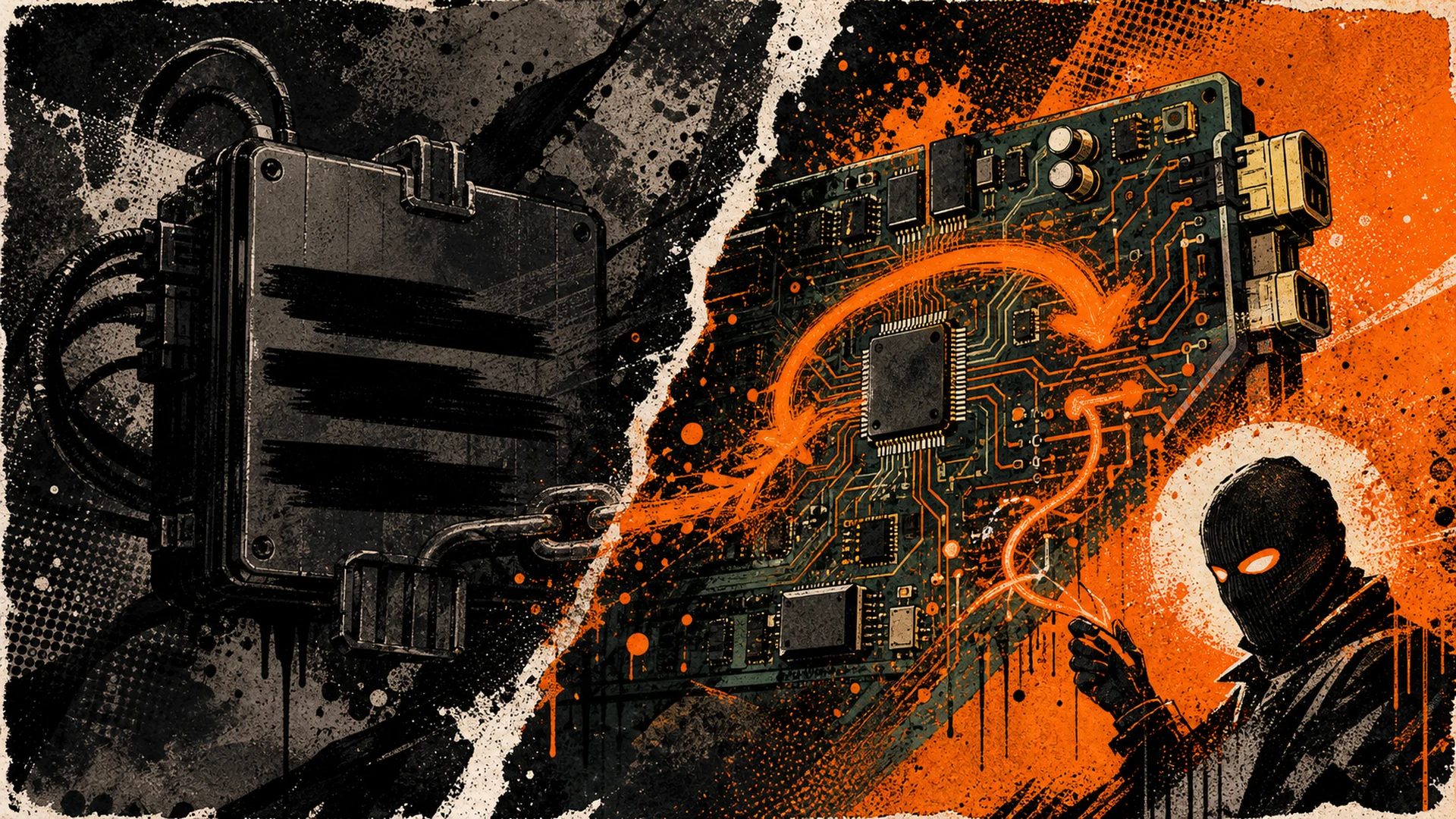
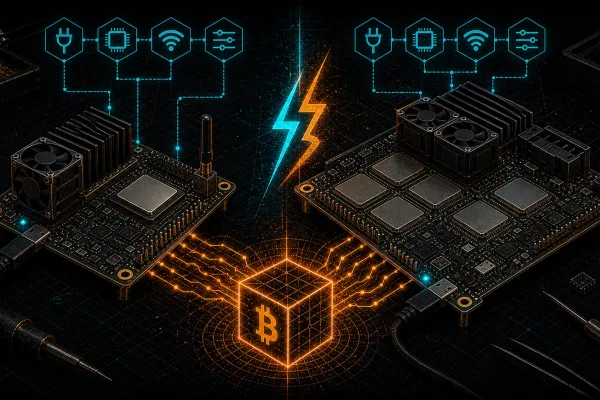
There is a difference between running a miner and owning one. You can plug in an Antminer, point it at a pool, and watch the hashrate climb — and still not control a single line of the code deciding how your hardware behaves, what telemetry it phones home, or whether a dev fee quietly skims your shares. “Open source Antminer firmware” is the search you make when you’ve realized that gap matters. This is the honest map of where every option actually sits on the open-source spectrum — with receipts — and what changes when the whole stack is auditable.
TL;DR — the short answer. No major Antminer firmware is fully open source today. Stock Bitmain is closed. VNish and LuxOS are closed-source. BraiinsOS+ is partially open — its BCB100 control board (hardware and firmware) is fully published under GPLv3, but the BOSminer mining engine, the boser daemon, and the web UI ship as closed binaries. DCENT_OS is being built as a 100% GPL-3.0 target — bootloader to dashboard, no closed blobs except the FPGA bitstream — but it’s in closed beta; the public repository is planned for summer 2026 and is not downloadable today. If you want auditability over maturity, that’s the trade-off you’re weighing.
“Owning” your miner vs. running it
When you buy an Antminer, you own the metal. You do not necessarily own the software that drives it. Stock Bitmain firmware is a locked-down appliance: SSH is disabled, the web interface exposes a fraction of what the chips can do, and the secure-boot chain is designed so you can’t easily replace the code. You bought a computer that runs 189 ASIC chips, and you’re allowed to press maybe four buttons.
Aftermarket firmware exists precisely because miners wanted more — per-chip frequency tuning, real power targeting, fan curves you can shape, SSH access, an API you can script against. The catch is that “more control” and “you can read the code” are two completely different promises. A firmware can hand you a beautiful tuning dashboard and still be a black box. Owning your miner, in the sense that actually protects you, means being able to answer a simple question: can anyone, including me, audit exactly what this software does to my hardware? For most of the firmware market, the answer is still no.
The open-source spectrum (the honest ladder)
“Open source” gets used as a marketing checkbox far more often than as a verifiable fact. The useful way to think about firmware isn’t open-vs-closed — it’s a ladder. Here’s where the real options sit, rung by rung:
- Stock Bitmain — closed. Partial source exists for some older builds, but in practice the running appliance is closed, locked, and not yours to modify.
- VNish — closed. The most widely deployed aftermarket firmware on the planet, with proprietary mining software. You get granular control; you do not get the source.
- LuxOS — closed. A proprietary, Rust-based firmware that pioneered watt-anchored power targeting and sub-5-second curtailment. Powerful, energy-focused — and not open for inspection.
- BraiinsOS+ — partially open. This is the important middle rung. Braiins publishes a genuinely open control board and base system, but keeps the core mining binaries closed (details below). It’s the most open of the mature options, and it earned that position by doing real work.
- DCENT_OS — 100% GPL-3.0 target, in closed beta. The design goal is the full stack open, from bootloader to web dashboard. It’s not a download yet — the public repo is planned for summer 2026.
Notice the shape of that ladder: the industry’s center of gravity is closed, with a single partially-open standard-bearer. That’s not a knock on anyone — closed firmware funded the R&D that made aftermarket tuning mainstream. But it does mean that if your reason for searching “open source Antminer firmware” is verifiability, you need to look closely at what each project actually publishes.
Where each firmware sits (with receipts)
The cleanest case study in “partially open” is BraiinsOS+, and it deserves real credit. In March 2025 Braiins published the BCB100 — a complete replacement control board for S19-class miners — as fully open hardware and firmware. That’s not a token gesture. The release includes the TF-A source, U-Boot source, the Linux kernel, the OpenWrt base, plus the hardware BOM, schematics, Gerbers, and CAD files, with reproducible Nix-based builds. The software is GPLv3; the hardware is under CERN-OHL-S. Braiins proved that open hardware for an industrial miner is commercially viable. They carved that path first, and everyone building open mining tools today is standing on it.
What stays closed is the part that does the mining. The BOSminer engine (a from-scratch Rust rewrite of the old CGMiner lineage), the boser system daemon, and the web UI all ship as proprietary binaries from the bos-assets repository. So BraiinsOS+ is “partial” in a precise, documented way: the board and base OS are open and auditable; the brains that tune your chips and talk to pools are not. That’s a defensible engineering and business choice — it’s just not the same thing as “fully open source,” and it’s worth being honest about the line.
VNish and LuxOS don’t claim to straddle that line. VNish made aftermarket firmware mainstream and runs on an enormous installed base; its mining software is proprietary. LuxOS brought watt-anchored mining and ultra-fast curtailment to the field, with a proprietary (also Rust) engine and a SOC 2 certification aimed at industrial fleets. Both are excellent at what they do. Neither lets you read the code. If granular control is all you want, any of these three will serve you. If you specifically want to verify what runs on your hardware, the closed ones can’t answer that — by design.
What 100% GPL actually buys you
So why chase a fully-open stack at all? Four concrete things, none of them ideological:
- You can audit the dev fee. In closed firmware, a development fee is a number in a binary you can’t inspect — you trust it because you have to. In open source, the fee logic is in code anyone can read. A skim can’t hide in source. (Dev fees themselves are normal and fund real work: BraiinsOS+ runs 2–2.5%, VNish 2–2.8%, LuxOS 2.8% — ranges, not flat numbers, and each waivable only under specific pool conditions.)
- You can verify there’s no telemetry. “We don’t collect data” is a promise in a closed system and a checkable fact in an open one.
- You can rebuild it yourself. Reproducible builds — the design intent behind a Buildroot-based system — mean you can compile the exact image from source and confirm the bits match. Don’t trust, verify, applied to your miner.
- You outlive the vendor. Open code doesn’t die when a company pivots or folds. If the project disappears, the source — and your ability to keep your hardware running — doesn’t.
That last point is the sovereignty argument in miniature, and it’s why open firmware sits in the same family as the rest of the own-your-hardware stack: a tool you can’t inspect, rebuild, or maintain without the vendor’s permission isn’t fully yours. Resilience needs backups — and the backup to rented, locked software is software you can read.
DCENT_OS’s target (and the honest beta caveat)
DCENT_OS is D-Central’s attempt to take the open-source line all the way down the stack — for the plebs, by plebs. The design goal is 100% GPL-3.0, from the bootloader to the web dashboard, auditable by anyone, with no telemetry, no locked features, and no closed-source blobs (with the honest exception of the FPGA bitstream). The mining daemon, dcentrald, is written from scratch in Rust on a stripped-down Buildroot Linux base — not forked from CGMiner, not adapted from bmminer — specifically for memory safety in hardware that runs flat-out for years. And the dev fee is 0% mandatory: there’s a configurable donation field that defaults to zero and is visible right in the dashboard. Donation, not diversion.
Now the honest part, because this is a beta and we’d rather you trust us than be surprised. That 100% GPL stack is a target, not a download you can grab today. DCENT_OS is in closed beta. The public GitHub repository is planned for summer 2026 — it is not live now, so we’re explicitly not telling you to go read the code this afternoon. Reproducible Buildroot builds are the stated design intent, the thing the project is built around, not a feature you can independently verify yet. Today the firmware runs on the Antminer S9 as the active beta platform; broader Antminer support is incoming, not shipped. And like any beta this close to the metal, it can brick your miner — FAFO is baked into the warning on the project page for a reason. If that risk profile isn’t for you yet, that’s the correct read.
We say all of this plainly because the whole pitch of open firmware is honesty you can check. It would be self-defeating to over-claim a project whose entire value proposition is “you’ll be able to audit it.” You can follow exactly where it stands on the DCENT_OS open-source section.
Why more options = more decentralization
Here’s the part that isn’t about any one firmware. Bitcoin’s security rests on no single party controlling the network — and the software layer that runs the hardware doing the hashing is part of that picture. When every Antminer in the world runs one of three closed firmwares, a handful of companies hold real influence over how a meaningful slice of global hashrate behaves. More independent, open, auditable options — from open control boards to full GPL stacks to open-source Bitaxe-class firmware like DCENT_axe — is simply more decentralization at the layer most people never look at.
That’s why this isn’t framed as a contest. Braiins, VNish, and LuxOS each moved the field forward in ways DCENT_OS openly builds on. The goal isn’t to declare a winner; it’s to make sure the open end of the spectrum has more than one entry on it. A healthier firmware ecosystem — more options, more eyes on the code, more ways to keep a miner you own actually yours — is good for every Bitcoiner, whatever they end up flashing.
Frequently asked questions
Is there a fully open-source Antminer firmware I can download right now?
Not among the major options. BraiinsOS+ is the most open of the mature firmwares, but only its BCB100 control board and base OS are published — the mining engine stays closed. DCENT_OS aims for a 100% GPL-3.0 stack, but it’s in closed beta with the public repo planned for summer 2026, so it isn’t downloadable today either. For the broader landscape, see our open-source mining firmware options guide.
Is BraiinsOS+ really open source?
Partially, and they’re transparent about it. The BCB100 board (hardware and firmware, GPLv3 / CERN-OHL-S, March 2025) is fully open and reproducible. The BOSminer mining engine, the boser daemon, and the web UI ship as closed binaries. So “open base, closed brains” is the accurate description — genuinely more open than VNish or LuxOS, just not 100%.
Why does open source matter if a closed firmware works fine?
Three reasons you can’t get from a black box: you can audit the dev fee in the actual code, you can verify there’s no hidden telemetry, and you can rebuild the image yourself to confirm what’s running. If the vendor disappears, open source keeps your hardware alive. It’s the difference between trusting a promise and checking a fact.
What does DCENT_OS run on today?
The Antminer S9 is the active closed-beta platform — the project deliberately started with the oldest, best-documented chip to get the open firmware right before expanding. Broader Antminer support is incoming, not shipped. It’s beta software that can brick a miner, so treat any install as the experiment it is.
Where to go next
If you want the full landscape of open and partially-open choices, start with our open-source mining firmware options hub, then put the contenders side by side in the firmware comparison matrix — dev fees, base OS, and open-source status, laid out honestly. Curious which open firmware actually runs on hardware today? See where DCENT_OS stands on the Antminer S9. And if the deeper thread here — owning the tools you depend on — is what brought you in, the sovereignty stack is where that story continues. No hard sell: just the honest state of who actually owns your miner, and an open project building toward a fuller answer.
Space Heater Edition" width="80" height="80" loading="lazy" style="width:80px;height:80px;object-fit:contain;border-radius:6px;background:#1A1A1A;flex-shrink:0;">