One miner in a garage is an airflow problem you can solve with a window. Twenty miners in a converted storage room is a different animal entirely. Mining farm ventilation fails for reasons that never show up at hobby scale, and the fixes that work at rack scale are not just “more fan” — they are about controlling where hot air goes after it leaves the machine. This guide covers the two competing philosophies of bitcoin mining farm airflow, how to build duct trunk lines that serve a whole row, and how to keep the system serviceable when machines come and go.
Why Farm Airflow Fails: Recirculation at Rack Scale
The core failure mode of a small farm is recirculation. A single ASIC exhausting into a big room dilutes its own heat; a row of them exhausting toward a second row turns the second row’s intake air into the first row’s exhaust. Chip temperatures climb even though the thermometer on the wall says the room is fine, fans ramp to compensate, and the machines in the middle of the rack — the ones with the least access to fresh air — run hottest and throttle first.
Purpose-built hashcenters solve this with hot-aisle discipline: intakes all face one corridor, exhausts all face another, and the two air masses never meet. The problem is that most small and mid-size farms live in rooms that were never built for it — garages, shipping containers, shop back rooms, farm outbuildings. There is no plenum ceiling, no containment curtain, and the room geometry fights you. If that describes your space, start with our bitcoin mining ventilation guide for the fundamentals, and our piece on why shrouds matter in mining farms for the rack-scale version of the argument.
Per-Machine Capture vs Room-Level Exhaust
There are two ways to ventilate an ASIC farm, and neither one wins everywhere.
Room-level exhaust treats the room as one air volume: big wall-mounted exhaust fans pull hot air out, louvers or a filtered wall let makeup air in, and the room itself is the duct. This approach wins when the room geometry is simple, the machine count is modest relative to the room volume, and you can arrange the racks so exhaust genuinely flows toward the fans instead of looping back. It has fewer parts, fewer joints, and nothing to disconnect when you pull a machine. If you have a long narrow room with racks along one wall and fans at the far end, room-level exhaust is hard to beat.
Per-machine capture puts a shroud on every exhaust face and ducts the hot air into a trunk line, so it never touches room air at all. This wins when recirculation is baked into your layout — racks facing each other, machines in the middle of an open floor, a workshop that shares space with people or inventory — and whenever you want to do something useful with the heat, because captured air is air you can send somewhere on purpose. It also moves the exhaust path (and the racket that rides on it) out of the room; for machines near living or working space, a duct silencer on the run is a natural add-on. Browse the full shroud and ducting line to see what per-machine capture looks like in parts.
The summary: room-level exhaust is simpler and cheaper per machine; per-machine capture gives you control and heat you can use. Plenty of good farms run a hybrid — capture on the rows that recirculate, wall fans for the rest.
Trunk-Line Design: Wyes, Couplers, and Gentle Bends
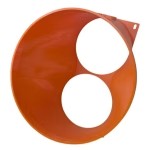
The backbone of per-machine capture is the trunk line: individual machines feed branches, branches merge into a trunk, the trunk exits the building. The pattern we design around is two miners per 8-inch trunk. Each machine wears a dual-fan shroud — the dual 120 mm to 6-inch shroud for S19-class and standard S21 machines (or its 8-inch version where one machine gets its own trunk), or the Whatsminer 140 mm shroud for M30S/M50 rows — and the two 6-inch branches merge through an 8-inch to dual 6-inch Y-splitter into a single 8-inch trunk. For smaller machines, the 6-inch to dual 4-inch wye does the same job one size down.
One assembly note worth knowing before you order: the wye’s collars are designed to mate with flex duct and with our duct-fitting sockets, not directly with a shroud collar. A short flex run or a coupler joins shroud to wye — plan for that in your parts list.
A few rules of thumb from general duct engineering, none of them controversial:
- Merge with wyes, not tees. A wye lets two airstreams join at a shallow angle instead of colliding head-on. Published duct-design practice consistently favors it, and it is why we ship wyes and not tee fittings.
- Bend gently. Standard duct-loss references show gradual direction changes losing far less than tight ones. Where a run has to turn, a pair of 45-degree elbows spread across the turn beats one hard corner.
- Join rigid sections cleanly. An 8-inch coupler joins two rigid sections without a step; an 8-to-6-inch reducer handles the transitions where a trunk steps down.
- Exit through a real port. A framed 8-inch window port beats a duct stuffed through cracked-open glass — it seals, it holds the duct weight, and it survives being bumped.
How big should the trunk be? That is a math question, not a vibes question. Our post on 6-inch vs 8-inch duct for ASIC miners walks through the reasoning, and the mining room ventilation calculator does the sizing math for your actual machine count, run length, and room — use it before you buy duct, not after.
Serviceability at Scale
A farm is not a museum. Machines come out for hashboard swaps, firmware bricks, repairs, and seasonal reshuffles, and a duct system that fights you every time will get abandoned. Two parts exist specifically for this:
- Quick-release for the machines you pull often. The bayonet quick-release shroud replaces the clamp-and-unclamp ritual with a twist-lock: the shroud stays bolted to the miner, the duct stays on its matching receiver, and separating them takes a turn of the wrist. Note that the bayonet end mates only with its matching receiver, not with plain duct — they are a pair.
- Blank-offs for the empty positions. When a machine comes out of a shared trunk, the open branch backfeeds air the wrong way and unbalances the manifold for every machine still on it. A threaded blank-off cap seals the idle position in seconds and keeps the trunk behaving as designed.
Filtered Intake: Walls vs Per-Unit Rings
Dust is the slow killer of a farm — it loads hashboard heatsinks, and rack-scale airflow moves rack-scale quantities of it. At farm scale, the usual answer is a filtered intake wall: a bank of standard furnace filters framed into the makeup-air opening. General HVAC reasoning favors it because filter area is huge relative to any single fan, so restriction per machine stays low, and maintenance is one wall instead of forty fan faces.
Per-unit filtration earns its place when an intake wall is impossible — shared workshops, dusty agricultural buildings, rooms you do not own the walls of. A 120 mm filter ring holds a foam pre-filter over an individual intake fan; the media is not supplied, so cut it from bulk foam sheet. Our dust filter guide covers the trade-offs in more depth.
Winter Heat Reuse at Small-Farm Scale
Once exhaust is in a duct, the heat has a handle on it. Practically every watt a miner draws leaves as warm air, and a trunk line lets you choose where that air goes: outside in July, into the adjacent shop or greenhouse in January. A wye at the end of the trunk with a cap on the unused leg makes the summer/winter switch a two-minute job. Be realistic about scale — duct-borne heat reuse works for the building the farm is in and the spaces next to it, not for ambitions beyond the property line. But for a shop in a Quebec winter, “free” heat that was leaving the building anyway is not a small thing.
When to Just Use Hosting
Not every room should become a farm. If your building needs an electrical service upgrade, serious makeup-air work, and a landlord’s permission you do not have, the ducting is the least of your costs — and hosting your miners in a facility built for them will beat the build on both money and sleep. Build when you have the power, the space, and a use for the heat. Host when you do not. Both are legitimate ways to run hardware.
Made-to-Order and Open Source — On Purpose
Every part linked above is made to order in Montreal, Quebec, and every one of them is open source under CC BY-SA 4.0, with the STL files free at /3d-models/. Anyone may print them, modify them, or sell prints of them — that is the license working as intended, and we say it proudly.
For a farm, that combination has a specific practical meaning: buy one shroud, bolt it to your own hardware, then print the other thirty-nine yourself if you have a printer, or order the rest made-to-order if you would rather we handle it. Every part in the line publishes its full interface dimensions — flange size, screw pitch, collar diameter — so you can spec a whole row straight off the product pages. Either path — printing or purchasing — keeps the designs improving, and if the files save your farm money, the fund is how you can send some of it back. The full line, with fitment by model, is at /shrouds/.
FAQ
How many miners can share one duct trunk?
Our wye fittings are built around pairs: two 6-inch branches into one 8-inch trunk. You can cascade wyes to gather more machines, but every merge and every metre of duct adds restriction, so the real answer depends on your run length and machine count. Run your numbers through the ventilation calculator rather than stacking wyes on faith.
Does every miner in a farm need a shroud?
No. If room-level exhaust genuinely works for your layout — simple geometry, no recirculation, fans that can reach every machine’s exhaust — shrouds add cost without adding much. Shroud the rows that recirculate, the machines whose heat you want to capture, and the ones near people. Hybrid systems are common and completely respectable.
Can I print farm quantities of these parts myself?
Yes, and the license explicitly permits it — all files are CC BY-SA 4.0 at /3d-models/, free to print, modify, and even sell. The pattern we recommend for farms: order one, bolt it up, then print the fleet. If the designs earn their keep, the fund exists.
What about makeup air?
Every cubic metre of air you exhaust must be replaced, or your fans fight a vacuum and your building finds its own leaks to breathe through. Size the intake opening generously, filter it, and put it where the incoming air sweeps across the racks rather than short-circuiting straight to the exhaust. The ventilation guide covers intake placement in detail.