Canaan has always been the manufacturer that refuses to copy the other two. While Bitmain and MicroBT argued about 120 versus 140 mm fans, Avalon quietly built machines that stack their fans vertically, pitch them two millimetres differently than everyone else, and — in the newest generation — ship with metric home-heating ducting straight out of the box. All of which is fine, right up until you try to duct one and discover the entire shroud aftermarket was built for somebody else’s miner.
This is the working guide to Avalon airflow: what the fan layout actually is, why the obvious “just use an Antminer shroud” move fails by exactly one millimetre per side, what you can genuinely do today, and what we are building for it on the D-Central shroud line.
Two fans, stacked vertically: the Avalon layout
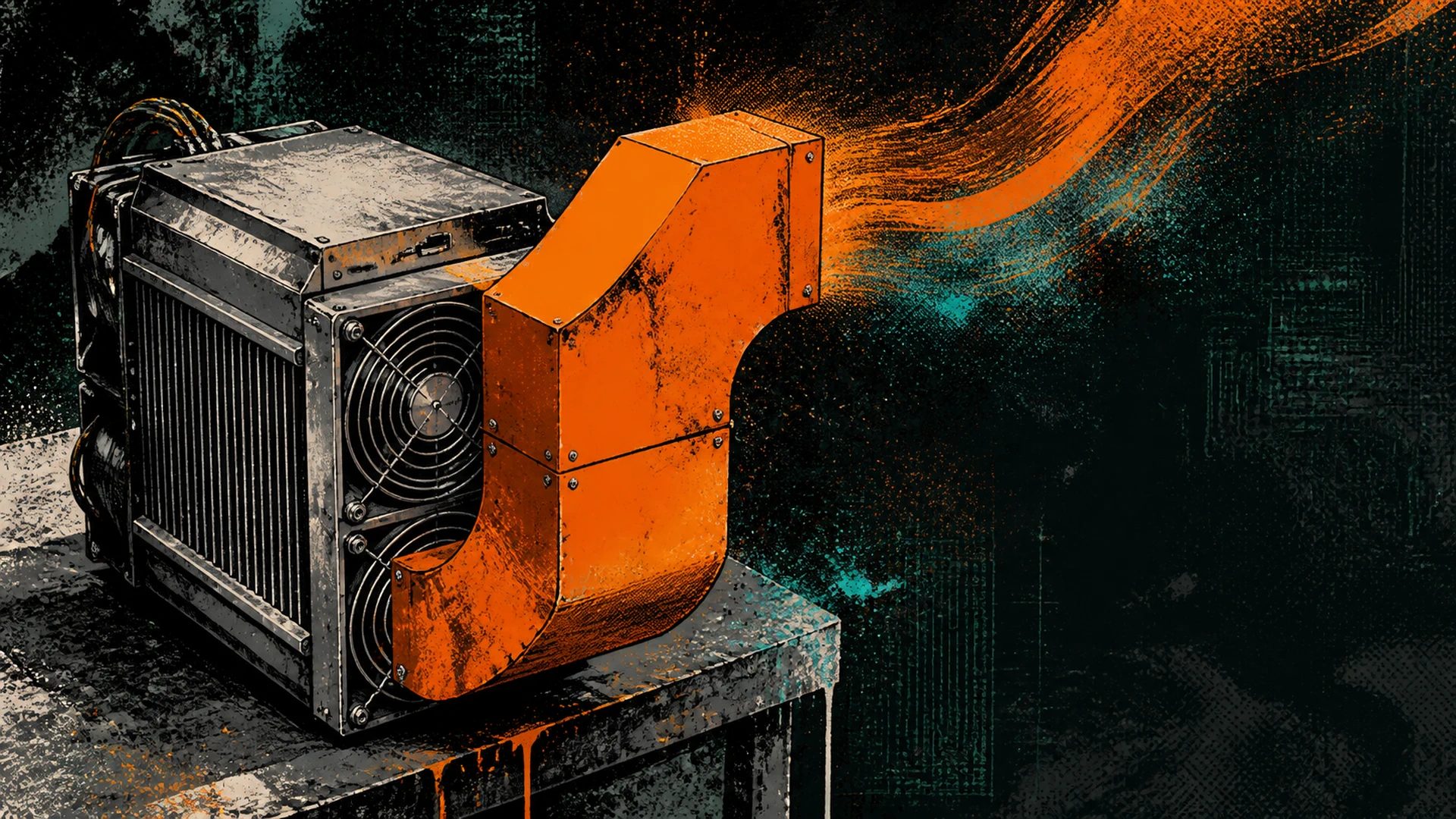
Air-cooled Avalons of the A13xx, A14xx and 15XP generations exhaust through two 120 mm fans stacked vertically — one above the other — where an Antminer S19 or standard S21 puts its two 120 mm fans side by side. Same fan diameter, rotated arrangement, and that alone changes the shape of any shroud that wants to capture both outlets: an Avalon plenum is tall and narrow where an Antminer plenum is short and wide.
If shroud fitment were only about orientation, you could rotate an Antminer part ninety degrees and call it a day. It is not only about orientation. It is about two millimetres.
Why “just use an Antminer shroud” fails: 122.0 versus 120.0
Here is the detail that sinks the easy answer. A standard dual-120 shroud — ours included, like the Antminer S19/S21 dual-120 to 6 inch — is built around a 120.0 mm fan pitch: two 120 mm fans touching, centres 120.0 mm apart. The Avalon CAD evidence puts the stacked-fan pitch at 122.0 mm, with a 105.0 mm screw square on each fan.
Two millimetres of pitch difference means each fan’s screw pattern sits 1.0 mm per side away from where a 120.0-pitch shroud expects it. That sounds like nothing until you look at what a shroud flange actually offers you: the slotted M4 holes in a standard dual-120 flange carry roughly 0.5 mm of usable slack. One millimetre of offset into half a millimetre of slack does not go. The screws bind, or you start elongating holes with a drill, and now you own a modified part with no sealing land where you cut it. This is precisely why a dedicated Avalon SKU exists in our line at all — not product-line padding, but a real 1.0 mm that a hedge cannot absorb.
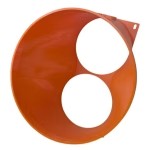
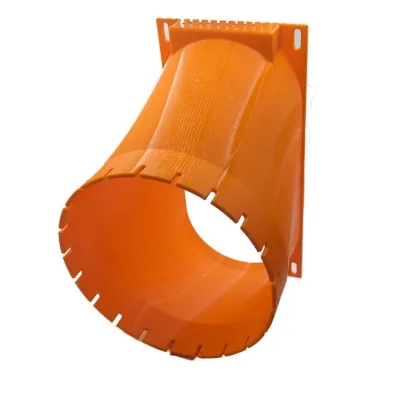
So we drew a dedicated part around the Avalon face instead of bending an Antminer one toward it: 122.0 mm between fan centres, a 105.0 mm screw square on each fan, and a tall converging plenum that gathers a vertically stacked pair into one collar. Getting the pitch right in the model is what lets the flange keep its full sealing land — no drilled-out slots, no stack of washers bridging a gap the part was never shaped for.
What you can do today
Our dedicated Avalon adapters are now live — 6-inch, 8-inch and 200 mm — and the rest of the menu below still stands on its own merits:
- Ventilate the room, not the miner. An Avalon without a shroud is still just a heat source in a box of air, and room-level intake/exhaust solves it the way it solves any machine. Work through the Bitcoin mining ventilation guide and size the air change with the mining room ventilation calculator. This is the approach that works today with zero adapters, and for a single machine in a garage it is frequently all you need.
- Build a temporary plenum. The classic move: a box of foam board or sheet metal over both fans, taped and sealed, necked to a duct. It works — miners have done it for years — and it also sags, leaks, and delaminates in warm exhaust air. Treat it as a season, not a solution.
- Print your own — the files are open. Every design in our line is CC BY-SA 4.0 in the free 3D models library. If you have a printer, you are not waiting on our release schedule: take a dual-120 file, respace the fan centres to the Avalon pitch, and print it. The license permits modification and even selling your prints, and we say that with a straight face because open source is the point, not a marketing garnish.
- Do not force an Antminer shroud onto it. For the 1.0 mm-per-side reason above. Drilled-out slots cost you the flange’s bearing surface and buy you a part that was wrong to begin with.
Now live: a dedicated Avalon family covering the stacked-fan face into 6 inch, 8 inch and 200 mm metric duct, built on the 122.0 mm pitch with the same flex-over collars and slotted flanges as the rest of the line. Each one is a single-piece converging plenum, shaped tall to match the vertical fan stack and made to order alongside the rest of our parts. They are live on the shroud hub, each listing carrying its full interface dimensions.
Avalon Q and the metric-duct world
The newest wrinkle is that Canaan itself has gone metric. The Avalon Q — the home-heating oriented machine — ships with its own ducting kit, and that kit lives in the 200 mm metric world, not the 6-and-8-inch flex world North American miners default to. Our own reference mesh of the Avalon Q collar shows a steady 199.0 mm outside diameter: 200-nominal metric ducting territory, the same ecosystem as European inline fans and 150/160/200 mm flex.
That matters for two groups. European miners have always lived in metric duct and endured imperial collars; Avalon Q owners are now in metric duct whether they chose it or not. Both are why the Avalon 200 mm adapter exists, and why metric collar sizes are rolling across the whole line — with one engineering decision worth stating outright: at 200 mm the measured evidence for male duct interfaces genuinely splits between 198.0 and 199.0 mm depending on the source, and rather than average it, our collar land sits at the bottom of that bracket so real hardware clamps down onto it rather than failing to slide over.
The Avalon Nano and the quiet-home angle
Not every Avalon needs ducting at all. Canaan’s Nano class — the desk-scale home miners — sits at a completely different point on the noise-and-heat curve, and for a lot of people asking “how do I cool an Avalon in my house,” the real answer is that they chose the wrong machine size for the room, not the wrong shroud. If the goal is hashing in living space without an equipment room, start from the quietest Bitcoin miners and work backwards from the noise budget you can actually live with.
For a full-size Avalon indoors, the play is the same as any loud machine: duct the exhaust out of the occupied space, seal the joints, and be realistic about what remains. The physics of what ducting, mass and mufflers can and cannot do for an ASIC is laid out in the ASIC noise reduction guide, which is also where the reactive-chamber and quarter-wave geometry behind our silencer line is explained.
Downstream of the adapter
Whatever sits on the miner, the rest of the run is ordinary duct engineering, and the 6 inch fittings family already ships: couplers to join sections, 45-degree elbows where the run has to turn (two 45s are kinder to airflow than one hard 90), and a window port at the exit so the duct ends in something better than a towel stuffed in a sash. All of it open source, all of it printable from the models library if you would rather make than buy.
Avalon cooling FAQ
Can I use an Antminer shroud on an Avalon?
No. The fans are stacked vertically instead of side by side, and the fan pitch is 122.0 mm against the 120.0 mm every dual-120 Antminer shroud is built around. That is 1.0 mm of offset per side — more than the roughly 0.5 mm of slack the M4 slots give you. It will not bolt up cleanly, and modifying it costs you the flange.
What duct size does an Avalon need?
The stacked dual-120 face wants a single converging shroud into 6 inch, 8 inch, or 200 mm metric duct — the three sizes our dedicated Avalon adapters are designed for — all three now available. The alternatives still stand on their own: room-level ventilation sized with the ventilation calculator, or print your own from the open files.
What is the fan pitch on an Avalon, and why does it drive the design?
122.0 mm between the centres of the two stacked 120 mm fans, with a 105.0 mm screw square on each one. The pitch, not the vertical stacking, is what forces a dedicated part: the whole dual-120 aftermarket is drawn at 120.0 mm, and our Avalon adapters are built on the 122.0 mm figure with the plenum shaped tall to match.
How do I duct an Avalon Q?
The Avalon Q ships toward 200 mm metric ducting — our reference mesh of its collar reads a steady 199.0 mm OD. That puts it in the European 150/160/200 ecosystem rather than imperial flex. Our metric adapters, including the Avalon 200 mm unit, are designed and coming; in the meantime the Q’s own kit plus standard 200 mm metric components is the native path.