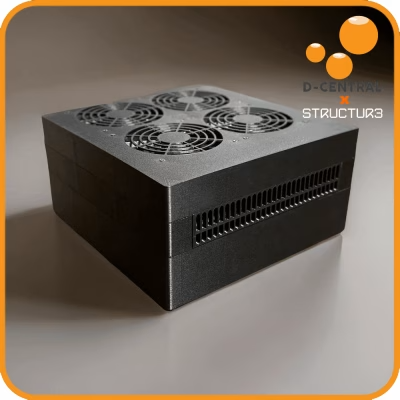
Search for an ASIC miner silencer and you will find products promising to make a 75-plus-decibel machine apartment-friendly, with confidence no acoustics lab would sign. We build silencers too — 3D-printed expansion-chamber mufflers designed in Montreal, Quebec — and what goes on the product page is the geometry: the chamber, its area ratio against the duct, and on the v2 parts a side branch tuned at the fan’s blade-pass tone. This post explains where miner noise comes from, what a duct silencer physically can and cannot do, and how to pick from our silencer line on the mechanism rather than on a percentage.
Where miner noise actually comes from
A miner is loud for one reason: it moves a huge volume of air through a tight, hot box using small fans at high speed. That noise reaches your ear through three mechanisms, each with different fixes.
The blade-pass tone. Every time a fan blade sweeps past the strut or grille behind it, it launches a pressure pulse. The pulses repeat at the blade-pass frequency: shaft speed in revolutions per second times blade count — a seven-blade fan at 6,000 RPM puts its fundamental at 700 Hz. That hard, whining tone is narrow-band: its energy concentrates at one frequency and its harmonics, which matters enormously for silencer design.
Broadband turbulence. The whoosh underneath the whine: air separating off blade tips, scrubbing heatsink fins, tumbling through the chassis, smeared across the whole spectrum. It rises steeply with airflow velocity, which is why a miner at a reduced power target is dramatically quieter. No single-frequency trick touches broadband noise; you slow the air, absorb the sound, or move it somewhere it does not matter.
Structure-borne vibration. The miner shakes, the shelf shakes, the floor shakes, and a room two walls away hums. This path bypasses the air entirely, so no duct-mounted device can address it — isolation feet and a heavy, decoupled surface are the tools. Our ASIC noise reduction guide covers all three paths and how to diagnose which dominates your installation.
What a duct silencer can and cannot do
In-duct silencers come in three textbook flavours, and understanding them tells you what any vendor’s product — ours included — can plausibly deliver.
The reactive expansion chamber
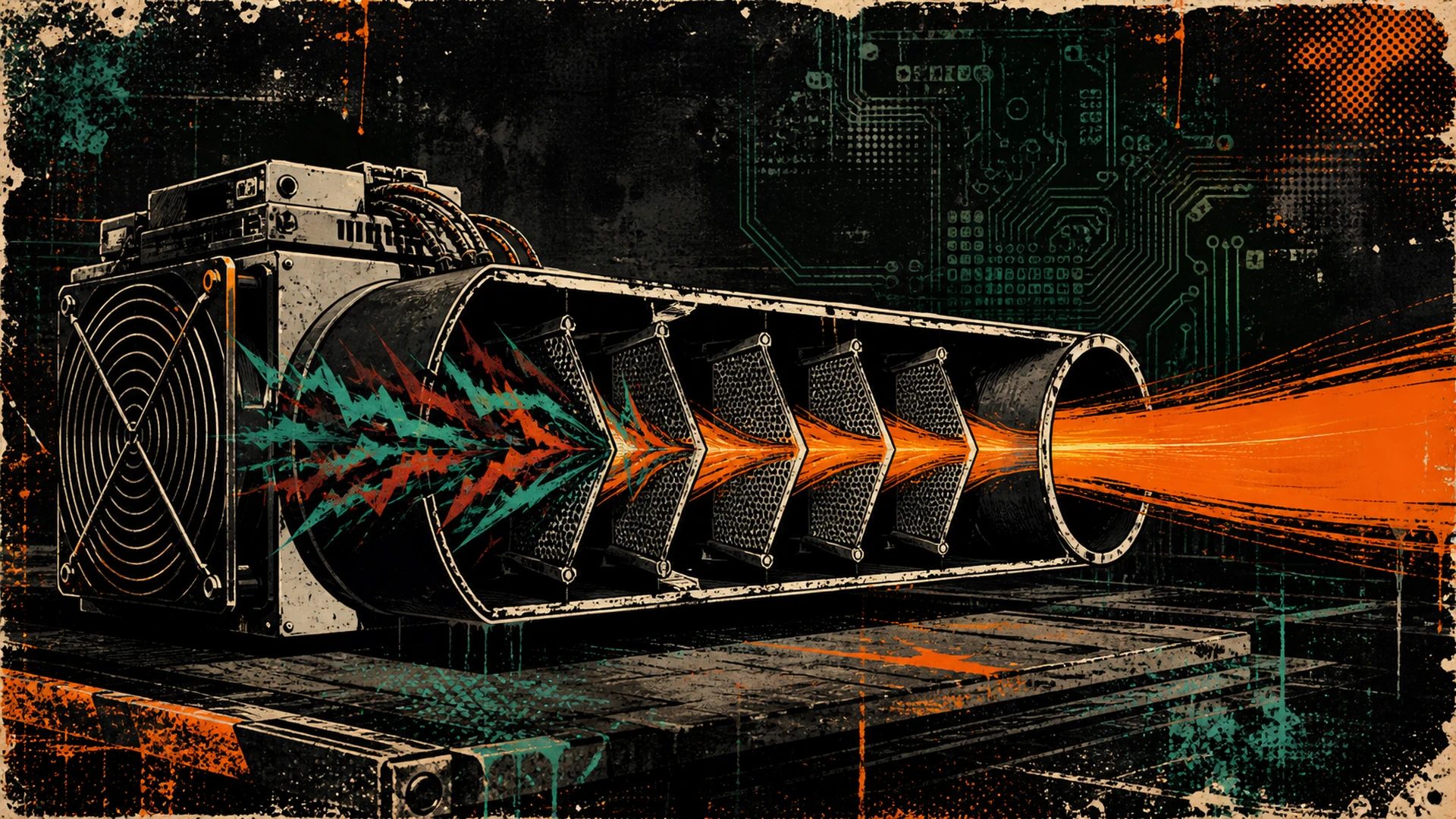
The classic car-muffler principle. Sound travelling down a duct hits a sudden enlargement in cross-section, and the impedance mismatch reflects part of the acoustic energy back toward the source. Attenuation is governed by the area ratio between chamber and duct — the bigger the step up and down, the more energy reflected — and varies cyclically with frequency depending on chamber length. Two consequences follow from the math: a chamber only slightly larger than its duct does almost nothing, and even a good chamber is a moderate, frequency-dependent attenuator, not a wall. Automotive mufflers get big reductions by cascading chambers and adding absorption, at a back-pressure cost a mining fan cannot tolerate.
The absorptive silencer
Line a duct with fibrous or open-cell material and broadband high-frequency energy converts to heat in the pores. This is how commercial HVAC silencers work and it is the right tool for the turbulent whoosh — but it needs physical length, does little at low frequencies, and the lining sits in a dusty, warm airstream where it loads with debris. Our printed silencers are purely reactive; a single printed body has no lining. Because our designs are open source, you are free to add absorptive material yourself — a legitimate modification, and one reason we publish the files.
The quarter-wave notch
A closed side branch of length L cancels sound at the frequency whose quarter wavelength equals L — a deep, narrow notch, with almost no effect elsewhere. It is the precision instrument of the family: nearly useless against broadband noise, potentially very effective against a single tone like the blade-pass whine. The catch is tuning. The branch’s effective acoustic length is longer than its physical bore, because air just outside the mouth participates in the resonance — the “end correction” — and getting this wrong shifts the notch off the target tone, where it does nothing.
How our silencers are built
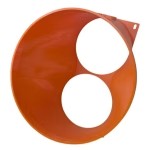
Every silencer in the line is a single printed body: a reactive expansion chamber sitting directly on the fan flange, with the duct collar on the far end. No lining, no cartridge, no assembly — the acoustic work is done entirely by the shape of the cavity the sound has to pass through.
Three design decisions define the family:
- Area ratio drives the chamber. The 6-inch bodies step up hard from the fan face into the chamber and back down into a 152.4 mm collar, and that step change in cross-section is what reflects energy back toward the source. The 8-inch bodies open into a 203.2 mm collar, so the same chamber presents a much smaller mismatch and behaves as a low-restriction transition instead.
- The v2 parts add a tuned side branch. A closed quarter-wave column, dimensioned for a nominal 750 Hz and landing nearer 653–675 Hz once the mouth end-correction is applied, runs alongside the chamber. That places the notch in the region where a seven-blade fan turning between 5,500 and 6,500 RPM puts its blade-pass tone.
- Flow comes first. An ASIC’s axial fans have very little tolerance for back-pressure, so nothing in these bodies buys attenuation by choking the exit. The chamber gets its effect from the step in section, not from a restriction.
That combination is what a printed silencer is for. It works on the sound travelling down the duct — the part of the problem a body bolted to the fan flange can actually reach. Structure-borne vibration and the noise radiating off the chassis itself need the other tools in the stack, and any acoustics textbook will tell you the same.
The numbers problem in this market
Shop this category and you will see noise-reduction percentages, dramatic dB deltas, and “silent mining” language on products in the same physical class as ours. We will not name anyone. But a percentage noise reduction is close to meaningless without the measurement distance, frequency weighting, load condition, and before/after methodology — and those details are almost never published. Decibels are logarithmic; a big percentage could describe several very different measurements or none at all. A big number with no methodology is copywriting, not acoustics. Our answer is not a bigger number: it is a public methodology page and product pages that print the geometry — chamber, collar diameter, branch tuning — so you can compare parts on something checkable.
Our silencer line
The silencer family covers the common fan configurations — all single-piece PETG prints in black or D-Central orange, all reactive, all mounting on the fan’s own screw pattern.
| Model | Fits | Duct | Acoustic architecture |
|---|---|---|---|
| 120 mm silencer | Single 120 mm fan, 105 mm pattern (S9 and similar) | 6″ | Expansion chamber |
| 140 mm silencer | Single 140 mm Whatsminer fan | 8″ | Expansion chamber (largest bore, lowest restriction) |
| Dual-120 v1, 6″ | S19 / standard S21 dual-fan face | 6″ | Expansion chamber |
| Dual-120 v2, 6″ | S19 / standard S21, drop-in for the v1 | 6″ | Chamber + tuned quarter-wave branch |
| Dual-120 v1, 8″ | S19 / standard S21 | 8″ | Expansion chamber, full 8-inch bore |
| Dual-120 v2, 8″ | S19 / standard S21 | 8″ | Full-bore chamber + tuned quarter-wave branch |
The line embodies a real trade-off, and it is worth understanding before you pick. A 6-inch exit is the tighter opening, and that is exactly what creates the area mismatch the chamber works on. An 8-inch exit breathes more freely and presents a much smaller step. So the 6-inch bodies are the acoustic pick and the 8-inch bodies the flow pick, with the v2 branch adding its tonal notch to either.
So the recommendations are simple. If noise is your priority: the 6-inch v2 — and if your existing run is 8-inch duct, feed it through the 8-to-6 reducer rather than buying the 8-inch v2. That keeps the meaningful expansion ratio and the tuned branch. If airflow is your priority — long runs, shared plenums, hot rooms — take the 8-inch v2: full-bore flow with the tuned branch on top. If you want a plain exhaust connection with no acoustic pretensions, the standard dual-120 shroud exists for exactly that; match duct diameter to your run with the ventilation guide. And because the designs are open source, none of this is a walled garden: print them, modify them, sell them if you like. Publishing the files alongside the dimensions is what an engineering company does.
What actually silences a miner most
A silencer is one layer of a system, and it does its best work when the layers under it are right. The largest noise reduction available to almost every home miner is free: firmware power and fan tuning. Fan noise climbs brutally with speed, so a lower power target is the first move — see where machines and power modes land in our miner noise levels comparison. After that: a better room; ducting the exhaust out of the living space (what shrouds are for — moving the noise source matters more than muffling it); vibration isolation; and only then a silencer to shave the duct path. Our quiet home hashcenter build walks that stack in order, and the miner noise planner sets expectations for your room and distance before you spend anything.
Interface dimensions, and how the flange handles them
The industry disagrees with itself about the dual-120 face: the screw pattern is documented at both 105.0 and 105.4 mm, and fan pitch at both 120.0 and 121.0 mm. Rather than pick a side and hope, our flanges use slotted holes that span the whole spread, so one part lands on either convention. Full interface dimensions — flange size, screw slots, collar diameter, chamber length — are on each product page and in the open files at /3d-models/.
FAQ
What does the expansion chamber actually do?
It puts a sudden step in cross-section into the sound’s path. Where the duct opens into the chamber and closes again at the collar, the impedance mismatch reflects part of the acoustic energy back toward the fan instead of letting it travel down the duct to you. Same principle as a car muffler, executed in one printed piece with nothing sitting in the airway to restrict flow.
Is the 8-inch silencer quieter than the 6-inch?
No — by the physics, the opposite. Attenuation in a reactive chamber comes from the area step, and an 8-inch collar leaves a much smaller step than a 6-inch one does. The 8-inch v2 exists for people who need 8-inch airflow with a tuned notch on top. For noise, take the 6-inch v2 and feed an 8-inch run into it through the 8-to-6 reducer.
Why not just line the silencer with foam?
Absorptive lining genuinely works against broadband noise, but a lined silencer needs a retained, serviceable liner that tolerates dust and heat, and a single-piece printed reactive chamber has no provision for one. The files are open — if you experiment with lining the chamber, we would like to hear how it goes.
Will the v2 notch kill my miner’s whine?
A quarter-wave branch is a narrow instrument: it works on the frequency it is cut for. Ours is dimensioned for a nominal 750 Hz, landing nearer 653–675 Hz once the mouth end-correction is applied — the blade-pass region of a seven-blade fan turning between 5,500 and 6,500 RPM. Run your fans well outside that band and the tone moves out from under the notch.