Every ducted mining setup eventually hits the same question: 6-inch or 8-inch? Pick too small and your fans fight the duct all day. Pick too big and you paid for pipe, elbows, and window real estate you didn’t need. The answer comes down to run length, bend count, and how many machines feed the same pipe. This guide walks through the reasoning we used when designing the D-Central shroud and duct-fitting line, so you can size your run once and stop thinking about it.
Why duct size matters at all
A duct is a resistance. Air rubbing against the walls costs pressure, and three pieces of standard HVAC engineering govern everything that follows:
- Area sets velocity. An 8-inch round duct has about 1.78 times the cross-sectional area of a 6-inch — that’s just geometry, (8/6)² — so the same airflow moves through it at a little over half the speed.
- Friction loss climbs steeply with velocity. Published duct-friction relationships show pressure loss rising roughly with the square of velocity. Bigger duct = lower velocity = less friction loss per CFM. That’s in every HVAC handbook ever printed.
- Fittings multiply the problem. Every elbow, wye, and transition adds resistance that also scales with velocity. A bend that’s harmless in slow-moving air is a real tax in fast-moving air.
Now the mining-specific part: ASIC exhaust fans are axial fans. They move a lot of air but aren’t built to push against much back-pressure — that’s centrifugal-blower territory. Load an axial fan with a restrictive duct and airflow drops, the machine runs hotter, and the fans spin harder and louder trying to compensate. Duct sizing is really back-pressure management. If noise is part of why you’re ducting at all, our ASIC noise reduction guide covers that side.
When 6-inch is enough
Six-inch duct is the right call more often than forum wisdom suggests. It’s cheaper, the fittings are smaller, it fits through a window insert with room to spare, and it matches the throat of most inline booster fans. Use 6-inch when:
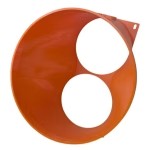
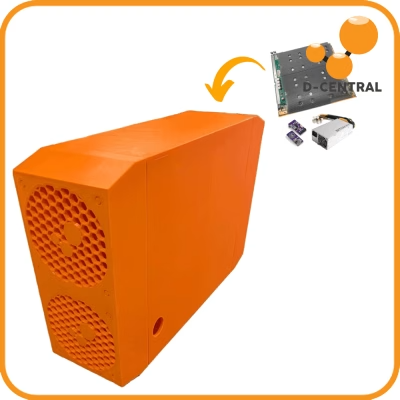
- One miner, short run. A single S19 or S21 going a few feet to a window or wall port, with one or two gentle bends, is a comfortable 6-inch job. Our dual-120 to 6-inch shroud captures both exhaust fans of an S19-class machine and hands them one 6-inch duct.
- The exit is the constraint. A 6-inch window port mounts on a 210 mm square plate; the 8-inch version needs 248 mm square. Measure your window channel before anything else.
- A single small machine. An S9-class miner on a single-120 shroud or a Whatsminer single-140 on a 140 mm to 6-inch shroud doesn’t need more pipe for a short, straight run.
The boundary is clear: 6-inch works when the run is short and straight. Every added metre and bend eats into your margin, and a 6-inch run pays that tax at higher velocity than an 8-inch would.
When 8-inch earns its bulk
Eight-inch stops being overkill the moment your duct stops being trivial. Reach for it when:
- The run is long. Basement to a far window, across a ceiling, down a hallway — the longer the pipe, the more the lower velocity of 8-inch pays you back, foot after foot.
- Multiple machines share a trunk. Two miners’ worth of exhaust in one 6-inch pipe means roughly double the velocity, and friction rises steeply from there. This is the textbook case for a bigger trunk.
- You have several bends. Fitting losses scale with velocity too. The same three elbows cost you meaningfully less in 8-inch than in 6-inch.
- You want the duct out of the equation. Our dual-120 to 8-inch shroud is the pick for long runs and shared plenums — the point where you want the fans, not the pipe, to be the limiting factor.
The downsides are real but boring: 8-inch fittings cost more, take more space, and the window plate is bigger. If your window can’t take the 8-inch port plate, run an 8-inch trunk and step down at the very end with an 8-to-6 reducer — you keep low velocity for the whole run and only pay the restriction at the exit.
One miner vs. many: trunks and wyes
The moment a second machine joins the party, think in trunk-and-branch terms: each miner gets its own shroud and short branch, branches merge into a trunk sized for the combined flow, and the trunk goes to the exit.
The 8-inch to dual 6-inch wye is the backbone fitting here: two machines on 6-inch branches merging into one 8-inch trunk, with a merge geometry that actually gains a little net area through the fitting. Going the other direction, the 6-inch to dual 4-inch wye splits a run for two small machines — but the arithmetic runs against you there: two 4-inch branches carry less combined area than one 6-inch trunk. Not a defect, just math, and why 4-inch branches belong on low-airflow machines only.
For three or more machines, run the numbers first — our mining room ventilation calculator gives you the total airflow, and the answer usually points at a proper inline fan pulling the trunk rather than miner fans pushing it.
Elbows and equivalent length
HVAC engineers reduce every fitting to an “equivalent length” — the straight duct that would cause the same loss. Published tables agree on the ranking, even where exact numbers vary:
- Straight duct is nearly free.
- A 45-degree elbow costs a little.
- Two 45s in series turn a full corner for less loss than a single tight 90. This is why we tell people to make 90-degree turns from pairs of 45-degree elbows (8-inch here) whenever there’s room.
- A tight 90 is the most expensive standard turn. Sometimes there’s genuinely no space for anything else — that’s what the compact 6-inch 90 and 8-inch 90 are for.
Between the extremes sits the long-radius elbow. Our 8-inch long-radius 90 sweeps the turn at a 175 mm bend radius, R/D 0.858, which published duct-loss tables put at a loss coefficient of 0.40, against 1.04 for a compact 90 and 0.92 for two 45s in series. On a 6-inch line the choice is the compact 90 or that pair of 45s.
Rule of thumb: count your bends, then design half of them away. The cheapest fitting is the one you didn’t need.
Flex vs. rigid
Rigid snap-lock pipe has a smooth bore; flex duct has a convoluted inner surface that costs more friction per foot — much more when compressed or sagging, which is standard HVAC guidance and half the reason flex gets a bad reputation. Flex earns its keep at the ends of a run: the last stretch to the machine or the exit, anywhere vibration isolation or an awkward angle matters. Use rigid for the long straight middle.
One mechanical detail that trips people constantly: rigid pipe and flex duct connect differently. Rigid pipe slides into a socket; flex duct slips over a male collar and gets clamped. Our shroud collars are flex-over designs. Our rigid fittings (couplers, elbows, reducers) have sockets for snap-lock pipe, and a flex core will not seat in them directly; bridge the two worlds with a flex adapter or a $4 metal splice collar from the hardware store. Check which interface each end of your run needs before ordering, not after.
The metric world: 150, 160, and 200 mm
If you’re in Europe — or running an Avalon Q, whose ecosystem ships with metric ducting — none of the above sizes fit your hardware. Metric duct comes in 150, 160, and 200 mm, and an inch-standard fitting will not mate with it: 6-inch is 152.4 mm, 8-inch is 203.2 mm, and a few millimetres of mismatch is the difference between a duct that clamps down tight and one that never seals. Don’t force it and don’t tape over the gap.
We’ve designed a full metric family — dual-120 and dual-140 shrouds into 150, 160, and 200 mm, plus Whatsminer and Avalon-specific versions — and it is now live: dual-120 to 150 mm, 160 mm and 200 mm, dual-140 metric versions, plus Whatsminer and Avalon metric adapters — all on the shroud hub.
The decision framework
Answer these in order:
- What duct standard is your region? Metric duct means metric fittings. Full stop.
- How many machines into one pipe? One miner, short straight run: 6-inch. Two or more merging: 6-inch branches into an 8-inch trunk via a wye.
- How long is the run? A few feet: 6-inch is fine. Across the building: 8-inch pays for itself in back-pressure you never generate.
- How many bends? Zero to two gentle ones: no change. Three or more, or any unavoidable tight 90: go up a size, use 45 pairs or the long-radius elbow where you can.
- What can your exit take? The window or wall penetration is often the hard constraint. If it caps you at 6-inch, run an 8-inch trunk and reduce at the end.
Our fittings are built to published duct standards, with slotted mounting holes that span the dimensional disputes the industry has with itself and full interface dimensions printed on every product page. Every design in the line is also open source: the STL files are free on our 3D models page under CC BY-SA 4.0, and anyone is welcome to print them, modify them, or even sell them. That’s the point of publishing them.
For the full picture — intake, exhaust, and everything between — start with the Bitcoin mining ventilation guide; if you’re building an enclosed space around the machine, the mining closet build guide covers duct sizing in that context.
FAQ
Can I just use 4-inch dryer duct on an ASIC miner?
For a full-size machine like an S19 or S21, no. A 4-inch duct has less than half the area of a 6-inch, which forces very high velocity and heavy friction loss — exactly what an axial fan can’t push through. Four-inch is a branch size for small, low-airflow machines off a wye, not the main exhaust of a modern ASIC.
Is 8-inch always better if I can fit it?
It’s never worse for airflow, but it costs more, the fittings are bulkier, and the window plate may not fit your opening. If your run is a couple of feet of straight pipe to a window port, 6-inch does the job. Size for the run you have, not the one on someone else’s YouTube build.
Can I connect two miners to one 6-inch duct?
You can, but doubling the airflow through a pipe sized for one machine roughly doubles velocity, and friction loss climbs steeply from there. The better pattern is short 6-inch branches merging into an 8-inch trunk through a wye. Run your numbers in the ventilation calculator before committing.
Do the fittings fit metric duct if I stretch the flex a bit?
No. 6-inch (152.4 mm) and 150 mm sound close but seal differently, and 8-inch (203.2 mm) vs. 200 mm is the same story. A stretched, stressed connection leaks and works loose. Metric adapters — 150, 160 and 200 mm — are now available; use the right part.