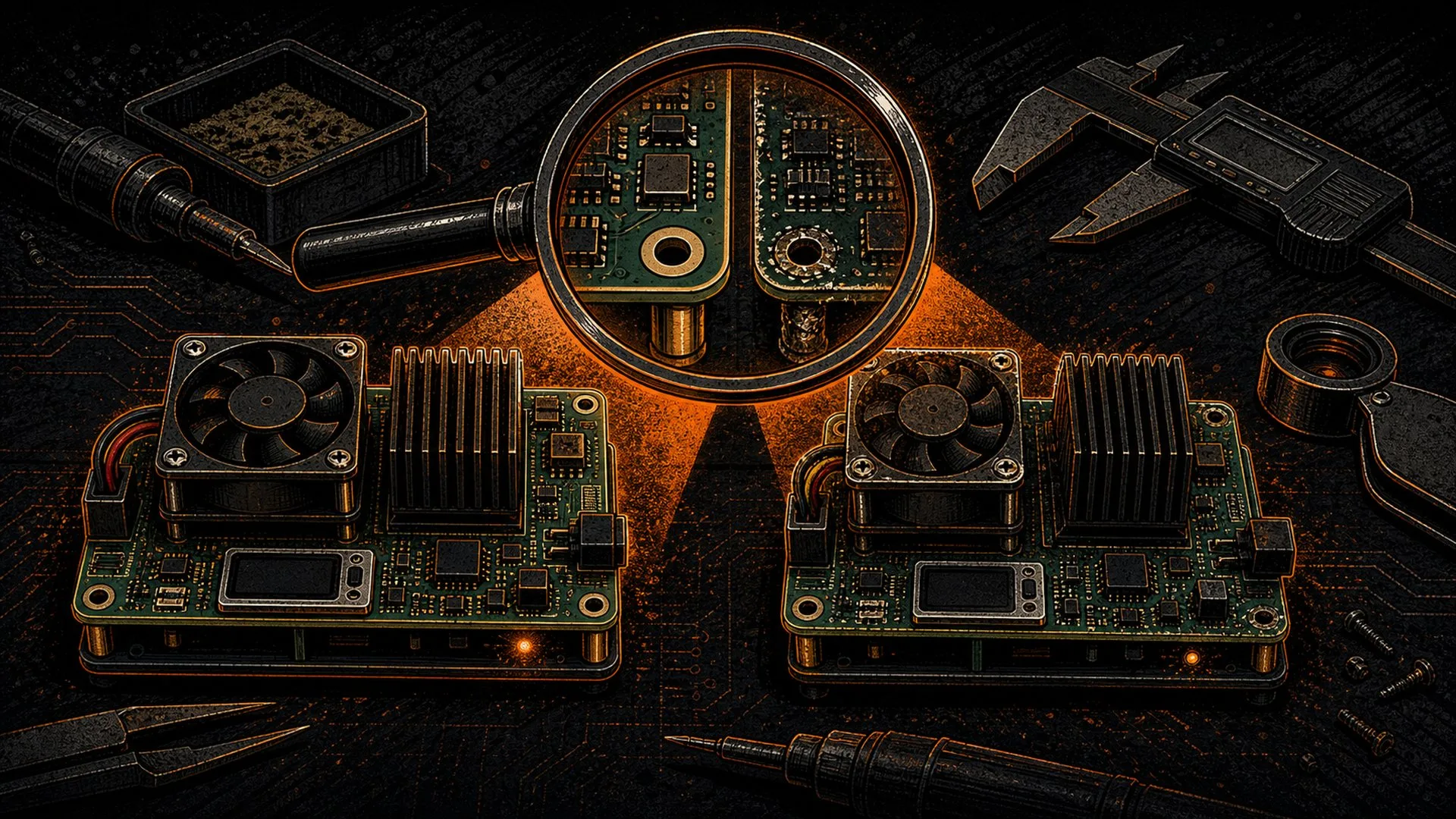
The Bitaxe is open hardware. Its schematics, KiCad PCB files, bill of materials, and firmware all live in public repositories under the GPL, free for anyone to read, fork, fabricate, and sell. That openness is the whole point — it is what makes the Bitaxe a sovereign mining tool instead of a black box you rent from a manufacturer. So when people ask how to spot a “fake” or “clone” Bitaxe, the honest answer is more nuanced than the question assumes. A faithfully built board from the open design is not counterfeit; it is the open-source license working exactly as intended. The thing worth scrutinizing is not whether someone copied the design, but whether the unit you are about to buy uses genuine silicon, ships safe power, runs trustworthy firmware, and comes with a vendor who will actually pick up the phone when a chip dies.
This guide separates the legitimate open-hardware ecosystem from the corners that cut quality, and it explains why buying a verified genuine Bitaxe from a domestic vendor matters even though the design belongs to everyone. It is buyer-trust content, not fear-mongering — we will give credit where it is due to the community that made all of this possible.
Clones are not the enemy — credit the open design first
The Bitaxe exists because a developer known as skot open-sourced the first fully open Bitcoin ASIC miner and handed it to the world. Over 100,000 units have shipped across every variant, and open-source single-board miners have already found multiple real solo blocks. None of that happens behind a patent wall. The license explicitly permits anyone to manufacture and resell the board — that is the design philosophy, not a loophole. A Chinese fab, a European maker, or a Canadian shop building the reference design to spec are all “real” Bitaxes in the way that matters: they run the open firmware on the documented hardware.
So drop the word “fake” for a moment. The useful distinction is between a faithful, well-built unit and a corner-cutting unit. The risk is not that a board is a copy. The risk is a copy assembled with reclaimed or re-marked ASICs, an under-spec power path, a tampered firmware image, or zero support after the sale. Those problems can appear on a board that is otherwise a perfect schematic match. This is the same ethos behind every D-Central product: we build on the shoulders of giants — skot’s hardware, the ESP-Miner community, Braiins, VNish, and LuxOS before us — and the goal is to honour the open design by building it correctly, not to claim we invented it.
What actually varies between a genuine build and a cut-corner clone
Here is where real quality lives. These are the variables that change between a unit you can trust and one you cannot, regardless of who fabricated the PCB.
| Trust factor | Genuine / faithful build | Corner-cutting unit |
|---|---|---|
| ASIC sourcing | New BM1366 / BM1368 / BM1370 silicon, correct chip for the model | Reclaimed, de-soldered, or re-marked chips from scrapped industrial miners |
| Controller | Genuine ESP32-S3 module running AxeOS / ESP-Miner | Cheaper ESP variant, weaker antenna, or flaky USB-UART bridge |
| Power path | Properly rated buck converters, correct VRM and thermal pads | Under-spec’d VRMs that sag, overheat, or shorten chip life |
| Firmware | Clean, current ESP-Miner build you can re-flash and verify | Pre-loaded image of unknown provenance, hard to update |
| QC & burn-in | Tested under load, hashrate and temps verified before shipping | Powered-on-and-boxed at best; no load test |
| Support | Named vendor, repair path, replacement parts | Anonymous storefront, no warranty, no recourse |
The chip is the heart of the matter
The single most important question is which ASIC is actually under the heatsink, and whether it is new. The genuine Bitaxe lineup maps cleanly to Bitmain’s chip generations: the BM1366 powers the Ultra (roughly 500 GH/s, around 21 J/TH) and the Ultra Hex; the BM1368 powers the Supra (about 625–775 GH/s) and Supra Hex; and the BM1370 powers the Gamma family and the GT (the Gamma 602 lands near 1.2–1.3 TH/s at roughly 15 J/TH). A unit advertised as a “Gamma” should carry a BM1370 — not a relabelled BM1366 from a scrapped S19 XP. Reclaimed chips pulled from dead industrial hashboards can hash, but they have already lived a hard thermal life, and a re-marked chip is outright dishonest. There is no way to verify any of this from a marketplace listing photo, which is the whole problem.
Power and thermals are where cheap units fail
An ASIC chip is a fussy load. The buck converters that feed it have to hold voltage cleanly while the chip ramps frequency, and the thermal interface has to move 15–90 watts (depending on whether it is a single-chip Gamma or a six-chip Supra Hex) off the die without throttling. Cut-corner boards skimp here because it is invisible in a photo — undersized inductors, the wrong thermal pad, a fan that is loud but moves little air. The board boots, hashes for a demo, then degrades. A faithful build uses the documented power stage and is load-tested before it leaves the bench.
Firmware provenance: the open part you can verify yourself
This is the good news about open hardware. The firmware — ESP-Miner, with its AxeOS web interface — is open source, runs on the ESP32-S3, and supports the full BM13xx chip range with OTA updates. Because it is open, you are never locked into whatever shipped on the board. The safest move on any new single-board miner, genuine or clone, is to flash a clean, current ESP-Miner build yourself the moment it arrives. That guarantees you know exactly what is running, eliminates any pre-loaded mystery image, and lets you confirm the hashrate and efficiency match the chip the unit claims to use. If you are new to the process, our Bitaxe hub collects the setup and firmware walkthroughs in one place. Firmware is the one trust factor a clone cannot poison permanently — you can always overwrite it.
How to vet a vendor before you buy
Since the hardware is legal to copy, your real diligence is on the seller, not the design. Run through this checklist before you pay:
- Do they name the chip and confirm it is new? A legitimate vendor states the exact ASIC (BM1366 / BM1368 / BM1370) and whether it is new silicon. Vagueness here is the biggest red flag.
- Is there a load test or burn-in? Ask whether each unit is run under load and its hashrate/temps verified before shipping. “We test every board” is a meaningful answer.
- Can you re-flash the firmware freely? The honest answer is always yes — it is open source. A vendor who discourages re-flashing is hiding something.
- Is there a real repair and warranty path? Single-board miners are repairable, but only if someone competent can do it. A vendor with an in-house ASIC repair bench can fix a failed VRM or re-seat a chip instead of telling you to bin the board.
- Where do they ship from, and how does support work? A domestic vendor means no month-long RMA voyage and no customs surprise. For Canadians, prices quoted in CAD and shipped from within Canada save the currency-conversion and brokerage games that come with overseas marketplace clones.
Beware the deceptively similar tier, too. Some commercial single-board miners run the open ESP-Miner firmware but ship hardware that is not fully open — the Lucky Miner line (LV06/LV07/LV08) and the SHA-256 Hammer Miner family (BC01, BC04, Thor X1) are the textbook examples. They are not scams, but they are not the reference Bitaxe either, and that distinction affects parts availability, repairability, and community support. Knowing which you are buying is part of buying smart. The good news is that firmware is the one thing you can reclaim: because these boards use the same Bitaxe-class ESP32 / BM13xx silicon, D-Central’s GPL-3.0 DCENT_axe firmware now flashes many of them straight from the browser at the web flasher — don’t trust a vendor binary, verify your own.
Why a verified Canadian vendor matters even for an open design
If the design is free, why not just buy the cheapest board on a global marketplace? Because the design being open does not make the build trustworthy or the support exist. A verified domestic vendor is buying you four things the open license cannot: confirmed new silicon, a real QC and burn-in step, a repair bench when something fails years from now, and accountability — a name attached to the product. That is the “not Amazon” model. Quality over speed, built by people who actually run these chips and can diagnose them.
DCENT_OS is D-Central Technologies’ GPL-3.0 open-source Bitcoin mining firmware for selected Bitmain Antminer ASIC miners. Guarded artifacts exist only for exact S9 XIL and S19j Pro XIL lanes; install evidence is incomplete and neither is production-ready. Check the exact evidence ledger.
Frequently asked questions
Is a Bitaxe clone illegal?
No. The Bitaxe hardware and firmware are released under the GPL with public KiCad files, which explicitly permit anyone to manufacture, modify, and sell the design. A board built to the open spec is legitimate. The thing to watch is build quality and chip sourcing, not the legality of the copy.
How can I tell if my Bitaxe has a genuine ASIC?
Match the advertised model to its chip generation — Ultra means BM1366, Supra means BM1368, Gamma/GT means BM1370 — and confirm the real-world hashrate and efficiency line up (a Gamma 602 should hash near 1.2–1.3 TH/s at roughly 15 J/TH). Numbers that fall well short of spec can indicate a reclaimed or mismatched chip. Buying from a vendor who states the chip is new silicon removes the guesswork.
Should I re-flash the firmware on a new Bitaxe?
Yes, it is good practice on any single-board miner. Because ESP-Miner / AxeOS is open source, flashing a clean current build yourself guarantees you know exactly what is running, removes any unknown pre-loaded image, and is a free, reversible safeguard regardless of where the board came from.
Is the Lucky Miner a real Bitaxe?
It runs the same open ESP-Miner firmware, but its hardware is not fully open like the reference Bitaxe. It is a legitimate product, just a different one — which matters for parts availability, repairability, and community support. Confirm exactly what you are buying so your expectations match the device. See our Lucky Miner technical page for per-model specs (LV06/LV07/LV08), and note that DCENT_axe can now flash these boards if you want a verifiable, first-party firmware.
Buy with confidence, not guesswork
Open hardware gave us a miner anyone can build — and that freedom is worth defending by building it right. A genuine, well-made Bitaxe with new silicon, a tested power path, verifiable open firmware, and a vendor who can repair it is not about exclusivity; it is about trust in a market the open license deliberately left wide open. If you want a unit you can plug in, verify, and own outright, buy a verified genuine Bitaxe in Canada — confirmed chips, load-tested boards, CAD pricing, and a real repair bench behind it.