This is the document to read before you join the DCENT_OS closed beta — the plain-language version of what you are agreeing to. We would rather you walk away informed than flash something you did not understand. DCENT_OS is D-Central’s open-source (GPL-3.0) Antminer firmware, and it is experimental, not a production product. It is in closed beta on the Antminer S9 family only, there are no public image downloads yet, and public beta is planned for summer 2026 — an estimate, not a guarantee. If you want the always-current status, the beta-status page is the single source of truth.
The honest risk note
Flashing custom firmware on a miner carries real risk. We are not going to soften it:
- It can brick your miner. A failed flash, a bad SD card, or a power interruption at the wrong moment can leave a miner that will not boot. We design for recoverability (see below), but “recoverable” still means downtime and effort, and there is no such thing as zero risk with beta firmware.
- It can cause downtime. A miner being flashed, tuned, or recovered is a miner not earning. Do not flash hardware you cannot afford to take offline.
- It is beta. Things will change between builds. UI labels move, behavior shifts, and you may hit bugs that we have not seen yet — reporting them is literally the point of a closed beta.
- Improper tuning can stress hardware. The firmware enforces thermal and voltage limits, but aggressive settings on eight-year-old silicon, or running hot with no cooling margin, shortens hardware life. Tuning for efficiency is safer than chasing maximum hashrate.
The one rule that makes all of this manageable: only flash a miner you are prepared to recover. Read the rollback & UART recovery guide before you flash, not after something goes wrong.
Why the S9, and why SD-card install, is the safer path
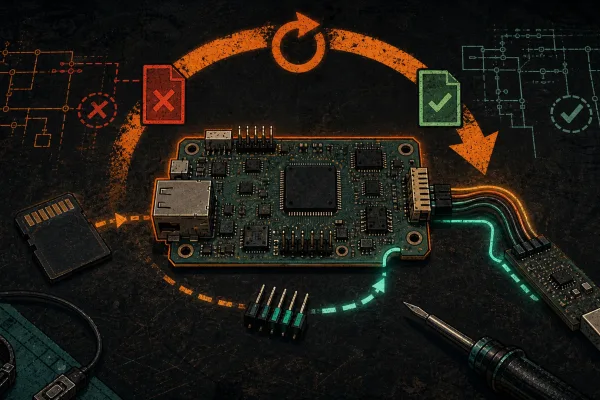
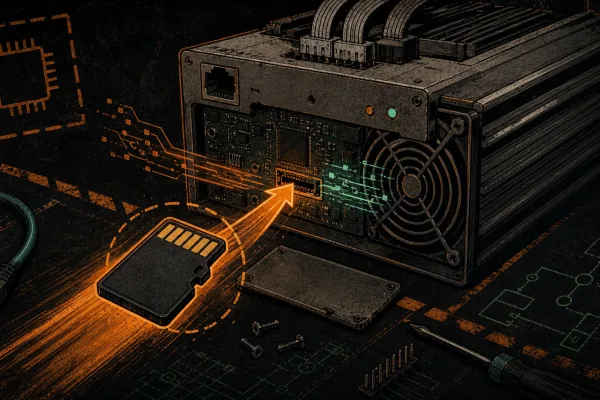
We chose the S9 family as the first beta target specifically because it is recoverable. A DCENT_OS S9 install runs from an SD card, and the Zynq SoC picks its boot source from a jumper: J3 open boots the internal NAND (stock firmware), J3 shorted boots the SD card (DCENT_OS). Because the install lives on the card, your stock firmware in NAND is never overwritten. Pull the card, set J3 back to open, and the miner boots stock as if nothing happened. That non-destructive design is the foundation of every safety claim in this guide.
Underneath that, the S9’s earliest boot stages are RSA-signed and effectively immutable — the BootROM is hardcoded in silicon, and the FSBL, FPGA bitstream, and U-Boot are RSA-verified with keys fused into the chip. You cannot brick those layers with an SD flash, which is why a genuinely unrecoverable S9 from an SD install is rare.
Electrical safety
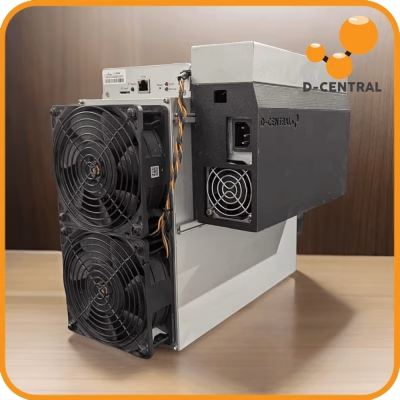
An Antminer S9 is a serious electrical load — treat it like the 1–1.4 kW appliance it is, regardless of which firmware runs on it.
- Use a PSU sized for the miner. The stock S9 pairing is the Bitmain APW3/APW3++ (1600 W at 220 V, 1200 W at 110 V) or the APW7 (1800 W at 220 V). A marginal or failing PSU can brown out during boot and look exactly like a brick.
- Mind the circuit. Do not run an S9 on an overloaded circuit or a daisy chain of extension cords. Give it dedicated headroom. On 120 V the S9 is power-limited compared to 220 V — plan accordingly.
- Heat is the product, and a hazard. If you run an S9 as a heater, keep it away from combustibles, ensure clean airflow, and have a working smoke detector in the space. Do not run it unattended in an unsafe location.
- Disconnect before you touch the board. Power off and unplug before setting jumpers or inserting the SD card, and let the PSU discharge.
Warranty: what flashing means for your coverage
Be clear-eyed about this before you flash:
- Flashing third-party firmware can void the manufacturer warranty. If your S9 is still under any manufacturer or seller warranty, flashing custom firmware — DCENT_OS or any other — may void it. Treat a flashed miner as out of manufacturer warranty for firmware-related issues. This is true of every custom firmware, not just ours.
- DCENT_OS is provided as-is under GPL-3.0. Like essentially all open-source software, it comes with no warranty of any kind. The GPL-3.0 license text says this explicitly: the software is provided without warranty, and you assume the risk of running it. Joining the beta is not a purchase and carries no service guarantee.
- The closed-beta waitlist is not a pre-order. You are not buying anything by joining. We collect your email and reach out once — when an S9 beta slot opens for you. We do not send newsletters or marketing.
- If your hardware needs repair, that is separate. D-Central runs a real ASIC repair bench — dead domains, failed chips, board faults. That is a paid repair service governed by its own terms, independent of the firmware beta. Running DCENT_OS does not entitle you to free repairs, and a hardware fault that existed before you flashed is a hardware fault.
If you bought refurbished hardware from D-Central, the condition and any applicable D-Central warranty are described at the point of sale; firmware flashing is a separate decision you make on your own hardware. See our warranty page and shipping policy for the commerce side.
What we ask of beta testers
Closed beta is a two-way street. In exchange for early access, the thing we genuinely need is honest reporting: tell us what broke, on which S9 control-board revision, under which mode and settings. That feedback is what gates each public stage — the timeline answers to the hardware, not the calendar. The live channel for that is our community Discord: join the D-Central Discord. You can also watch github.com/DCentralTech/DCENT_OS, where a release is how we announce each build.
Frequently asked questions
Does flashing DCENT_OS void my warranty?
Flashing any third-party firmware can void the manufacturer warranty, and DCENT_OS is no exception. Treat a flashed miner as out of manufacturer warranty for firmware-related issues. DCENT_OS itself is provided as-is under GPL-3.0 with no warranty.
Is joining the waitlist a purchase or pre-order?
No. The closed-beta waitlist is collection-only and free. It is not a pre-order, and joining commits you to nothing. We reach out once, when an S9 slot opens; we do not send newsletters.
Can DCENT_OS damage my miner?
Flashing carries brick and downtime risk, and aggressive tuning can stress aging silicon. The firmware enforces thermal and voltage limits, and an SD-card S9 install is non-destructive to your stock firmware, but no beta firmware is risk-free. Only flash a miner you can recover, and read the recovery guide first.
What hardware is covered by the beta?
The Antminer S9 family only (S9 / S9i / S9j). The S19 and S21 families are in active development with no public image yet — do not attempt to flash them. The beta-status page is the current source of truth.
If I brick my miner, will D-Central fix it for free?
No. The firmware beta carries no service guarantee. If you need a board repaired, that is our separate paid ASIC repair service. The good news is that an SD-card S9 install is recoverable without a repair in the large majority of cases — see the recovery guide.
Next steps
If you have read this and you are in: the rollback & UART recovery guide comes first, then the S9 SD-card install guide, then the Heat Mode first-boot guide or the overclocking walkthrough depending on what you want your S9 to do.
Informed and ready? DCENT_OS is in closed beta on the Antminer S9 today — experimental, GPL-3.0, public beta planned for summer 2026 (an estimate). Join the waitlist to get on the S9 testing list. The waitlist is not a pre-order, and we will not email you anything else yet.
Space Heater Edition" width="80" height="80" loading="lazy" style="width:80px;height:80px;object-fit:contain;border-radius:6px;background:#1A1A1A;flex-shrink:0;">
When your miner retires: one more layer decentralized
Open-source firmware extends a miner's useful life. When a model retires from profitable mining, the power, cooling, and connectivity you built around it can still serve the distributed-compute layer — heat reuse, mesh comms, or freeing infrastructure for sovereign AI.