In eleven days, Bitcoin lost more money to software defects than to any exchange failure since 2022. A hardware wallet generated seeds from a broken random number generator for four and a half years. A payment server handed attackers the credentials to Lightning nodes. A swap service shut itself down because it could no longer patch faster than it was being attacked. None of these were protocol failures — Bitcoin itself did exactly what it was told, every time. They were failures in the software people trust to speak to Bitcoin on their behalf, and the difference matters enormously if you hold your own keys.
This is the factual record of what happened, in the order it happened, with the specific actions each event demands. If you run a node, a wallet, or a merchant server, at least one section below is addressed to you directly.
Coldcard: Four and a Half Years of Weak Seeds
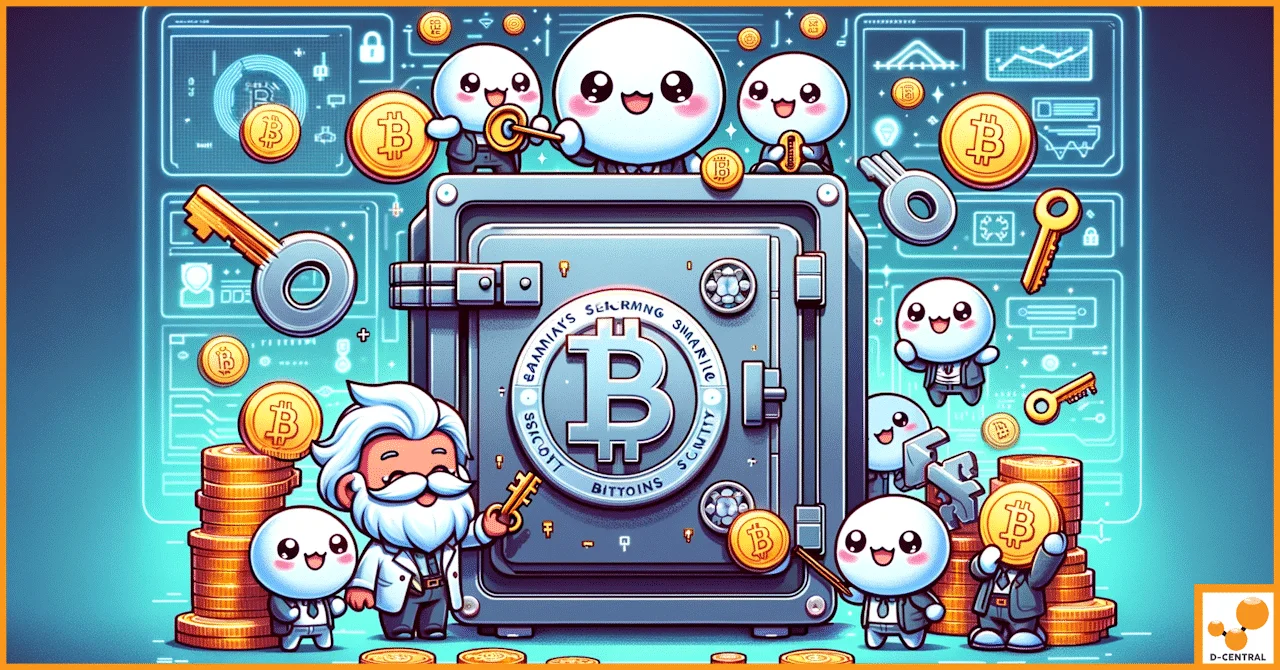
Coinkite disclosed on 30 July 2026 that Coldcard firmware had, under certain builds, been generating wallet seeds from the wrong source of randomness. The cause is a single line of C preprocessor logic. The firmware tested #ifndef MICROPY_HW_ENABLE_RNG — which asks whether a symbol is defined, not whether it is true. The board configuration defined it as (0). Defined, but zero. The test passed, the hardware random number generator was skipped, and seed generation silently fell back to MicroPython’s Yasmarang pseudo-random generator, seeded with far less entropy than a Bitcoin key deserves.
The practical effect: an effective seed strength of roughly 40 bits on Mk2 and Mk3 devices, and roughly 72 bits on Mk4, Mk5 and Q — against the 128 bits a 12-word seed is supposed to carry. Forty bits is not a theoretical weakness. It is a weekend of compute.
The defect traces back to a firmware release in March 2021. Coinkite patched it on 31 July 2026, one day after disclosure. Here is the part that matters most and that too much of the coverage buried: the patch cannot repair a seed that has already been generated. Entropy is spent at the moment of creation. A device that produced a weak seed in 2022 and has been dutifully updated ever since is still guarding a weak seed today. The only remedy is a new wallet, generated on patched firmware, with the funds moved to it.
That also means the diagnostic question is not “what firmware am I running?” It is “what firmware was running the day this seed was first created?” Those are different questions with different answers, and only the second one tells you whether you are exposed.
The losses have been substantial and are still being counted. Galaxy Research confirmed on 8 August that 1,719 BTC — roughly $111 million — has been stolen, with total losses potentially reaching 2,055 BTC, or about $130 million. The theft is not the work of one party: analysts have identified at least fifteen independent attackers across more than twenty-five distinct attack patterns in three waves. Roughly 90% of the stolen coins have not moved since. No CVE was issued. No other hardware wallet vendor was affected — Trezor, Ledger, Jade and Passport all published “not affected” statements, and those statements have held up.
We published a full advisory when this broke, including how to determine your exposure and how to migrate: see our Coldcard seed vulnerability advisory. If you have ever generated a seed on a Coldcard, read it before you read anything else on this page.
BTCPay Server: Credentials, Not Coins
On 7 August 2026, BTCPay Server published a security advisory and released version 2.4.2. The vulnerability allowed an unauthenticated remote attacker to obtain .macaroon credential files for LND. A macaroon is the bearer token that authorises commands against a Lightning node. Whoever holds it can control the node and move its funds. The attacker never needed a password, a session, or a foothold on the machine — the credentials were reachable from outside.
The flaw was found and responsibly disclosed by Craig Raw, the developer behind Sparrow Wallet. BTCPay’s advisory is unambiguous about what followed: “We have confirmed that attackers exploited this vulnerability. Users were affected and funds were stolen.” Foundation, the company behind Passport hardware wallets, and Citadel21 both had Lightning nodes swept before the public warning went live. That detail is the whole story of modern disclosure in one line: the window between a fix being written and the attack arriving is now measured in hours, and the defenders on the wrong side of it had done nothing wrong.
Every version prior to 2.4.2 is affected, including the 2.4.2 release candidates. On-chain wallets are not exposed by this flaw; only LND deployments leak credentials.
If you run BTCPay Server with LND, the update alone is not sufficient, and this is the point operators are most likely to get wrong:
- Update immediately — Server Settings → Maintenance → Update. Confirm the admin footer reads 2.4.2 and that LND reports 0.21.1.
- Understand what the update does not do. Version 2.4.2 closes the hole. It does not invalidate credentials that were already stolen. A macaroon exfiltrated last week still works against an updated server unless it is rotated.
- Rotate your macaroons. This happens automatically on upgrade to 2.4.2 — verify it actually did.
- Audit the node. Review transaction history, channel closures and on-chain balances for activity you did not authorise.
- Rotate anything else exposed. If LND is reachable through an external reverse proxy or a Tor hidden service, rotate those credentials too.
- Move funds out of any BTCPay-generated on-chain hot wallet to a wallet whose keys never touched the affected server.
- If you cannot update right now, take the server offline. An offline merchant server costs you sales. An online vulnerable one costs you the node.
We have long recommended self-hosted BTCPay as the sovereign way to accept Bitcoin, and we still do — our guides on self-hosted BTCPay and BTCPay with WooCommerce stand. Self-hosting means you own the outcome, and that cuts both ways. Owning your payment stack means owning its patch schedule. This is the week that bill came due.
Boltz: The Shutdown That Should Worry You Most
On 3 August 2026, Boltz suspended its non-custodial swap service indefinitely. No funds were lost — the service is non-custodial by design, and that design held. What broke was the team’s ability to keep up.
Boltz cited months of automated, AI-assisted probing of its infrastructure, and put the reason for stopping in plain language: “Attackers now iterate faster than a team our size can find and patch.” Within hours, Aqua, Bull Bitcoin and Zeus lost Boltz-powered swap functionality.
Read that quote again, because it is the most important sentence in this article. Coldcard was a bug that sat undiscovered for four years. BTCPay was a bug found by a good-faith researcher. Boltz is something new: a competent team, with a sound architecture, that shut down a working service because the rate of incoming attack exceeded their capacity to respond. Nobody beat their security model. They were simply outpaced.
That is what changes when attack tooling becomes automated and cheap. The constraint on exploitation used to be skilled human attention, which is scarce and expensive. When that constraint lifts, every small team maintaining Bitcoin infrastructure — and almost all of it is maintained by small teams — faces an adversary that never sleeps, never gets bored, and costs a few dollars an hour to run.
What Actually Connects These Three
It is tempting to file these as three unrelated bugs in a bad month. They are not.
Bitcoin is the most purely cyber-native asset ever created. There is no chargeback, no fraud department, no court that can reverse a confirmed transaction. Every other financial system has a human layer that absorbs errors after the fact. Bitcoin’s finality — the property that makes it worth holding — means a software defect converts directly and irreversibly into stolen value. That has always been true. It has been true since 2009.
What is new is the cost of finding the defect. A weak-RNG bug of the Coldcard variety is exactly the kind of thing a machine reads code for tirelessly and a human reviewer’s eye slides over — a preprocessor directive that is subtly, quietly wrong, in a file nobody has needed to look at since 2021. The economics of auditing have inverted: the search that used to require a specialist’s month now takes a well-configured harness an afternoon.
That cuts both ways, and the rest of this series is about which way it cuts. Attackers got the capability first, as they usually do. The defensive response — a volunteer effort called the Bitcoin Red Team that put sixteen researchers and a purpose-built AI harness against 390 Bitcoin repositories in a single sprint — is covered in the second article in this series. What that effort ran into when it asked the frontier AI labs for access is covered in the third, and it is the part of this story that has not been told properly anywhere else.
Your Checklist
If you do nothing else from this article:
- Ever generated a seed on a Coldcard? Determine the firmware version in use on the day that seed was created. If it predates the 31 July 2026 patch, move your funds to a wallet generated on a device you trust. Start with our advisory.
- Run BTCPay Server with LND? Update to 2.4.2, confirm the macaroon rotation actually occurred, audit your channels, and empty any BTCPay-generated hot wallet.
- Run any self-hosted Bitcoin infrastructure? Subscribe to its security announcements through a channel you actually read. In the Boltz and BTCPay cases, the difference between a patched operator and a drained one was hours, not days.
- Hold coins on hardware you have not thought about in years? This month is the argument for periodically revisiting that decision. Firmware written in 2021 is still guarding money in 2026.
None of this is an argument against self-custody. It is an argument for self-custody with maintenance — the same relationship you already have with any machine you own and run. We repair mining hardware for a living, and the failure mode we see most often is not a machine that was built badly. It is a machine nobody checked for four years.