On this page
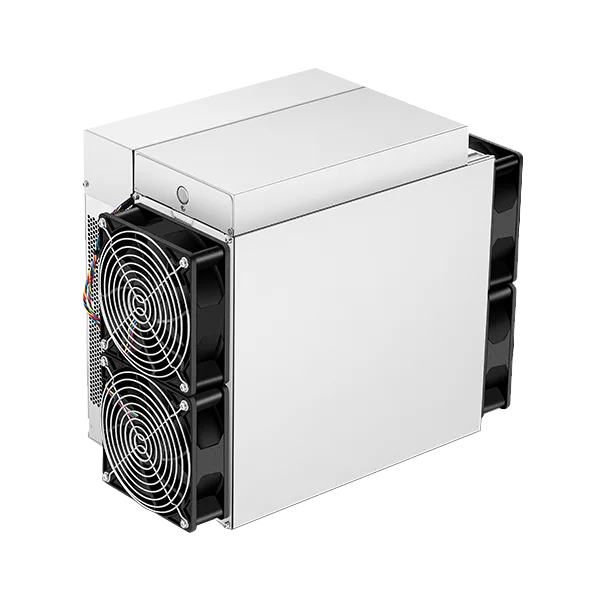
Antminer S19 Pro+
Enhanced S19 Pro with 120 TH/s. Improved binned chips for better efficiency. Standard S19 form factor.
Quick answer
The Antminer S19 Pro+ is a Bitcoin miner rated about 120 TH/s at roughly 3,360 W (about 28 J/TH), built on 126× BM1398. An industrial-class unit — loud and power-hungry, best suited to a dedicated mining space, not living areas.
DCENT_OS Compatible
DCENT_OS is custom firmware developed by D-Central Technologies specifically for home miners. It transforms this miner with whisper-quiet fan profiles, 120V North American outlet support, auto-tuning for maximum efficiency, heater mode integration, and a clean web dashboard for monitoring.
Miners running DCENT_OS score higher on our Home Mining Assessment because the firmware is purpose-built to make industrial hardware livable in residential spaces.
Learn More About DCENT_OS →Professional-Grade Miner
This miner draws 3,360W and produces 75 dB of noise — it is designed for dedicated mining environments, not living spaces. Professional-grade miners deliver the highest hashrate and revenue per unit but require proper infrastructure: a 240V circuit, adequate ventilation or exhaust ducting, and a space where noise is not a concern (garage, basement, warehouse, or outdoor enclosure).
However, this miner is compatible with DCENT_OS — D-Central's custom firmware that adds whisper-quiet fan profiles and 120V North American outlet support. With DCENT_OS installed, this industrial miner can be transformed for home use.
Heater-Class Miner
At 3,360W, this miner outputs approximately 11464.3 BTU/hr of heat — equivalent to a standard electric space heater. Every watt consumed by an ASIC miner is converted to heat with 100% efficiency, making it a space heater that also mines Bitcoin.
During heating season, miner heat can offset part of the heat a room would otherwise need from another electric heater. The economics depend on your electricity rate, room heat demand, BTC price, network difficulty, and noise constraints.
Profitability Calculator
| Period | Revenue | Electricity Cost | Profit |
|---|---|---|---|
| Daily | $3.78 | $5.64 | $-1.87 |
| Weekly | $26.45 | $39.51 | $-13.07 |
| Monthly | $113.34 | $169.34 | $-56.01 |
| Yearly | $1,378.92 | $2,060.35 | $-681.43 |
Heating offset estimates the value of heat replacing an electric space heater during heating season (~6 months/year in Canada). Actual savings depend on your heating setup and climate.
Where to Buy the Antminer S19 Pro+
D-Central Technologies
CanadaBitcoin Mining Hackers since 2016. Ships from Laval, Quebec.
Shop all Bitcoin mining productsASIC Miner Market
United StatesWide selection of new and used ASIC miners. US-based shipping.
Shop NowFull Specifications
| Model | Antminer S19 Pro+ |
|---|---|
| Model Number | S19 Pro+ |
| Manufacturer | Bitmain |
| Algorithm | SHA-256 |
| Coins Mined | Bitcoin (BTC) |
| Hashrate | 120 TH/s |
| Power Consumption | 3,360 W |
| Efficiency | 28 J/TH |
| Noise Level | 75 dB |
| Chip Model | BM1398 |
| Chip Count | 126 |
| Cooling | Air |
| Voltage Range | 200-240V AC |
| Operating Temperature | 5-40°C |
| Dimensions | 400x195x290 |
| Weight | 14.4 |
| Interface | Ethernet |
| BTU Output | 11464.3 BTU/hr |
| Equivalent Heater | Equal to a 3,360W space heater |
| Daily Power Cost | $5.64/day |
| Monthly Power Cost | $169.34/mo |
| Circuit Requirement | 240V circuit required |
| Release Date | 2022-01-01 |
| MSRP | $3,000.00 |
| Status | Active |
Home Mining Assessment
Enhanced S19 Pro with 120 TH/s. Improved binned chips for better efficiency. Standard S19 form factor.
The Antminer S19 Pro+ is Bitmain’s air-cooled, BM1362-based SHA-256 miner, rated at 120 TH/s for roughly 3,360 W — about 28 J/TH at the wall. Built on TSMC’s 5nm BM1362 ASIC, it is one of the more efficient air-cooled units in the S19 family and undervolts cleanly to well under 23 J/TH.
Sold by some vendors simply as the “S19 Pro+,” it is the air-cooled member of Bitmain’s S19j Pro+ line. It pairs the hashrate density of the S19 Pro with the 5nm efficiency of the later S19j generation, which is why it remains a workhorse for low-cost-power home and small-business miners. Below is a full technical breakdown grounded in board-level teardown data — the kind of detail you need before you buy one, tune one, or send one in for repair.
Chip and hashboard architecture
The S19 Pro+ is built around the Bitmain BM1362, a fourth-generation SHA-256 ASIC fabricated on TSMC’s 5nm process. Each chip integrates a small cluster of large SHA-256 hashing engines, and the dies are binned tightly so the “+” variant lands at a better efficiency point than the standard S19j Pro. The move from the 7nm BM1398 (used in the original S19 and S19 Pro) to 5nm silicon is the single biggest reason this unit does more hashrate per watt without changing the familiar S19 chassis.
Internally the miner uses the classic Antminer three-board layout: three series-wired hashboards, each densely populated with a full string of BM1362 chips (on the order of 110-plus ASICs per board in this generation). Each board carries:
- A dsPIC33EP-class microcontroller that gates the board’s main MOSFET, runs the boot heartbeat, and brokers I2C traffic. (Note: the no-PIC security change belongs to the later S21/BM1368 generation — the S19j Pro+ still uses a dedicated hashboard MCU.)
- An EEPROM holding the board’s calibration and identity data, which the control board reads at startup. A corrupt or mismatched EEPROM is enough to make a perfectly good board refuse to enumerate.
- Four on-board temperature sensors feeding the fan curve and thermal-protection logic.
- An 18-pin ribbon back to the control board carrying 3.3 V logic power, ground, reset, the UART command/response pair (TX/RX), and the I2C lines for the sensors and EEPROM.
Power on each board is organized into voltage domains, not per-chip rails. Chips are wired in series within a domain, and each domain is fed by its own LDO or buck regulator that steps the boosted board voltage down to the precise core voltage the chip group needs. This is the detail most spec sheets get wrong: voltage is controlled per domain, never per individual chip. It is also why a single shorted chip can pull an entire domain — and sometimes the whole board — offline.
The brain of the machine is a control board built on a Xilinx Zynq-7010 (XC7Z010) SoC: dual ARM Cortex-A9 cores at 667 MHz alongside an Artix-7 FPGA fabric, with 256 MB of NAND, 256 MB of DDR3, and Gigabit Ethernet. Because the S19j Pro+ shipped across a long production window, you may also encounter it on alternate control boards — Amlogic, BeagleBone-class (TI AM335x), or Cvitek CV1835 — depending on the batch. They are functionally interchangeable from a mining standpoint but matter a great deal when you flash firmware or source a replacement.
Real-world power, efficiency and tuning headroom
Nameplate is 120 TH/s at 3,360 W. The figure you actually pay for is higher at the wall: the PSU’s own conversion losses sit on top of the hashboard draw, and the unit requires a 200–240 V AC supply — it will not run on a standard North American 120 V circuit without a 240 V drop. Plan your circuit and breaker around the wall figure, not the nameplate.
Where the BM1362 platform shines is its tuning curve. The S19 Pro+ carries roughly two dozen embedded power profiles, and the efficiency at the low end is genuinely excellent for an air-cooled S19. A representative slice of that curve:
| Wall power | Hashrate | Efficiency | Use case |
|---|---|---|---|
| 1,450 W | 65 TH/s | 22.3 J/TH | Ultra-efficient / heat-reuse |
| 1,750 W | 75 TH/s | 23.3 J/TH | Quiet, low-bill home mining |
| 2,950 W | 112 TH/s | 26.3 J/TH | Balanced |
| 3,200 W | 116 TH/s | 27.6 J/TH | Near-stock |
| 3,500 W | 122 TH/s | 28.7 J/TH | Stock / mild push |
| 5,900 W | 159 TH/s | 37.1 J/TH | Aggressive overclock |
The takeaway: dropped to its lowest profile this miner hits 22.3 J/TH — better efficiency than a stock 7nm S19 Pro — while still producing 65 TH/s. Pushed hard it will clear 150 TH/s, but efficiency degrades fast past ~130 TH/s and heat and stress climb with it. For most operators the sweet spot is somewhere between the 75 TH/s low-power profile and the stock setting, depending on your power price. The full curve and tuning notes live on our ASIC power profiles database.
From a heat standpoint, at stock the S19 Pro+ rejects roughly 11,460 BTU/h — meaningful, ductable space heat. In a cold climate that turns a heating bill into hashrate, but it is also why noise (~75 dB) and airflow planning matter; this is a garage, utility-room, or ducted-enclosure machine, not a living-room appliance.
Firmware compatibility
Out of the box the S19 Pro+ runs Bitmain’s stock cgminer-based firmware. Because the BM1362 hashboard is well understood, the unit also accepts mature aftermarket firmware that exposes autotuning, undervolting, and per-domain frequency control — the same levers that produce the efficiency profiles above. A few honest caveats:
- Autotuner values are calculated at runtime by sweeping each board and settling on stable frequency/voltage points — they are not a fixed “preset” baked into the image.
- If protocol-level efficiency matters to you, note that BraiinsOS+ is the firmware that natively speaks Stratum V2; we credit the Braiins team for that work, and it is the practical answer for V2 on Antminer hardware today.
- Firmware is tied to the control-board variant. Confirm whether your unit is a Xilinx Zynq, Amlogic, BeagleBone, or Cvitek board before flashing anything.
The S19 Pro+ is one of the platforms DCENT_OS — D-Central’s GPL-3.0 Antminer firmware — is being validated on. DCENT_OS is in closed beta with a public beta planned for summer 2026; it stands on the shoulders of the open-source firmware projects that came before it and aims to add one more layer of operator control and decentralization rather than replace what works.
Common faults and troubleshooting
The S19 Pro+ fails in the same handful of ways every BM1362 board does. The most common symptoms, and what they usually mean:
- Fewer chips than expected / “0 ASIC found” on a chain: a broken signal chain, most often a cold solder joint on a CLK or CI/BO resistor at a domain boundary, or a shorted chip dragging a domain down. Chip enumeration stops at the break.
- Low hashrate with all chips detected: degraded transistors or chip characteristic drift showing up as a low nonce rate. The board still enumerates but under-delivers.
- Board not recognized at all: EEPROM corruption or an EEPROM mismatch between mixed boards — the control board can’t read the board’s identity.
- Temperature sensor errors / fan ramps to 100%: a failed I2C temp sensor or a sensor line fault on the ribbon, which the firmware treats as a thermal risk.
- Whole board drops out under load: a domain short pulling voltage to near zero, triggering the boost circuit to current-limit or shut down.
Our interactive ASIC fault finder walks these symptoms back to a root cause and the specific board component to probe, so you can decide whether it is a five-minute fix or a board that needs the bench.
Repair and longevity
The S19 Pro+ is very much a repairable machine, and that is central to its value: a 5nm board that can run at 22 J/TH is worth keeping alive. D-Central has run an in-house ASIC repair lab in Laval, Quebec since 2016, and we service these boards at the component level — isolating a faulty chip by binary-search chip-count probing, reflowing or replacing cold-joint CLK/CI resistors, reprogramming or transplanting EEPROMs, and rebuilding domain regulation rather than scrapping a board over one bad chip. PSU (APW-series) and fan service round out the common jobs.
Because the BM1362 platform is so well characterized, a board that drops a chain is usually recoverable rather than landfill. If your unit is throwing any of the symptoms above, our ASIC repair service can diagnose and quote it — keeping hardware hashing instead of replacing it is the most direct form of mining sovereignty there is.
Who it’s for and how to buy
The S19 Pro+ is a strong fit if you have access to inexpensive 240 V power and want maximum air-cooled hashrate density without stepping up to immersion or hydro. Its undervolt headroom makes it equally at home as a heat-reuse unit in a cold climate or a balanced earner where electricity is cheap. It is not the right pick if you need a quiet, plug-and-play home device — for that, a small open-source miner like a Bitaxe-class board makes more sense — but for someone who understands the trade-offs, it is one of the better value-per-terahash air units of its era.
You can browse our full, spec-verified ASIC miner catalog to compare the S19 Pro+ against current options, and reach out if you want a unit configured, tuned, or repaired before it ships.
Where it sits in the S19 generation
The S19 Pro+ occupies a useful middle ground. It is more efficient than the 7nm S19 Pro it visually resembles, but it predates the 5nm efficiency leaps of the S19 XP and the S21 line:
| Model | ASIC | Node | Stock hashrate | Stock efficiency |
|---|---|---|---|---|
| S19 Pro | BM1398 | 7nm | ~110 TH/s | ~29.5 J/TH |
| S19 Pro+ (S19j Pro+) | BM1362 | 5nm | 120 TH/s | ~28 J/TH |
| S19 XP | BM1366 | 5nm | ~140 TH/s | ~21.5 J/TH |
| S21 | BM1368 | 5nm | ~200 TH/s | ~17.5 J/TH |
Against newer silicon, 28 J/TH is a previous-generation efficiency tier — which is exactly what makes the S19 Pro+ attractive on the secondary market. Bought right and undervolted, it delivers respectable terahash at a fraction of next-gen hardware cost, and because it is fully repairable it can keep earning long after the warranty lapses. Credit where due: Bitmain’s BM1362 design is what made an air-cooled S19 this efficient in the first place, and the S19 Pro+ remains one of the smartest-value ways to own a piece of that generation.
Broken miner? Get a real quote.
Tell us the symptom and get an instant repair-tier estimate ($95 / $145 / $195 CAD). Mail-in from across Canada, bench in Laval, Quebec.
Send it to D-Central — start a repair →Antminer S19 XP specs, repair, and parts
Use the S19 XP cluster to confirm specs, maintenance steps, hashboard symptoms, and compatible power or board parts before buying.
Frequently Asked Questions
What are the current mining economics for the Antminer S19 Pro+?
At $0.07/kWh, the Antminer S19 Pro+ currently shows an estimated daily net cost of $1.87 before pool fees and hardware cost. Lower electricity rates, network changes, BTC price changes, or useful heat recovery can change the result.
Can I mine Bitcoin at home with the Antminer S19 Pro+?
The Antminer S19 Pro+ has a home mining score of 8/100. With 75 dB noise and 3,360W power draw, it may require a dedicated space like a garage, basement, or outdoor enclosure. Consider noise insulation and proper ventilation.
Can the Antminer S19 Pro+ heat my home?
The Antminer S19 Pro+ outputs approximately 11464.3 BTU/hr of heat. For reference, a typical space heater produces 5,000-5,500 BTU/hr. All electrical energy consumed by the miner is converted to heat, making it 100% efficient as a heater. D-Central offers Bitcoin Space Heater builds designed specifically for home heating integration.
Does D-Central repair the Antminer S19 Pro+?
Yes, D-Central provides professional repair services for the Antminer S19 Pro+. Services include hashboard repair, control board diagnostics, fan replacement, and full refurbishment. Ship your miner to our Laval, Quebec facility for diagnosis and repair.
What power supply does the Antminer S19 Pro+ need?
The Antminer S19 Pro+ draws 3,360W of power. You need a power supply rated for at least 3,696W with appropriate voltage (200-240V AC). D-Central stocks compatible power supplies in our shop. Always use a quality PSU from a reputable manufacturer to protect the miner and wiring.

