
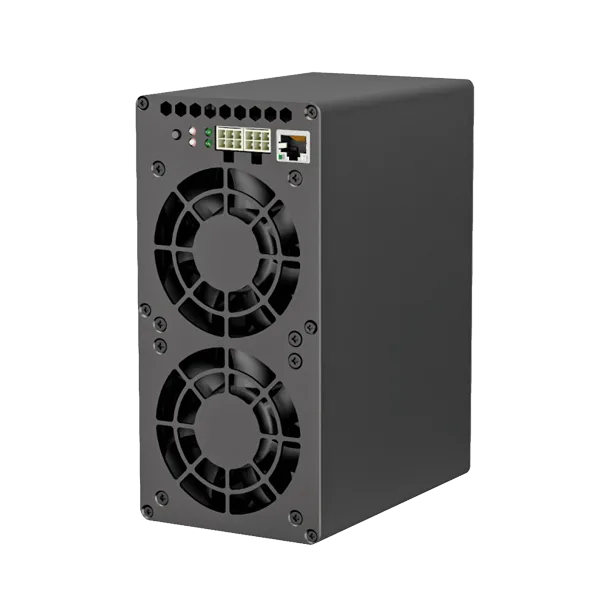
Goldshell Mini-DOGE III
Compact Scrypt miner suitable for home use. Low noise and standard outlet power. Mines both LTC and DOGE via merge mining.
Quick answer
The Goldshell Mini-DOGE III is a Scrypt miner rated about 800 MH/s at roughly 500 W, built on the Custom ASIC ASIC. Runnable at home with proper airflow and noise control; best in a dedicated space.
Heater-Class Miner
At 500W, this miner outputs approximately 1706 BTU/hr of heat — equivalent to a standard electric space heater. Every watt consumed by an ASIC miner is converted to heat with 100% efficiency, making it a space heater that also mines Bitcoin.
During heating season, miner heat can offset part of the heat a room would otherwise need from another electric heater. The economics depend on your electricity rate, room heat demand, BTC price, network difficulty, and noise constraints.
Profitability Calculator
| Period | Revenue | Electricity Cost | Profit |
|---|---|---|---|
| Daily | $0.00 | $0.84 | $-0.84 |
| Weekly | $0.00 | $5.88 | $-5.88 |
| Monthly | $0.00 | $25.20 | $-25.20 |
| Yearly | $0.01 | $306.60 | $-306.59 |
Heating offset estimates the value of heat replacing an electric space heater during heating season (~6 months/year in Canada). Actual savings depend on your heating setup and climate.
Where to Buy the Goldshell Mini-DOGE III
D-Central Technologies is a Bitcoin-only company. For this miner, check out our trusted partner retailers below.
ASIC Miner Market
United StatesWide selection of new and used ASIC miners. US-based shipping.
Shop NowPartner links may earn D-Central a commission at no extra cost to you. Have you considered Bitcoin mining instead? Explore Bitcoin miners →
Full Specifications
| Model | Goldshell Mini-DOGE III |
|---|---|
| Model Number | Mini-DOGE III |
| Manufacturer | Goldshell |
| Algorithm | Scrypt |
| Coins Mined | Litecoin (LTC), Dogecoin (DOGE) |
| Hashrate | 800 MH/s |
| Power Consumption | 500 W |
| Efficiency | 0.62 J/MH |
| Noise Level | 55 dB |
| Chip Model | Custom ASIC |
| Cooling | Air |
| Voltage Range | 100-240V AC |
| Operating Temperature | 0-40°C |
| Dimensions | 200x130x145 |
| Weight | 3.2 |
| Interface | WiFi + Ethernet |
| BTU Output | 1706 BTU/hr |
| Equivalent Heater | Small personal heater (1,706 BTU/hr) |
| Daily Power Cost | $0.84/day |
| Monthly Power Cost | $25.20/mo |
| Circuit Requirement | Fits 120V 15A circuit budget (1,440 W continuous, NEC 80% rule) - stock APW-series PSUs still need 200-240V input |
| Release Date | 2023-08-01 |
| MSRP | $499.00 |
| Status | Active |
Home Mining Assessment
Compact Scrypt miner suitable for home use. Low noise and standard outlet power. Mines both LTC and DOGE via merge mining.
The Goldshell Mini-DOGE III is a compact, plug-and-play Scrypt ASIC that merge-mines Litecoin and Dogecoin at a rated 800 MH/s for roughly 500 W (about 0.625 J/MH). Built for a desk, a closet, or duty as a quiet space heater, it trades data-center efficiency for living-room practicality. Here is the full D-Central breakdown.
Chip and hashboard architecture
The Mini-DOGE III runs on Goldshell’s own in-house Scrypt ASIC rather than a Bitmain part, so there is no public datasheet and no community-confirmed chip SKU or per-board chip count. What is fixed is the algorithm it has to satisfy, and that is where the engineering gets interesting. Scrypt is a memory-hard key-derivation function: Litecoin and Dogecoin both use the same parameters (N=1024, r=1, p=1), and every nonce attempt requires a 128 KB scratchpad of fast on-chip SRAM. That single constraint shapes the whole chip.
Because each hashing core needs its own 128 KB scratchpad, a Scrypt die is dominated by SRAM, not logic. The result is a chip with very few cores compared to a Bitcoin ASIC of the same era — for reference, Bitmain’s 28 nm BM1485 (Antminer L3+) carried just 12 Scrypt cores, while its same-generation SHA-256 sibling, the BM1387, packed 114. A Scrypt miner therefore wins hashrate by clocking and stacking many small, SRAM-heavy chips rather than by brute core count.
There is one more architectural quirk worth knowing. A Scrypt ASIC cannot accept a pre-computed midstate the way a Bitcoin chip does; the algorithm can’t be split that way. The control board hands the chip the full block header and the ASIC performs the entire Scrypt computation internally. Power delivery on Scrypt hashboards is organised into series-connected voltage domains — a group of chips sharing one regulated rail — not per-chip control. On the L3+ that is 12 domains of 6 chips; on the L7, 24 domains of 5. Goldshell integrates the regulation onto a single compact board, but the principle is the same: voltage is trimmed per domain, and a small drift between domains is the classic early warning of a sick chip or regulator.
Real-world power and efficiency
At the nameplate 800 MH/s and 500 W, the Mini-DOGE III lands at roughly 0.625 J/MH (about 625 J/GH). Expect the figure at the wall to run a little higher than the sticker once you account for power-supply conversion losses, on-board regulators and the cooling fan — plan your circuit and your electricity math around real wall draw, not the rated number. It accepts 100–240 V AC, so a standard North American 120 V outlet is fine; there is no need for a 240 V drop the way a full-size rig demands.
Put that efficiency in context. The 2017-era Antminer L3+ delivered about 1.6 J/MH, so the Mini-DOGE III is materially more efficient than the unit that defined home Scrypt mining for years. It is not, however, in the same league as the full-size data-center Antminer L7, which reaches roughly 0.36 J/MH. That is the trade you are making: the Mini-DOGE III buys you a quiet, outlet-friendly, desk-sized box at the cost of the raw joules-per-hash a 3,400 W L7 achieves.
| Miner | Algorithm | Hashrate | Power | Efficiency | Form factor |
|---|---|---|---|---|---|
| Goldshell Mini-DOGE III (2023) | Scrypt | ~800 MH/s | ~500 W | ~0.625 J/MH | Compact desktop, air-cooled, ~55 dB |
| Antminer L3+ (2017) | Scrypt | ~504 MH/s | ~800 W | ~1.6 J/MH | Full-size, air-cooled |
| Antminer L7 (2021) | Scrypt | ~9,500 MH/s | ~3,425 W | ~0.36 J/MH | Full-size data-center, air-cooled |
Tuning headroom on a compact Goldshell unit is modest. Unlike the deep, runtime-calculated autotuning available on aftermarket Antminer firmware, the Mini-DOGE III is governed by its stock firmware and offers limited frequency or voltage adjustment. Treat the rated spec as close to the ceiling rather than a starting point to be overclocked. For how voltage-domain and frequency tuning actually works across the wider ASIC landscape, see our ASIC power profiles database.
Firmware compatibility
The Mini-DOGE III runs Goldshell’s own closed stock firmware with a simple web dashboard for pool setup, monitoring and updates. Because Litecoin and Dogecoin are merge-mined, you point the miner at a Scrypt pool that supports the LTC+DOGE pair and earn both coins from the same shares — no second machine required. Communication with the pool is standard Stratum V1.
Common faults and troubleshooting
Compact Scrypt miners fail in predictable places, and most issues announce themselves as hashrate sliding below the nameplate figure or chips dropping out of the chain. Before assuming the worst, work through our ASIC fault finder to localise the symptom. The usual suspects:
- Voltage-domain drift. Scrypt boards regulate per domain, and rails are expected to track each other tightly (the L3+ spec allows only about ±0.05 V between domains). A domain that reads off indicates a failing chip or regulator on that rail.
- Dead or missing chips. A chip that drops out of the daisy-chain shows up as a lower reported chip count and a proportional hashrate loss. Because Scrypt chips are few and individually significant, even one failure is visible in the numbers.
- Cooling and the fan. The single high-RPM fan is what produces the ~55 dB rating and is the most common wear item. Dust loading or a worn bearing leads to thermal throttling and a quiet, steady decline in output. Keep the intake clear and listen for bearing noise.
- Temperature-sensor faults. Scrypt boards rely on on-board thermal sensing (the L-series uses a TMP451-class sensor read over I²C). A bad reading can trigger protective throttling or shutdowns that look like a hashrate fault.
- Power and network. An undersized or aging supply, a marginal outlet, or a flaky web-UI/network connection will all surface as instability, restarts or dropped pool connections before any chip is actually at fault.
Repair and longevity
D-Central has repaired ASIC hardware in-house in Montréal, Québec since 2016, and the same board-level discipline that keeps Antminers alive applies to compact Scrypt units: diagnosing voltage domains, reflowing or replacing regulators and capacitors, and chip-level work where it makes sense. If your Mini-DOGE III is under-hashing, throwing thermal errors, or refusing to boot, our team can diagnose the board rather than condemn the whole unit. Start at our ASIC repair service.
We will also be straight with you on economics. The Mini-DOGE III is a sub-$500 machine, so for some failures the honest answer is that a repair only makes sense if the fault is localised and the parts are cheap — a fan, a connector, a single regulator. A diagnosis tells you which side of that line you are on, and it keeps a working miner out of the e-waste stream, which is the whole point of repair over replacement.
Who it is for, and buying notes
The Mini-DOGE III is a home and hobby machine first. It suits the miner who wants to participate in the Scrypt network without a dedicated mining shed: it runs on a normal outlet, stays reasonably quiet at ~55 dB (audible, but not a jet engine), and earns Litecoin and Dogecoin together through merge-mining. It is an excellent learning platform — small enough to live on a shelf while you get fluent in pools, firmware dashboards and payout mechanics.
The other strong use case is heat. The Mini-DOGE III dumps about 1,706 BTU/h of waste heat, which is genuinely useful for warming a small room, an office or a workshop in winter. Ducted thoughtfully, that turns money you would have spent on heating into a trickle of LTC and DOGE — the most defensible way to run a legacy-efficiency miner. As a pure profit engine at 0.625 J/MH it is best understood as a hobby and heat-reuse device, not a return-on-investment play.
If your interest is the sovereign, do-it-yourself end of Scrypt, it is worth knowing that the open-source community has been adapting the BitAxe approach to Scrypt single-chip miners (the community “LiteAxe” effort, built around the salvaged BM1485). That work stands on the shoulders of Bitmain’s and Goldshell’s silicon and points toward a more decentralized, self-hosted future for Litecoin and Dogecoin hashing. The Mini-DOGE III is the polished, ready-to-run version of that same idea.
Generational context
Goldshell’s Mini-DOGE line has iterated steadily, each generation pushing hashrate and efficiency on the same compact, home-friendly chassis, and the Mini-DOGE III is the most capable of the family to date. Stepping back, the broader Scrypt timeline runs from the 28 nm Bitmain L3+ (≈1.6 J/MH, 2017), through Goldshell’s compact desktop generation, to the full-size L7 (≈0.36 J/MH, 2021) that still anchors industrial Scrypt mining. The Mini-DOGE III sits squarely in the middle of that arc: dramatically more efficient than the machine that introduced most people to home Scrypt mining, while deliberately giving up the raw efficiency of a data-center box in exchange for being something you can actually live with. For the right miner — one who values quiet, an ordinary outlet, dual-coin merge-mining and useful winter heat — that is exactly the right trade.
Broken miner? Get a real quote.
Tell us the symptom and get an instant repair-tier estimate ($95 / $145 / $195 CAD). Mail-in from across Canada, bench in Montreal, Quebec.
Send it to D-Central — start a repair →Recommended parts and tools
Confirm symptoms against the guide, then route to the exact part, tool, or repair workflow that matches the miner family.
Related Miners
Goldshell Mini DOGE III (500Mh)
VOLCMINER D1 Mini Pre 2.2Gh
Goldshell LT Lite
Fluminer L1
Compare the Goldshell Mini-DOGE III
Frequently Asked Questions
What are the current mining economics for the Goldshell Mini-DOGE III?
At $0.07/kWh, the Goldshell Mini-DOGE III currently shows an estimated daily net cost of $0.84 before pool fees and hardware cost. Lower electricity rates, network changes, BTC price changes, or useful heat recovery can change the result.
Can I mine Bitcoin at home with the Goldshell Mini-DOGE III?
Yes, the Goldshell Mini-DOGE III scores 67/100 for home mining viability. It produces 55 dB of noise and draws 500W. It is suitable for home environments with appropriate placement considerations.
Can the Goldshell Mini-DOGE III heat my home?
The Goldshell Mini-DOGE III outputs approximately 1706 BTU/hr of heat. For reference, a typical space heater produces 5,000-5,500 BTU/hr. All electrical energy consumed by the miner is converted to heat, making it 100% efficient as a heater. D-Central offers Bitcoin Space Heater builds designed specifically for home heating integration.
What power supply does the Goldshell Mini-DOGE III need?
The Goldshell Mini-DOGE III draws 500W of power. You need a power supply rated for at least 550W with appropriate voltage (100-240V AC). D-Central stocks compatible power supplies in our shop. Always use a quality PSU from a reputable manufacturer to protect the miner and wiring.