On this page
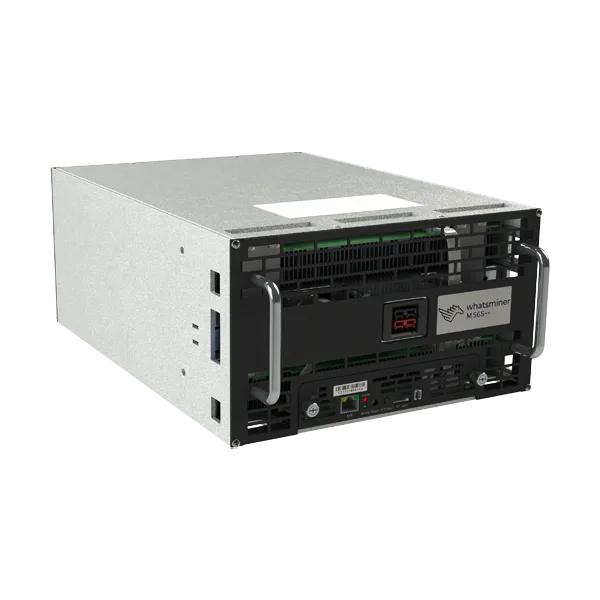
Whatsminer M56S+
Best-efficiency M56 immersion variant at 216 TH/s. Improved chips deliver lower watts-per-terahash in immersion cooling.
Quick answer
The Whatsminer M56S+ is a Bitcoin miner rated about 216 TH/s at roughly 5,060 W (about 23.43 J/TH), built on the WM3610 ASIC. An industrial-class unit — loud and power-hungry, best suited to a dedicated mining space, not living areas.
Immersion-Cooled Miner
This miner is designed to operate fully submerged in a dielectric (non-conductive) cooling fluid. Unlike hydro miners that circulate liquid through internal channels, immersion miners have their entire board and chips bathed in engineered coolant inside a specialized tank.
Immersion cooling is the most effective thermal management available for ASIC miners. It eliminates all fan noise (completely silent operation), removes dust and humidity as failure factors, enables maximum overclocking potential, and dramatically extends hardware lifespan by maintaining perfectly even chip temperatures.
The trade-off is infrastructure: immersion requires a tank, dielectric fluid (typically engineered hydrocarbon or synthetic), and a heat exchanger. It is the gold standard for professional mining farms and serious home miners who want maximum performance with zero noise.
Professional-Grade Miner
This miner draws 5,060W and produces 50 dB of noise — it is designed for dedicated mining environments, not living spaces. Professional-grade miners deliver the highest hashrate and revenue per unit but require proper infrastructure: a 240V circuit, adequate ventilation or exhaust ducting, and a space where noise is not a concern (garage, basement, warehouse, or outdoor enclosure).
For home miners looking for a quieter alternative, consider our Bitcoin Space Heater builds or explore open-source miners like the Bitaxe that are purpose-built for residential environments.
Profitability Calculator
| Period | Revenue | Electricity Cost | Profit |
|---|---|---|---|
| Daily | $6.22 | $8.50 | $-2.28 |
| Weekly | $43.54 | $59.51 | $-15.97 |
| Monthly | $186.59 | $255.02 | $-68.43 |
| Yearly | $2,270.21 | $3,102.79 | $-832.58 |
Heating offset estimates the value of heat replacing an electric space heater during heating season (~6 months/year in Canada). Actual savings depend on your heating setup and climate.
Where to Buy the Whatsminer M56S+
D-Central Technologies
CanadaBitcoin Mining Hackers since 2016. Ships from Laval, Quebec.
Shop all Bitcoin mining productsASIC Miner Market
United StatesWide selection of new and used ASIC miners. US-based shipping.
Shop NowFull Specifications
| Model | Whatsminer M56S+ |
| Model Number | M56S+ |
| Manufacturer | MicroBT |
| Algorithm | SHA-256 |
| Coins Mined | Bitcoin (BTC) |
| Hashrate | 216 TH/s |
| Power Consumption | 5,060 W |
| Efficiency | 23.43 J/TH |
| Noise Level | 50 dB |
| Chip Model | WM3610 |
| Cooling | Immersion |
| Voltage Range | 380-480V 3-phase |
| Operating Temperature | 5-45°C |
| Dimensions | 267x147x401 |
| Weight | 13 |
| Interface | Ethernet |
| BTU Output | 17264.7 BTU/hr |
| Equivalent Heater | Equal to a 5,060W space heater |
| Daily Power Cost | $8.50/day |
| Monthly Power Cost | $255.02/mo |
| Circuit Requirement | 240V circuit required |
| Release Date | 2024-01-01 |
| MSRP | $6,000.00 |
| Status | Active |
Home Mining Assessment
Best-efficiency M56 immersion variant at 216 TH/s. Improved chips deliver lower watts-per-terahash in immersion cooling.
The Whatsminer M56S+ is MicroBT’s immersion-cooled SHA-256 ASIC, rated at 216 TH/s for 5,060 W (roughly 23.4 J/TH). It is the middle efficiency bin of the M56 immersion trio, built for dielectric-fluid tanks and three-phase industrial sites rather than a spare bedroom.
Chip and hashboard architecture
The M56S+ belongs to MicroBT’s fifth-generation (“M5x”) platform, which moved the company to a Samsung 5nm-class SHA-256 ASIC. The die is catalogued here as the WM3610; unlike Bitmain, MicroBT does not publicly brand its silicon, and it has historically fabricated at Samsung rather than TSMC. Where a Bitmain S19 carries 76 chips per board and an S19 Pro 114, MicroBT spreads its hash across three hashboards driven in series, with each board carrying a high count of small 5nm cores. We list the per-board chip count as unverified on this model and will not guess a number the manufacturer has never published.
The most important architectural point for anyone repairing or tuning this machine: voltage is regulated per power domain, not per chip. A group of series-wired ASICs shares a regulated rail, so a single weak or shorted die can drag a whole domain off-target. That is true across every modern Antminer and Whatsminer, and it shapes how a board is diagnosed.
The control side is where MicroBT diverges most sharply from Bitmain. There is no FPGA in a Whatsminer. Antminers since the S9 have paired an ARM core with a Xilinx Zynq FPGA (the classic 667 MHz Zynq pairing) to build mining work; MicroBT instead uses a pure Allwinner ARM SoC (the H-series CB-family control boards) that talks to the ASICs directly. The mining engine is btminer, MicroBT’s proprietary software, not cgminer or BOSminer. One practical consequence: Whatsminer hashboards are not interchangeable with Antminer control boards, and vice versa. The EEPROM format, the power-domain map, the ribbon connectors and the communication protocol are all vendor-specific.
Real-world power and efficiency
The 23.4 J/TH nameplate is a chip-level figure measured at the board, not at the wall. Because the M56S+ is an immersion unit, your true site draw also has to carry the tank pump and the fluid-to-water or fluid-to-dry-cooler heat-exchange loop. Budget for that overhead when you size a circuit: the miner itself is the 5 kW figure, but the facility around it adds a few more percent. The unit expects a 380-480 V three-phase feed and a 5-45 °C ambient/coolant window.
The upside of immersion is headroom. Submerged in dielectric fluid, the silicon runs cooler and more evenly than it ever could on air, which is exactly why MicroBT ships the M56 family with a wider power envelope than its air-cooled M5x cousins. Operators who want to chase either lower J/TH (underclock) or more raw TH/s (overclock) have real room to move here, provided the loop can reject the heat. Our ASIC power profiles database is the place to model those trade-offs before you commit a tank of fluid to a setting.
Here is how the M56S+ sits within its own immersion family and against a current-generation reference point:
| Model | Hashrate | Power | Efficiency | Cooling | Gen |
|---|---|---|---|---|---|
| Whatsminer M56S | 212 TH/s | ~5,550 W | ~26.2 J/TH | Immersion | 5nm (2023) |
| Whatsminer M56S+ | 216 TH/s | 5,060 W | 23.4 J/TH | Immersion | 5nm (2023-24) |
| Whatsminer M56S++ | 254 TH/s | ~5,588 W | ~22 J/TH | Immersion | 5nm (2023) |
| Whatsminer M66 (reference) | 276 TH/s | ~5,490 W | ~19.9 J/TH | Immersion | 2024 |
The “+” and “++” suffixes are efficiency bins of the same architecture, not different chips. The M56S+ trades a little outright hashrate for a meaningfully better watts-per-terahash than the base M56S, which is the bin most secondary-market buyers actually want.
Firmware compatibility
Out of the box the M56S+ runs MicroBT’s stock btminer firmware, managed through its web UI on port 80 and the btminerAPI on port 4028. Read commands (version, summary, pools, devs) are open by default; write commands such as pool changes, reboot, power-off and frequency targets require token-based encryption that you unlock with the WhatsMinerTool utility.
Be honest about the third-party landscape on this specific machine. Braiins OS+ does not run on any Whatsminer — it is an Antminer-only firmware, and it is the only firmware that natively speaks Stratum V2, so that feature is off the table here regardless. VNish publishes Whatsminer builds, but its documented coverage centres on the air-cooled M2x/M3x and M50/M50S/M53/M60 series; immersion M56 support is not something we will promise sight-unseen, and you should confirm a specific build against your exact control-board revision before flashing. The most established path to vendor-independent control on M5x hardware is a replacement control board such as the ePIC UMC, which swaps out MicroBT’s board entirely for open tuning without a dev fee. D-Central stocks that board.
For monitoring rather than reflashing, the M56S+ is well covered. Open tooling that speaks the btminerAPI — the same protocol family the DCENT Toolbox and libraries like pyasic use — can read hashrate, per-board temperatures, fan/pump telemetry and pool state across a fleet without touching the stock firmware. That keeps the warranty intact while still giving you sovereign visibility into the machine.
Common faults and troubleshooting
Immersion changes the failure profile compared with an air-cooled rig. You will not chase dust-clogged heatsinks or seized fans, but you inherit fluid-specific problems instead:
- Domain / hashboard drop-outs. A board reporting low or zero hashrate usually traces back to one power domain pulling out of spec — a weak ASIC, a failed domain regulator, or a cold-solder joint that surfaces once the board has thermally cycled in fluid.
- Connector and contact corrosion. Long immersion exposure can wick fluid into data and power connectors; intermittent boards or boards that re-detect on reseat are classic symptoms.
- Coolant and loop issues. Degraded or contaminated dielectric fluid, an under-performing heat exchanger, or a pump fault will show up as rising chip temperatures and protective throttling long before a hard failure.
- Control-board / communication faults. Because there is no FPGA buffering the link, an Allwinner SoC or ASIC-bus problem tends to present as missing chips in the chain or a board that never initialises.
Work the symptom methodically. Start with the ASIC fault finder to translate the error or the API readout into a likely root cause, and cross-check the btminerAPI summary and devs output to see which board and which domain is actually misbehaving before anyone opens a tank.
Repair and longevity
D-Central has repaired ASICs in-house in Laval, Quebec since 2016, and a 5nm immersion board is squarely the kind of work our bench is built for. Domain-level diagnosis, regulator and ASIC-level rework, connector remediation after fluid exposure, and full board testing are all things that keep an M56S+ earning long after a warranty lapses. These are durable machines — immersion keeps the silicon at gentle, stable temperatures, so a well-maintained M56S+ can run for years. The economics favour repair, too: at secondary-market prices, fixing a board almost always beats replacing the unit. If a hashboard is down or a unit is mis-reporting, our ASIC repair service can diagnose it and quote the fix.
Who it is for, and buying
Be clear-eyed about the deployment. The M56S+ is a facility miner, full stop. It needs a dielectric immersion tank, a heat-rejection loop and a 380-480 V three-phase feed, and it carries no internal air-cooling of its own. That makes it a strong fit for immersion farms, hashcenters and any low-cost-power industrial site that already runs fluid — and a poor fit for a home or garage, despite waste heat that can absolutely be reclaimed into a building’s heating loop where the infrastructure exists.
If you are shopping for a sub-5 kW machine, the question is really about your cooling reality. Already running immersion with cheap power? The M56S+ delivers a lot of terahash per dollar on the used market. Mining at home on a single 240 V circuit, or just learning? An air-cooled unit or an open-source Bitaxe-class device is the honest recommendation instead. Browse the full lineup and live profitability in our ASIC miner catalog to compare the M56S+ against air-cooled alternatives before you buy.
Generational context
The M56S+ landed in MicroBT’s 2023-24 5nm wave, the generation that followed the M53 hydro line and sat alongside the air-cooled M50/M50S. In its own family it is the balanced middle child — more efficient than the M56S, less power-hungry than the all-out M56S++. Against the current frontier it is honestly a generation behind: the 2024 M66 immersion units land near 19.9 J/TH, and the 2025 M70/M76 platform pushed efficiency down toward 13-14.5 J/TH. That does not make the M56S+ obsolete. At the right acquisition price and with cheap, ideally curtailable power, a 23.4 J/TH immersion machine still produces honest hashrate — and it is exactly the kind of proven, repairable hardware that keeps small operators sovereign rather than locked into the latest flagship. Credit where it is due: MicroBT’s M5x immersion line did a great deal to make tank-based mining mainstream, and these units are still earning their keep in the field.
Antminer S19 specs, repair, and parts
Use the S19 cluster to connect the product page, specs, maintenance guide, repair service, and compatible high-value parts.
- Antminer S19 specs and profitability
- Buy a tested Antminer S19
- Bitmain Antminer S19 Pro
- Bitmain Antminer S19j Pro
- Antminer S19 maintenance guide
- Antminer S19 repair service
- S19 hashboard troubleshooting
- S19 family replacement hashboard
- C52 replacement control board
- APW12 S19 PSU
- BM1398AC ASIC chip
- Compare Antminer S19 options
Frequently Asked Questions
What are the current mining economics for the Whatsminer M56S+?
At $0.07/kWh, the Whatsminer M56S+ currently shows an estimated daily net cost of $2.28 before pool fees and hardware cost. Lower electricity rates, network changes, BTC price changes, or useful heat recovery can change the result.
Can I mine Bitcoin at home with the Whatsminer M56S+?
The Whatsminer M56S+ has a home mining score of 32/100. With 50 dB noise and 5,060W power draw, it may require a dedicated space like a garage, basement, or outdoor enclosure. Consider noise insulation and proper ventilation.
Can the Whatsminer M56S+ heat my home?
The Whatsminer M56S+ outputs approximately 17264.7 BTU/hr of heat. For reference, a typical space heater produces 5,000-5,500 BTU/hr. All electrical energy consumed by the miner is converted to heat, making it 100% efficient as a heater. D-Central offers Bitcoin Space Heater builds designed specifically for home heating integration.
Does D-Central repair the Whatsminer M56S+?
Yes, D-Central provides professional repair services for the Whatsminer M56S+. Services include hashboard repair, control board diagnostics, fan replacement, and full refurbishment. Ship your miner to our Laval, Quebec facility for diagnosis and repair.
What power supply does the Whatsminer M56S+ need?
The Whatsminer M56S+ draws 5,060W of power. You need a power supply rated for at least 5,566W with appropriate voltage (380-480V 3-phase). D-Central stocks compatible power supplies in our shop. Always use a quality PSU from a reputable manufacturer to protect the miner and wiring.
