Quick answer
Own your compute the way you own your keys. The local-AI stack runs open-weight models on hardware you control: data sovereignty means your text never leaves the box, algorithm sovereignty means weights you possess. Three layers — a GPU (a used 24 GB RTX 3090), the model you flash, and your interface — backing up rented intelligence, not Bitcoin.
Why “own your compute” matters now
You already own your money. You hold your keys, you run your node, and you stopped asking an exchange for permission a long time ago. That instinct — possession over trust — is the whole reason Bitcoin exists. The argument here is simple: the same instinct now applies one layer up, to the machine that does your thinking. Own your compute the way you own your keys.
Frontier artificial intelligence is centralized intelligence. Every prompt to a hosted model is metered. Every response is logged. Every model sits inside a jurisdiction that can be leaned on, and every API key is a kill switch someone else holds. A terms-of-service update is a unilateral rewrite of what you are allowed to ask out loud. This is the correspondent-banking system of cognition, and a Bitcoiner already knows in their bones why renting a thing is not the same as holding it.
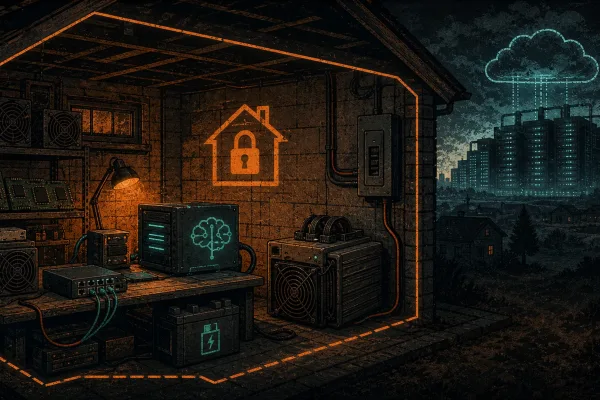
Two kinds of sovereignty are at stake. Data sovereignty means the text you feed a model never leaves hardware you control — no egress, no telemetry, no logging endpoint that answers to a subpoena. Algorithm sovereignty means the model that generates your tokens runs against weights you possess, on a runner you can read, that will still work the day the lab that trained it is acquired, shut down, or pressured. Weights, once released, cannot be unreleased. That is the same finality property that makes a signed Bitcoin transaction irreversible: once the numbers are out, they are out.
To be clear about scope: this is a backup to rented intelligence, not a replacement for Bitcoin. Hosted frontier models are convenient and, for some tasks, still better — more on that honestly below. Local AI is the layer you keep so that when the rented version is metered, censored, or simply gone, you still have a working machine. Bitcoin stays the anchor. Local compute is the newest backup we keep, the same way a mesh network backs up the internet and your own kWh back up the grid.
The self-sovereign local-AI stack
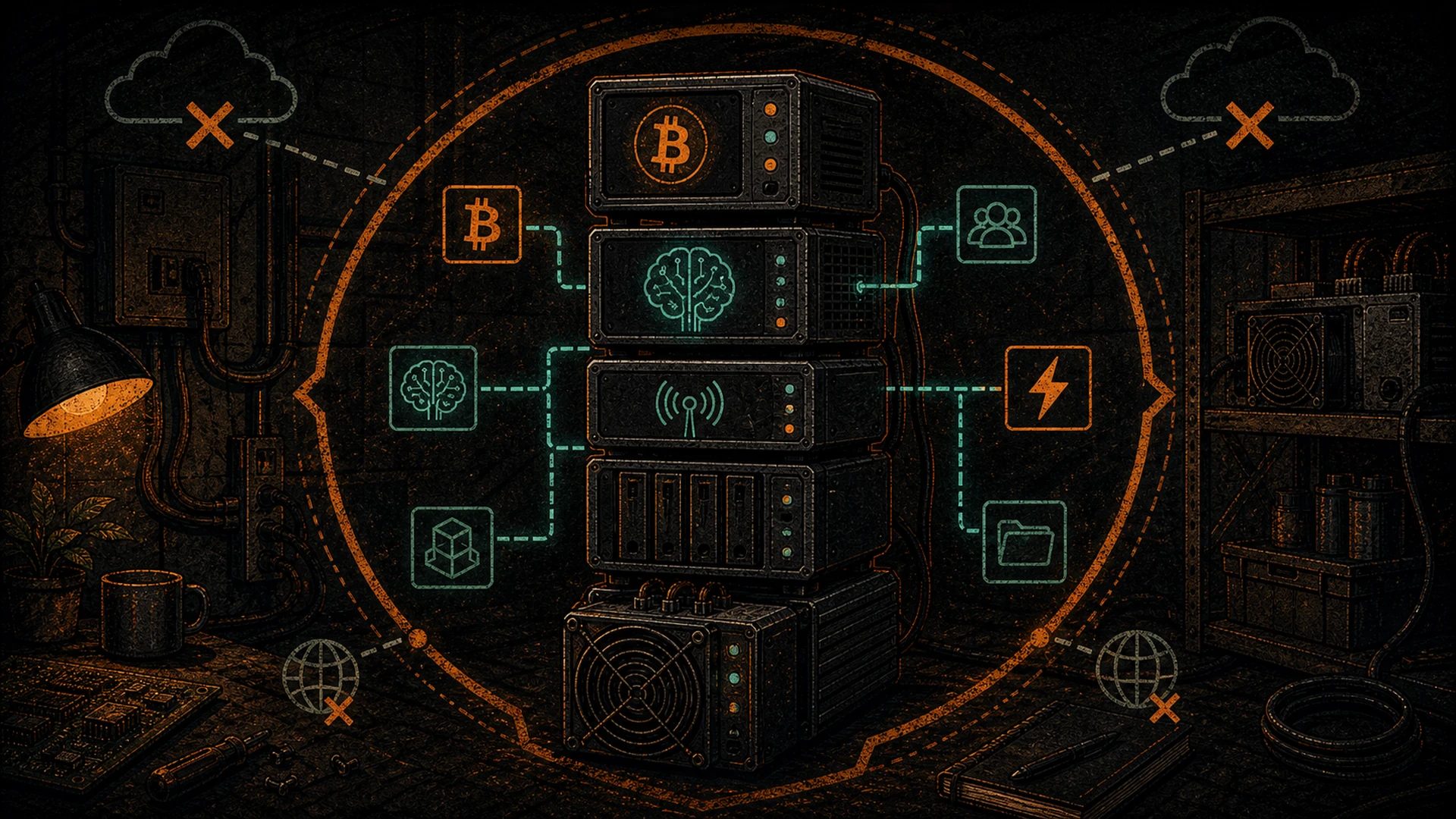
The stack has three layers, and each one maps cleanly onto hardware you already understand. There is no magic box here. You assemble it the way you assemble a mining rig: hardware at the bottom, the artifact you flash in the middle, the interface you operate from on top.
Hardware — the silicon you own. Inference is a GPU-shaped workload. The constraint is VRAM, not raw compute, because the model weights have to fit in memory to run fast. A used Nvidia RTX 3090 with 24 GB of VRAM, left over from the Ethereum-mining era, is the single most cost-effective piece of inference hardware a pleb can own. One runs a capable mid-size model; two run a large one. A modern CPU with enough system RAM will also run smaller models, slowly — fine for batch jobs, painful for live chat. The point is that the silicon is something you bought, racked, and can unplug.
Model — the weights you possess. A model is a file: billions of floating-point parameters trained by someone with a very large cluster, released for download. Think of it the way you think of a miner’s firmware image — a compiled artifact you flash to hardware you control. Open-weight families like Meta’s Llama, Google’s Gemma, Alibaba’s Qwen, Mistral’s models, and DeepSeek’s releases live on your filesystem and do not phone home. Quantization is the compression knob that makes this pleb-scale: a 70-billion-parameter model wants ~140 GB at full precision but fits in roughly 40 GB at 4-bit, with a quality cost you can measure.
Interface — the layer you operate from. A runner loads the weights and serves inference; a chat UI sits on top so you are not typing into a terminal all day. The runner exposes an API; the UI talks to it over your LAN. Nothing in this chain requires the public internet once the files are on disk.
What you actually run
This is the real, named tooling — the open-source projects that make local inference work today. None of it is D-Central’s work, and that matters: this stack belongs to the open-weight community, and we are users of it, not authors.
Ollama is where most operators start. It wraps Georgi Gerganov’s llama.cpp — the bare-metal C++ reference runner — in a daemon with a sane CLI and a model registry. It is to llama.cpp roughly what running bitcoind is for someone who just wants a node up without compiling flags by hand. Install it, run ollama pull on a model, and you have inference. If you want to tune quantization and batching yourself, drop down to llama.cpp directly. If you are GUI-first and on a Mac, LM Studio is the desktop option. These are not competitors; they are different doors into the same room.
A model to actually use. For general chat and reasoning, start with Meta’s Llama or Google’s Gemma in a size that fits your VRAM — the smaller Gemma and Llama variants are good enough to replace most hosted-chatbot usage for most people, and the larger ones close more of the gap. For code, Alibaba’s Qwen Coder line is the current pleb-scale answer and runs on a single 3090 at reasonable quantization. For transcription, OpenAI’s Whisper runs on CPU if you are patient and GPU if you are not — and it is the reason you never pay a transcription service again.
A UI on top. Open WebUI is the self-hosted chat interface most operators land on. It points at your Ollama instance and looks like the hosted chatbots you already know, except the traffic never leaves your network. Access it over your LAN, or over an encrypted mesh like Tailscale if you want it from your phone without opening a port to the world.
MCP — the connective tissue. The Model Context Protocol is an open standard for letting a local model reach tools and data — your files, a search index, a script — through a defined interface instead of a hardcoded integration. It is the part that turns a chatbot into something that can actually do work against your own systems, and because it is open, you can read exactly what it touches. The community owns this layer too.
We did not train any of these models. We did not write any of these runners. The stack stands on the shoulders of Meta, Google, Alibaba, Mistral, DeepSeek, Gerganov, the Ollama team, the LM Studio team, OpenAI’s openly-released Whisper, and the thousands of unnamed contributors on Hugging Face. Credit where it is due: this works because they did the hard part and gave it away.
Where Bitcoin and Lightning fit
Own-money and own-compute are the same move made twice. The Bitcoiner who refused to hold coins on an exchange, refused to trust a hosted node, and refused to let a third party terminate their TLS is the same person who is not going to be thrilled feeding every thought to a logging endpoint. The reflex transfers exactly.
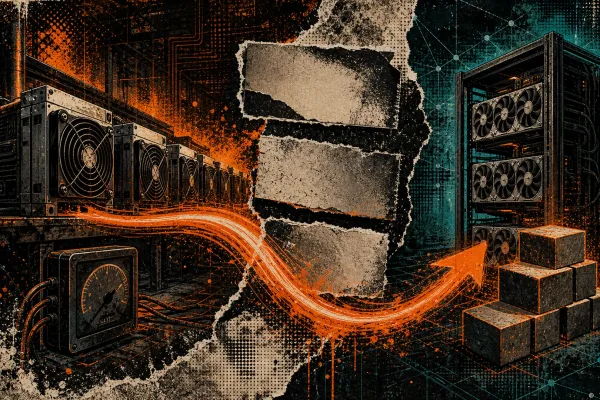
The infrastructure transfers too. Sovereign inference needs real power on a dedicated circuit, PSU fluency, thermal management, rack space, and Linux comfort — the exact stack a home miner already runs in their Hashcenter, our term for a compute facility optimized around a sovereign workload under individual or small-group ownership. A garage with a rack of retired GPUs running an open-weight model is a Hashcenter, the same as a shed full of ASICs is. On cold nights you tilt the joules toward whichever workload you want; the power you put in comes out as heat either way, and the heat ends up in your house.
Lightning closes the loop on the economics. When you are not using your own compute, the same rig can sell inference for sats over Lightning — metered, trustless, pay-per-token settlement with no payment processor in the middle. Own-money funds and monetizes own-compute. The Bitcoiner is not bolting AI onto an unrelated life; they are extending a sovereignty stack they already run into one more adjacent layer.
The honest tradeoffs
We are not going to pretend the local stack is strictly better. It is not, and selling it that way would be the corporate move we avoid. Here is the honest accounting.
There is a real capability gap versus the frontier. The largest hosted models from the well-capitalized labs are, today, more capable than what you can run at home — broader knowledge, longer usable context, stronger reasoning on the hardest tasks. Open-weight releases keep narrowing that gap and have already matched the frontier on plenty of everyday work, but on the genuinely hard problems the hosted models still win. If you need the absolute best answer to a frontier-grade question, the rented machine is sometimes the right tool. Sovereignty has a cost, and pretending otherwise insults your intelligence.
There is an upfront cost. A used GPU, a platinum PSU that will not sag under transient load, system RAM, fast storage, and a spare circuit are real money out the door before you generate a single token. The hosted option is pennies per query with zero capital outlay. You are trading recurring rent for one-time ownership — the same trade as buying a miner instead of renting a hashrate contract, and the math depends on how much you actually use it.
There is operator overhead. You own the uptime now. No SLA, because the operator and the beneficiary are the same person. You patch it, you cool it, you debug the kernel panic at 2 a.m. For a pleb who already maintains miners, this is familiar work and not a dealbreaker. For someone who wants a turnkey appliance, it is friction. We are not going to dress it up.
The honest summary: local AI is a backup and a sovereignty hedge, excellent for the majority of everyday tasks, run on hardware and a thermal envelope you mostly already own — and not a magic replacement for the frontier on the hardest problems. Keep Bitcoin as the anchor and treat local compute as the layer you control when the rented one is taken away.
How to start small
You do not need a quad-GPU rig to begin. The smallest honest first step is one evening of work:
- Install a runner. Put Ollama on a machine you already own — even a laptop with a decent GPU, or a CPU box if you are patient. One command gets the daemon running.
- Pull one small model. Grab a small Gemma or Llama variant that fits your VRAM. It will be good enough to feel the difference between a model on your disk and a model on someone’s server.
- Talk to it in the terminal first. Confirm it works, measure your tokens-per-second, and get a feel for what your hardware can do before you spend anything.
- Add a UI when you want one. Stand up Open WebUI pointed at your runner so the rest of the household can use it like a normal chatbot — except the traffic stays on your LAN.
- Scale into your Hashcenter only if the use justifies it. If you find yourself reaching for it daily, then add a used 3090, a proper PSU, and a spare 20-amp circuit — the headroom probably already exists next to your miners.
That is the whole on-ramp. No purchase required to start, no lock-in, no account. Weights on the disk, a runner on the boot, and an evening.
Where to go from here: read the wider case for sovereign AI on /ai/, see how this fits the broader pleb sovereignty stack, and read the longer argument in the Mining Hackers manifesto. The open-source ethos behind all of it is the same one that drives our firmware work on DCENT_OS — and if you are sourcing the hardware to run any of this, the shop is where the silicon lives. One note on that ethos, stated plainly: DCENT_OS is referenced here purely as an example of the open-source instinct. It is mining firmware. It does not run the AI stack, and no D-Central product runs your inference. Your compute runs on a GPU or CPU you own — that is the entire point.
FAQ
What is the cheapest way to start running AI locally?
Install Ollama on a machine you already own and pull a small open-weight model like a compact Gemma or Llama variant. If you have a gaming GPU with 8–12 GB of VRAM, you can run a useful model tonight for the cost of an evening. You only need to buy dedicated hardware — a used 24 GB GPU, a proper PSU, a spare circuit — once your usage justifies it.
Is local AI as good as ChatGPT or Claude?
Honestly, not on the hardest tasks. The largest hosted frontier models are still more capable on the toughest reasoning and the broadest knowledge. But open-weight models already match the frontier on a large share of everyday work, and they run entirely on hardware you own with no logging, no metering, and no kill switch. Treat local AI as a sovereign backup that handles most of what you need, not a strict replacement for the frontier.
Does D-Central make an AI product or a box that runs the models?
No. D-Central is a Bitcoin mining hardware and firmware company. We do not sell an AI appliance, and no D-Central product runs your inference. Everything described here runs on open-source tools — Ollama, llama.cpp, open-weight models, MCP — on a GPU or CPU you own. We reference DCENT_OS only as an example of the same open-source ethos, not as part of the AI stack.
Can I run AI on my ASIC miners?
No — an ASIC is purpose-built for the SHA-256 hashing in Bitcoin mining and cannot run a language model. Inference is a GPU-shaped workload. What does transfer is the facility: the power, the dedicated circuits, the thermal design, the racks, and the Linux fluency in your Hashcenter. Bolt a GPU rack onto that envelope and you have a dual-workload setup that can hash or inference from the same room.
How does Bitcoin or Lightning connect to running my own AI?
Owning your compute is the same move as owning your keys, one layer up — possession over trust. Bitcoin stays the anchor; local AI is an additional sovereignty layer you control. Practically, Lightning lets you sell spare inference for sats over a trustless, pay-per-token channel when you are not using the rig yourself, so the same hardware that hedges your sovereignty can also earn.