Quick answer
Both turn nearly 100% of their watts into heat — thermodynamics, not marketing. For heating a room the ASIC wins: it runs flat-out 24/7, giving steady, predictable warmth plus a Bitcoin rebate — ideal for a workshop, garage, or basement all season. A GPU only heats while loaded with AI work, so it’s the better pick when the compute is the real goal and the heat a welcome bonus.
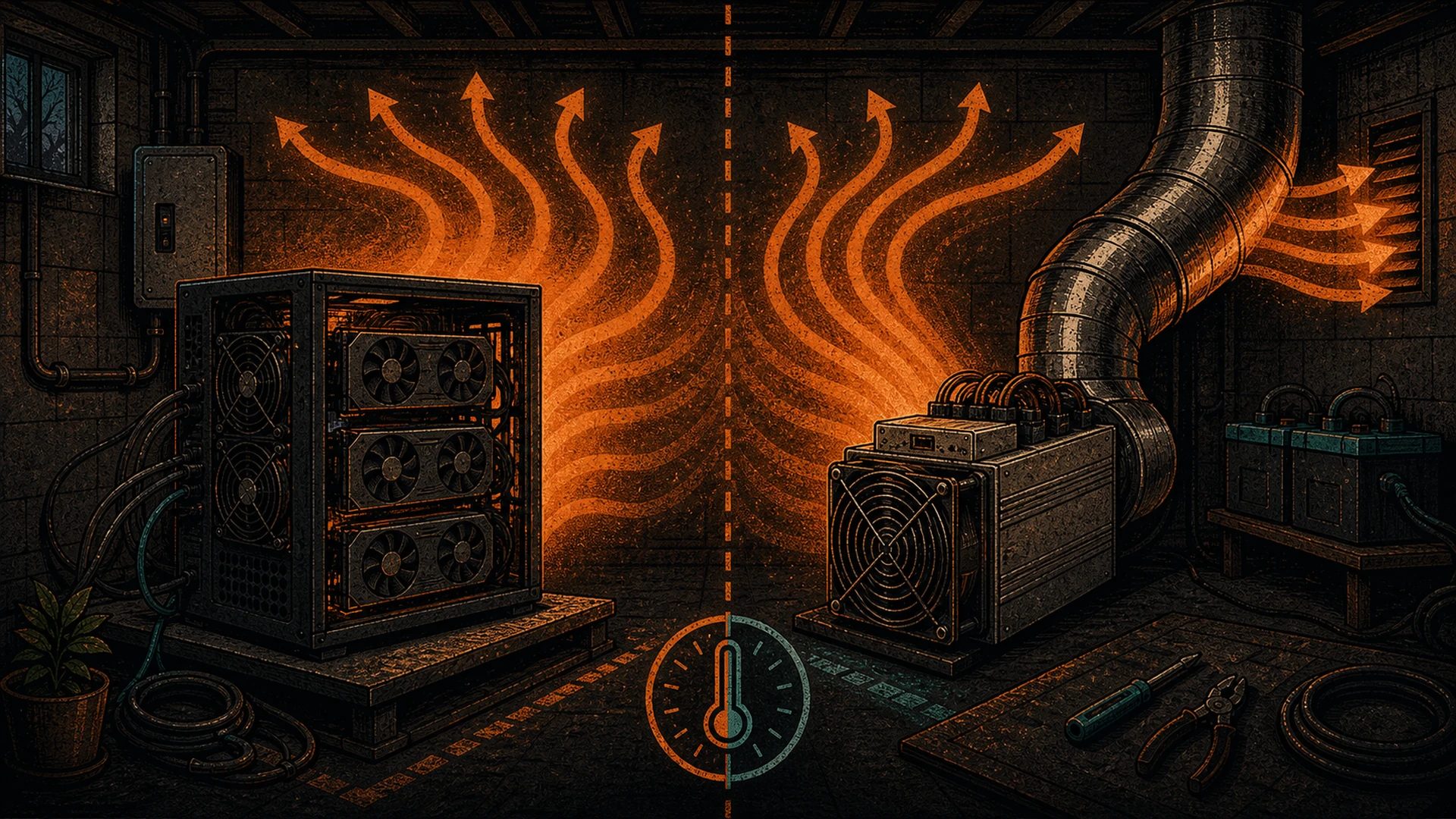
Both an AI GPU and a Bitcoin ASIC turn nearly 100% of the electricity they draw into heat — that is the first law of thermodynamics, not marketing. The real difference is the shape of the heat and what you get back. An ASIC runs flat-out 24/7, so it heats a room steadily and pays you in sats while it does it. An AI GPU runs in bursts and idles cold between jobs, earning tokens when it is busy and almost nothing when it is not. A rented “heat-as-a-service” box earns you neither. There is no free heat in any of them — you always pay for the watts. The only question is whether those watts also do something useful on the way out.
We are Bitcoin mining hackers. We repair what the industry throws away, we read the silicon datasheets, and we have spent enough winters standing next to running hardware to know exactly how much heat comes off a hashboard. So let us cut through the “crypto heater” hype with the only thing that actually settles the argument: physics. This is an honest comparison of GPU heat versus ASIC heat, and which one earns its keep in a real room.
The physics: nearly 100% of electricity becomes heat
Start with the rule that governs everything below. Every watt of electricity that goes into a computer comes back out as heat. Not most of it — essentially all of it. A GPU does not store energy. An ASIC does not ship energy off-site down the network cable. The tiny fraction that leaves as radio noise or light is a rounding error. The first law of thermodynamics says energy is conserved, and a sealed box of silicon has nowhere to put that energy except into the air around it as heat.
This is why a 1,500W space heater, a 1,500W gaming PC, and a 1,500W Bitcoin miner all warm a room by the same amount. They are thermodynamically identical as heaters. The conversion factor never changes:
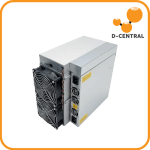
1 watt = 3.412 BTU/hr. Multiply the device’s actual wall draw by 3.412 to get its heat output. A 1,000W draw produces ~3,412 BTU/hr. A 3,250W Antminer S19 produces ~11,089 BTU/hr — comparable to a mid-size electric baseboard heater. The same math applies whether the watts are spent on SHA-256 hashing or on running a language model. Heat does not care what the silicon was thinking about.
So if both devices convert watts to heat at the same rate, why does anyone argue about which heats “better”? Because a room is not a calorimeter. What matters in practice is when the heat shows up, how hot the surface gets, how loud the fans are, and what the machine hands you in return. That is where the GPU and the ASIC part ways.
The ASIC heat profile: constant, hot, 24/7
A Bitcoin ASIC is a single-purpose machine, and that single purpose is to run as close to 100% utilization as it can, every second of every day. The chips — whether an older BM1398 in an S19 or a newer BM1370 in an S21 Pro — are wired to compute double SHA-256 and nothing else. There is no idle state worth mentioning. The pool always has more work, so the hashboards stay pinned, and the power draw is rock-steady.
From a heating standpoint, that is close to the ideal load. The output is:
- Constant. A miner pulling 3,250W pulls roughly that all day. No spikes, no troughs — a flat thermal curve you can plan a room around.
- Dense and hot. Three hashboards in a metal sleeve push a lot of watts through a small volume, so the exhaust air comes out genuinely warm, not lukewarm. That high delta-T is what makes a miner feel like a heater rather than a warm laptop.
- Predictable 24/7. It runs while you sleep, while you are at work, through the whole heating season. In a cold climate like Canada, where heating season runs six to eight months, that uptime is the entire value proposition.
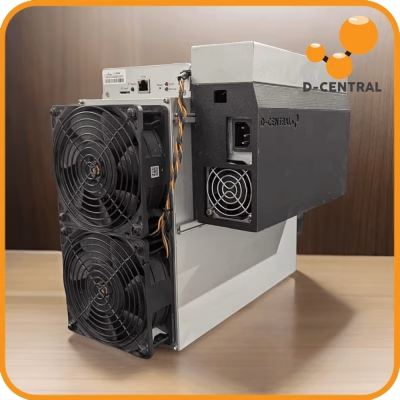
The trade-off is noise. Stock data-center miners are loud — jet-engine loud — because their fans are tuned for a Hashcenter, not a living room. That is exactly the problem the space-heater conversions exist to solve, with quieter fans, sound-dampened cases, and tuned-down power profiles. More on that below. The point here is that an ASIC’s heat is the most heater-like heat in the building: steady, warm, and always on.
The GPU heat profile: bursty, and idle-cold
An AI GPU is the opposite kind of animal. A modern accelerator can draw 350W to 700W flat-out, which is a serious amount of heat — a single 700W card running an inference job produces ~2,388 BTU/hr, real warmth by any measure. The catch is the word “flat-out.” A GPU only hits that draw while it is actually crunching a job.
AI inference is bursty by nature. A request comes in, the GPU spikes to full power for a few seconds or a few minutes, finishes, and drops back to an idle floor that can be a tenth of its peak. Unless you are running a continuously saturated workload — training a model around the clock, or serving a constant stream of inference — the card spends a lot of its life sipping power and producing almost no heat. As a room heater, that gives you:
- Bursty output. The heat tracks the workload, so the room warms up during a heavy job and cools off the moment the queue empties. Great for a thermostat-controlled load; useless if you wanted steady warmth overnight.
- Idle-cold gaps. An idle GPU is a cold GPU. If nobody is sending it work at 3 a.m., it is producing baseboard-level heat at best, while you are still paying for the box, the host CPU, and the cooling to sit there ready.
- Higher overhead. A GPU does not run alone. It needs a host CPU, RAM, a motherboard, and storage around it, all drawing their own watts. That is more heat, yes, but also more cost per useful watt than a self-contained ASIC.
None of this makes a GPU a bad heater — when it is loaded, it is an excellent one. It makes a GPU an intermittent heater whose warmth is tied to demand you do not fully control. And it is worth being precise about one thing the internet constantly blurs: the GPU is a completely separate device from any mining ASIC. A SHA-256 ASIC physically cannot run AI inference — it is fixed-function silicon with no floating-point math and no VRAM — so “run AI on your miner” is not a thing. We wrote a whole honest answer on that: see Can You Actually Run AI on a Bitcoin Miner? The two chips just happen to make similar amounts of heat.
The “yield” difference: sats vs tokens vs nothing
Here is the part that actually decides the question, because the heat is a tie. If three boxes all turn 1,500W into the same 5,118 BTU/hr, the only thing left to compare is what each one hands you back while it warms the room. Think of it as the yield on heat you were going to buy anyway.
- An ASIC earns sats. Every watt that becomes heat also takes a swing at a Bitcoin block. You were going to pay for that heat regardless; the miner hands back a portion of the cost in BTC, steadily, the whole time it runs. Constant load means constant yield.
- An AI GPU earns tokens. When it is loaded, it is producing inference or training output you can sell or use — potentially high-value work. When it is idle, it earns nothing and heats nothing. The yield is bursty and demand-dependent, and you carry the host hardware’s overhead the whole time.
- A rented heat-as-a-service box earns you nothing. Some “digital boiler” products run someone else’s workload and pay you back in a discount or a small credit. The compute revenue goes to the operator. You get heat and a coupon. There is nothing wrong with that if the discount is real, but be clear-eyed: you own the electricity bill and the operator owns the upside.
This is also why “free heat” is the one claim we will never make. You pay for every watt no matter which box you plug in. The honest framing is a rebate: you were already going to spend money heating the room, and the right device gives part of that money back as BTC. The heat is a by-product of useful work, not a magic discount on physics. Anyone selling you free heat is selling you a violation of thermodynamics.
Which one for which room and use
With the physics settled, the choice comes down to your load shape and your tolerance for noise and tinkering.
Choose ASIC heat when you want a real heater
If the goal is to actually heat a space — a workshop, a garage, a basement, a chilly home office — the ASIC wins because it runs constantly and gives you steady, predictable warmth plus a Bitcoin rebate. A properly converted unit in a sound-dampened case is the closest thing to a “set it and forget it” heater that also earns. This is the lane our Antminer S9 Space Heater Edition (gentle, quiet, small rooms) and Antminer S19 Space Heater Edition (serious BTU output for larger spaces) were built for. For the full lineup and an honest comparison against the alternatives, start with our best Bitcoin mining heaters guide.
Choose GPU heat when the compute is the point
If you already run AI workloads — you are serving inference, training models, or renting compute — then capturing that GPU heat for a room you happen to occupy is smart engineering. The compute is the job; the heat is a bonus you would otherwise vent to nowhere. Just do not buy a rack of GPUs to heat a room. The intermittent load and the host-hardware overhead make it an expensive, unpredictable heater compared to an ASIC. The GPU earns its place when the tokens, not the BTU, are the reason it is running. We dug into the practical side of pairing heat with compute in Heating Your Home With Inference, Not Just Hashing.
Be skeptical of rented-heat boxes
The “we’ll heat your home and pay you back” appliances are convenient and genuinely quiet, but you are renting your room out as cooling for someone else’s compute. If the discount pencils out for you, fine — just know you own the watts and they own the work. We would rather you own both. That is the whole point of running your own hardware: one more layer decentralized, with the yield in your wallet instead of a vendor’s.
Honest caveats: noise, control, and no “free heat”
We would be poor craftsmen if we sold you the upside without the fine print. Three things are true no matter which device you pick:
- Noise is real. Stock miners are deafening, and even GPUs under full load spin up hard. Living-space use means a converted case, quieter fans, and a tuned-down power profile — or a basement and a duct. Do not put a stock data-center unit in a bedroom and expect to sleep.
- Heat is harder to throttle than a thermostat. A miner runs flat; it does not modulate to hold 21°C. You control output by choosing a power profile or by ducting and scheduling, not by turning a dial. A GPU’s heat, conversely, swings with workload you may not control at all. Neither replaces a thermostat-driven furnace for whole-home comfort — they are zone heaters that earn.
- There is no free heat. You pay for every watt. The device gives some of it back — in sats, in tokens, or in a vendor’s coupon — but the electricity bill is yours. Anyone who tells you otherwise is rounding away the laws of physics.
Get those three right and a mining heater is one of the most honest deals in hardware: heat you were buying anyway, with a Bitcoin rebate stapled to it. That is not a gimmick. It is thermodynamics plus a payout. If you want to go deeper on running your own infrastructure on your own terms, that thread runs through our whole sovereignty coverage — heating your home with hardware you own is one more layer of it.
Frequently asked questions
Does a Bitcoin miner actually heat a room?
Yes — completely and measurably. Nearly 100% of the electricity a miner draws is converted to heat, at the standard rate of 1 watt = 3.412 BTU/hr. A 3,250W Antminer S19 produces roughly 11,089 BTU/hr, comparable to a mid-size electric baseboard heater, and it does so constantly because it runs at full load 24/7. The only real obstacle to using one indoors is noise, which is what sound-dampened space-heater conversions are built to fix.
Does a GPU or an ASIC produce more heat per watt?
Exactly the same amount per watt — 3.412 BTU/hr for every watt either one draws. There is no such thing as silicon that heats more or less efficiently; heat is conserved energy, not a feature. What differs is the load shape: an ASIC pulls steady full power 24/7, so its heat is constant, while a GPU spikes during AI jobs and drops to near-idle between them, making its heat bursty and demand-dependent.
Is mining heat “free heat”?
No. You pay for every watt the machine consumes. The honest framing is a rebate: you were going to spend money heating the room regardless, and a mining heater gives part of that cost back in BTC while delivering the exact same warmth as a dumb space heater. The heat is a by-product of useful work, not a discount on the electricity bill. “Free heat” would violate the first law of thermodynamics — treat any product that promises it with suspicion.
Can I run AI on my Bitcoin miner to get both heat and tokens?
No. A Bitcoin SHA-256 ASIC is fixed-function silicon — it can only compute double SHA-256 and has no floating-point math or VRAM, so it physically cannot run AI inference, and no firmware can change that. The GPU that runs AI is always a separate device sitting next to the miner, not the mining chip itself. If you want the full breakdown, read Can You Actually Run AI on a Bitcoin Miner?
Which is the better home heater: an AI GPU or a Bitcoin miner?
For actually heating a room, the ASIC wins because it runs constantly and gives predictable, steady warmth plus a Bitcoin rebate — ideal for a workshop, garage, basement, or office over a long heating season. A GPU only heats while it is loaded with AI work, so it is the better choice when the compute is the real goal and the heat is a welcome by-product. If the room is the point, choose a converted ASIC heater; if the tokens are the point, capture the GPU’s heat as a bonus.