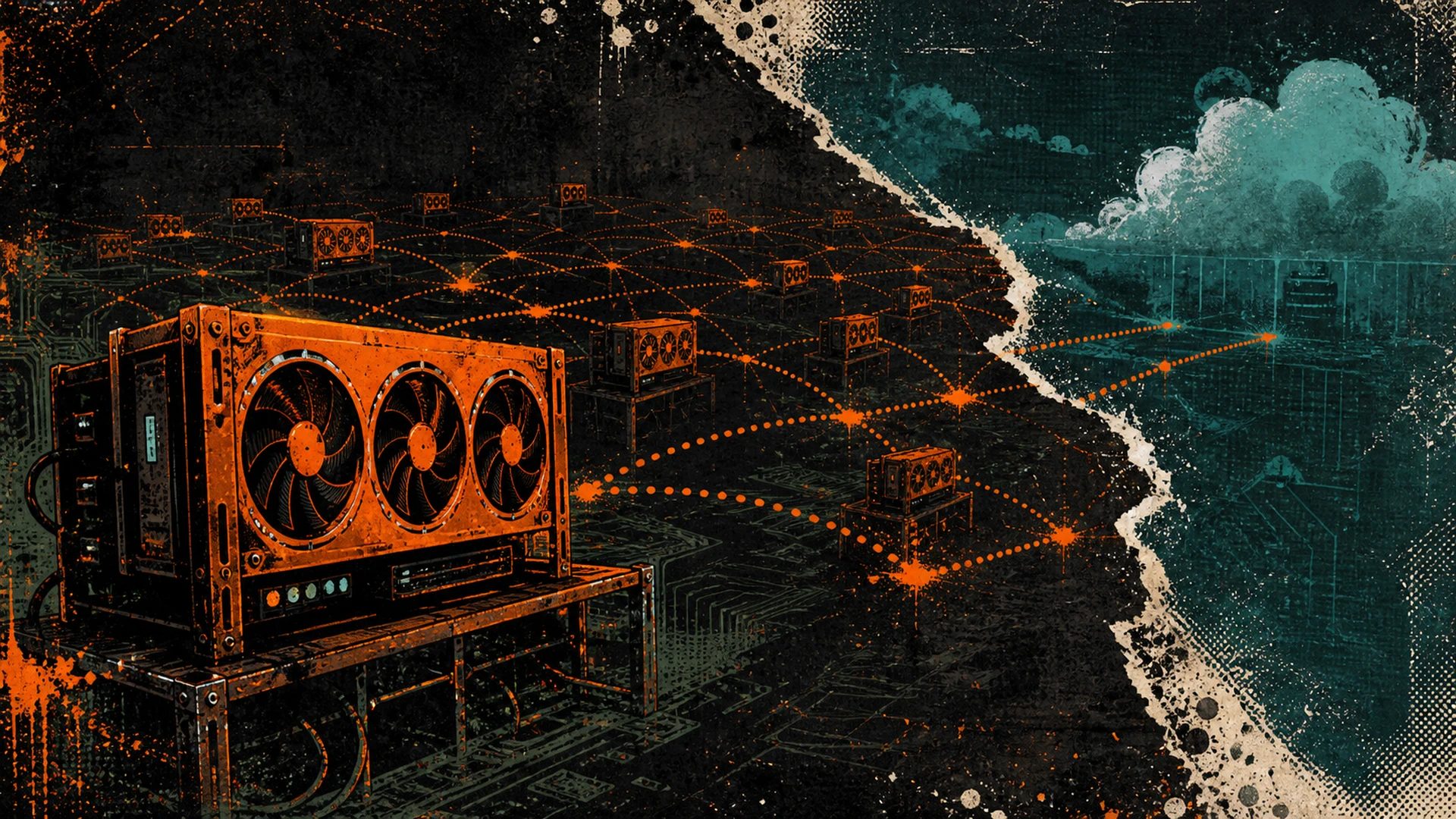
When Poolin filed for bankruptcy in July 2026, it closed a chapter that Bitcoin miners have read many times: capital floods into a frontier, concentrates into a few enormous operations, races the hardware forward, and then discovers that the business underneath was never as durable as the technology. We have argued that this is good for Bitcoin — it pushes hashing out of the megasites and back toward the edges.
Here is the larger claim we will make now: the exact same crisis is coming for the AI industry, for the exact same reasons, and it will be just as healthy. AI compute and Bitcoin mining are not cousins. They are the same animal wearing different collars. Both are the frontier of computing meeting the frontier of energy, and both go through the same brutal discovery process: extreme concentration, a wave of burned early investors who were sure they had struck gold, and then a long, quiet distribution of the compute to everyone else.
Two industries, one machine
Strip away the vocabulary and the two look identical. Both take enormous quantities of specialized silicon and cheap electricity and turn them into something valuable — hashes in one case, tokens in the other. Both concentrate into what we at D-Central call hashcenters: warehouse-scale concentrations of computing power, whether that power is hashing Bitcoin or multiplying matrices for a language model. Both are financed on the assumption that demand and margins only climb. And both run on hardware that goes obsolete faster than the accountants want to admit.
That last point is the fuse, and it is worth being precise about, because it is where the AI story is quietly rhyming with the mining story right now.
GPUs are the new ASICs
A Bitcoin miner understands hardware obsolescence in their bones. An Antminer S9 was a money-printer in 2017 and a doorstop — or at best a space heater — a few years later, not because it broke, but because newer silicon did the same job for a fraction of the power. Efficiency, not failure, is what kills a miner. The next generation makes the last one uneconomic to run long before it is unable to run.
The AI industry has just built itself the same trap, on a far larger balance sheet. NVIDIA has moved to an annual product cadence — Hopper in 2022, Blackwell in 2024, Rubin in 2026 — and each generation lands with dramatically better performance per watt. The moment a new generation does the same workload for a fraction of the power, the previous generation becomes what analysts have started calling “OpEx obsolete”: still perfectly functional, still switched on, but no longer economic against the machine in the next rack. That is the ASIC treadmill, exactly, only the chips cost tens of thousands of dollars each instead of a few thousand.
Now stack the accounting on top. By most estimates, somewhere between $1.5 and $2 trillion of GPU-heavy capex will sit on balance sheets between 2023 and 2026, most of it depreciated over five or six years — while the economic life of the hardware looks more like two or three. That gap is not a rounding error. If the big operators were forced to depreciate GPUs on the schedule the technology actually dictates, the hit to reported earnings across 2026–2028 has been estimated north of $176 billion. The market has noticed: H100 rental rates fell from roughly $8 an hour in early 2024 to around $1.70 by late 2025 before a partial recovery — a collapse and rebound that will look painfully familiar to anyone who has watched hashprice whipsaw a mining operation into and out of solvency.
And layered under all of it is the financing. Vendor equity stakes, take-or-pay compute commitments, and debt-funded GPU purchases now circle between a handful of chipmakers, model labs, and cloud operators in a loop that more than one observer has compared to the vendor financing of 1999–2001. No one has yet financed a fleet of GPUs through a full technology cycle. Nobody actually knows what a two-generations-old cluster is worth in a downturn. Bitcoin miners know exactly what it is worth, because they have lived it: pennies on the dollar, sold to whoever will haul it away.
The burn is the mechanism, not the accident
So here is the uncomfortable prediction, offered as an argument and not as a forecast with a date on it: a meaningful share of today’s AI hashcenter operators will not survive their own hardware cycle. The ones carrying the most debt against the fastest-depreciating GPUs, betting that rental prices and utilization will hold long enough to service it, are running the Poolin playbook a second time. When the frontier moves — and with an annual chip cadence, it always moves — the operators who over-leveraged the last generation get caught holding assets that are still humming and no longer paying.
This is not schadenfreude, and it is not a wish. There are real people and real capital on the wrong end of every one of these cycles. But it is worth naming plainly what the burn actually is: it is not a malfunction in the system. It is the system. The concentrated, over-capitalized first movers are the ones who prove out the hardware, drive the efficiency curve, and pay for the mistakes — and then, having done the expensive part, they hand the matured technology down to everyone who comes after. The first investors so often get burned precisely because they mistook being early to a discovery process for having found a durable monopoly.
Why the trickle-down is the whole point
Watch where the compute goes when the capital retreats, because this is the part that matters for decentralization.
When a mining megasite fails, its S19s do not evaporate. They cascade — to smaller operators, to home miners, to people heating a workshop with them, to anyone who can plug one watt of them into a purpose the original owner never imagined. Concentrated hashrate becomes distributed hashrate through the simple economics of a fire sale. The network gets more decentralized on the far side of each bust, not less.
AI compute is now positioned to do the same thing, and the early evidence is already here. Every “OpEx obsolete” H100 that a hyperscaler retires is a machine that becomes affordable to a university lab, a startup, a small cloud, an individual. Open-weight models keep collapsing the amount of hardware you need to do real work — you can run a genuinely capable model at home on a single retired GPU today, something that required a hyperscaler’s permission a few years ago. The same discovery process that concentrated AI compute into a dozen balance sheets is the process that will, cycle by cycle, spread it across ten thousand basements. Cheap, “outdated” silicon is the on-ramp, not the scrap heap.
This is the healthy version of a bubble. Railroads over-built and left behind track that a whole economy rode for a century. Dot-com fiber was laid at a loss and became the backbone of everything that followed. The overbuild is how the expensive frontier becomes cheap infrastructure — and cheap infrastructure is what decentralization is made of.
Where it settles: sovereign compute at the edge
Strip both cycles down to their end state and they converge on the same quiet conclusion. Home Bitcoin mining and home LLM inference will both be alive and well long after this settles — long after the current crop of hashcenters has been bought, sold, written down, and forgotten.
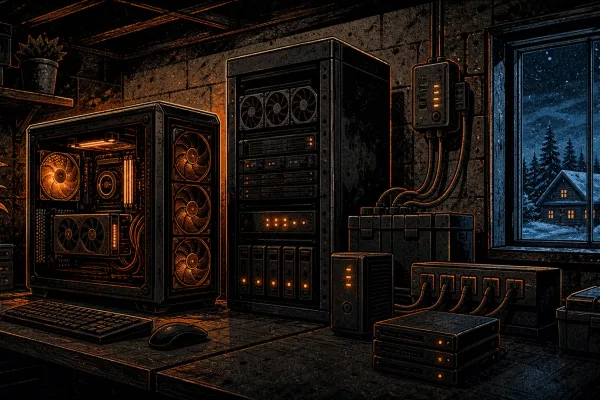
The frontier will keep moving, and the megasites will keep chasing it and keep periodically imploding. But the durable layer — the part that does not depend on cheap capital cooperating, the part no bankruptcy court can freeze — is the distributed one. A miner in a garage hashing to its own node. A retired GPU in a closet running a local model that answers only to its owner. Increasingly, the same site doing both, turning one stream of stranded power into hashes, heat, and tokens. That is not a fallback for when the hyperscalers stumble. It is the layer that was always going to outlast them.
D-Central has watched one full version of this cycle from the inside — the mining one — and we are building for the distributed end of both. We owe the frontier operators their due: they do the expensive proving, in AI as in mining. But we have made our bet on the trickle-down, on the plebs who inherit the matured hardware and point it at their own sovereignty. Concentrated compute is a phase. Distributed compute is the destination — and, in both of these strange twin industries, the burn on the way there is not the tragedy. It is the engine.
The AI-industry figures in this article — chip cadence, depreciation schedules, capex totals, and rental-price movements — reflect public reporting and analyst estimates as of mid-2026. The thesis that these dynamics will drive consolidation and then decentralization is D-Central’s own argument, not a claim of certainty about any specific company’s outcome.