“Can you convert a Bitcoin mining rig into an AI compute node?” is one of the most common questions we field as the AI-Bitcoin convergence narrative heats up. The honest engineering answer has two halves, and conflating them is where most of the internet goes wrong. At the level of a single machine, the answer is a flat no: a SHA-256 ASIC physically cannot run AI, and no firmware flash or driver will change that. But ask the question at the level of a facility — the building, the power interconnect, the cooling loop, the racks, and the operator’s hard-won skills — and the answer flips to a qualified yes. This guide separates what actually transfers when you convert a mining operation to AI compute from what gets cut up for scrap, so you can plan a Hashcenter without believing in magic.
Why a single SHA-256 ASIC can never run AI
Start with the silicon, because everything else follows from it. The chips inside an Antminer — the BM1366 in S19 XP-class machines, the BM1368 in the S21, the BM1370 in the S21 Pro — are application-specific integrated circuits in the most literal sense. Their datapath does exactly one thing: double-SHA256 hashing. There is no general-purpose instruction set, no floating-point unit, no matrix-multiply array, and no programmable logic on the hash board to add one. The gates are etched at the foundry to compute hashes and nothing else. You cannot “reprogram” a BM1370 to run a transformer model any more than you can reprogram a key to start a different car.
People sometimes point at the control board and hope. That hope also dies on contact with the spec sheet. The brains of an Antminer is a tiny embedded system-on-chip: a Xilinx Zynq 7010 (dual Cortex-A9 at 667 MHz with a small Artix-7 FPGA) on S9/S17-era machines, or a BeagleBone, an Amlogic S905, or a CVitek CV1835 on newer models. These run with roughly 256 MB to 512 MB of RAM and a few hundred megabytes of NAND. Their entire job is to feed work to the hash boards over UART and I2C, manage fans and PSU voltage, and serve a web UI. They are control plumbing, not compute. A modern AI workload — even modest local inference — wants a GPU or purpose-built accelerator with tens of gigabytes of high-bandwidth memory. The gap between a 667 MHz embedded core and an AI accelerator is not a tuning problem; it is a different category of hardware.
If you want the long version of the device-level case, we wrote it up separately in our deep dive on the Hashcenter migration. The short version: at the box level, a miner is a miner. The conversion story lives one level up.
What actually converts: the facility, not the box
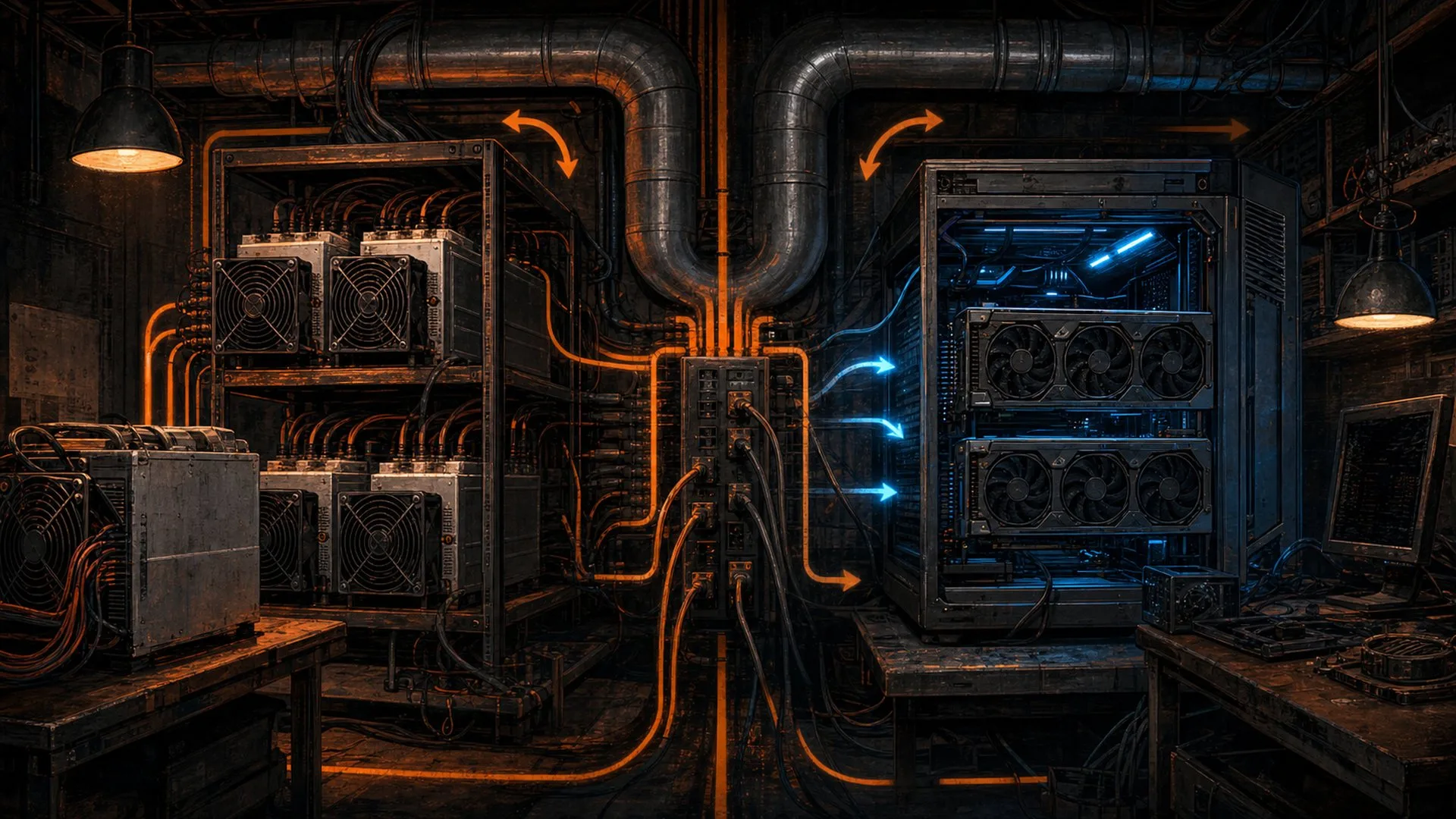
Here is the part the device-level pessimists miss. A mining operation is not just a pile of ASICs — it is an industrial site engineered to deliver enormous, dense electrical power and remove enormous, dense heat, run by people who understand both. Those are precisely the hard, slow, capital-intensive parts of standing up AI compute. The boxes are interchangeable; the building is not.
When a mining facility pivots toward GPU AI compute, the transferable assets are the ones that took the longest to acquire:
- The power interconnect. Getting megawatts to a site — the utility agreement, the substation, the transformers, the medium-voltage gear — is the single hardest thing about both mining and AI. AI racks are far denser per square foot, but the upstream interconnect and the relationship with the utility carry straight over.
- The building and the racks. Reinforced floors, dock access, physical security, and the rack infrastructure itself were built for heavy, hot equipment running 24/7. That envelope hosts GPU servers as readily as it hosted miners.
- The cooling system. This is where mining experience pays off most directly. A site already plumbed for immersion or hydro cooling has solved the dominant problem in dense AI compute: getting heat out of a tightly packed rack. Air-cooled mining sheds transfer less cleanly, but the thermal-engineering know-how does.
- The operator’s skills. The people who keep a Hashcenter alive already understand power distribution, thermal management, remote monitoring, firmware and fleet management, and the discipline of maximizing uptime on hardware that runs flat-out. Those skills are the scarce input in AI infrastructure too.
This is exactly the convergence playbook the public miners are running — pivoting Hashcenter buildouts toward high-margin AI tenancy without throwing away the site. The site is the moat. The chips are a consumable.
What gets scrapped
Being honest means naming the losses, because vendors selling “AI conversion kits” rarely will. When a site converts, the genuinely mining-specific gear has no AI future and should be planned for resale, redeployment to another mining site, or responsible recycling:
- The ASIC hash boards. Fixed-function SHA-256 silicon. Zero AI value. Their second life is more mining (resale to home miners) or heat — an S19 makes a perfectly good space heater, which is a real and honest reuse.
- The mining control boards. Embedded SoCs that only know how to drive hash chains. Not reusable for GPU servers.
- The mining-specific PSUs. An APW12 is built to deliver a fixed 12 V rail to hash boards. GPU servers use entirely different power architectures.
- Air-cooling shrouds and ducting tuned to ASIC airflow profiles rather than GPU server form factors.
If your miners still have profitable life left, the smartest move is often not to scrap them at all but to redeploy or sell them — and to keep them running their best with open firmware and good maintenance. That is the home-mining counterweight to industrial centralization, and it is a story we care about deeply.
Transfers vs. scrap at a glance
| Asset | Converts to AI? | Why |
|---|---|---|
| Utility interconnect / substation | Yes | Hardest asset to acquire; carries straight over |
| Building, floor, racks, security | Yes | Built for dense, hot, 24/7 equipment |
| Immersion / hydro cooling loop | Yes | Solves the core AI density problem |
| Operator skills (power, thermal, ops) | Yes | The scarce input in AI infrastructure |
| SHA-256 ASIC hash boards | No | Fixed-function silicon; hashing only |
| Mining control boards (Zynq / CV1835) | No | Embedded SoCs, ~256–512 MB RAM, control plumbing |
| Mining PSUs (e.g. APW12) | No | Fixed 12 V hash-board power architecture |
The decentralization throughline
It would be easy to read “miners become AI compute” as surrender — Bitcoin hardware giving way to the AI gold rush. We read it the other way. The reason a mining operator can pivot at all is that they own the physical layer: the power, the cooling, the building, the expertise. That ownership is sovereignty made of concrete and copper. The same instinct that drives a pleb to run their own node, own their keys, and flash open firmware onto their own miner is the instinct that says: own your compute, too.
That is why we treat AI compute as one more layer to decentralize rather than a betrayal of mining. You can stack hash and inference under one roof, on power you control, with code you control. If you want the small-scale, sovereign version of this idea — running models on your own hardware instead of renting someone’s API — start with the plebs’ guide to self-hosted AI and the practical install-Ollama-in-10-minutes walkthrough. Both live in our broader AI section, which sits alongside the sovereignty hub for a reason: self-hosting compute is sovereignty, the same way self-custody and self-mining are.
So, should you “convert” your rig?
If “your rig” means a single Antminer in a garage, the honest answer is no — there is no path from a SHA-256 ASIC to AI, and anyone selling you one is selling fiction. Keep mining it, heat your home with it, or redeploy it. If “your rig” means a facility — power, cooling, racks, and a team — then the conversion question is real, and the answer is a careful, asset-by-asset yes for the site and a no for the boxes. Plan around that split and you will not waste capital chasing a flash that does not exist.
Designing a Hashcenter that can host hash today and pivot toward AI tenancy later is genuinely hard engineering, and the decisions you make about power, cooling topology, and rack density at buildout determine whether that pivot is cheap or impossible. If you are scoping a build at that scale, our team will sit down and work the numbers with you. Talk to us about a Hashcenter and AI-compute build consultation before you pour the slab — it is far cheaper to plan for both loads than to retrofit one.
Frequently asked questions
Can I flash firmware to make my Antminer run AI?
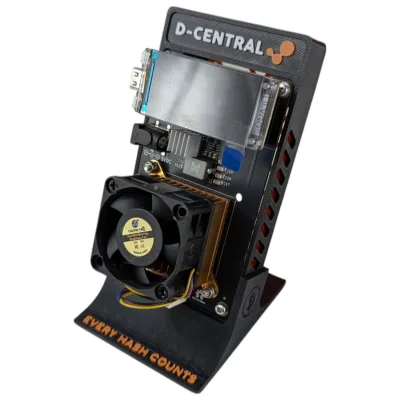
No. Firmware controls how the hash boards are driven, tuned, and monitored — it cannot add a general-purpose or matrix-math datapath that the silicon does not have. The BM1366/BM1368/BM1370 chips compute double-SHA256 and nothing else. Open firmware like DCENT_OS can give you control, efficiency, and no mandatory dev fee on your existing hardware (the optional donation ships on at 2% and takes one click to set to 0%), but no firmware turns a hashing ASIC into an AI accelerator.
Is an ASIC or a GPU better for AI?
For AI you want a GPU or a purpose-built AI accelerator — they have the general-purpose, high-throughput matrix-math hardware and large memory that AI models need. A Bitcoin ASIC is the opposite design philosophy: maximum efficiency at exactly one fixed function. ASICs win decisively for SHA-256 mining; GPUs and AI accelerators win for AI. They are not interchangeable.
What part of a mining operation actually carries over to AI compute?
The facility, not the machines. The utility interconnect, building, racks, physical security, cooling system, and — most valuable of all — the operator’s expertise in power and thermal management transfer to GPU AI compute. The ASIC hash boards, mining control boards, and mining PSUs do not.
Does running AI compute mean abandoning Bitcoin mining?
Not necessarily. A well-designed Hashcenter can host both: SHA-256 mining for energy monetization and grid flexibility, plus AI compute for higher-margin tenancy. Both run on power and infrastructure you own, which is the whole point — one more layer of compute brought back under your control.