Quick answer
The sovereign compute loop wires two sovereignties together: a local model runs the inference on hardware you own, and your own node settles the bill in Bitcoin over Lightning — no account, no API key, no middleman. Most edge-AI stories stop at the private model; closing the loop makes the payment as permissionless as the inference.
Two sovereignties are converging. Bitcoin already gave you money no one can freeze. Local AI is quietly giving you a model no one can throttle, log, or revoke. The sovereign compute loop is what happens when you wire those two together: your hardware runs the model, your node settles the payment, and no account, API key, or middleman sits in between. This is the canonical definition of that loop — the piece our other AI write-ups point back into.
What “sovereign compute” actually means
TL;DR — Definition. Sovereign compute is the practice of running AI inference on hardware you own and paying for compute (or charging for it) with money you control — Bitcoin over the Lightning Network — with no account, no platform, and no third party holding the keys to either the model or the money. The sovereign compute loop is the closed circuit formed when one operator owns both ends: the box that does the thinking and the node that does the settling.
Most “AI on the edge” stories stop at the model. They tell you to run a local LLM and call it private. That is half the loop. The other half is the payment rail. If your private model still bills through a corporate API key tied to your identity, your sovereignty leaks out the side. Sovereign compute closes that gap by making the payment as permissionless as the inference.
Two ownership claims, fused:
- Own your money — Bitcoin and the Lightning Network. No bank, no card processor, no chargeback desk.
- Own your compute — a local large language model running on a GPU or CPU you own. No cloud quota, no content filter you cannot change, no surprise deprecation.
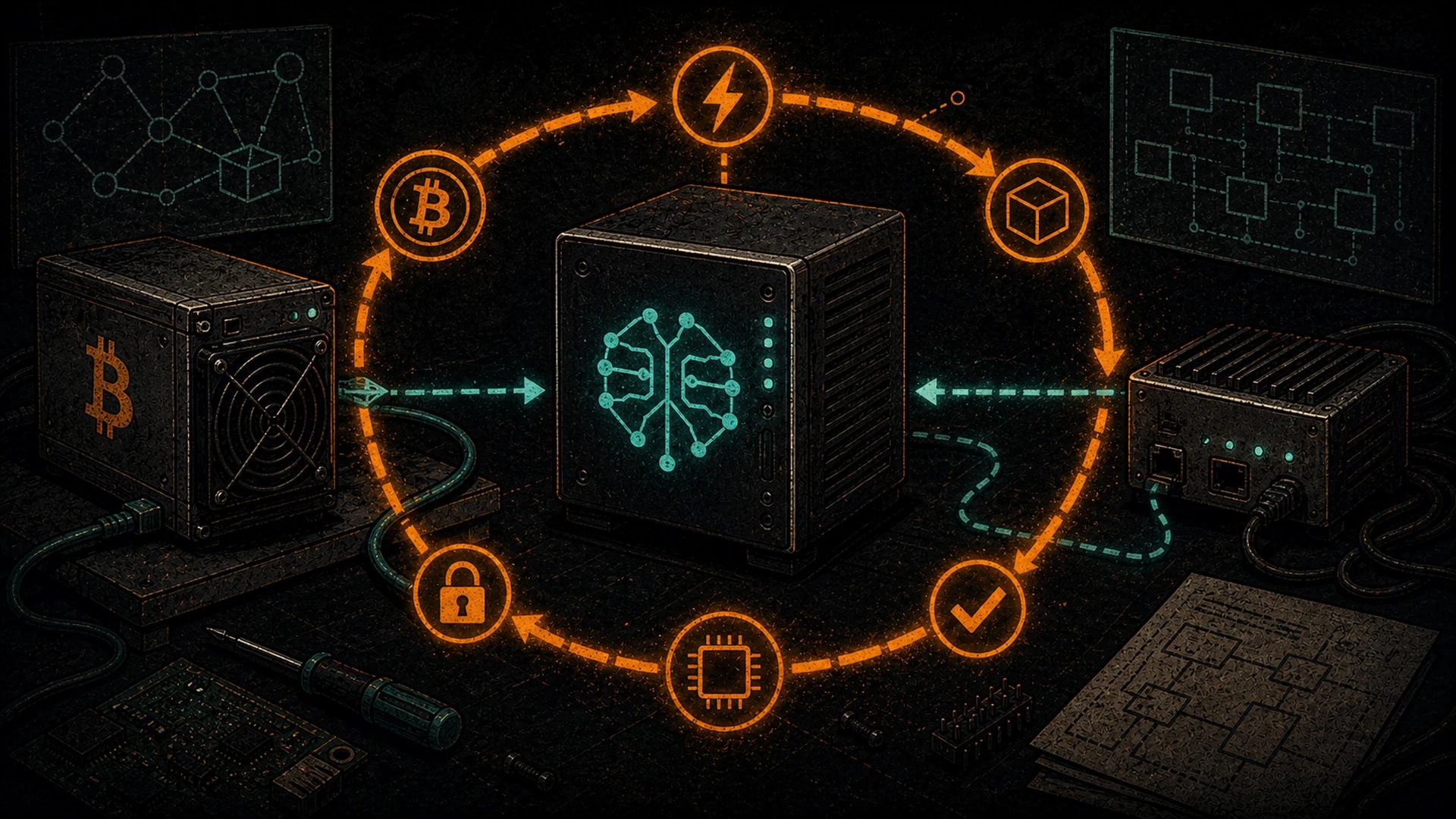
The loop: your hardware → your model → your money
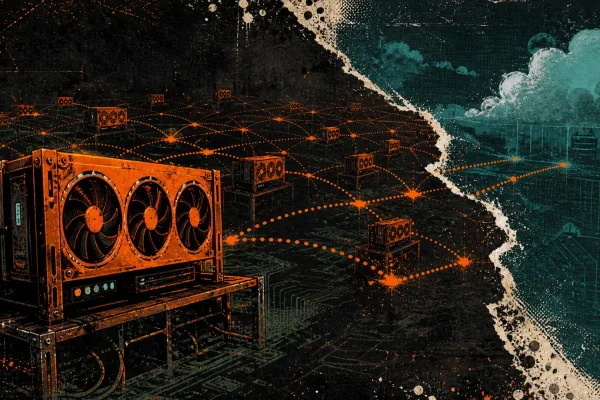
Picture a single circuit. A request comes in. Your machine answers it. Sats settle the bill. The same request can flow either direction — you can be the one buying inference, or the one selling it. Either way the loop is identical in shape:
- Your hardware. A GPU or CPU you own, sitting in your home, office, or Hashcenter. This is the silicon that runs the math.
- Your model. An open-weight LLM you pulled down and run locally — for example with Ollama, which makes running models like Llama, Mistral, or Gemma on your own box about as hard as installing an app.
- Your money. A Lightning node you control. When a request is paid for, the sats land in your channel — not a custodian’s ledger.
The magic is that nothing in this loop knows your name. The model does not need a login. The payment does not need a card. The request either comes with valid proof of payment or it does not get served. That is the whole trust model, and it is the same trust model Bitcoin taught us: verify, do not ask permission.
The accuracy wall: this does not run on your ASIC
Read this twice, because the internet gets it wrong constantly. AI inference does not — and cannot — run on a Bitcoin mining ASIC. A SHA-256 ASIC (the chip inside an S19, S21, or any Antminer-class miner) is a single-purpose hashing engine. It computes one function — double SHA-256 — billions of times a second and literally nothing else. It has no general-purpose cores, no floating-point units, and no way to run a neural network. You cannot load Llama onto an S21. The idea is physically meaningless.
Inference runs on general-purpose silicon you own — a consumer GPU, a workstation, a Mac, or even a capable CPU for smaller models. We unpack exactly why the two are different classes of hardware in our keystone explainer, Can you run AI on a Bitcoin miner? The short version: the miner and the inference box are two different machines, often owned by the same operator, never the same chip.
Why does the same operator end up owning both? Because mining already taught them the hard parts — sourcing power, racking hardware, running a node, treating uptime as a discipline. The skill set transfers. The ASIC mines; the GPU infers; the node settles. Three jobs, one operator, one philosophy.
What L402 actually is
L402 is an open protocol from Lightning Labs for charging per API call using the Lightning Network — pay-per-call, no account, no signup. It repurposes the long-dormant HTTP 402 Payment Required status code and turns it into a working payment handshake.
The flow is simple enough to hold in your head:
- A client asks your API for something.
- The server replies
402 Payment Requiredand hands back two things: a Lightning invoice and a partial authentication token (a macaroon). - The client pays the invoice over Lightning. Payment yields a preimage — cryptographic proof the sats moved.
- The client retries the request, presenting the macaroon plus the preimage. The server verifies the proof and serves the response.
No email. No password. No KYC form. No subscription you forget to cancel. The token is the receipt, and the receipt is the access. The reference implementation that brokers this on the server side is Aperture, also from Lightning Labs — a reverse proxy that sits in front of your API, issues the 402 challenge, and lets requests through once they carry valid payment proof.
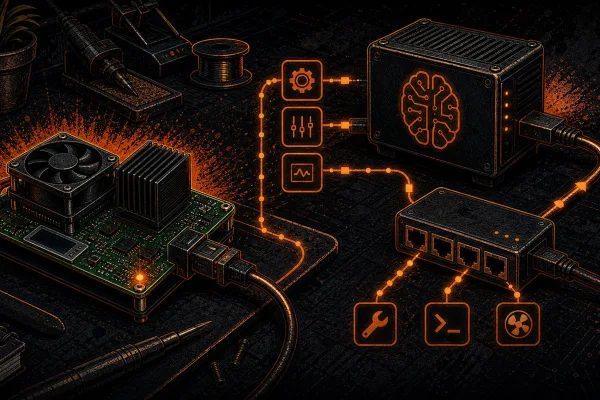
So a clean sovereign-compute stack looks like this: Ollama (runs your model) → your API (wraps the model behind an HTTP endpoint) → Aperture / L402 (gates each call behind a Lightning invoice) → your Lightning node (settles the payment into a channel you control). Four layers, all open, all yours.
L402 is not the only way to make AI agents pay per call — there is an emerging field of agent-payment protocols, and we weigh the trade-offs in our look at the broader Bitcoin × AI stack. But L402 is the one that is Lightning-native and account-free by design, which is why it sits at the center of the sovereign loop.
Buy side vs sell side
The loop runs both directions, and most people will eventually stand on both sides of it.
Buy side — you are the consumer
You want inference but do not want a model running on your own box for this particular task — maybe it is a larger model than your GPU can hold, or a specialized one. You find an L402-gated endpoint, your client pays the invoice, you get the answer. You never created an account. You never handed over a card. You paid for exactly what you used, in sats, and walked away clean. No standing relationship for anyone to mine, sell, or subpoena.
Sell side — you are the provider
You already own the GPU and the Lightning node. You wrap your local model behind an API, put Aperture in front, and now anyone on the internet can pay you in sats per call — without you ever running a billing department, a signup funnel, or a fraud team. The protocol handles trust. You handle uptime. This is the part that genuinely rhymes with mining: you are selling a verifiable unit of work for Bitcoin, no permission required.
We are deliberately not quoting sats-per-call numbers, monthly revenue, or yield figures here. Pricing depends entirely on your model, your costs, and your market, and anyone promising you a fixed return is selling something. The point of the sell side is not a get-rich scheme — it is that the rail exists and it is permissionless.
Why Bitcoiners are already positioned for this
The sovereign compute loop asks for three things most people do not have lying around. Bitcoiners — especially miners — tend to have all three already.
- A Lightning node you actually run. The payment leg of the loop is your existing node. You already learned channel management, liquidity, and the discipline of running infrastructure that has to stay up. That is the hard part, and it is done.
- A hardware mindset. If you have racked a miner, sorted out power, and kept a box online through a heat wave, standing up a GPU and an API endpoint is familiar territory. You think in terms of uptime and ownership, not subscriptions.
- The sovereignty reflex. You already chose self-custody over a custodian once. Choosing your own model over a rented one is the same instinct applied to compute. We treat this as one continuous philosophy across our sovereignty work — every tool is one more layer you stop renting.
How it ties back to mining
Here is the cleanest way to see the whole picture: one operator owns the power, the node, and the box.
- The power. A miner has already solved the unglamorous problem of cheap, reliable electricity and a place to dissipate heat. Whether it is a home setup or a full Hashcenter, the energy and thermal groundwork is in place — and it is exactly what a GPU doing inference needs too.
- The node. The same Lightning node that could route mining-pool payouts or sovereign spending also settles inference payments. One node, multiple jobs.
- The box. The SHA-256 ASIC mines Bitcoin. A separate GPU or CPU runs the model. Same rack, same operator, same energy contract — two distinct chips doing two distinct jobs. (Again: never the same silicon. The ASIC cannot infer; the GPU does not hash competitively.)
This is why we think the sovereign compute loop is a mining story, not just an AI story. The people who already own power, run nodes, and treat hardware as something you hold rather than rent are the people for whom this loop closes most naturally. If you want to keep building toward that, our open tooling for sovereign operators lives in the DCENT_Toolbox — utilities for people who would rather run their own stack than trust someone else’s.
DCENT_OS is D-Central Technologies’ GPL-3.0 open-source Bitcoin mining firmware for selected Bitmain Antminer ASIC miners. Guarded artifacts exist only for exact S9 XIL and S19j Pro XIL lanes; install evidence is incomplete and neither is production-ready. Check the exact evidence ledger.
Frequently asked questions
What is “pay per inference” in Bitcoin terms?
Pay-per-inference means you are charged for each individual AI request rather than a monthly subscription, and the payment settles in Bitcoin over the Lightning Network. Using the L402 protocol, a single API call is gated behind a Lightning invoice — you pay sats, you get the response, and there is no account or card involved. It is the most granular billing model possible: one request, one micropayment.
What is L402 and who made it?
L402 is an open protocol from Lightning Labs that combines the HTTP 402 Payment Required status code with a Lightning invoice and an authentication token (a macaroon) to enable pay-per-call API access with no signup. The server-side reference implementation is Aperture, also from Lightning Labs. It lets any API charge for access in sats without running a traditional accounts-and-billing system.
Can a Bitcoin miner run AI inference?
No. A Bitcoin mining ASIC is a SHA-256 hashing chip with no ability to run a neural network — it computes one function and nothing else. AI inference runs on general-purpose hardware you own, such as a GPU or CPU. The same operator can run both a miner and an inference box, but they are two different machines, never the same silicon. We cover this in depth in Can you run AI on a Bitcoin miner?
Do I need an account or KYC to use L402?
No. That is the entire point. L402 carries proof of payment in the request itself — a macaroon plus the Lightning payment preimage — so there is nothing to sign up for and no identity to verify. If the request arrives with valid payment proof, it is served; if not, it gets a 402. No email, no password, no KYC.
What software do I need to build the sovereign compute loop?
At minimum: a local model runner like Ollama to serve an open-weight LLM on your own GPU or CPU, a thin API in front of it, Aperture (or another L402 implementation) to gate each call behind a Lightning invoice, and a Lightning node you control to settle the sats. All four layers are open source and operator-owned, which is what makes the loop sovereign end to end.
Is the sovereign compute loop the same as decentralized AI hosting?
It is the building block. The sovereign compute loop describes a single operator owning the model and the payment rail. Wire many of these loops together — independent operators each serving inference for sats — and you get a permissionless, decentralized compute market with no central platform. The loop is the atom; the market is what the atoms form.