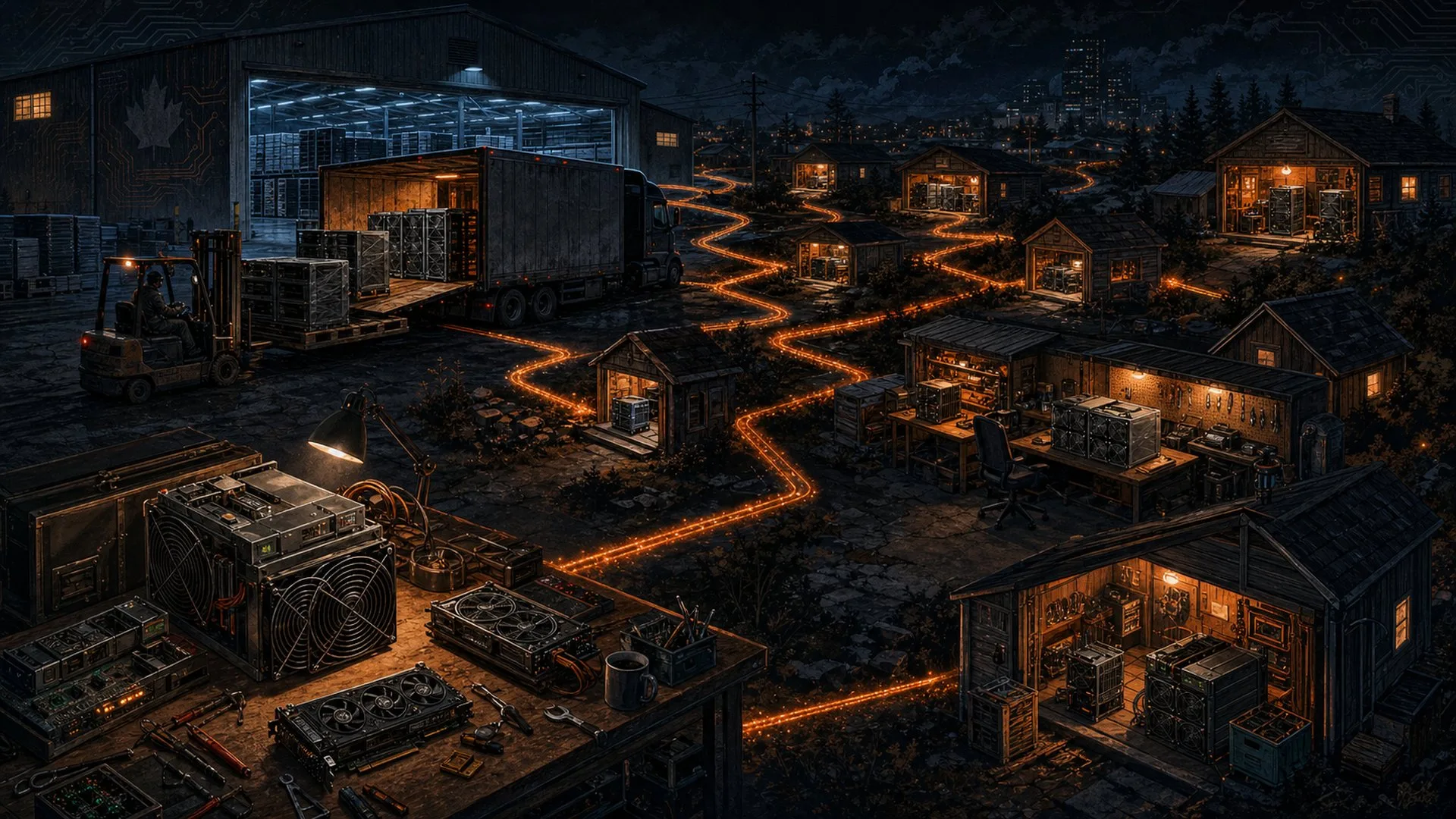
There is a contrarian case to be made that the most decentralizing event for Bitcoin mining this decade will not be a new chip, a new firmware, or a new pool. It will be an AI bubble that corrects. The AI compute glut — the inevitable hangover from a buildout that assumed demand would rise forever — would leave behind exactly the inputs Bitcoin mining thrives on: cheap power, paid-for cooling, empty industrial space, and a flood of used hardware. And unlike a hyperscaler, Bitcoin can reabsorb all of it at the edges, in basements and garages and small shops, one watt at a time. A bubble that pops is bad for the people who overbuilt. It can be quietly good for decentralization. And the AI industry that creates those leftovers is running the very same concentrate-and-distribute cycle itself — GPUs are becoming the new ASICs.
This is not a prediction that AI will collapse, and it is not schadenfreude. It is an observation about where stranded resources go when the capital that created them retreats. History rhymes here: every previous overbuild — railroads, fiber in the dot-com era, fracked gas with nowhere to flow — eventually fed something the original investors never planned for. Bitcoin mining is the most opportunistic buyer of stranded inputs ever built, and an AI correction would hand it a buffet.
What “AI compute glut” actually means
The current AI buildout is a bet that demand for training and inference compute will keep compounding faster than the capacity being poured into it. Capital is committing to multi-year power contracts, multi-gigawatt campuses, and GPU orders years in advance. That is the textbook setup for an overbuild: when a market prices in permanent exponential growth and then meets a plateau, the gap between installed capacity and real demand becomes a glut.
A glut in AI compute shows up as three distinct piles of stranded value, and each one maps onto a Bitcoin mining input:
- Stranded power and interconnect. Power purchase agreements and grid interconnections that were secured for compute campuses do not vanish when demand softens. The substations, the transformers, the transmission upgrades — those are sunk, energized, and looking for a load.
- Stranded space and cooling. Buildings designed for high-density compute already have the electrical distribution, the cooling loops, and the structural capacity that a generic warehouse lacks. Empty, they are a liability. With a load that tolerates heat and intermittency, they are an asset.
- Stranded hardware. A GPU glut floods the secondary market. This does not turn GPUs into Bitcoin miners — Bitcoin’s SHA-256 proof-of-work is the domain of ASICs, and GPU mining of Bitcoin has been dead for over a decade. But it crashes the broader hardware economy, depresses lease rates, and pulls capital out of the people who were renting hashrate-adjacent infrastructure at a premium.
The key word is stranded. Bitcoin mining is, at its core, a machine for monetizing energy and infrastructure that nobody else wants at that moment, in that place, at that price. That is why miners already chase flared gas, curtailed wind, and off-peak hydro. A compute glut is just another flavor of stranded input — and a large one.
Why a bubble is good for decentralization
Centralized mining wins when capital is cheap and inputs are scarce. Big players outbid everyone for power, lock up the newest machines, and amortize fixed costs across enormous fleets. The pleb — the home miner, the small shop, the sovereign Bitcoiner running a few units in the garage — gets squeezed out of the margin.
A correction inverts that. When the capital retreats and the inputs go stranded, the advantage shifts from who can outspend to who can opportunistically absorb. And nobody absorbs small, irregular, cheap loads better than a distributed mesh of independent miners:
- Cheap power flows to whoever shows up. When a site has energized capacity and no anchor tenant, it will take a smaller, flexible load it would have ignored in a boom. Curtailable Bitcoin mining is the canonical flexible load.
- Used hardware reaches the edges. A flooded secondary market for ASICs — driven by distressed industrial operators selling fleets — is precisely the hardware price crash that opens a pleb buying window. Machines that were unaffordable at boom prices land in home setups.
- Space democratizes. Industrial sites built for hyperscale rarely subdivide into pleb-scale operations. But the knowledge and the supply chain they leave behind — cooling vendors, electricians who now understand high-density loads, refurbishers with spare parts — diffuse outward to everyone.
This is the throughline of everything D-Central builds: every layer you can pull back from the giants and into your own hands is one more layer decentralized. A bubble doesn’t decentralize mining on its own. It creates the conditions — cheap inputs, abundant hardware, idle infrastructure — under which decentralized actors can reabsorb what centralized capital overbuilt.
The hashprice mechanism: why cheaper inputs change who mines
Hashprice is the revenue a miner earns per unit of hashrate per day. It is set by the Bitcoin price, the network difficulty, and transaction fees — none of which a glut directly controls. So a compute glut does not raise hashprice. What it does is lower the cost side of the equation for the operators positioned to grab stranded inputs.
That matters because mining profitability is a contest of marginal cost. When two miners earn the same hashprice, the one with cheaper power and amortized infrastructure survives a downturn the other doesn’t. In a glut:
- The home miner who picks up a used machine for a fraction of boom-era pricing has a near-zero hardware cost basis. Their breakeven hashprice drops accordingly.
- The miner who plugs into stranded, energized capacity at a discount has a lower power cost than the industrial operator who locked in long-term contracts at peak demand.
- The flexible miner who runs only when power is cheapest — the approach behind the great Hashcenter migration in reverse — captures the troughs that rigid loads can’t.
In other words, a glut redistributes the cost advantage from the operators who bet on permanent scarcity to the operators who can move fast and stay small. That redistribution is, mechanically, decentralization.
What the convergence does and doesn’t share
It’s worth being precise about what Bitcoin mining and AI compute actually have in common, because the overlap is real but narrower than the headlines suggest. Confusing the two leads to the fantasy that a GPU glut turns into a mining boom overnight. It doesn’t.
| Resource | Shared by both? | What a glut hands to Bitcoin mining |
|---|---|---|
| Energized power capacity | Yes | Directly usable — flexible mining loves stranded, curtailable power |
| Industrial space | Yes | Reusable shells with electrical and cooling already in place |
| Cooling infrastructure | Partly | Liquid and immersion loops transfer; air systems vary by density |
| Compute hardware | No | GPUs can’t mine Bitcoin profitably; only ASICs do SHA-256 at scale |
| Skilled labor & supply chain | Yes | Electricians, cooling vendors, refurbishers diffuse to small operators |
The hardware row is the one most people get wrong. Bitcoin’s proof-of-work runs on purpose-built ASICs — chips like the BM1368 in the Antminer S21 class and the BM1370 in the S21 Pro class — not general-purpose GPUs. A glut of AI accelerators does nothing for your hashrate directly. What it does is collapse the cost of everything around the ASIC: the power, the building, the cooling, the labor, and indirectly the price of used ASICs as distressed industrial fleets hit the market. That is where the decentralization dividend lives.
How to be positioned when stranded inputs appear
The plebs who benefit from a glut are the ones already set up to absorb a windfall. You cannot conjure cheap power on demand, but you can be the operator who’s ready when it shows up. A few principles:
- Stay liquid on hardware, not locked in. Refurbished and previous-generation ASICs are where the cost basis is lowest. A flooded secondary market rewards buyers who can move on a deal, not those waiting on the newest model. Browse the best Bitcoin miners hub to understand which machines hold up economically at the low end.
- Build for flexibility. A rig that can throttle, curtail, or run only during cheap hours captures stranded power that a fixed industrial load can’t. This is where firmware that you actually control — not a black box with a mandatory dev fee — becomes a sovereignty tool.
- Keep your footprint small and self-sufficient. The whole point of sovereign compute in your basement rather than a national GPU strategy applies equally to mining. Small, distributed, owner-operated setups are antifragile in a downturn. They have no investors to answer to and no lease to default on.
- Treat the bust as a buying window, not a warning. When industrial operators capitulate, that’s when machines and parts get cheap. The pleb’s edge is patience and a low cost basis.
This is the same posture D-Central takes across its whole stack: own your data, own your compute, own your code, own your hardware. A glut is simply a moment when the market makes ownership cheaper than it’s been in years.
Where DCENT_OS fits the decentralization thesis
If a glut hands you cheap, flexible, owner-operated hardware, the missing piece is firmware you fully control. Most third-party firmwares carry a mandatory dev fee — typically a range, not a flat number: Braiins OS+ in the 2–2.5% band, VNish around 2–2.8%, LuxOS at 2.8%. Those are reasonable prices for real engineering, and they were built on years of reverse-engineering work that everyone in this space stands on the shoulders of.
DCENT_OS is D-Central Technologies’ GPL-3.0 open-source Bitcoin mining firmware for selected Bitmain Antminer ASIC miners. Guarded artifacts exist only for exact S9 XIL and S19j Pro XIL lanes; install evidence is incomplete and neither is production-ready. Check the exact evidence ledger.
Cheap inputs decentralize who can mine. Open firmware decentralizes who controls the mine. Together, an AI correction plus owner-controlled tooling is the most pleb-friendly setup the industry has seen.
Frequently asked questions
Would an AI bubble pop actually crash Bitcoin’s price?
Not necessarily, and the two are largely separate. Bitcoin’s price is driven by its own supply schedule, adoption, and macro liquidity. An AI correction would primarily affect the cost side of mining — power, space, cooling, used hardware — rather than the revenue side. The decentralization argument doesn’t depend on a price move at all; it depends on stranded inputs becoming available to smaller operators.
Can I use surplus AI GPUs to mine Bitcoin?
No — at least not profitably. Bitcoin’s SHA-256 proof-of-work is dominated entirely by purpose-built ASICs, and GPU mining of Bitcoin has been economically dead for over a decade. A GPU glut helps Bitcoin mining indirectly by crashing the cost of power, space, and the broader hardware economy, not by giving you machines that can hash competitively. If you want to mine, you want ASICs.
Why is this “good for decentralization” rather than just good for big miners?
Big miners win when capital is cheap and inputs are scarce, because they can outbid everyone. A glut inverts that: capital retreats and inputs go stranded, which rewards whoever can opportunistically absorb small, flexible, cheap loads. That describes a distributed mesh of home and small-shop miners far better than it describes a hyperscale operation locked into peak-era contracts.
What should a home miner do to be ready?
Keep a low hardware cost basis by favoring refurbished and previous-generation ASICs, build setups that can curtail and run flexibly on cheap power, stay small and owner-operated, and treat an industrial bust as a buying window. Pairing cheap hardware with firmware you fully control is how you capture the full decentralization dividend.
The takeaway
An AI compute glut would be painful for the people who priced in permanent growth. But the stranded power, cooling, space, and hardware it leaves behind don’t disappear — they flow to whoever can absorb them, and nobody absorbs stranded inputs better than a distributed network of independent Bitcoin miners. A bubble doesn’t centralize hashrate; it scatters the conditions for hashrate to the edges. That’s the contrarian truth: for the plebs, a correction is an opening.
If you want to be positioned for it, start with the hardware that holds its economics in a downturn and the firmware that keeps control in your hands. Explore the best Bitcoin miners for the lowest cost-basis machines, see how the convergence is reshaping infrastructure across the D-Central AI vertical, and read why the great Hashcenter migration cuts both ways. The next layer of decentralization isn’t waiting on a new chip — it’s waiting on a market that overbuilt.