Quick answer
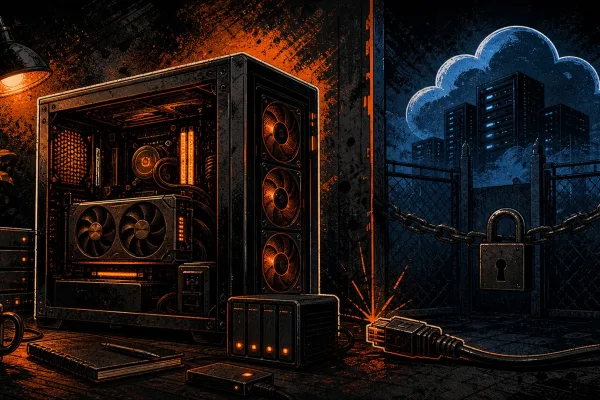
Honestly, it depends on the job. Cloud AI is still smarter at the frontier and cheaper for light or occasional use. Local AI is private by construction — nothing leaves your machine — can’t be switched off from someone else’s boardroom, and for steady work it pays for itself. Frontier reasoning or light use → cloud; privacy, control, and constant workloads → local.
Most “local vs cloud AI” comparisons are written by someone selling one of them. This one isn’t. We build and run both, and we’ll tell you plainly where each wins. Below are the questions plebs and businesses actually bring to us in Montreal—answered straight, including the ones where the cloud is still the right call.
The short version: cloud AI is still smarter at the frontier, and for light or occasional use it’s cheaper. Local AI is private by construction, can’t be switched off from someone else’s boardroom, and for steady work it pays for itself. Pick the tool that fits the job. Here’s how to tell which is which.
Key takeaways
- Cloud still wins on raw capability at the hardest tasks—the best open models you can run at home trail the best hosted models by roughly a few months, and that gap is closing.
- Local AI can’t be revoked. A model on your own disk keeps working no matter what a vendor, a regulator, or an export directive decides next.
- Local AI is more private by design—your data never leaves your machine—but you inherit the responsibility for securing it.
- The hardware bar is lower than people think: a capable assistant runs on a single used GPU; the heavy lifting only starts at the 70B+ tier.
- It’s a “both” world. Use local for your private, repeatable, everyday work; reach for the cloud when you genuinely need the frontier—with eyes open that your data leaves your box.
Local AI vs cloud AI at a glance
| Local AI (your hardware) | Cloud AI (hosted) | |
|---|---|---|
| Capability ceiling | Excellent and rising; best open models trail the frontier by roughly a few months | Highest available today on the hardest tasks |
| Privacy / data residency | Data stays on your machine; residency is wherever your box sits | Data leaves your premises; residency depends on the provider |
| Can it be revoked? | No—it runs offline and can’t be switched off remotely | Yes—access can change by policy, pricing, or directive |
| Upfront cost | Higher—you buy the hardware once | Near zero—no hardware to own |
| Ongoing cost | Mostly electricity after purchase | Recurring subscription or per-token billing |
| Setup effort | Easy to start, more involved to run well | Sign up and go |
| Best for | Private, steady, repeatable work; teams; sensitive data; sovereignty | Frontier tasks, huge multimodal jobs, occasional or bursty use |
Is a local AI model as smart as Claude or GPT?
Not at the very frontier today—and we won’t pretend otherwise. The best hosted models still lead on the hardest reasoning, the longest context, and the trickiest multimodal work. The best open models you can run yourself trail them by roughly a few months, and that gap has been closing steadily. The more useful question is “smart enough for what?” For everyday work—drafting and editing writing, summarizing long documents, classifying and tagging, coding assistance, and retrieval-augmented generation (RAG) over your own files and notes—a good local model is already genuinely good. Most business value lives in those tasks, not in frontier puzzles, which is why “local can’t compete” is usually wrong in practice. Credit where it’s due: that progress comes from the open-model community shipping strong weights anyone can use.
Can a local AI be banned or switched off like Claude Fable 5 was?
No—and that’s the entire point of owning the model. As of mid-June 2026, on June 12, a US export-control directive forced Anthropic to disable Claude Fable 5 and Mythos 5 for foreign nationals. People who depended on those models lost access overnight, through no fault of their own. A model sitting on your own disk can’t be revoked by a directive, a pricing change, or a vendor’s product decision. It runs offline, it runs next year, and it runs whether or not the company that trained it still offers it. That’s not a knock on any provider—it’s just the difference between renting a capability and owning one.
Is local AI actually more private than the cloud?
Yes, by construction. When the model runs on your machine, your prompts and documents never leave it—there’s no third party to log them, train on them, get breached, or be compelled to hand them over. That’s the strongest privacy posture available, and it’s not a marketing claim; it’s just where the data physically is. The honest caveat: privacy is now your job. Nobody else is patching, backing up, or securing that box—you are. Good cloud providers invest heavily in security you’d otherwise have to build yourself. Local gives you control; control comes with responsibility.
What hardware do I need to run AI locally?
Think of it as a VRAM ladder, where bigger models need more video memory:
- 7–8B models: about 8 GB of VRAM—a modest modern GPU.
- 13B models: about 12 GB.
- 30–32B models: about 24 GB—a single used RTX 3090 is the classic value pick here.
- 70B models: about 48 GB, or Apple Silicon with 128 GB of unified memory.
- gpt-oss-120b: around 80 GB.
The takeaway: a capable private assistant is within reach of a single well-chosen GPU, and only the largest open models demand serious silicon. For the full build-out and model-matching walkthrough, see our guide on how to replace cloud AI with a local LLM.
Is local AI hard to set up?
It’s easy to start and harder to do well—both true at once. Tools like Ollama and LM Studio have made the first run genuinely simple: install, pull a model, and you’re chatting in minutes, with full credit to those projects for lowering the bar. The harder part is everything around the model—power draw, heat, cooling, quiet 24/7 operation, and tuning it for real workloads. That’s where most home and office setups quietly struggle. We wrote about exactly this trap in Ollama is the easy part: power and heat are the rest, and the deeper end-to-end build lives in the local LLM guide.
Does running AI locally satisfy Quebec’s Law 25?
It’s a strong posture, not a legal guarantee—and this isn’t legal advice. Keeping personal information on infrastructure you control, where data never leaves your premises, lines up well with the privacy and data-handling expectations Law 25 is built around. It removes whole categories of risk that come with shipping sensitive data to third parties. That said, compliance is about your full set of practices, not one architecture choice, so confirm your specifics with qualified counsel. We unpack the on-premise angle in detail in our piece on Quebec’s Law 25 and on-premise LLMs.
Can I run a coding agent locally?
Yes—with tradeoffs worth knowing going in. Local coding agents can read your repo, edit files, run tools, and work fully offline or air-gapped, which is exactly what you want for sensitive or proprietary codebases. The honest part: on the very hardest, most open-ended engineering tasks, a frontier hosted model will still feel sharper, and you’ll want a capable GPU to keep things responsive. For everyday coding assistance and private work, local is very usable today. We cover the setup, model choices, and limits in running coding agents offline with local models.
When should I still use cloud AI?
Plenty of times—and we’d be lying to say otherwise. Use the cloud when you need absolute frontier capability on the hardest problems, when you’re running huge multimodal jobs (large-scale image, audio, or video work), when you want zero hardware for occasional or one-off use, or when you need massive scale you have no desire to host and operate yourself. In all of those, cloud is simply the better tool. Just use it with eyes open: your data leaves your box, and access depends on a vendor’s terms. Match the tool to the task and you’ll often run a sensible mix of both.
What is the “sovereign stack” and why is AI only one layer?
The sovereign stack is the set of self-hosted layers that, together, let you operate without depending on any single provider’s permission: local AI for intelligence, Bitcoin for money, mesh networking for connectivity, Nostr for identity and communication, and solar for power. Local AI is one layer because intelligence alone isn’t sovereignty—an AI that runs offline still needs money, a network, an identity layer, and power that nobody can cut. Each piece is one more layer decentralized. See how they fit together on our sovereign stack map.
How much does local AI cost compared to the cloud?
It’s the classic own-versus-rent question. Local AI is mostly an upfront hardware cost, with electricity as the main ongoing expense after that. Cloud AI is the reverse: little or nothing upfront, with a recurring subscription or usage bill that never stops. Directionally, that means steady, daily, or team-wide use tends to favour buying the hardware, because the recurring cloud bill would otherwise keep climbing—while light or occasional use usually favours the cloud, since you’d be paying for hardware that mostly sits idle. We won’t quote a payback period, because it depends entirely on your models, hardware, power rates, and how hard you actually use it. The honest framing: heavy and predictable leans local; light and bursty leans cloud.
Can D-Central set up local AI for me, or sell me a box that’s already running?
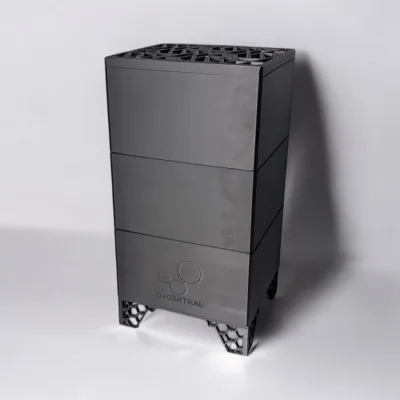
Yes—both. If you’d rather not assemble and tune it yourself, we do the build, the model selection, the power-and-heat planning, and the hardening, so what you receive is already running. If you want to learn first or sanity-check an approach, we offer AI sovereignty consulting, and our ready-to-run gear lives in the sovereign AI shop. We’ll also tell you honestly when the cloud is the better answer for your use case—that’s the whole point of asking people who run both.
Want to go deeper or have us do it for you? Start with Sovereign AI in Canada to learn the lay of the land, browse the full AI hub for the supporting guides, and when you’re ready to make it real, book AI sovereignty consulting and we’ll build a private AI setup that fits your work—no hype, no lock-in, and a straight answer on where the cloud still wins.
Own your AI: the sovereign path
Move from understanding the risk to owning your compute: read the pillar, compare local against cloud, check the Quebec Law 25 angle, then have D-Central build or guide your on-premise setup.